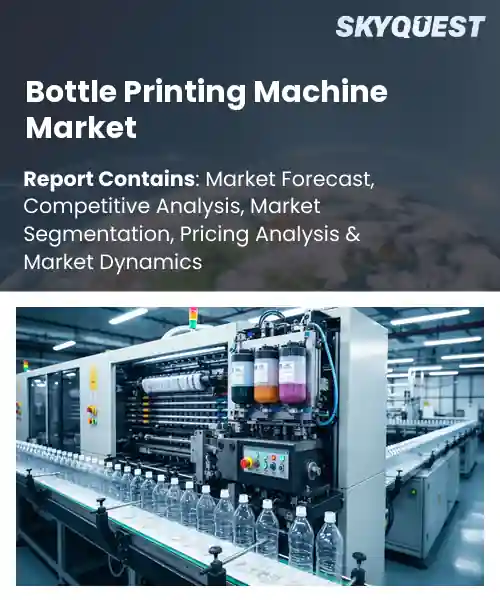
Bottle Printing Machine Market
Report ID: SQMIG20I2767
Report ID: SQMIG20I2767
[email protected]
USA +1 351-333-4748
Report ID:
SQMIG20I2767 |
Region:
Global |
Published Date: March, 2026
Pages:
157
|Tables:
119
|Figures:
77


Global Bottle Printing Machine Market size was valued at USD 500.0 Million in 2024 and is poised to grow from USD 580.0 Million in 2025 to USD 1830.0 Million by 2033, growing at a CAGR of 15.5% during the forecast period (2026-2033).
Key Takeaways : Market Trends & Insights
The global bottle printing machine market growth is driven by two opposing forces which include the need for packaging customization and the need for strict brand identity compliance which makes manufacturers buy advanced equipment that supports rapid product changes. The market consists of industrial equipment which applies printing to create customized products which can be tracked through their individual designs. The study shows that on store shelves while meeting regulatory standards because digital printing technology has upgraded from conventional analogue systems. Beverage producers switched from traditional pad printing methods to contemporary inkjet and digital UV technology for their marketing and tracking initiatives.
The demand for on-demand variable printing solutions which enable complete production changes through reduced inventory requirements, drives growth for businesses that build branding and compliance needs. Digital and hybrid printers provide manufacturers with fast job transition capabilities which help them meet their needs for shorter production runs by decreasing waste while accelerating their launch process for seasonal flavors and serialized pharmaceutical products. Craft breweries utilize UV digital printers to create customized beer releases while pharmaceutical companies use variable data printing together with serialization software to create complete regulatory audit trails. Manufacturers gain new revenue opportunities through two specific use cases which involve selling modular retrofits and cloud-based monitoring systems together with subscription-based services that generate additional income for each machine.
How is Automation Improving Efficiency in the Bottle Printing Machine Market?
The global bottle printing machine market penetration benefits from automation technology, which enables production efficiency through digital print head robotics and inline inspection systems working together to create efficient production workflows. The system operates through three main components which include automated job changes, efficient data processing, and flexible controls. Nowadays, production lines have replaced traditional manual setups with fully automated systems which maintain continuous operations to decrease material waste while enhancing product launch speed. The market demands personalized products with more SKUs, which leads customers to adopt flexible digital printers together with robotic systems for material handling. Direct to shape inkjet systems and AI-assisted process control systems enable businesses to maintain constant decoration quality while producing shorter runs which require fast product delivery and rework reduction.
The Domino N730i digital press at Domino March 2026 equipment site demonstrates how digital presses with automatic inspection capabilities enable fast printing setup procedures which allow quick product changes. The development shows how automated systems increase production output while helping brands create unique bottle designs at a faster pace.
Market snapshot - 2026-2033
Global Market Size
USD 0.5 Million
Largest Segment
Screen Printing
Fastest Growth
Digital Inkjet Printing
Growth Rate
15.5% CAGR
To get more insights on this market click here to Request a Free Sample Report
The global bottle printing machine market is segmented based on printing technology, automation grade, bottle material compatibility, end-use industry, and region. In terms of printing technology, the market is divided into screen printing, digital inkjet printing, pad printing, and laser marking or etching. Based on automation grade, it is categorized into fully automatic inline systems, semi-automatic standalone units, and manual systems. By bottle material compatibility, the market includes glass bottles, plastic, and metal or aluminum flasks. In terms of end-use industry, it is segmented into beverage, cosmetics and personal care, pharmaceutical and healthcare, and household chemicals. Regionally, the market is analyzed across North America, Europe, Asia Pacific, Latin America, and the Middle East & Africa.
As per the global bottle printing machine market analysis, the digital inkjet printing leads the market because it provides brands with high resolution printing capabilities which include full color graphics and variable data printing, thus enabling them to create distinct packaging designs with reduced setup time and material waste. The technology enables swift job transitions while its connection to digital artwork systems lets manufacturers produce intricate designs which need traceability, thus helping companies boost their product creation abilities through personalized design options.
However, the screen printing stands as the fastest expanding sector because UV ink and curing innovations enable premium bottles to achieve tactile and special finishes. The machine shows the potential to target luxury packaging through its ability to create thick ink deposits on various materials while its modern automation capabilities and mandated printing solutions increase decorative machine demand.
According to the global bottle printing machine market forecast, the fully automatic inline systems segment leads the market because it delivers printing capabilities which function inside rapid filling and packaging systems to maintain print quality through automatic printing while reducing manual printing operations and stopping production temporarily. Large manufacturers invest in complete solution systems which boost production capacity and operational dependability because the system can print multiple methods through its inline curing function and automatic inspection technology which meets both brand guidelines and regulatory requirements.
Whereas the printing solutions have expanded through the growth of semi-automatic standalone units because small producers and niche brands need portable low-cost printers which can handle multiple printing volumes and design alterations. The manufacturing sector achieves operational growth through better quick-change tooling and modular automation systems and user-friendly control interfaces which create new business opportunities for equipment suppliers through their need for retrofitting and maintenance services.
To get detailed segments analysis, Request a Free Sample Report
As per the bottle printing machine market regional forecast, Asia Pacific leads the market because its manufacturing systems produce strong industrial output, yet its beverage and pharmaceutical industries create high demand, and its manufacturers quickly use new printing technology. Regional suppliers focus on delivering customized solutions through their inline printing systems which work together with filling processes to streamline operations for major production facilities. The combination of extensive supplier networks and established expertise in machinery maintenance enables businesses to deliver efficient local packaging support services. Equipment manufacturers and brand owners work together to develop new ink formulations which enable long-lasting printing technology across various materials, strengthening the region's position as both a high-volume producer and specialized application developer. The plant enhances output, creates quality consistency for production, and raw material sources which need to take less time for delivery.
The Japanese bottle printing machine industry operates through precise engineering, which requires automated systems to achieve packaging results that meet strict industry standards. Domestic manufacturers choose to build small machines which deliver reliable performance by using sophisticated control technology that works with their automated production systems. The strong research and development focus of the organization enables scientists to discover new ink formulas which create more sustained print results. The equipment manufacturing and brand partnership system provides service networks which help both industries develop solutions for specific requirements in pharmaceutical and beverage manufacturing.
The South Korean bottle printing machine market trends show strong demand for compact printing systems which operate at high speeds while enabling multiple print options through their digital technology. The local manufacturers create user-friendly interfaces which enable quick equipment changes through their electronic system integration. Companies use packaging designers to create unique solutions for cosmetic and beverage brands, while its service team provides equipment repairs and system improvements. The organization uses collaborative testing which focuses on innovation to help determine which equipment products match demand.
The European bottle printing machine market growth experiences rapid boost because companies focus on sustainable development while consumers prefer unique packaging solutions, and digital printing technology enables them to make short runs of flexible products. The brand owners require their product decoration to possess both durability and recyclability, which motivates equipment manufacturers to develop ink systems that work with both recycling materials and various surfaces. The established industrial clusters in the area provide service networks with skilled workers and expertise to design custom solutions, which enabled manufacturers to update their production lines through retrofit and modular solutions without requiring complete system replacements. The collaborative efforts between converters and machinery suppliers and material formulators help Europe achieve its status as a market that offers both advanced inline systems and specialized niche applications. The printing industry receives brand investments in advanced printing technology because the existing regulatory systems and consumer demand for sustainable packaging solutions create a supportive environment for growth. The craft beverage and beauty industry creates further demand for businesses to produce customized products at small production runs.
The German bottle printing machine market penetration relies on its engineering capabilities, which create high-quality products that meet strict industrial standards and its extensive network of industrial suppliers for operational support. The domestic equipment manufacturers deliver high-performance machines, which converters and global brands prefer to use. The combination of precise measurements and dependable production methods creates customer demand for engineered solutions, which include after-sales assistance. The printing durability and production line integration advancement work together through manufacturer partnerships, which include packaging converters and technical institutes for ongoing printing process development.
The United Kingdom bottle printing machine sector is expanding because businesses need unique packaging solutions and short production runs. Brands and converters require digital printing systems which allow them to quickly introduce new products to the market. The service ecosystems, which include retrofit options, help businesses upgrade their operational systems through affordable modernization solutions. The collaborative work between converters, design agencies, and equipment suppliers creates unique packaging solutions which support the craft beverage industry and premium personal care market while driving domestic customer demand and international brand exports.
The emerging French bottle printing machine market attracts boutique converters and brand owners who want advanced visual designs and environmentally friendly printing technologies. The cosmetics, specialty beverages, and artisanal food producers need distinctive labeling, which drives product demand for their businesses. The machine suppliers provide systems which allow both customers to adapt to different materials and recycling requirements. The designers, converters, and equipment vendors collaborate closely to create custom solutions which enable their clients to implement digital printing and hybrid printing technologies.
North America enhances its economic power through automation and system integration and service-based value propositions which support multiple production methods. Equipment providers design their products with modular components which connect to factory control systems for better line upgrades and data-based process management. Companies work with key brand partners to develop machines which fulfill strict quality and traceability standards while their strong aftermarket network delivers fast maintenance and parts services. The region becomes a practical user of high speed and digital printing technologies because personalization and sustainable inks drive suppliers to create multipurpose platforms which maintain efficient production rates and adaptable capabilities. Research and development funding from local areas together with industry-academic partnerships leads to faster development of new ink technologies and process control methods. The service training and certification programs improve operator skills while decreasing machine downtime in advanced manufacturing settings.
The United States Bottle Printing Machine Market develops through strong market needs from beverage and pharmaceutical companies who need printing systems which can be expanded. Domestic suppliers and original equipment manufacturers focus on three key areas which enable them to create effective solutions for intricate manufacturing processes. The system supports digital printing operations together with flexible ink technologies which enable companies to create distinct brand identities. The two groups work together to test machines and provide operator education while establishing effective line connections which maximize machine availability.
The Canadian bottle printing machine market share shows sustainable development principles through its current requirements from the craft beverage and personal care industries which need special decoration methods. Suppliers provide efficient systems which can be modified, and they also offer inks which maintain performance in recycling processes. Local converters need both retrofitting solutions and different substrate running technical assistance. Equipment vendors work together with local service suppliers to provide training and component delivery, which ensures uptime reliability and helps customers implement cutting edge printing solutions with flexible short run capabilities.
To know more about the market opportunities by region and country, click here to
Buy The Complete Report
Rising Demand For Customization
Technological Advancements In Equipment
High Initial Capital Investment
Regulatory And Environmental Concerns
Request Free Customization of this report to help us to meet your business objectives.
The market development currently proceeds through market consolidation together with technology licensing between original equipment manufacturers who execute particular acquisition targets together with strategic alliance formation and printhead introductions for maintaining their market share while achieving faster product launches, through CCL's regional buyouts and Xaar's Aquinox printhead and Epson's D3000 series and system integrators who supply electronics and software to original equipment manufacturer platforms in order to create complete bottle-printing solutions.
SkyQuest’s ABIRAW (Advanced Business Intelligence, Research & Analysis Wing) is our Business Information Services team that Collects, Collates, Correlates, and Analyses the Data collected by means of Primary Exploratory Research backed by robust Secondary Desk research.
As per SkyQuest analysis, the global bottle printing machine market is growing because customers want customized packaging solutions, and brands need fast-changeover, which allows them to create their products through demand-based printing. The market faces major growth obstacles because established converters need to spend large amounts of money to adopt modern systems, which prevents smaller converters from making the shift. Asia Pacific leads the global market because its manufacturing base supports multiple sectors, which include beverage and pharmaceutical production together with a strong network of suppliers. Digital inkjet printing technology leads the market through its ability to produce native high-resolution output which allows users to create personalized designs and unique serial numbers.
| Report Metric | Details |
|---|---|
| Market size value in 2024 | USD 500.0 Million |
| Market size value in 2033 | USD 1830.0 Million |
| Growth Rate | 15.5% |
| Base year | 2024 |
| Forecast period | 2026-2033 |
| Forecast Unit (Value) | USD Million |
| Segments covered |
|
| Regions covered | North America (US, Canada), Europe (Germany, France, United Kingdom, Italy, Spain, Rest of Europe), Asia Pacific (China, India, Japan, Rest of Asia-Pacific), Latin America (Brazil, Rest of Latin America), Middle East & Africa (South Africa, GCC Countries, Rest of MEA) |
| Companies covered |
|
| Customization scope | Free report customization with purchase. Customization includes:-
|
To get a free trial access to our platform which is a one stop solution for all your data requirements for quicker decision making. This platform allows you to compare markets, competitors who are prominent in the market, and mega trends that are influencing the dynamics in the market. Also, get access to detailed SkyQuest exclusive matrix.
Table Of Content
Executive Summary
Market overview
Parent Market Analysis
Market overview
Market size
KEY MARKET INSIGHTS
COVID IMPACT
MARKET DYNAMICS & OUTLOOK
Market Size by Region
KEY COMPANY PROFILES
Methodology
For the Bottle Printing Machine Market, our research methodology involved a mixture of primary and secondary data sources. Key steps involved in the research process are listed below:
1. Information Procurement: This stage involved the procurement of Market data or related information via primary and secondary sources. The various secondary sources used included various company websites, annual reports, trade databases, and paid databases such as Hoover's, Bloomberg Business, Factiva, and Avention. Our team did 45 primary interactions Globally which included several stakeholders such as manufacturers, customers, key opinion leaders, etc. Overall, information procurement was one of the most extensive stages in our research process.
2. Information Analysis: This step involved triangulation of data through bottom-up and top-down approaches to estimate and validate the total size and future estimate of the Bottle Printing Machine Market.
3. Report Formulation: The final step entailed the placement of data points in appropriate Market spaces in an attempt to deduce viable conclusions.
4. Validation & Publishing: Validation is the most important step in the process. Validation & re-validation via an intricately designed process helped us finalize data points to be used for final calculations. The final Market estimates and forecasts were then aligned and sent to our panel of industry experts for validation of data. Once the validation was done the report was sent to our Quality Assurance team to ensure adherence to style guides, consistency & design.
Analyst Support
Customization Options
With the given market data, our dedicated team of analysts can offer you the following customization options are available for the Bottle Printing Machine Market:
Product Analysis: Product matrix, which offers a detailed comparison of the product portfolio of companies.
Regional Analysis: Further analysis of the Bottle Printing Machine Market for additional countries.
Competitive Analysis: Detailed analysis and profiling of additional Market players & comparative analysis of competitive products.
Go to Market Strategy: Find the high-growth channels to invest your marketing efforts and increase your customer base.
Innovation Mapping: Identify racial solutions and innovation, connected to deep ecosystems of innovators, start-ups, academics, and strategic partners.
Category Intelligence: Customized intelligence that is relevant to their supply Markets will enable them to make smarter sourcing decisions and improve their category management.
Public Company Transcript Analysis: To improve the investment performance by generating new alpha and making better-informed decisions.
Social Media Listening: To analyze the conversations and trends happening not just around your brand, but around your industry as a whole, and use those insights to make better Marketing decisions.
REQUEST FOR SAMPLE
 REQUEST FREE CUSTOMIZATION
Global Bottle Printing Machine Market size was valued at USD 0.5 Million in 2024 and is poised to grow from USD 0.58 Million in 2025 to USD 1.83 Million by 2033, growing at a CAGR of 15.5% during the forecast period (2026-2033).
The competitive landscape is driven by consolidation and technology licencing as established OEMs pursue targeted acquisitions, strategic partnerships and printhead launches to defend share and speed time to market, for example CCL’s regional buyouts, Xaar’s Aquinox printhead and Epson’s D3000 series, while system integrators add electronics and software to OEM platforms to deliver turn-key bottle-printing solutions. 'Krones AG', 'Hinterkopf GmbH', 'HP Inc.', 'Epson', 'Canon Inc.', 'Velox Ltd.', 'Dacen', 'LC Printing Machine Factory', 'Shenzhen Juste Machine', 'Koenig & Bauer', 'Heidelberger Druckmaschinen', 'Mimaki Engineering', 'Roland DG', 'EFI', 'Inkcups Now', 'Engineered Printing Solutions', 'Dubuit', 'OMSO', 'Fermac', 'M&R Printing'
The growing consumer preference for personalized and brand differentiated packaging encourages manufacturers to invest in advanced bottle printing machines that enable short runs and diverse graphics. By supporting on demand customization, these machines help brand owners rapidly introduce new designs, seasonal promotions, and targeted campaigns without complex tooling changes. This flexibility reduces time to market for new packaging concepts and strengthens brand engagement, prompting converters and packaging firms to upgrade equipment to meet client expectations for variety and visual appeal in finished products.
On-Demand Customization: Rising consumer preference for personalized packaging has pushed bottle printing suppliers to prioritize modular machines that enable rapid changeovers and short-run production. Manufacturers increasingly seek equipment that supports variable graphics, batch differentiation and flexible substrate compatibility, allowing brands and co-packers to respond quickly to market trends and promotional campaigns. This shift encourages investment in quick-set tooling, automated registration systems and operator-friendly interfaces to reduce setup time and maintain consistent print quality across frequent design variations, enhancing market responsiveness and brand differentiation.
As per the bottle printing machine market regional forecast, Asia Pacific leads the market because its manufacturing systems produce strong industrial output, yet its beverage and pharmaceutical industries create high demand, and its manufacturers quickly use new printing technology.
The screen printing segment is the fastest-growing due to advancements in UV inks and curing technologies, enabling premium finishes, thicker ink deposits, and enhanced decorative capabilities for high-end packaging.
Automation plays a critical role by enabling inline production, robotic print head operations, and real-time inspection systems, which improve efficiency, reduce waste, and support faster product changeovers in high-volume manufacturing environments.
Key opportunities lie in modular retrofitting, cloud-based monitoring systems, and subscription-based service models, allowing manufacturers to generate recurring revenue and enhance machine performance through digital connectivity and maintenance services.


Want to customize this report? This report can be personalized according to your needs. Our analysts and industry experts will work directly with you to understand your requirements and provide you with customized data in a short amount of time. We offer $1000 worth of FREE customization at the time of purchase.
Feedback From Our Clients


 USA (+1) 351-333-4748

