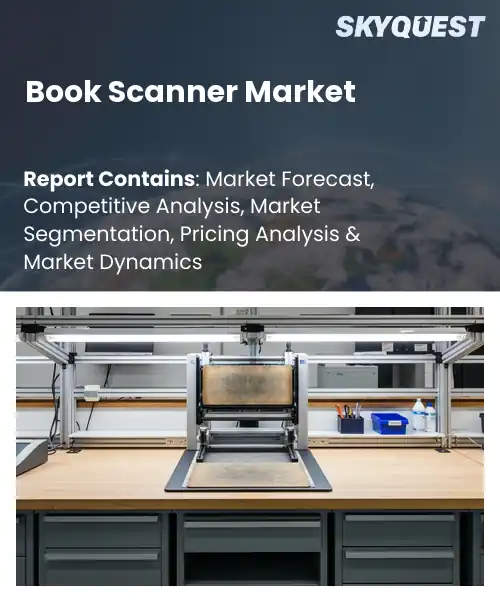
Book Scanner Market
Report ID: SQMIG45I2331
Report ID: SQMIG45I2331
[email protected]
USA +1 351-333-4748
Report ID:
SQMIG45I2331 |
Region:
Global |
Published Date: February, 2026
Pages:
157
|Tables:
147
|Figures:
78


Global Book Scanner Market size was valued at USD 1.4 Billion in 2024 and is poised to grow from USD 1.51 Billion in 2025 to USD 2.8 Billion by 2033, growing at a CAGR of 8.0% during the forecast period (2026-2033).
The global book scanning industry has created a change in how libraries, publishers, colleges, universities and cultural institutions generate demand for scanning products. The driving force behind these market developments has been the need to digitize and preserve analog books. Digitizing physical books produces searchable digital surrogates, allowing for greater access to content; safeguarding the original copies, and providing researchers with new ways to study printed works, such as through full-text search techniques. Over the past two decades the sector moved from consumer flatbeds to overhead planetary scanners, automated page-turners and cloud-integrated OCR platforms, with projects like Google Books and HathiTrust demonstrating scale, catalyzing investment.
A key trend driving global book scanner sector growth is advances in automation and AI-powered OCR that raise throughput and extract structured metadata, which increases the economic case for large-scale digitization programs. As recognition accuracy improves, institutions can produce searchable, machine-readable corpora at lower cost per page, enabling legal discovery teams to ingest archival records, universities to publish thesis repositories and publishers to create accessible e-book editions. Those outcomes encourage procurement of higher-end scanners and subscription software, which attracts OEMs to offer cloud workflows, multilingual models and pay-per-scan services, opening broad growth opportunities in emerging markets and heritage preservation initiatives.
How is AI Improving OCR Accuracy in the Book Scanner Market?
In the book scanner market, AI is enhancing OCR accuracy through the combination of advanced image preprocessing, deep learning recognition methods, and contextual language models. The significant features that contribute to the improvement are the removal of noise from fragile pages, the analysis of layout to maintain reading order, and the use of various fonts and character sets to minimize mistake rates in transcription. The current state shows vendors shifting from rule-based engines to end-to-end vision language systems that handle messy scans and handwriting and reduce manual correction. This change is driven by commercial product upgrades and new research that make digitization workflows more reliable for libraries and scanning services.
ScannX, January 2026, received recognition for its cloud-based book and document scanning software and services, and that development illustrates how AI-enabled OCR improves throughput and lowers post scan cleanup. The result supports market growth by boosting efficiency in library and institutional digitization projects.
Market snapshot - (2026-2033)
Global Market Size
USD 1.4 Billion
Largest Segment
Overhead Book Scanners
Fastest Growth
Overhead Book Scanners
Growth Rate
8.0% CAGR
To get more insights on this market click here to Request a Free Sample Report
Global book scanner market is segmented by product type, technology, application, distribution channel, end-user and region. Based on product type, the market is segmented into flatbed book scanners, overhead book scanners, handheld book scanners and others. Based on technology, the market is segmented into CIS, CCD and others. Based on application, the market is segmented into libraries, educational institutions, archives, offices and others. Based on distribution channel, the market is segmented into online and offline. Based on end-user, the market is segmented into commercial, residential, government and others. Based on region, the market is segmented into North America, Europe, Asia Pacific, Latin America and Middle East & Africa.
Based on the global book scanner market forecast, overhead book scanners segment dominates because their noncontact scanning design preserves binding integrity and minimizes physical stress on fragile volumes, enabling safe digitization of rare or tightly bound materials. Their optical configuration and computer-controlled optical correction streamline handling time and facilitate legibility, thus making them the preferred preservation workflow. As both an institution's preference for their image quality and operational efficiency affect procurement decisions for overhead configurations as well as long-term access to them, these systems continue to grow in popularity.
Flatbed book scanners are projected to be the fastest growing product type in the global book scanner market due to their affordability, user-friendly operation, and widespread adoption across educational institutions, offices, and small libraries. Due to their product's capability of scanning books, documents, and images as well as compact size/footprint and advances in resolution functions; this will create a greater demand on these products over time.
CIS segment dominates because its compact, low power sensor architecture enables slimmer, more affordable scanning devices that align with widespread document and book digitization needs. The simplified optical path reduces calibration complexity and maintenance, which lowers total cost of ownership and speeds deployment in constrained operational settings. Manufacturers leverage CIS to deliver consistent text capture and streamlined device designs that satisfy high volume scanning requirements and buyer cost sensitivity.
CCD technology is expected to be the fastest growing in the global book scanner market due to its superior image quality, greater depth of field, and precise color accuracy, making it ideal for scanning bound, fragile, and archival books. High definition CCD-based scanning systems are in ever-increasing demand due to the increasing number of digitization initiatives in libraries, museums, and academic institutions.
To get detailed segments analysis, Request a Free Sample Report
Based on the global book scanner market analysis, North America dominates the market due to concentrated demand from academic, corporate, library, and archival institutions that prioritize document digitization and preservation. Established distribution networks with developed service providers (DPS) -- Significant number of vendors represents major manufacturer support of integration between multi-function devices (MFDs) to document management workflow. There is an active level of both innovation and uptake of advanced capture technologies due to the growing commitment to accessibility and knowledge management across organizations. Procurement practices are designed to support quality and reliability, making it easier for premium products to attract customers. The availability of enterprise software, technical assistance and organized training support also adds to the number of customers for products in the marketplace. Regulatory and institutional emphasis on preserving digital assets have resulted in consistent sources of demand for these products while providing smaller institutions and companies with increased access through leasing and financing arrangements.
Book scanner market in United States is driven by institutional demand from universities, research libraries, and archives requiring robust capture and preservation solutions. Providers prioritize workflow integration, service support, and advanced image processing to satisfy expectations for reliability and accessibility. Public sector digitization efforts and established vendor ecosystems support adoption, while resale and maintenance channels enable long term care. Commercial suppliers deliver specialized systems for professional scanning applications and support.
Book scanner market in Canada reflects steady demand from academic institutions, national archives, and corporate clients focused on long term digitization projects. Vendors place a high priority on having reliable equipment and a network of responsive service providers to help support the many different types of users who are located in different places around the world. Some governments provide cultural programs and modernizing libraries, which will help enable the purchase of archival grade capture solutions. Channel partners and service bureaus have provided installations for users located in urban areas, and education and training & maintenance services will further support the continued operational effectiveness of these solutions.
Rapid expansion in Europe is propelled by coordinated cultural preservation efforts, strong library modernization programs, and active participation from academic and research communities seeking improved access to collections. Pan-regional initiatives and the interoperability priorities of these initiatives bind fragmented national markets by promoting standardized capture methods and metadata practices that encourage usage. A combination of a robust vendor presence with localized support provides demand for numerous different types of institutional support related to language capabilities; a combination of various sources of public-sector funding and institutional partnership agreements is enabling the development of projects in the areas of heritage, education, and legal as well. The focus on open access (OA) and accessibility also prioritizes digitization from a strategic perspective, with large numbers of service providers and technology integrators creating an expanding marketplace where both off-the-shelf scanners and customized workflows can be provided to with different types of institutions by different types of providers.
Book scanner market in Germany is anchored by significant institutional demand from national libraries, archives, and museums that prioritize archival grade capture and long term preservation. Quality of engineering, workflow customization and compliance with preservation standards are among the top priorities for local vendors (and systems integrators). Good procurement practices and regional service networks support deployments. Innovations in scanning techniques and workflows for metadata adapted to multilingual collections are created through collaborative projects between cultural institutions and providers of technologies.
Book scanner market in United Kingdom is characterized by dynamic adoption across universities, public libraries, and private digitization firms responding to strong demand for digital access and preservation. Vendors offer modular solutions and services that can fit into a broad range of project budgets and requirements. Collaborative innovation Hubs and cultural heritage programs support trial and use of new technology in capturing evidence of cultural heritage sites and objects. Channel partners will provide maintenance and training services to speed the rollout of scanning operations.
Book scanner market in France is emerging through cultural heritage initiatives and academic digitization projects aimed at improving public access. Local suppliers and integrators adapt solutions for French language materials and conservation needs. Public programs and institutional collaborations support deployment of flexible scanning formats and metadata practices. Service providers assist institutions in replacing older workflows, while training and local support enable sustainable digitization across museum and library collections and archives.
Asia Pacific is strengthening its position in the book scanner market through concentrated technology development, strong manufacturing capabilities, and active institutional digitization programs. Compact high-performance scanners are being tailored to meet both academic and commercial scanning needs, providing regional markets with a high level of technical expertise among vendors. Adoption is also aided by integrated solutions for cloud storage, OCR and content management platforms issue to accommodate local languages. Cross border co-operation among technology providers and cultural institutions will further accelerate the deployment of targeted solutions for preservation and access. The establishment of additional service ecosystems, such as training, maintenance and managed scanning services, provides institutions with a means to scale their operations while competing in regional markets through the provision of competitively priced manufacturing bases to supply equipment. The volume of R&D activity, as well as the partnerships between academia and technology providers to develop improvements in capture accuracy.
Book scanner market in Japan is driven by advanced engineering and OEM presence, combined with demand from universities, national libraries, and archives seeking high fidelity capture and preservation workflows. Vendors concentrate on building high quality products with precision and building compactly (for restricted spaces) while using OCR (Optical Character Recognition) and other content platforms with a Japanese Language interface. They also have established strong after-service relationships with dealers and various technical support service providers to support their deployments.
Book scanner market in South Korea is advancing through strong technology adoption, active participation from academic institutions, and corporate demand for digital transformation. Local firms create small fast scanners with optical character recognition that understands multiple languages and converts data into digitised computer files. Service companies provide scanning and converting services to assist customers who want to digitise their records. Government-sponsored culture initiatives and alliances between industries create facilitation to test new releases; meanwhile, local channel partners provide customers with product/service training and support.
To know more about the market opportunities by region and country, click here to
Buy The Complete Report
Expansion Of Digital Archiving
Increased emphasis on preserving physical documents and making content accessible is prompting institutions and businesses to invest in book scanning solutions that can convert paper collections into searchable digital formats. Vendors are being encouraged to enhance their scanner functionality, improve their workflows and integrate with Digital Asset Management systems. All of this is helping fuel the use of scanning technologies in libraries, archives and corporate records departments. In addition to long-term preservation, stakeholders have begun to focus on risk mitigation and access as factors that are influencing procurement decisions in favour of proven scanning technologies; therefore, the book scanner market will continue to grow at a steady rate.
Advancements In Imaging Technology
Advancements of recent years in imaging sensors, optical character recognition algorithms, and automated page turning mechanisms are resulting in significantly faster and more accurate capture of bound materials with less handling than ever before. The improved throughput of the digitization process has resulted in higher-quality final output as well as ease of use (lower operational complexity) resulting in increased attractiveness of book scanners for institutions that want to digitize their collections more efficiently. Vendors that are using these advances to enhance their product lines, accommodate a variety of material types, and reduce barriers to adoption will drive demand across the academic, commercial, and cultural heritage markets and ultimately contribute to the global book scanner market growth.
High Initial Investment Costs
Pricing pressure on organizations that are purchasing enterprise grade book scanners (including software and associated infrastructure) derives from Significant upfront cost of acquisition, and the legislators’ limitations due to limited capital budgets, resulting in being unable to afford the purchase of the scanner. When an organization is unable to afford an enterprise grade scanner, they may consider moving to phases of digitization, deferring their decision to digitize, or employing a third party business providing digitization services, therefore decreasing the industry's direct sales. Procurement committees consider several factors when evaluating a product or service such as pricing.
Limited Skilled Workforce Availability
The lack of trained personnel as well as those qualified to provide preservation to digital files results in hindered project deployment by way of scanning books due to there being either 1) a lack of qualified staff internally within their organization, and/or 2) lack of have sufficient qualified staff available externally to provide the same service. As a result – when an organization has insufficient staffing, the organization will likely experience delays in their project implementation, inconsistent realization of quality, have a higher reliance on external vendors (thus increasing ongoing operational expense) and have decreased control.
Request Free Customization of this report to help us to meet your business objectives.
The global book scanner market outlook is moderately consolidated, with key international players such as Zeutschel GmbH, Plustek Inc., Fujitsu (PFU), Microtek International, and Image Access driving competition through technological innovation and digitization solutions. Zeutschel focuses on high-end overhead scanners for archives and libraries, reinforcing leadership through preservation-focused innovation, while Plustek emphasizes affordable OpticBook series expansion and OCR integration. Fujitsu and PFU leverage strong scanner portfolios and enterprise imaging expertise to strengthen global distribution and workflow automation capabilities.
Founded in 2016, VIISAN Technology emerged as a fast-growing smart scanner developer focusing on overhead and portable book scanners for education and enterprise use. Its flagship K21 book scanner uses high-speed camera sensors and intelligent page-flattening software for bound book digitization. Users needed fast yet small scanners, so VIISAN developed software driven R&D for imaging that increased processing speeds, reduced distortion, and helped speed up the acceptance of scanners in digital classrooms and the digital office workflow.
Established in 2017, Eloam Technology develops intelligent document and book scanning solutions integrated with visual presentation systems. One feature of is that its overhead book scanners utilize CMOS imaging processors, curve-flattening technologies and built-in Optical Character Recognition (OCR) Software for rapid, lossless digitization. Because institutions demanded portable and accurate scanning tools, Eloam’s R&D focus on software-driven image enhancement led to improved text recognition, faster processing, and wider adoption across education, government, and archival digitization projects.
SkyQuest’s ABIRAW (Advanced Business Intelligence, Research & Analysis Wing) is our Business Information Services team that Collects, Collates, Correlates, and Analyses the Data collected by means of Primary Exploratory Research backed by robust Secondary Desk research.
As per SkyQuest analysis, the global book scanner industry is propelled primarily by the need to digitize and preserve analog collections, which drives institutional procurement and investment in advanced capture workflows. A second driver is rapid AI driven improvements in OCR and automation that raise throughput and reduce manual cleanup. A key restraint remains high initial investment costs for enterprise grade systems, which limit adoption among smaller institutions. North America emerges as the dominating region due to mature demand, vendor presence and institutional programs. Overhead book scanners are the dominating segment because their noncontact design and image correction make them preferred for preservation workflows and largescale digitization projects.
| Report Metric | Details |
|---|---|
| Market size value in 2024 | USD 1.4 Billion |
| Market size value in 2033 | USD 2.8 Billion |
| Growth Rate | 8.0% |
| Base year | 2024 |
| Forecast period | (2026-2033) |
| Forecast Unit (Value) | USD Billion |
| Segments covered |
|
| Regions covered | North America (US, Canada), Europe (Germany, France, United Kingdom, Italy, Spain, Rest of Europe), Asia Pacific (China, India, Japan, Rest of Asia-Pacific), Latin America (Brazil, Rest of Latin America), Middle East & Africa (South Africa, GCC Countries, Rest of MEA) |
| Companies covered |
|
| Customization scope | Free report customization with purchase. Customization includes:-
|
To get a free trial access to our platform which is a one stop solution for all your data requirements for quicker decision making. This platform allows you to compare markets, competitors who are prominent in the market, and mega trends that are influencing the dynamics in the market. Also, get access to detailed SkyQuest exclusive matrix.
Table Of Content
Executive Summary
Market overview
Parent Market Analysis
Market overview
Market size
KEY MARKET INSIGHTS
COVID IMPACT
MARKET DYNAMICS & OUTLOOK
Market Size by Region
KEY COMPANY PROFILES
Methodology
For the Book Scanner Market, our research methodology involved a mixture of primary and secondary data sources. Key steps involved in the research process are listed below:
1. Information Procurement: This stage involved the procurement of Market data or related information via primary and secondary sources. The various secondary sources used included various company websites, annual reports, trade databases, and paid databases such as Hoover's, Bloomberg Business, Factiva, and Avention. Our team did 45 primary interactions Globally which included several stakeholders such as manufacturers, customers, key opinion leaders, etc. Overall, information procurement was one of the most extensive stages in our research process.
2. Information Analysis: This step involved triangulation of data through bottom-up and top-down approaches to estimate and validate the total size and future estimate of the Book Scanner Market.
3. Report Formulation: The final step entailed the placement of data points in appropriate Market spaces in an attempt to deduce viable conclusions.
4. Validation & Publishing: Validation is the most important step in the process. Validation & re-validation via an intricately designed process helped us finalize data points to be used for final calculations. The final Market estimates and forecasts were then aligned and sent to our panel of industry experts for validation of data. Once the validation was done the report was sent to our Quality Assurance team to ensure adherence to style guides, consistency & design.
Analyst Support
Customization Options
With the given market data, our dedicated team of analysts can offer you the following customization options are available for the Book Scanner Market:
Product Analysis: Product matrix, which offers a detailed comparison of the product portfolio of companies.
Regional Analysis: Further analysis of the Book Scanner Market for additional countries.
Competitive Analysis: Detailed analysis and profiling of additional Market players & comparative analysis of competitive products.
Go to Market Strategy: Find the high-growth channels to invest your marketing efforts and increase your customer base.
Innovation Mapping: Identify racial solutions and innovation, connected to deep ecosystems of innovators, start-ups, academics, and strategic partners.
Category Intelligence: Customized intelligence that is relevant to their supply Markets will enable them to make smarter sourcing decisions and improve their category management.
Public Company Transcript Analysis: To improve the investment performance by generating new alpha and making better-informed decisions.
Social Media Listening: To analyze the conversations and trends happening not just around your brand, but around your industry as a whole, and use those insights to make better Marketing decisions.
REQUEST FOR SAMPLE
 REQUEST FREE CUSTOMIZATION
Global Book Scanner Market size was valued at USD 1.4 Billion in 2024 and is poised to grow from USD 1.51 Billion in 2025 to USD 2.8 Billion by 2033, growing at a CAGR of 8.0% during the forecast period (2026-2033).
I can proceed but I need a quick clarification first. I cannot find verified hardware book scanner startups that were established in 2019 or later. Do you want me to instead (choose one) include startups in adjacent book digitization or AI OCR services founded 2019 or later, or include recent product entrants and spinouts from incumbent scanner companies that were founded before 2019? 'Fujitsu', 'Canon', 'Epson', 'Kodak', 'Scannx', 'Plustek', 'Bookeye', 'Doxie', 'iRex Technologies', 'ScanSnap', 'Atiz Innovation', 'Babenko Scanner', 'IRIS', 'Zeutschel', 'KODAK Alaris', 'Avision', 'InoTec', 'ScanSystem', 'SmartDocumentor', 'Asura Technologies'
Increased emphasis on preserving physical documents and making content accessible is prompting institutions and businesses to invest in book scanning solutions that can convert paper collections into searchable digital formats. This demand is encouraging vendors to enhance scanner capabilities, workflows, and integration with digital asset management, aiding adoption across libraries, archives, and corporate records departments. As stakeholders prioritize long term preservation, risk mitigation, and access, procurement decisions increasingly favor proven scanning technologies, thereby supporting steady expansion of the book scanner market.
Based on the global book scanner market analysis, North America dominates the market due to concentrated demand from academic, corporate, library, and archival institutions that prioritize document digitization and preservation.


Want to customize this report? This report can be personalized according to your needs. Our analysts and industry experts will work directly with you to understand your requirements and provide you with customized data in a short amount of time. We offer $1000 worth of FREE customization at the time of purchase.
Feedback From Our Clients


 USA (+1) 351-333-4748

