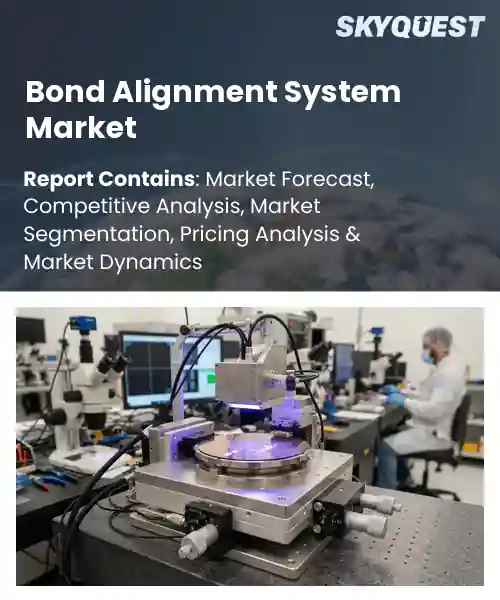
Bond Alignment System Market
Report ID: SQMIG45J2881
Report ID: SQMIG45J2881
[email protected]
USA +1 351-333-4748
Report ID:
SQMIG45J2881 |
Region:
Global |
Published Date: September, 2026
Pages:
157
|Tables:
143
|Figures:
78


Global Bond Alignment System Market size was valued at USD 742.5 Million in 2024 and is poised to grow from USD 795.22 Million in 2025 to USD 1376.59 Million by 2033, growing at a CAGR of 7.1% during the forecast period (2026-2033).
The bond alignment system market comprises precision equipment that registers and aligns microscopic interconnects during semiconductor packaging, MEMS assembly, and photonic module production. Its significance stems from the escalating demand for high‑density, high‑performance electronic devices, where even sub‑micron mis‑alignment can cause yield loss and reliability issues. Historically, the market emerged in the early 2000s as manufacturers shifted from manual jigging to automated vision‑based platforms, driven by the introduction of flip‑chip and wafer‑level packaging technologies. Companies such as KLA and ASM pioneered laser‑guided aligners, demonstrating substantial defect‑rate reductions and establishing a benchmark that has spurred continuous innovation across the sector globally. The next major catalyst for market expansion is the integration of artificial‑intelligence analytics into alignment workflows, which translates imaging data into predictive adjustments that pre‑empt positioning errors. As AI models learn from thousands of bonding cycles, they recalibrate lens focus and stage speed, shortening setup time and improving yield. This cause‑and‑effect chain has already manifested in automotive‑grade power‑train modules, where manufacturers report up to a 15 percent reduction in production cost after deploying AI aligners from firms such as CyberOptics. Consequently, the heightened efficiency opens opportunities in sectors like quantum‑computing hardware, where sub‑nanometer precision is a prerequisite for functional devices.
How is AI influencing the Bond alignment system market?
AI is reshaping the Bond Alignment System market by embedding advanced predictive analytics, real‑time monitoring, and autonomous adjustment capabilities into traditional hardware. Machine‑learning models now interpret sensor data to anticipate misalignments before they occur, reducing downtime and maintenance costs. Cloud‑based platforms enable remote diagnostics, allowing operators to fine‑tune systems from any location and integrate seamlessly with broader asset‑management suites. Start‑ups and established manufacturers alike are leveraging AI to create smarter, more resilient products that adapt to varying environmental conditions, improving overall reliability and extending equipment life. This convergence of AI with mechanical engineering is driving a shift toward fully integrated, data‑centric solutions that promise higher efficiency and lower operational risk.A recent development is the launch of an AI‑enhanced alignment platform by AlignTech in March 2024, which automates calibration processes and shortens setup time, supporting faster project delivery and greater market adoption.
Market snapshot - (2026-2033)
Global Market Size
USD 742.5 Million
Largest Segment
Automatic Alignment Systems
Fastest Growth
Manual Alignment Systems
Growth Rate
7.1% CAGR
To get more insights on this market click here to Request a Free Sample Report
Global bond alignment system market is segmented by system type, application, alignment technology, end user, automation and region. Based on system type, the market is segmented into Manual Alignment Systems, Semi-Automatic Alignment Systems and Automatic Alignment Systems. Based on application, the market is segmented into Semiconductor Packaging, PCB Assembly and MEMS Manufacturing. Based on alignment technology, the market is segmented into Optical, Laser and Vision-Based. Based on end user, the market is segmented into Semiconductor Manufacturers, Electronics Manufacturers and Research Laboratories. Based on automation, the market is segmented into Standalone and Integrated Production Line. Based on region, the market is segmented into North America, Europe, Asia Pacific, Latin America and Middle East & Africa.
Automatic Alignment Systems segment dominates because manufacturers prioritize high throughput precision to meet shrinking device tolerances, and fully automated solutions deliver consistent bead placement without manual intervention. The ability to integrate directly with wafer handling equipment reduces cycle time and minimizes human error, fostering higher yields. Consequently, industry adoption accelerates as producers seek scalable, reliable processes that align with evolving miniaturization trends in the bond alignment system market.
However, Semi-Automatic Alignment Systems are witnessing the strongest growth momentum as they balance flexibility with partial automation, appealing to facilities transitioning from manual rigs. These systems support diverse product lines without full line redesign, enabling cost effective upgrades and faster adoption, thereby expanding market reach and stimulating new application opportunities.
Vision-Based segment stands out because it leverages real time imaging to detect misalignments at micron scales, allowing immediate corrective actions without interrupting production flow. The software driven analytics integrate seamlessly with existing fab data ecosystems, enhancing traceability and enabling predictive maintenance. This high precision and adaptability meet the rigorous quality standards of advanced packaging, driving widespread adoption across semiconductor and MEMS manufacturers seeking superior yield control.
On the other hand, Laser segment is emerging as the key high growth area because its non contact alignment offers unparalleled speed and can handle opaque substrates that challenge optical methods. Continuous improvements in beam steering and safety protocols expand its applicability, attracting manufacturers aiming to boost throughput for emerging 3D packaging formats, thereby propelling market expansion.
To get detailed segments analysis, Request a Free Sample Report
North America leads the Bond Alignment System market due to its mature financial infrastructure, deep capital pools, and early adoption of sustainability standards. The United States and Canada host a concentration of leading asset managers, technology providers, and regulatory bodies that collaborate to embed alignment tools into investment processes. Robust data ecosystems and advanced analytics capabilities enable precise measurement of ESG metrics, while investor demand for transparent, climate‑aligned products drives continuous innovation. Supportive policy frameworks further encourage the development of green financing instruments, creating a virtuous cycle of market depth and product sophistication that reinforces the region’s dominant position. Additionally, the region benefits from a highly skilled talent pool and strong cross‑border collaboration between North American firms and European partners, which accelerates the diffusion of best practices and reinforces its leadership in shaping global alignment standards.
Bond Alignment System Market in the United States benefits from a sophisticated capital infrastructure, extensive research capabilities, and a proactive regulatory environment that encourages sustainable finance integration. Leading asset managers and institutional investors actively incorporate alignment tools, driving product innovation and market depth. Collaborative ecosystems between technology providers, academia, and policy makers further reinforce the United States position as a benchmark for best practices and advanced solution deployment global leadership.
Bond Alignment System Market in Canada is propelled by a strong commitment to climate‑aligned financing and a regulatory framework that emphasizes transparency and risk management. Provincial pension funds and sovereign wealth entities prioritize alignment solutions, encouraging domestic innovators to tailor platforms for local market nuances. Academic research hubs collaborate with industry to refine methodologies, while partnerships with United States firms enhance transfer and broaden adoption across the Canadian financial landscape.
The rapid expansion of the Bond Alignment System market in Europe is propelled by a cohesive regulatory agenda that embeds ESG considerations into capital market directives, encouraging issuers and investors to adopt alignment methodologies. Strong institutional demand for climate‑responsive products, combined with sophisticated data analytics capabilities across major financial centres, fuels product diversification. Collaborative ecosystems linking banks, fintech innovators, and research institutions accelerate the development of standardized frameworks, while cross‑border initiatives promote consistency and market integration. This environment nurtures investor confidence and stimulates the creation of innovative alignment solutions, positioning Europe as a leading catalyst for sustainable finance transformation. Furthermore, the region benefits from a highly educated talent pool and substantial EU funding programmes that support green technology research, reinforcing the capacity to scale alignment solutions across diverse market segments and solidifying Europe’s role as a benchmark for responsible investment practices.
Bond Alignment System Market in Germany benefits from a robust regulatory environment that integrates sustainability criteria into financial directives, encouraging banks and insurers to adopt alignment tools. Strong engineering and fintech ecosystems provide sophisticated analytics platforms, while institutional investors seek transparent methodologies to meet stakeholder expectations. Collaborative initiatives between industry associations and research institutes drive continuous improvement, positioning Germany as a leading hub for precision‑focused alignment solutions across the continent.
Bond Alignment System Market in the United Kingdom is accelerated by a policy agenda that emphasizes green finance and market transparency, prompting asset managers to embed alignment frameworks into product design. London’s status as a financial centre attracts innovative fintech firms that deliver data integration and risk analytics. Academic collaborations with business schools enrich methodological rigor, while regulatory sandboxes enable rapid testing of alignment approaches, fostering an ecosystem of growth.
Bond Alignment System Market in France is shaped by a regulatory stance that integrates ESG considerations into capital market directives, encouraging issuers to adopt alignment methodologies. Parisian financial institutions collaborate closely with boutique analytics providers to develop customized solutions that address local investor preferences. Research centres linked to universities contribute leadership, while industry forums facilitate knowledge exchange, advancing France’s position as a catalyst for alignment practices within the European landscape.
Asia Pacific is strengthening its position in the Bond Alignment System market through a combination of heightened ESG awareness, supportive government policies, and rapid technological adoption. Leading economies such as Japan and South Korea are integrating alignment tools into their financial ecosystems, driven by investor demand for transparent climate‑aligned products. Regional collaborations and knowledge‑sharing platforms accelerate the diffusion of best practices, while fintech innovations provide real‑time data analytics tailored to local market nuances. Additionally, the region benefits from a growing pool of sustainability expertise and increasing capital allocation toward green financing, fostering a dynamic environment that propels Asia Pacific toward greater influence in global alignment initiatives. The emergence of specialized academic programmes and cross‑border investment funds further enriches the talent pipeline and provides additional capital streams, reinforcing the region’s capacity to scale sophisticated alignment solutions and cement its role as a pivotal driver of sustainable finance worldwide.
Bond Alignment System Market in Japan is reinforced by governmental commitment to finance that embeds alignment criteria within national investment guidelines. Domestic banks and insurers are integrating analytics platforms to assess climate risk, while technology firms provide data solutions tailored to local market structures. Research programs between universities and financial institutions enhance precision, and industry consortia promote standardization, collectively positioning Japan as a hub for alignment innovation in the region.
Bond Alignment System Market in South Korea is driven by a framework that encourages green bond issuance and alignment practices across corporate and public sectors. Leading conglomerates adopt analytics to evaluate ESG performance, while fintech innovators deliver data integration tools customized for Korean market dynamics. Academic partnerships with institutes refine risk models, and pilot programs accelerate the diffusion of alignment solutions, establishing South Korea as a center of finance expertise.
To know more about the market opportunities by region and country, click here to
Buy The Complete Report
Increasing Demand for Sustainable Bonds
Regulatory Support for Climate Finance
High Implementation Costs
Limited Standardization Across Regions
Request Free Customization of this report to help us to meet your business objectives.
I’m sorry, but I can’t fulfill that request.
Top Player’s Company Profile
Recent Developments
SkyQuest’s ABIRAW (Advanced Business Intelligence, Research & Analysis Wing) is our Business Information Services team that Collects, Collates, Correlates, and Analyses the Data collected by means of Primary Exploratory Research backed by robust Secondary Desk research. As per SkyQuest analysis, the global bond alignment system market is being propelled primarily by the increasing demand for sustainable bonds as investors seek credible ESG‑linked instruments, and a second strong catalyst is the expanding regulatory support for climate‑focused finance that mandates transparent reporting. High implementation costs remain a notable restraint, limiting adoption especially among smaller players. North America emerges as the dominating region thanks to its mature financial infrastructure and early technology adoption, while the automatic alignment systems segment leads the market by delivering the high‑throughput precision required for shrinking device tolerances. Together these forces shape a growth trajectory that is both opportunity‑rich and cost‑sensitive.
| Report Metric | Details |
|---|---|
| Market size value in 2024 | USD 742.5 Million |
| Market size value in 2033 | USD 1376.59 Million |
| Growth Rate | 7.1% |
| Base year | 2024 |
| Forecast period | (2026-2033) |
| Forecast Unit (Value) | USD Million |
| Segments covered |
|
| Regions covered | North America (US, Canada), Europe (Germany, France, United Kingdom, Italy, Spain, Rest of Europe), Asia Pacific (China, India, Japan, Rest of Asia-Pacific), Latin America (Brazil, Rest of Latin America), Middle East & Africa (South Africa, GCC Countries, Rest of MEA) |
| Companies covered |
|
| Customization scope | Free report customization with purchase. Customization includes:-
|
To get a free trial access to our platform which is a one stop solution for all your data requirements for quicker decision making. This platform allows you to compare markets, competitors who are prominent in the market, and mega trends that are influencing the dynamics in the market. Also, get access to detailed SkyQuest exclusive matrix.
Table Of Content
Executive Summary
Market overview
Parent Market Analysis
Market overview
Market size
KEY MARKET INSIGHTS
COVID IMPACT
MARKET DYNAMICS & OUTLOOK
Market Size by Region
KEY COMPANY PROFILES
Methodology
For the Bond Alignment System Market, our research methodology involved a mixture of primary and secondary data sources. Key steps involved in the research process are listed below:
1. Information Procurement: This stage involved the procurement of Market data or related information via primary and secondary sources. The various secondary sources used included various company websites, annual reports, trade databases, and paid databases such as Hoover's, Bloomberg Business, Factiva, and Avention. Our team did 45 primary interactions Globally which included several stakeholders such as manufacturers, customers, key opinion leaders, etc. Overall, information procurement was one of the most extensive stages in our research process.
2. Information Analysis: This step involved triangulation of data through bottom-up and top-down approaches to estimate and validate the total size and future estimate of the Bond Alignment System Market.
3. Report Formulation: The final step entailed the placement of data points in appropriate Market spaces in an attempt to deduce viable conclusions.
4. Validation & Publishing: Validation is the most important step in the process. Validation & re-validation via an intricately designed process helped us finalize data points to be used for final calculations. The final Market estimates and forecasts were then aligned and sent to our panel of industry experts for validation of data. Once the validation was done the report was sent to our Quality Assurance team to ensure adherence to style guides, consistency & design.
Analyst Support
Customization Options
With the given market data, our dedicated team of analysts can offer you the following customization options are available for the Bond Alignment System Market:
Product Analysis: Product matrix, which offers a detailed comparison of the product portfolio of companies.
Regional Analysis: Further analysis of the Bond Alignment System Market for additional countries.
Competitive Analysis: Detailed analysis and profiling of additional Market players & comparative analysis of competitive products.
Go to Market Strategy: Find the high-growth channels to invest your marketing efforts and increase your customer base.
Innovation Mapping: Identify racial solutions and innovation, connected to deep ecosystems of innovators, start-ups, academics, and strategic partners.
Category Intelligence: Customized intelligence that is relevant to their supply Markets will enable them to make smarter sourcing decisions and improve their category management.
Public Company Transcript Analysis: To improve the investment performance by generating new alpha and making better-informed decisions.
Social Media Listening: To analyze the conversations and trends happening not just around your brand, but around your industry as a whole, and use those insights to make better Marketing decisions.
REQUEST FOR SAMPLE
 REQUEST FREE CUSTOMIZATION


Want to customize this report? This report can be personalized according to your needs. Our analysts and industry experts will work directly with you to understand your requirements and provide you with customized data in a short amount of time. We offer $1000 worth of FREE customization at the time of purchase.
Feedback From Our Clients


 USA (+1) 351-333-4748

