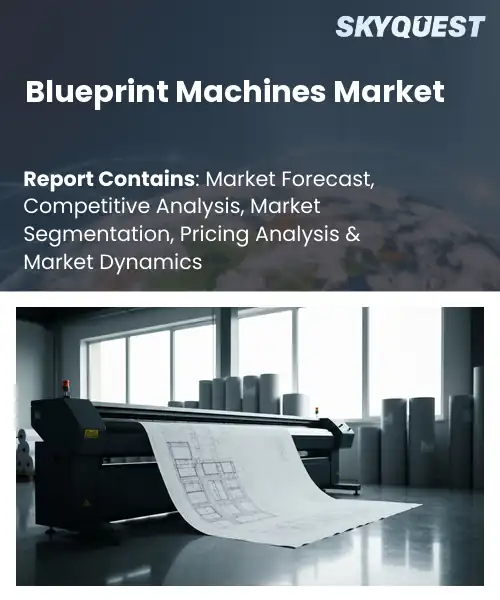
Blueprint Machines Market
Report ID: SQMIG20I2759
Report ID: SQMIG20I2759
[email protected]
USA +1 351-333-4748
Report ID:
SQMIG20I2759 |
Region:
Global |
Published Date: March, 2026
Pages:
157
|Tables:
118
|Figures:
77


Global Blueprint Machines Market size was valued at USD 897.2 Million in 2024 and is poised to grow from USD 971.67 Million in 2025 to USD 1838.85 Million by 2033, growing at a CAGR of 8.3% during the forecast period (2026-2033).
Key Takeaways: Market Trends & Insights
Hardware and software systems for reproducing technical drawings, maps, and schematics for architecture, engineering, and manufacturing now comprise the blueprint machine industry. This industry is important because large reproduction prints are essential for synchronizing construction on the job site, keeping archival materials compliant with regulations, and maintaining regulatory compliance even as more companies adopt digital workflows.
The blueprint machines industry has transitioned from using analog reprographic presses to using integrated digital plotters, and companies have moved from using film to using high-quality inkjet plotters to improve delivery time. Investment in precision and integration has also reduced printing costs while supporting demand for products in developing or expanding areas.
A growing blueprint machines market trend for the industry is the connection between digital design systems and physical reprographics, as companies are increasingly adopting building information modeling (BIM) and looking for blueprint machinery that can produce large, high-quality printed work. Companies also want their printed material to be able to be produced in a timely manner using the same processes they use to produce their digital version of the model.
For example, civil engineers can produce and distribute annotated drainage maps during nighttime hours when they will be on a job site, or a manufacturer can produce assembly schematics on demand so they can do work without shutting down their equipment due to downtime. Therefore, services and subscriptions have helped to create consistent revenue streams for businesses.
How does AI-driven Automation Improve Productivity in the Blueprint Machines Market?
Improvements in productivity through automation powered by artificial intelligence will come from the use of automated prepress processes to optimize file workflows and from the reduction of redundant prepress processes. There are many examples of these technologies and processes being used in the fast growing blueprints market today, such as automation of intelligent preparation; automated translation from CAD to print; and machine vision for quality control and predictive maintenance. The shift from traditional methods to connected production is currently occurring in the industry.
For example, automated preflight eliminates issues before the production stage; layout optimization allows for quicker turnaround on documents; remote monitoring allows for early identification of service requirements. These new technologies allow blueprint organizations to produce quickly turnaround documents and produce consistent results for construction and engineering customers. In addition, HP has updated the PrintOS Production Hub to include automated Preflight and Routing and has demonstrated solutions to assist blueprint printers in scaling their operations while reducing manual handling of jobs.
Market snapshot - 2026-2033
Global Market Size
USD 897.2 Million
Largest Segment
2D Blueprint Machines
Fastest Growth
3D Blueprint Machines
Growth Rate
8.3% CAGR
To get more insights on this market click here to Request a Free Sample Report
Global blueprint machines market is segmented into machine type, application, technology, end-user industry and region. Based on machine type, the market is segmented into 2d blueprint machines, 3d blueprint machines and hybrid blueprint machines. Based on application, the market is segmented into construction, manufacturing and design. Based on technology, the market is segmented into laser technology, inkjet technology and electrostatic technology. Based on end-user industry, the market is segmented into aerospace, automotive, electronics and others. Based on region, the market is segmented into North America, Europe, Asia Pacific, Latin America and Middle East & Africa.
The 3D blueprint machines are the largest blueprint machines market share because they create complex designs and prototypes in three-dimensional space, which cannot be done with traditional 2D systems. The increased need for digital integrated workflows between manufacture, construction, and design has developed a need for machines that produce sophisticated geometries and the ability to quickly iterate. Therefore, vendors place high importance on machines that produce high-quality resolution output along with supporting CAD interoperability, making procurement decisions favour the 3D capable platform that will create direct value within their product development or process improvement.
Hybrid blueprint machines are the largest area of blueprint machines market growth because they assist in combining accurate flat plotting with volumetric fabrication into a single platform. The multifunctionality of hybrid blueprint machines excites users looking for workflow consolidation and lowering manufacturing costs, thereby accelerating the adoption of hybrid blueprint machines and creating new aftermarket opportunities.
As per blueprint machines market forecast, the inkjet technology segment shines due to the fact that its ability to deposit droplets without making contact allows for high-quality full-colour and monochrome printing on virtually any type of media and at extremely quick speeds. Its ability to work with digital file formats as well as the low complexity of setup reduces the workload for operators and support on-demand production within design and construction functions, as well as within manufacturing functions. The fact that print heads and inks are available specifically designed to yield consistent results makes inkjet technology an ideal choice for producing highly detailed blueprints as well as iteratively designed products.
As per blueprint machines market analysis, laser technology segment is growing the fastest because of its ability to mark or cut with accuracy and precision without having to make contact with the surface being marked/cut, while producing a high-quality (durable) product with high contrast; thus, making it suitable for many industrial uses. Additionally, the ability of laser technology to integrate with automated and/or material processing, allows for the expanded use of laser technology into prototyping and parts marking, creating a large amount of demand for manufacturers interested in providing goods with traceability or long-term delivery of blueprints.
To get detailed segments analysis, Request a Free Sample Report
As per blueprint machines industry analysis, the North American region is characterized by concentrated demand from advanced industrial and architectural markets, an established manufacturing base, and a widespread network of service providers and distributors. The combination of a mature manufacturing base and innovation from early adopters of automation, digital workflows, integrated design-to-production solutions, and developing commercial applications provides a significant competitive advantage. Furthermore, well-established aftermarket support, standardization of products and services, and customer experience with the use of high-precision equipment facilitates the deployment of these machines into various markets.
As per blueprint machines market regional outlook, the U.S. market includes significant demand for this equipment to be used by various architectural, engineering, and industrial designers, and has been aided by a wide variety of dealer networks and specific service providers related to these markets. The demand from customers for customization and integration of their equipment with digital design platforms influences the suppliers' emphasis on modular and high-precision products. Original Equipment Manufacturers (OEMs) are increasingly working with software developers, in addition to upgrading their aftermarket capabilities, to enable fast-paced deployments, tailored training for operators, and the continuation of services for contractors and niche fabrication companies.
The blueprint machines market is made up primarily of regional fabricators and design consultants who focus on producing high-quality and sustainable workflows. Most of the equipment purchased in this market is based on the customers' preferences for flexibility in the types of equipment purchased, having a tech-based support process for their products, and using digital design tools to support their manufacturing process. Collaborative partnerships between suppliers and institutions that provide training will ultimately increase the skill level of the machine operators and improve the ease with which new customers can adopt the technology.
The blueprint machines market in Europe is developing rapidly because of the convergence between modernization in both construction and manufacturing workflow, the establishment and widespread use of digital design tools, and a regulatory climate that focuses on quality, efficiency, and sustainability. Strong regional cooperation among providers of equipment, software developers, and architectural offices has resulted in a rapid deployment of integrated solutions to reduce project complexity and support preservation and renovation activities. The demand for blueprint machines (BPM) in national market segments is fragmented, yet sophisticated, which creates a need for localized service models and modular equipment offerings.
The blueprint machines market in Germany is based on a solid manufacturing ecosystem and very high engineering standards that support advanced precision machinery. Very strong connections between suppliers and industrial users promote customization of BPMs for complex applications, while specialized service networks and training programs aid in integrating BPMs into the production process. The focus on durable, upgradeable BPMs and collaboration on product development with research institutions will help to support continued demand for high-end BPMs across construction and industrial fabrication, in a wide variety of applications.
The blueprint machines market within the United Kingdom has seen an explosion of adoption based off the need for modernization in design strategies, renewal of urban areas and enhancement of technology in architecture and construction firms. Suppliers that focus on providing implementation services, multiple financing options or adaptable financing programs (especially for digital integration between equipment and design systems) will continue to gain momentum in this space. The collaboration between multiple sectors will result in a higher calibre of operator competency. Contractor demand for modular systems, upgrades that help streamline the documentation and fabrication process at the job site are leading to increased demand.
As per blueprint machines market regional forecast, France is evolving out of the restoration market, a focus on environmentally friendly development within the construction industry (the trend of green design), and the steady growth of digital workflow adoption by architecture firms and regional builders. The market in France will favour equipment that is flexible and able to be serviced to support the continued preservation of historic/heritage-based buildings and new construction projects. The role of French distributors in assisting the transfer of technology into France from markets outside of France has been very strong, while vendor partnerships with training facilities are creating a strong, local operator competencies and yet still allowing for the maturity of the overall market and also establishing a local aftermarket service solution.
Through innovation, smaller-sized equipment, and full integration into the local supply chain for manufacturing, the Asia-Pacific region continues to grow its presence within the blueprint machines market. The key characteristics of the Asia-Pacific market are accuracy, electronic compatibility, and small design, as they relate to urban building projects and special applications for fabrication processes in urban areas. Regional original equipment manufacturers (OEMs) and component suppliers work together to provide rapid customizable solutions and responsive service agreements for aftermarket products. Partnerships with software companies provide seamless connectivity between the design and manufacturing phases of the process.
As per blueprint machines market outlook, Japan market has a strong history of creating equipment that is manufactured with precision, and providing high-quality equipment designed to be compact enough to work well in a production facility. The suppliers are focused on integrating the equipment with electronic control systems and are providing dependable service offerings to accomplish their customers' expectations for reliability. The suppliers also work closely to enhance operator training and improve their systems over time through collaborative efforts between equipment manufacturers, software manufacturers, and vocational institutions.
The South Korea blueprint machines market is linking sophisticated electronic technology with precision fabrication clusters resulting in increased demand for automated, compact-sized equipment for high-density production. With this equipment readily available from local suppliers, the focus for suppliers is to ensure compatibility with digital design platforms and develop strong service networks that minimize machine downtime. The cooperative endeavors between the equipment manufacturers, technology companies, and universities support the development of innovative solutions and training for users/operators.
To know more about the market opportunities by region and country, click here to
Buy The Complete Report
Increasing Automation Adoption
The use of blueprint automation in manufacturing workflows leads to improved consistency, decreased manual errors, and shorter timeframes between design and production. These advancements inspire companies to invest in automated blueprints as a result of decreased dependence on human-drafted blueprints and the ability to move people into higher value-added activities. By implementing these new technologies, companies can see improvements in their operational efficiencies and capacity utilization. With lower perceived implementation risks due to the substitution effects created by automating blueprints, these companies can more easily identify operational benefits and, therefore, will be more inclined to implement automated blueprints. As a result, there will be more widespread implementation of automated blueprints across industries requiring large volumes of complex, high-quality blueprints, which will continue to drive growth in this market segment.
Advancements In Digital Integration
Advancements in digital integration capabilities, including greater interoperability between CAD systems and increased availability of cloud-based collaboration platforms, will make it easier to share and modify data related to blueprints across companies, thus reducing time wasted during handoffs and minimizing inaccuracies. The ability for all stakeholders involved in creating a product or service to have immediate access to accurate and up-to-date data will allow them to quickly iterate different versions of a design; support distributed manufacturing; and enable easier management of multiple copies of the same file.
High Initial Capital Requirements
Upfront capital requirements for the acquisition of advanced blueprint machines, their integration into existing systems, and the training of personnel for their use are significant entry barriers for small and medium-sized businesses limiting their immediate adoption. In addition, the required complementary investments in Software, Infrastructure, and Process Redesign result in a higher total cost of ownership and longer payback period causing procurement managers to delay or reduce purchases. As a result, this financial burden diminishes the market's ability to grow by reducing the total number of potential customers to only those large enough to have the capital to support advanced adoption and reduces the rate at which the market as a whole can develop.
Technical Skill Shortage
There is a limited number of qualified technicians and engineers that can operate, maintain, and optimize sophisticated blueprint machines causing a lack of deployment and lost performance because organizations cannot recruit or retain qualified staff. A further result of a lack of qualified technical expertise creates an increased dependence on vendor support and training creating delays in implementation and increased operational costs. In a tight labor market, this lack of available skills has resulted in slow adoption, discouragement from utilizing the advanced features of the machines, and uncertainty concerning future service for the machines leading to limitations on the expansion and adoption of the overall market.
Request Free Customization of this report to help us to meet your business objectives.
Technological differentiation and strategic partnerships contribute more towards the competitive landscape of the overall global market for blueprint machines than the use of commodity pricing. These companies often use targeted acquisitions, robotic & material partnerships, and platform innovation to secure project pipelines. Examples include robotic platforms and suppliers’ material agreements that shift fabrication off-site to factories, which create even more direct competition between incumbent OEMs and deep-tech start-ups.
SkyQuest’s ABIRAW (Advanced Business Intelligence, Research & Analysis Wing) is our Business Information Services team that Collects, Collates, Correlates, and Analyses the Data collected by means of Primary Exploratory Research backed by robust Secondary Desk research.
As per SkyQuest analysis, the global blueprint machines industry is propelled by integration of digital design ecosystems and BIM adoption as a key driver, while high initial capital requirements act as a significant restraint. North America remains the dominating region due to mature industrial demand and strong service networks. 3D blueprint machines are the dominating segment because they enable complex prototyping and design-to-production workflows. A second driver is the rise of AI-driven automation which streamlines file-to-print workflows, improves uptime and reduces waste, enabling faster iteration and service revenue growth. Market momentum favors vendors that combine precision hardware, cloud-native workflows and robust aftermarket support.
| Report Metric | Details |
|---|---|
| Market size value in 2024 | USD 897.2 Million |
| Market size value in 2033 | USD 1838.85 Million |
| Growth Rate | 8.3% |
| Base year | 2024 |
| Forecast period | 2026-2033 |
| Forecast Unit (Value) | USD Million |
| Segments covered |
|
| Regions covered | North America (US, Canada), Europe (Germany, France, United Kingdom, Italy, Spain, Rest of Europe), Asia Pacific (China, India, Japan, Rest of Asia-Pacific), Latin America (Brazil, Rest of Latin America), Middle East & Africa (South Africa, GCC Countries, Rest of MEA) |
| Companies covered |
|
| Customization scope | Free report customization with purchase. Customization includes:-
|
To get a free trial access to our platform which is a one stop solution for all your data requirements for quicker decision making. This platform allows you to compare markets, competitors who are prominent in the market, and mega trends that are influencing the dynamics in the market. Also, get access to detailed SkyQuest exclusive matrix.
Table Of Content
Executive Summary
Market overview
Parent Market Analysis
Market overview
Market size
KEY MARKET INSIGHTS
COVID IMPACT
MARKET DYNAMICS & OUTLOOK
Market Size by Region
KEY COMPANY PROFILES
Methodology
For the Blueprint Machines Market, our research methodology involved a mixture of primary and secondary data sources. Key steps involved in the research process are listed below:
1. Information Procurement: This stage involved the procurement of Market data or related information via primary and secondary sources. The various secondary sources used included various company websites, annual reports, trade databases, and paid databases such as Hoover's, Bloomberg Business, Factiva, and Avention. Our team did 45 primary interactions Globally which included several stakeholders such as manufacturers, customers, key opinion leaders, etc. Overall, information procurement was one of the most extensive stages in our research process.
2. Information Analysis: This step involved triangulation of data through bottom-up and top-down approaches to estimate and validate the total size and future estimate of the Blueprint Machines Market.
3. Report Formulation: The final step entailed the placement of data points in appropriate Market spaces in an attempt to deduce viable conclusions.
4. Validation & Publishing: Validation is the most important step in the process. Validation & re-validation via an intricately designed process helped us finalize data points to be used for final calculations. The final Market estimates and forecasts were then aligned and sent to our panel of industry experts for validation of data. Once the validation was done the report was sent to our Quality Assurance team to ensure adherence to style guides, consistency & design.
Analyst Support
Customization Options
With the given market data, our dedicated team of analysts can offer you the following customization options are available for the Blueprint Machines Market:
Product Analysis: Product matrix, which offers a detailed comparison of the product portfolio of companies.
Regional Analysis: Further analysis of the Blueprint Machines Market for additional countries.
Competitive Analysis: Detailed analysis and profiling of additional Market players & comparative analysis of competitive products.
Go to Market Strategy: Find the high-growth channels to invest your marketing efforts and increase your customer base.
Innovation Mapping: Identify racial solutions and innovation, connected to deep ecosystems of innovators, start-ups, academics, and strategic partners.
Category Intelligence: Customized intelligence that is relevant to their supply Markets will enable them to make smarter sourcing decisions and improve their category management.
Public Company Transcript Analysis: To improve the investment performance by generating new alpha and making better-informed decisions.
Social Media Listening: To analyze the conversations and trends happening not just around your brand, but around your industry as a whole, and use those insights to make better Marketing decisions.
REQUEST FOR SAMPLE
 REQUEST FREE CUSTOMIZATION
Global Blueprint Machines Market size was valued at USD 897.2 Million in 2024 and is poised to grow from USD 971.67 Million in 2025 to USD 1838.85 Million by 2033, growing at a CAGR of 8.3% during the forecast period (2026-2033).
The competitive landscape for the global blueprint machines market is driven by technology differentiation and strategic alliances rather than commodity pricing. Firms pursue targeted acquisitions, robotics and materials partnerships, and platform innovation to secure project pipelines. Examples include robotic platform collaborations and material supplier tie ups that move fabrication from site to factory, intensifying direct competition between legacy OEMs and deep tech entrants. 'Stratasys Ltd.', '3D Systems Corporation', 'Ultimaker B.V.', 'Markforged Inc.', 'HP Inc.', 'Formlabs Inc.', 'Carbon, Inc.', 'Xact Metal', 'Desktop Metal, Inc.', 'SLM Solutions Group AG', 'EOS GmbH', 'Materialise NV', 'Renishaw plc', 'باکستر(Baxter)', 'Prusa Research', 'Anycubic Technology Co., Ltd.', 'Creality 3D', 'Aon3D', 'Rize Inc.', 'Arburg GmbH + Co KG'
The integration of automated blueprint machines into manufacturing workflows enhances consistency, reduces manual errors, and shortens design-to-production cycles, thereby encouraging firms to invest in these technologies. By enabling repeatable precision and reducing reliance on skilled manual drafting, companies can reallocate human resources to higher-value tasks, improving operational efficiency and capacity utilization. This substitution effect lowers perceived implementation risk and demonstrates clear operational benefits, prompting broader adoption across industries that require complex, high-volume blueprint production and fostering sustained market growth.
Smart Automation And Connectivity: Integration of advanced automation, embedded sensors, and seamless connectivity is transforming blueprint machine capabilities. Manufacturers leverage real-time data exchanges and interoperable platforms to enable remote monitoring, adaptive control, and predictive maintenance, improving uptime and responsiveness. This trend fosters closer collaboration across supply chains, accelerates customization, and supports software-driven value propositions such as subscription services and performance-based contracts. Stakeholders prioritize open architectures and standardized protocols to ensure scalability, facilitate third-party integrations, and maintain competitive advantage through continuous firmware and application updates.
North America Dominate the Global Blueprint Machines Market.
The Blueprint Machines Market is segmented by product type (CNC blueprint machines, laser blueprint machines, 3D blueprint machines, others), application (construction, automotive, aerospace, others), end user, and region.
AI is enhancing the Blueprint Machines Market by enabling automation, predictive maintenance, and improved design accuracy. Integration of AI with smart manufacturing systems allows better efficiency, reduced downtime, and optimized production processes, supporting the shift toward Industry 4.0-driven machinery solutions.


Want to customize this report? This report can be personalized according to your needs. Our analysts and industry experts will work directly with you to understand your requirements and provide you with customized data in a short amount of time. We offer $1000 worth of FREE customization at the time of purchase.
Feedback From Our Clients


 USA (+1) 351-333-4748

