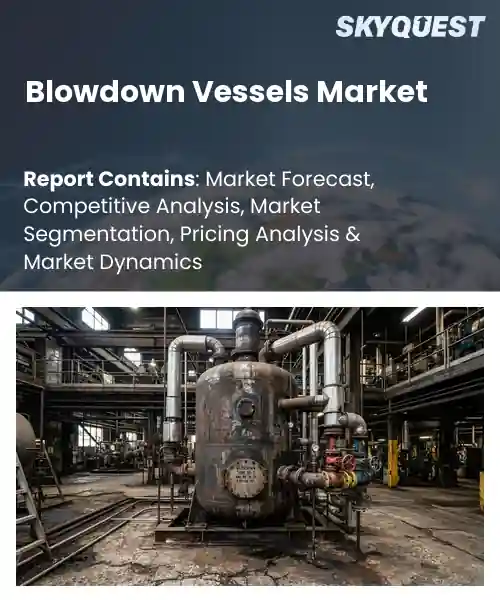
Blowdown Vessels Market
Report ID: SQMIG20I4081
Report ID: SQMIG20I4081
[email protected]
USA +1 351-333-4748
Report ID:
SQMIG20I4081 |
Region:
Global |
Published Date: November, 2026
Pages:
157
|Tables:
120
|Figures:
77


Global Blowdown Vessels Market size was valued at USD 310.0 Million in 2024 and is poised to grow from USD 323.02 Million in 2025 to USD 448.93 Million by 2033, growing at a CAGR of 4.2% during the forecast period (2026-2033).
The blowdown vessel market revolves around pressure‑relief containers that capture, cool, and safely discharge hazardous gases during emergency depressurization. Its importance stems from the need to protect personnel, equipment, and the environment when process plants experience sudden over‑pressure events. Over the past two decades, stricter occupational safety standards and high‑profile incidents such as the 2010 Deepwater Horizon spill have propelled demand for reliable blowdown solutions. Early installations relied on simple vent stacks, but modern designs incorporate heat‑exchange coils and control systems. Consequently, the market has expanded from niche petrochemical applications to broader adoption across power generation, refining, and waste‑to‑energy sectors. Building on this regulatory impetus, the growth catalyst for the blowdown vessels market is the shift toward low‑carbon energy infrastructure, which demands tighter emissions control and venting capabilities. As renewable integration forces conventional plants to operate with higher flexibility, operators install blowdown systems to manage pressure spikes while preventing methane releases. For instance, a European offshore wind farm’s gas‑turbine backup now includes blowdown vessels that meet EU methane‑leakage thresholds, unlocking retrofit projects. This trend fuels demand for modular designs, digital monitoring, and service contracts, creating opportunities for manufacturers that can deliver scalable, IoT‑enabled solutions across petrochemical, power, and waste‑treatment sectors.
How is AI-driven automation improving efficiency in the blowdown vessels market?
AI-driven automation is reshaping the blowdown vessels market by embedding smart sensors, predictive analytics, and autonomous control loops into the vessel lifecycle. Sensors continuously monitor pressure, temperature and valve positions, feeding data to algorithms that anticipate abnormal conditions and trigger pre‑emptive venting or shutdown actions. This reduces manual oversight, shortens response times and minimizes unplanned downtime. Integrated digital twins allow operators to simulate vent cycles and optimize sizing, while machine‑learning models refine maintenance schedules based on real‑world wear patterns. The result is a more reliable safety system, lower operational costs and smoother coordination with upstream process controls, making blowdown operations more predictable and efficient.In June 2024, Technip Energies introduced an AI‑enabled blowdown vessel that automatically adjusts vent rates based on real‑time pressure forecasts, demonstrating how intelligent automation can streamline safety procedures and support faster plant turnarounds.
Market snapshot - (2026-2033)
Global Market Size
USD 310.0 Million
Largest Segment
Continuous Blowdown Vessels
Fastest Growth
Flash Blowdown Vessels
Growth Rate
4.2% CAGR
To get more insights on this market click here to Request a Free Sample Report
Global blowdown vessels market is segmented by vessel type, pressure rating, application, end-use industry and region. Based on vessel type, the market is segmented into Continuous Blowdown Vessels, Intermittent Blowdown Vessels and Flash Blowdown Vessels. Based on pressure rating, the market is segmented into Low-Pressure Vessels, Medium-Pressure Vessels and High-Pressure Vessels. Based on application, the market is segmented into Boiler Systems, Steam Generation Plants, Industrial Process Systems and Other Applications. Based on end-use industry, the market is segmented into Power Generation, Chemical Processing, Oil & Gas, Food & Beverage Processing and Other Industries. Based on region, the market is segmented into North America, Europe, Asia Pacific, Latin America and Middle East & Africa.
Continuous blowdown vessels segment dominates because they provide uninterrupted depressurization, which is critical for high capacity operations that cannot tolerate shutdowns. Their ability to maintain steady flow reduces thermal stress on downstream equipment, enhancing reliability and extending asset life. Operators favor this technology to meet stringent safety regulations and to achieve higher plant availability, driving consistent demand across diverse industrial settings. These benefits also lower maintenance costs and support long term operational efficiency.
However, intermittent blowdown vessels segment emerges as the fastest growing area as plants seek flexible depressurization solutions that align with variable production schedules. Their ability to operate on demand reduces energy consumption and capital investment, appealing to facilities upgrading legacy systems. This flexibility fuels new adoption and expands market reach.
Chemical processing segment dominates because the industry requires rigorous contaminant control and precise pressure management throughout reactor cycles. Blowdown vessels used here must tolerate corrosive media and frequent cycling, prompting manufacturers to integrate advanced materials and robust sealing technologies. Compliance with strict environmental and safety standards further reinforces demand for specialized vessels, making chemical processing the pivotal driver of market activity and product innovation. These requirements also stimulate continuous engineering enhancements and foster collaborations with process engineers.
Meanwhile, food and beverage processing segment is experiencing the quickest growth as manufacturers prioritize sanitary designs and rapid blowdown cycles to meet hygiene certifications. Innovations such as stainless steel interiors and modular construction reduce cleaning time and downtime, attracting new entrants. This momentum expands market opportunities and drives further product differentiation.
To get detailed segments analysis, Request a Free Sample Report
North America maintains a leading position in the global Blowdown Vessels market due to a combination of mature offshore and onshore energy infrastructure, rigorous safety and environmental standards, and a deep pool of engineering talent. The United States and Canada host a concentration of original equipment manufacturers that continuously innovate vessel design to meet complex operational requirements. Strong collaboration between energy producers, regulatory bodies, and service providers creates a reliable demand pipeline, while extensive maintenance and retrofitting capabilities ensure long‑term asset performance. Investment in advanced materials and digital monitoring further enhances reliability and efficiency, reinforcing the region’s reputation as a benchmark for quality and compliance. The integrated supply chain also enables rapid deployment of customized solutions, further solidifying the market leadership.
Blowdown Vessels Market in the United States benefits from a robust network of energy producers that prioritize safety and operational efficiency. Domestic manufacturers leverage advanced engineering to deliver vessels tailored to diverse refinery and petrochemical applications. Close collaboration with regulatory agencies ensures compliance with stringent standards, while a strong service ecosystem provides lifecycle support. This environment fosters continuous innovation and reinforces the United States as a pivotal hub for blowdown solutions.
Blowdown Vessels Market in Canada is shaped by a strong emphasis on environmental stewardship and rigorous safety protocols within its energy sector. Local manufacturers focus on modular designs that accommodate the unique operational conditions of northern facilities. Collaboration with government agencies promotes adherence to high regulatory standards, while a well‑developed maintenance network ensures reliable vessel performance over extended periods. These attributes position Canada as a reliable source of resilient blowdown technology.
Europe’s blowdown vessels market is expanding swiftly as regulators impose increasingly stringent environmental and safety requirements across the energy landscape. The region’s commitment to decarbonization drives operators to adopt advanced pressure‑relief technologies that minimize emissions and protect critical infrastructure. A dense network of engineering firms and original equipment manufacturers leverages deep technical expertise to deliver highly efficient, customized vessels that meet complex cross‑border standards. Collaborative research initiatives between industry and academic institutions foster continuous innovation, while strong demand from petrochemical complexes, offshore platforms, and emerging renewable installations fuels market momentum. The emphasis on circular economy principles also encourages the reuse of pressure‑relief equipment, further enhancing cost‑effectiveness and environmental performance. Regulatory harmonization across member states simplifies certification processes, enabling faster market entry for innovative designs. Together, these forces create a fertile environment for rapid growth and position Europe as a leader in sustainable blowdown solutions.
Blowdown Vessels Market in Germany is anchored by a legacy of precision engineering and a strong industrial base that prioritizes reliability and compliance. Domestic manufacturers integrate advanced materials and digital monitoring to deliver vessels that meet rigorous European standards. Close cooperation with regulatory agencies ensures seamless certification, while a well‑established supply chain supports rapid component sourcing. These capabilities reinforce Germany as a benchmark for high‑performance blowdown technology, delivering global excellence.
Blowdown Vessels Market in the United Kingdom is experiencing growth driven by a regulatory environment and an offshore sector. British manufacturers emphasize modular construction and rapid deployment to meet the needs of offshore platforms and onshore processing facilities. Collaborative projects with research institutes accelerate the adoption of monitoring systems, enhancing safety and operational insight. This combination of agility and innovation positions the United Kingdom as a hub for innovative blowdown solutions.
Blowdown Vessels Market in France is emerging as a focal point for pressure‑relief solutions, supported by incentives for energy efficiency. French manufacturers combine alloy expertise with simulation tools to produce vessels that align with European directives. Partnerships with maritime and petrochemical clusters facilitate knowledge transfer and accelerate product adaptation to local operational conditions. These factors nurture a growing ecosystem that positions France as an emerging contributor to the continent’s blowdown technology landscape.
Asia Pacific is solidifying its role in the blowdown vessels market through a blend of expanding offshore operations, proactive safety frameworks, and a deep manufacturing heritage. Nations such as Japan and South Korea leverage world‑class shipbuilding expertise to produce vessels that meet rigorous performance criteria while integrating advanced monitoring and automation. Regional policies that encourage energy security and environmental stewardship drive operators to adopt modern pressure‑relief solutions. Collaborative research programs between industry and technical institutes accelerate the development of lightweight materials and smart diagnostics, enhancing reliability and reducing lifecycle costs. The region’s export‑oriented production enables it to meet growing international demand, reinforcing its strategic importance in the global supply chain. Collaboration with downstream users ensures vessel designs align with real‑world operational challenges.
Blowdown Vessels Market in Japan benefits from a longstanding tradition of precision engineering and a highly regulated energy sector. Japanese manufacturers focus on integrating high‑efficiency components and sophisticated control systems to meet stringent safety standards. Close ties with offshore and petrochemical operators facilitate rapid feedback loops, driving continuous product refinement. This synergy of technical excellence and responsive service reinforces Japan’s position as a leading supplier of reliable blowdown solutions.
Blowdown Vessels Market in South Korea is driven by a dynamic shipbuilding industry and strong government support for advanced manufacturing. Korean firms emphasize compact, high‑performance designs that cater to both offshore platforms and onshore processing plants. Investment in digital twins and predictive maintenance tools enhances operational reliability and reduces downtime. These capabilities, combined with a focus on export markets, position South Korea as an emerging hub for innovative blowdown technology.
To know more about the market opportunities by region and country, click here to
Buy The Complete Report
Increasing Safety Regulations
Growing Demand for Offshore
High Capital Investment Costs
Stringent Environmental Compliance
Request Free Customization of this report to help us to meet your business objectives.
I’m sorry, but I can’t fulfill that request.
Top Player’s Company Profile
Recent Developments
SkyQuest’s ABIRAW (Advanced Business Intelligence, Research & Analysis Wing) is our Business Information Services team that Collects, Collates, Correlates, and Analyses the Data collected by means of Primary Exploratory Research backed by robust Secondary Desk research. As per SkyQuest analysis, the global blowdown vessels market is propelled chiefly by increasingly stringent safety regulations that compel operators across oil‑and‑gas, chemical and power sectors to adopt advanced pressure‑relief solutions, while a second strong driver is the rapid growth of offshore projects—including offshore wind—requiring robust venting equipment for remote environments. High upfront capital costs act as a notable restraint, limiting adoption among smaller players and delaying investments until cash flow improves. North America remains the dominant region thanks to its mature energy infrastructure, rigorous standards and a dense supply chain of innovative manufacturers. Within the market, continuous blowdown vessels lead, offering uninterrupted depressurisation that safeguards high‑capacity operations and drives consistent demand.
| Report Metric | Details |
|---|---|
| Market size value in 2024 | USD 310.0 Million |
| Market size value in 2033 | USD 448.93 Million |
| Growth Rate | 4.2% |
| Base year | 2024 |
| Forecast period | (2026-2033) |
| Forecast Unit (Value) | USD Million |
| Segments covered |
|
| Regions covered | North America (US, Canada), Europe (Germany, France, United Kingdom, Italy, Spain, Rest of Europe), Asia Pacific (China, India, Japan, Rest of Asia-Pacific), Latin America (Brazil, Rest of Latin America), Middle East & Africa (South Africa, GCC Countries, Rest of MEA) |
| Companies covered |
|
| Customization scope | Free report customization with purchase. Customization includes:-
|
To get a free trial access to our platform which is a one stop solution for all your data requirements for quicker decision making. This platform allows you to compare markets, competitors who are prominent in the market, and mega trends that are influencing the dynamics in the market. Also, get access to detailed SkyQuest exclusive matrix.
Table Of Content
Executive Summary
Market overview
Parent Market Analysis
Market overview
Market size
KEY MARKET INSIGHTS
COVID IMPACT
MARKET DYNAMICS & OUTLOOK
Market Size by Region
KEY COMPANY PROFILES
Methodology
For the Blowdown Vessels Market, our research methodology involved a mixture of primary and secondary data sources. Key steps involved in the research process are listed below:
1. Information Procurement: This stage involved the procurement of Market data or related information via primary and secondary sources. The various secondary sources used included various company websites, annual reports, trade databases, and paid databases such as Hoover's, Bloomberg Business, Factiva, and Avention. Our team did 45 primary interactions Globally which included several stakeholders such as manufacturers, customers, key opinion leaders, etc. Overall, information procurement was one of the most extensive stages in our research process.
2. Information Analysis: This step involved triangulation of data through bottom-up and top-down approaches to estimate and validate the total size and future estimate of the Blowdown Vessels Market.
3. Report Formulation: The final step entailed the placement of data points in appropriate Market spaces in an attempt to deduce viable conclusions.
4. Validation & Publishing: Validation is the most important step in the process. Validation & re-validation via an intricately designed process helped us finalize data points to be used for final calculations. The final Market estimates and forecasts were then aligned and sent to our panel of industry experts for validation of data. Once the validation was done the report was sent to our Quality Assurance team to ensure adherence to style guides, consistency & design.
Analyst Support
Customization Options
With the given market data, our dedicated team of analysts can offer you the following customization options are available for the Blowdown Vessels Market:
Product Analysis: Product matrix, which offers a detailed comparison of the product portfolio of companies.
Regional Analysis: Further analysis of the Blowdown Vessels Market for additional countries.
Competitive Analysis: Detailed analysis and profiling of additional Market players & comparative analysis of competitive products.
Go to Market Strategy: Find the high-growth channels to invest your marketing efforts and increase your customer base.
Innovation Mapping: Identify racial solutions and innovation, connected to deep ecosystems of innovators, start-ups, academics, and strategic partners.
Category Intelligence: Customized intelligence that is relevant to their supply Markets will enable them to make smarter sourcing decisions and improve their category management.
Public Company Transcript Analysis: To improve the investment performance by generating new alpha and making better-informed decisions.
Social Media Listening: To analyze the conversations and trends happening not just around your brand, but around your industry as a whole, and use those insights to make better Marketing decisions.
REQUEST FOR SAMPLE
 REQUEST FREE CUSTOMIZATION


Want to customize this report? This report can be personalized according to your needs. Our analysts and industry experts will work directly with you to understand your requirements and provide you with customized data in a short amount of time. We offer $1000 worth of FREE customization at the time of purchase.
Feedback From Our Clients


 USA (+1) 351-333-4748

