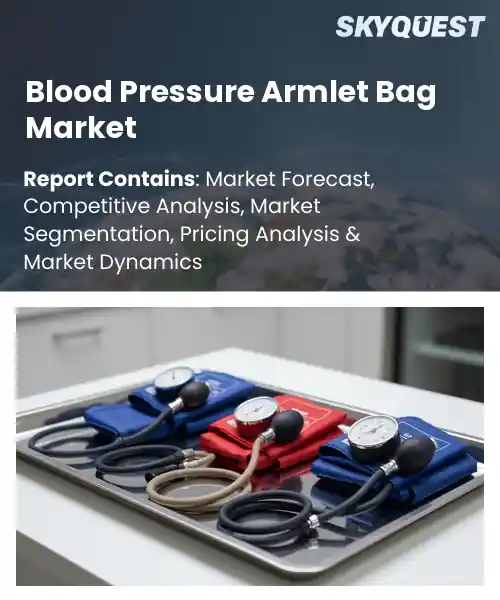
Blood Pressure Armlet Bag Market
Report ID: SQMIG35A3280
Report ID: SQMIG35A3280
[email protected]
USA +1 351-333-4748
Report ID:
SQMIG35A3280 |
Region:
Global |
Published Date: February, 2026
Pages:
157
|Tables:
115
|Figures:
77


Global Blood Pressure Armlet Bag Market size was valued at USD 1.10 Billion in 2024 and is poised to grow from USD 1.21 Billion in 2025 to USD 2.64 Billion by 2033, growing at a CAGR of 10.2% during the forecast period (2026-2033).
The blood pressure armlet bag market is the segment that supplies arm cuffs and carrying or storage bags used with sphygmomanometers for clinical and home blood pressure monitoring. Because hypertension continues to be the primary risk factor for cardiovascular disease worldwide, demand for accurate cuff systems will continue to be strong in clinics, pharmacies, and home use. The traditional market has transitioned primarily from the use of mercury and aneroid cuff device designs (devices that do not require any batteries) to more sophisticated and automated oscillometric cuff designs with modular variations for different arm sizes. This trajectory underpins current procurement strategies.
The key trend driving the global blood pressure armlet bag sector is the rapid expansion of remote patient monitoring and telemedicine, which creates a need for validated armlet bags and cuffs that integrate with digital platforms. As clinicians adopt remote hypertension management protocols, they prescribe or distribute Bluetooth-enabled arm cuffs to ensure accurate home readings, and this causes manufacturers to invest in IoT connectivity and standardized interoperability, lowering barriers to scale. Real-world programs demonstrate effect: a heart-failure clinic reduced readmissions by equipping patients with connected cuffs linked to care teams, while payers piloted reimbursement for RPM, creating market opportunity for subscription models, data services, and emerging-market distribution.
How is IoT Adoption Reshaping the Blood Pressure Armlet Bag Market?
IoT adoption is reshaping the blood pressure armlet bag market by turning a simple cuff component into a connected data gateway. Key aspects include embedded sensors, wireless connectivity and secure cloud links that let arm cuff systems stream readings to clinician platforms. At this time, manufacturers are evolving by changing their designs of rubber bladders into advanced style where sensor location, ease of use for the customer, and simple transfer of data are key aspects of modern design. Manufacturers can create alternate methods to stand out from competition; support telehealth care; improve collaboration between device manufacturers and digital-health platforms to improve adherence and help for future clinical follow-up.
OMRON May 2025, launched home blood pressure monitors with AI powered AFib detection and Bluetooth connectivity, showing how IoT enabled cuffs and associated armlet bag designs support remote monitoring workflows and smoother data sharing between patients and clinicians.
Market snapshot - (2026-2033)
Global Market Size
USD 1.1 Billion
Largest Segment
Standard Armlet Bags
Fastest Growth
Digital Armlet Bags
Growth Rate
10.2% CAGR
To get more insights on this market click here to Request a Free Sample Report
Global blood pressure armlet bag market is segmented by product type, material type, end user, distribution channel and region. Based on product type, the market is segmented into standard armlet bags, digital armlet bags and customizable armlet bags. Based on material type, the market is segmented into fabric-based bags and plastic-based bags. Based on end user, the market is segmented into healthcare facilities and home users. Based on distribution channel, the market is segmented into online retail, physical retail, and direct sales. Based on region, the market is segmented into North America, Europe, Asia Pacific, Latin America, and Middle East & Africa.
Based on the global blood pressure armlet bag market forecast, digital armlet bags segment dominates because continuous connectivity, integrated sensors and seamless data transfer make them central to modern blood pressure monitoring workflows. Structured reading data that can be deployed into clinical platforms supporting providers leads to greater diagnostic confidence and more seamless care coordination, thereby facilitating procurement both by healthcare institutions and home users looking to automate patient tracking. Enhanced firmware updates, interoperability and vendor collaboration contribute to increasing utilization by improving clinical outcomes associated with their use and enhancing the long-term perceived value.
However, customizable armlet bags are emerging as the fastest growing area driven by demand for personalized fit and clinician-configurable features. The multiple components of modular solutions allow for unique cuff interface patterns and private label offerings to attract device manufacturers and enterprises. Moreover, by customizing the product with a unique design, new pathways are created for commercial business between both the healthcare system and consumer markets.
Fabric-based bags segment dominates because their breathable, flexible construction improves patient comfort and adherence in prolonged monitoring contexts, making them preferred by clinicians and caregivers. Easy washability and gentle interfaces reduce skin irritation and support repeated use, which lowers lifecycle costs and simplifies inventory management. Material adaptability allows integration with different cuff designs and padding, driving procurement decisions by facilities and encouraging broad acceptance across home care applications.
However, plastic-based bags are witnessing the strongest growth momentum as demand for disposable hygienic options rises in clinical workflows. These materials are produced at a lower cost than traditional materials; can be used in conjunction with current single-use protocols; will assist infection prevention efforts. These materials are able to be manufactured quickly and cleaned simply allowing for greater distribution opportunities and also lead to the development of disposable accessory options and efficient procurement processes.
To get detailed segments analysis, Request a Free Sample Report
As per the global blood pressure armlet bag market analysis, North America dominates the industry due to a convergence of supportive healthcare infrastructure, strong clinical adoption pathways, and established distribution networks that facilitate rapid product availability. Payer reimbursements and big institution purchasing rules tend to encourage the standardization of clinically proven aftermarket products so that manufacturers put emphasis on getting into the market quickly and making their product even better. This region is very fortunate to benefit from many research activities focused here, collaborating among device developers and clinical facilities, and having a highly developed regulatory process.
Blood pressure armlet bag market in the United States is characterized by early clinical adoption, integrated hospital procurement, and close collaboration between device manufacturers and leading medical centers. Vendors are encouraged to provide varied materials for manufacture and sterilization through an emphasis on product consistency and reliability in their relationship with various cuffing systems. The reimbursement framework and institutional buying practices have the same impact on vendors, as endorsed methods facilitate "validated" product offerings from those vendors.
Blood pressure armlet bag market in Canada benefits from a coordinated health system focus on patient safety, standardized clinical guidelines, and centralized procurement practices that prioritize quality and compatibility. Suppliers engage with provincial healthcare bodies to align product specifications with infection control protocols. Demand favors durable, reusable armlet solutions and effective service support, prompting manufacturers to tailor distribution and training initiatives that reinforce clinical confidence and robust enduring hospital relationships.
Rapid expansion in Europe in the blood pressure armlet bag market is propelled by harmonized regulatory frameworks, strong adoption within established hospital systems, and growing emphasis on standardized patient monitoring across care settings. Purchasing models through collaborations of health systems focus on the improvement of quality of care; creating a positive need for reliable, reusable cuff accessories. Established suppliers and agile innovators working together towards both supply side and demand side compatibility and infection control regularly demonstrate their ability to respond to product needs based on the clinical environment in which cuff accessories are used.
Blood pressure armlet bag market in Germany is anchored by strong industrial capability, a mature medical technology sector, and tight integration between manufacturers and hospitals. The focus on engineering quality and meeting regulatory requirements drives product specification to meet the exacting standards of clinical practice and manufacturer network and specialized distribution networks provide the necessary procurement to sustain high levels of service. Manufacturers utilize long-lasting materials; evaluate compatibility with other systems; and offer extensive after-market support in order to remain leaders in the market for in- and out-of-hospital use monitoring.
Blood pressure armlet bag market in the United Kingdom is marked by accelerating adoption across outpatient clinics and expanding procurement channels that favor innovative, user friendly designs. Flexible purchasing approaches and collaboration between clinical groups and distributors enable product trials and regional rollouts. The requirement for light-weight materials, surfaces that can easily be sterilized, and compatibility guidance that is clearly communicated, has encouraged suppliers to develop products "custom fit" to the needs of clinicians.
Blood pressure armlet bag market trends in France is emerging through targeted adoption in hospital networks and specialized clinics, supported by initiatives emphasizing patient safety and infection control. Validated medium armlet solutions are being tested by procurement and clinical champions to provide input for overall standardized solutions. Suppliers that offer compatibility across cuff ecosystems and localized service support gain traction. Emphasis on clinician education and alignment with national guidelines is encouraging uptake and strengthening market foundations.
Asia Pacific is strengthening its position in the blood pressure armlet bag market through a combination of advanced manufacturing capabilities, targeted clinical partnerships, and increasing emphasis on domestic supply resilience. To meet the needs of a broad spectrum of clinical environments from tertiary hospitals to outpatient facilities, regional manufacturers are modifying their designs and investing in new materials to ensure their products meet the requirements of durability and sterilization. Collaboration between local distributors, training programs, and other service supports is essential to maintain the confidence of clinicians as well as expectations for after sales service.
Blood pressure armlet bag market in Japan is supported by strong precision manufacturing, rigorous quality standards, and alignment between device makers and research institutions. Medical institutions focus on finding durable devices that are compatible with existing equipment. This has pushed supply companies to develop durable materials and ways to prove the origin of their products through material science and traceability. End users are looking for products that work well with monitoring devices and can be reliably sterilized between patients.
Blood pressure armlet bag market share in South Korea benefits from a strong technology driven medical manufacturing sector and agile suppliers that prioritize rapid product refinement. Facilities such as hospitals and specialty clinics select solutions with a strong alignment with connected monitoring systems and efforts toward effective sterilization. Local distributors and export-oriented manufacturers also create a solid logistics and service framework. Collaboration with academic institutions enhances the validation process, while engagement with clinicians and training helps facilitate adoption throughout the continuum of care.
To know more about the market opportunities by region and country, click here to
Buy The Complete Report
Increasing Prevalence of Hypertension
Innovations In Device Design
Regulatory Approval and Reimbursement
Limited Adoption in Emerging Markets
Request Free Customization of this report to help us to meet your business objectives.
The competitive landscape in the global blood pressure armlet bag market outlook is shifting from incumbent cuff manufacturers toward deep tech wearables and sensor startups, driven by clinical validation demands, regulatory clearances, and concrete partnerships and technology collaborations. Strategic moves include product innovation for wearable form factors, corporate collaborations on sensor chips, and university spinouts progressing toward clinical use and FDA filings.
SkyQuest’s ABIRAW (Advanced Business Intelligence, Research & Analysis Wing) is our Business Information Services team that Collects, Collates, Correlates, and Analyses the Data collected by means of Primary Exploratory Research backed by robust Secondary Desk research.
As per SkyQuest analysis, the global blood pressure armlet bag industry is poised for sustained growth driven foremost by the rapid expansion of remote patient monitoring and telemedicine and further supported by the increasing prevalence of hypertension. Complex regulations and inconsistent reimbursement methods continue to be a major barrier to market entry and an increase in the cost of product development by delaying the adoption of innovative practices. Currently North America has the largest share of the market, owing to an advanced healthcare infrastructure and proven methods to procure items; digital armlet bags provide the largest share of sales due to their ability to connect and have integrated sensors. To capitalize on future telehealth integration and increased need for chronic disease management, manufacturers must focus on interoperability, clinical validation, and establishing a scalable supply chain.
| Report Metric | Details |
|---|---|
| Market size value in 2024 | USD 1.1 Billion |
| Market size value in 2033 | USD 2.64 Billion |
| Growth Rate | 10.2% |
| Base year | 2024 |
| Forecast period | (2026-2033) |
| Forecast Unit (Value) | USD Billion |
| Segments covered |
|
| Regions covered | North America (US, Canada), Europe (Germany, France, United Kingdom, Italy, Spain, Rest of Europe), Asia Pacific (China, India, Japan, Rest of Asia-Pacific), Latin America (Brazil, Rest of Latin America), Middle East & Africa (South Africa, GCC Countries, Rest of MEA) |
| Companies covered |
|
| Customization scope | Free report customization with purchase. Customization includes:-
|
To get a free trial access to our platform which is a one stop solution for all your data requirements for quicker decision making. This platform allows you to compare markets, competitors who are prominent in the market, and mega trends that are influencing the dynamics in the market. Also, get access to detailed SkyQuest exclusive matrix.
Table Of Content
Executive Summary
Market overview
Parent Market Analysis
Market overview
Market size
KEY MARKET INSIGHTS
COVID IMPACT
MARKET DYNAMICS & OUTLOOK
Market Size by Region
KEY COMPANY PROFILES
Methodology
For the Blood Pressure Armlet Bag Market, our research methodology involved a mixture of primary and secondary data sources. Key steps involved in the research process are listed below:
1. Information Procurement: This stage involved the procurement of Market data or related information via primary and secondary sources. The various secondary sources used included various company websites, annual reports, trade databases, and paid databases such as Hoover's, Bloomberg Business, Factiva, and Avention. Our team did 45 primary interactions Globally which included several stakeholders such as manufacturers, customers, key opinion leaders, etc. Overall, information procurement was one of the most extensive stages in our research process.
2. Information Analysis: This step involved triangulation of data through bottom-up and top-down approaches to estimate and validate the total size and future estimate of the Blood Pressure Armlet Bag Market.
3. Report Formulation: The final step entailed the placement of data points in appropriate Market spaces in an attempt to deduce viable conclusions.
4. Validation & Publishing: Validation is the most important step in the process. Validation & re-validation via an intricately designed process helped us finalize data points to be used for final calculations. The final Market estimates and forecasts were then aligned and sent to our panel of industry experts for validation of data. Once the validation was done the report was sent to our Quality Assurance team to ensure adherence to style guides, consistency & design.
Analyst Support
Customization Options
With the given market data, our dedicated team of analysts can offer you the following customization options are available for the Blood Pressure Armlet Bag Market:
Product Analysis: Product matrix, which offers a detailed comparison of the product portfolio of companies.
Regional Analysis: Further analysis of the Blood Pressure Armlet Bag Market for additional countries.
Competitive Analysis: Detailed analysis and profiling of additional Market players & comparative analysis of competitive products.
Go to Market Strategy: Find the high-growth channels to invest your marketing efforts and increase your customer base.
Innovation Mapping: Identify racial solutions and innovation, connected to deep ecosystems of innovators, start-ups, academics, and strategic partners.
Category Intelligence: Customized intelligence that is relevant to their supply Markets will enable them to make smarter sourcing decisions and improve their category management.
Public Company Transcript Analysis: To improve the investment performance by generating new alpha and making better-informed decisions.
Social Media Listening: To analyze the conversations and trends happening not just around your brand, but around your industry as a whole, and use those insights to make better Marketing decisions.
REQUEST FOR SAMPLE
 REQUEST FREE CUSTOMIZATION
Global Blood Pressure Armlet Bag Market size was valued at USD 1.1 Billion in 2024 and is poised to grow from USD 1.21 Billion in 2025 to USD 2.64 Billion by 2033, growing at a CAGR of 10.2% during the forecast period (2026-2033).
Competitive landscape in the global blood pressure armlet bag market is shifting from incumbent cuff manufacturers toward deep tech wearables and sensor startups, driven by clinical validation demands, regulatory clearances, and concrete partnerships and technology collaborations. Strategic moves include product innovation for wearable form factors, corporate collaborations on sensor chips, and university spinouts progressing toward clinical use and FDA filings. 'Omron Healthcare', 'A&D Medical', 'Philips Healthcare', 'Withings', 'High Blood Pressure Solutions', 'SunTech Medical', 'Mindray Medical', 'Welch Allyn', 'Qardio', 'American Diagnostic Corporation', 'Riester', 'Tensio', 'Beurer', 'Braun', 'Cardiovascular Systems', 'Veris Health', 'Abbott Laboratories', 'Zoll Medical', 'Medtronic', 'GE Healthcare'
The rising prevalence of hypertension increases demand for reliable blood pressure monitoring devices, prompting healthcare providers and patients to seek armlet bags for routine measurement, continuity of care, and long term monitoring. As awareness and screening expand, clinical workflows prioritize devices that support consistent cuff fit and ease of use, leading institutions to include armlet bags in procurement decisions. This sustained clinical and consumer demand drives manufacturers to scale production, improve distribution, and invest in supply chain reliability, reinforcing market growth.
Remote Monitoring Integration: The integration of armlet bags with remote patient monitoring and telehealth platforms is driving product innovation and vendor partnerships. Manufacturers are prioritizing interoperability, secure data transfer, and user-centric connectivity to support care pathways outside traditional settings. This trend enables continuous blood pressure management, improves clinical workflows, and fosters recurring revenue models through connected services. Ecosystem collaboration with software providers and healthcare networks is expanding value propositions, positioning armlet bags as components of comprehensive chronic disease management solutions.
As per the global blood pressure armlet bag market analysis, North America dominates the industry due to a convergence of supportive healthcare infrastructure, strong clinical adoption pathways, and established distribution networks that facilitate rapid product availability.


Want to customize this report? This report can be personalized according to your needs. Our analysts and industry experts will work directly with you to understand your requirements and provide you with customized data in a short amount of time. We offer $1000 worth of FREE customization at the time of purchase.
Feedback From Our Clients


 USA (+1) 351-333-4748

