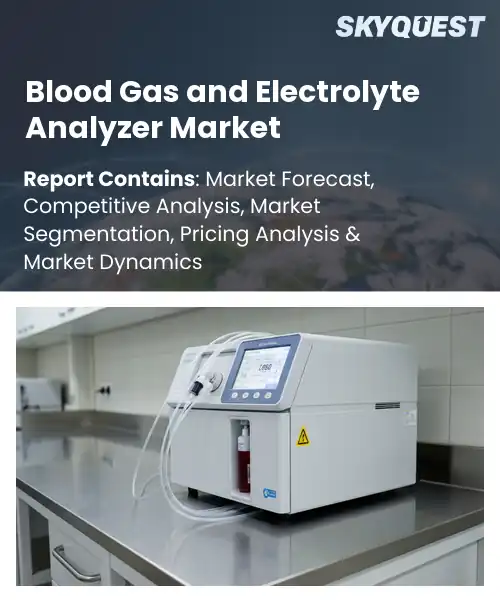
Blood Gas and Electrolyte Analyzer Market
Report ID: SQMIG35A4058
Report ID: SQMIG35A4058
[email protected]
USA +1 351-333-4748
Report ID:
SQMIG35A4058 |
Region:
Global |
Published Date: July, 2026
Pages:
157
|Tables:
176
|Figures:
79


Global Blood Gas And Electrolyte Analyzer Market size was valued at USD 2.80 Billion in 2024 and is poised to grow from USD 2.95 Billion in 2025 to USD 4.46 Billion by 2033, growing at a CAGR of 5.3% during the forecast period (2026-2033).
Increasing regulatory emphasis on patient safety and clinical accuracy is accelerating growth in the blood gas and electrolyte analyzer market trends. Healthcare providers are under pressure to deliver faster, more reliable diagnostic results while minimizing the risk of errors, prompting greater adoption of integrated analyzer platforms that combine blood gas, electrolyte, and co-oximetry testing within a single system.
In the United States, value-based reimbursement models have encouraged hospitals to reduce laboratory operating costs, driving demand for analyzers capable of producing rapid results and improving workforce efficiency. Consequently, leading manufacturers such as Abbott Laboratories and Siemens Healthineers are investing heavily in advanced connectivity solutions that enable seamless integration with electronic health record systems, creating additional revenue opportunities through software, data management, and service-based offerings.
How is AI-driven Automation Influencing Growth in the Blood Gas and Electrolyte Analyzer Market?
AI-led automation is transforming the blood gas and electrolyte analyzer market growth by incorporating intelligent algorithms into the hardware and software of instruments. Machine learning models interpret complex blood chemistry patterns that allow predictive maintenance and adaptive calibration to keep devices running at optimal performance. Integrated data platforms link analyzers with electronic health records, allowing clinicians to receive immediate, actionable insights without manual transcription. Automated sample loading and cartridge recognition reduce hands-on time, lower error rates and free up laboratory staff for higher value tasks. These capabilities reduce turnaround time, improve diagnostic accuracy, and meet the increasing need for rapid point of care testing in hospitals and clinics.
In June 2024, a leading manufacturer launched a new AI enhanced analyzer that automates sample handling and delivers real time decision support, reducing turnaround time and improving lab efficiency, fueling market growth and underscoring the importance of automation in driving growth across clinical settings around the world today improving patient outcomes and operational profitability.
Market snapshot - (2026-2033)
Global Market Size
USD 2.8 Billion
Largest Segment
Benchtop Blood Gas Analyzers
Fastest Growth
Portable Blood Gas Analyzers
Growth Rate
5.3% CAGR
To get more insights on this market click here to Request a Free Sample Report
Global blood gas and electrolyte analyzer market is segmented by product type, parameter type, application, end user, technology, modality and region. Based on product type, the market is segmented into benchtop blood gas analyzers, portable blood gas analyzers, point-of-care blood gas & electrolyte analyzers and integrated blood gas & electrolyte analyzers. Based on parameter type, the market is segmented into blood gas parameters, electrolyte parameters, metabolite parameters and co-oximetry parameters. Based on application, the market is segmented into critical care testing, emergency medicine, operating room monitoring, neonatal & pediatric care and others. Based on end user, the market is segmented into hospitals, diagnostic laboratories, ambulatory care centers, clinics and others. Based on technology, the market is segmented into cartridge-based systems, reagent-based systems and sensor-based systems. Based on modality, the market is segmented into standalone analyzers and integrated analyzers. Based on region, the market is segmented into North America, Europe, Asia Pacific, Latin America and Middle East & Africa.
Benchtop blood gas analyzers segment dominates due to high precision, multiplexed testing capability, and robust workflow integration in central laboratories. “Stable temperature control and larger sample capacity are essential to meet the demanding throughput of intensive care environments and we are attracting institutions seeking reliable long term performance.” Plus, the ability to run large test menus and existing maintenance contracts add to the trust and drive widespread adoption across hospital labs.
However, the portable blood gas analyzers are emerging as the high growth area in the market. Their small size and battery operation make them useful for point of care testing in emergency rooms and ambulances, where there is increasing demand for rapid results at the patient’s bedside. This mobility increases the decentralized testing activities of hospitals and thus leads to a faster overall market expansion.
Electrolyte parameters lead the segment with critical care management of fluid balance, cardiac function and renal health depending upon the accurate measurement of ions’ concentration. This parameter is central to daily hospital workflows, as clinicians rely on accurate sodium, potassium, and calcium readings to guide life-saving interventions. Integration with electronic medical records and automated quality controls make it even more indispensable ensuring demand remains strong across a variety of care settings.
Meanwhile, metabolite parameters are experiencing the strongest growth momentum in the market. With the increased focus on sepsis detection and metabolic monitoring, lactate, glucose and hemoglobin are now available on expanded test menus. This extended clinical relevance is driving adoption of advanced analyzer platforms, creating new revenue streams and supporting growth in the market.
To get detailed segments analysis, Request a Free Sample Report
North America region dominates the market with a combination of advanced clinical infrastructure, strong research ecosystems and an early adoption of technology. Integrated hospital networks focused on rapid point-of-care diagnostics support timely therapeutic decisions by clinicians and benefit healthcare providers across the United States and Canada. The widespread adoption of advanced analyzers is driven by robust reimbursement frameworks and top manufacturers have a significant development and manufacturing footprint in the region. Partnerships between academia and industry accelerate the innovation process, allowing for continuous improvements in assay precision and workflow optimization. Clear pathways for device approval are established by regulatory agencies, lowering barriers to entry into the market and encouraging investment in next-generation platforms. An advanced biomedical engineering workforce further enhances the region’s ability to adapt solutions to different clinical settings.
Blood gas and electrolyte analyzer market outlook in United States thrives on a dense network of research hospitals and private health systems that prioritize precision diagnostics. Strong investment in digital health infrastructure encourages integration of analyzers with electronic medical records, enhancing data accessibility. The presence of multiple global manufacturers supports a competitive environment that drives continual product refinement and service excellence, meeting the exacting expectations of clinicians and patients alike.
Blood gas and electrolyte analyzer market forecast in Canada benefits from a publicly funded health system that emphasizes cost‑effective yet high‑quality diagnostics. Provincial health authorities encourage adoption of interoperable technologies, fostering uniform standards across acute and community care settings. Collaborative research initiatives between universities and device makers accelerate the introduction of innovative features, while a strong emphasis on clinician training ensures optimal utilization of analyzer capabilities within diverse patient populations.
Europe is witnessing a fast-paced growth in the market driven by harmonized regulatory frameworks, large public and private healthcare spend and a strong emphasis on patient safety. The clinical excellence focus of the region creates a need for analyzers that can provide fast and accurate results in the hospital and point-of-care setting. Research institutions and device manufacturers operate in collaborative networks to speed development of next generation platforms and digitization efforts link analyzer results to the larger health information system. Value-based care reimbursement policies further incentivize adoption, and the presence of established multinational firms ensures a steady supply of sophisticated technologies. Healthcare providers are focused on interoperability and are seeking solutions that can be integrated with laboratory information systems to improve efficiency of workflows and data analytics. Greener manufacturing is driven by a strong emphasis on sustainability, aligning with regional policy goals. Taken together, these dynamics make Europe a vibrant center of growth and innovation in blood gas and electrolyte analysis.
Blood gas and electrolyte analyzer market regional outlook in Germany is anchored by a strong engineering tradition and extensive clinical research infrastructure. The country’s health system emphasizes high‑quality diagnostics, driving procurement of analyzer platforms across university hospitals and clinics. Close collaboration between manufacturers and academic laboratories accelerates integration of novel sensor technologies, while regulatory alignment with European standards ensures swift market entry. This environment sustains Germany’s role as a leading driver of regional market momentum.
Blood gas and electrolyte analyzer market regional forecast in United Kingdom accelerates as NHS initiatives prioritize rapid bedside testing to improve patient flow. Investment in digital health platforms facilitates seamless data exchange between analyzers and electronic records, supporting clinical decision‑making. Strong academic partnerships drive evaluation of emerging technologies, while the regulatory environment balances safety with innovation, enabling timely introduction of next‑generation devices. Consequently, the United Kingdom emerges as a fast‑moving hub for adoption and clinical integration.
Blood gas and electrolyte analyzer market penetration in France gains momentum through national health strategies that encourage adoption of point‑of‑care diagnostics in both hospital and ambulatory settings. Collaborative projects between French research institutes and device manufacturers foster co‑development of miniaturized platforms tailored to regional clinical workflows. Reimbursement incentives for efficient testing amplify demand, while a focus on sustainable manufacturing aligns with broader environmental objectives. These factors collectively nurture an emerging yet increasingly influential market presence.
Asia Pacific is strengthening its position by combining rapid healthcare modernization with better access to high-quality diagnostics across a broad spectrum of economies. Hospitals are upgrading their intensive care units and adding new point-of-care sites with sophisticated blood gas and electrolyte analyzers to meet government health programs that emphasize early detection and effective patient management. Regional manufacturers are building cheap and reliable platforms using their electronics know-how, often in partnership with international technology companies, to embed artificial intelligence and connectivity features. The rise in the middle-class population drives the requirement for hospital services, while private clinic networks adopt portable analyzer solutions to cater to outpatient needs. Moreover, targeted investment in training and regulatory alignment creates pathways to adoption and rapid market access for novel devices. Collectively these initiatives will strengthen the competitive position of Asia Pacific and cement the region as a key growth driver for the global market.
Blood gas and electrolyte analyzer market analysis in Japan thrives amid a mature healthcare ecosystem that values precision and reliability. Large teaching hospitals and specialized clinics prioritize integration of analyzers with sophisticated electronic health record platforms, enhancing real‑time decision support. Domestic manufacturers combine long‑standing sensor expertise with emerging digital functionalities, while collaborations with international firms accelerate access to cutting‑edge technologies. Policy support for geriatric care further fuels demand for rapid bedside testing, reinforcing Japan’s influential market position.
Blood gas and electrolyte analyzer industry trends in South Korea accelerates as the nation invests heavily in smart hospital initiatives and advanced diagnostic capabilities. Government incentives promote adoption of compact, network‑enabled analyzers that feed data into national health information exchanges, improving population health monitoring. Domestic firms excel in microfluidic sensor design, partnering with global players to embed AI‑driven analytics. This synergy of technology leadership and supportive health policies strengthens South Korea’s emerging influence within the regional market.
To know more about the market opportunities by region and country, click here to
Buy The Complete Report
Increasing Clinical Demand
Advancements In Point‑of‑Care Technology
High Initial Capital Investment
Regulatory Compliance Complexity
Request Free Customization of this report to help us to meet your business objectives.
The global blood gas and electrolyte analyzer market is characterized by the presence of several established diagnostic and healthcare technology companies competing through product innovation, technological advancements, strategic collaborations, and geographic expansion. Leading market participants focus on enhancing analyzer accuracy, reducing turnaround times, improving connectivity with hospital information systems, and expanding point-of-care testing capabilities. Increasing demand for rapid diagnostic solutions in critical care settings, emergency departments, and clinical laboratories continues to encourage investments in automation, digital healthcare integration, and advanced data management technologies. Strategic partnerships with healthcare providers and ongoing research and development activities remain key factors shaping the competitive landscape.
Top Player’s Company Profile
Recent Developments in the Blood Gas and Electrolyte Analyzer Market
SkyQuest’s ABIRAW (Advanced Business Intelligence, Research & Analysis Wing) is our Business Information Services team that Collects, Collates, Correlates, and Analyses the Data collected by means of Primary Exploratory Research backed by robust Secondary Desk research. As per SkyQuest analysis, the market are the increasing clinical need for rapid diagnosis in emergency and critical-care settings and the second driver is innovative point-of-care technology that combines with electronic health records and AI-powered analytics. The benchtop blood gas analyzer segment accounts for the largest share owing to high precision and high-throughput capacity. North America holds the leading position in the global landscape owing to the presence of a robust infrastructure, early technology adoption and reimbursement policies. However, high initial capital investment acts as a major constraint which limits the adoption among smaller facilities and slows down the overall market penetration. Institutions are considering leasing or phased deployments to spread out the cost while still reaping the benefits of faster diagnostics when faced with this financial challenge.
| Report Metric | Details |
|---|---|
| Market size value in 2024 | USD 2.8 Billion |
| Market size value in 2033 | USD 4.46 Billion |
| Growth Rate | 5.3% |
| Base year | 2024 |
| Forecast period | (2026-2033) |
| Forecast Unit (Value) | USD Billion |
| Segments covered |
|
| Regions covered | North America (US, Canada), Europe (Germany, France, United Kingdom, Italy, Spain, Rest of Europe), Asia Pacific (China, India, Japan, Rest of Asia-Pacific), Latin America (Brazil, Rest of Latin America), Middle East & Africa (South Africa, GCC Countries, Rest of MEA) |
| Companies covered |
|
| Customization scope | Free report customization with purchase. Customization includes:-
|
To get a free trial access to our platform which is a one stop solution for all your data requirements for quicker decision making. This platform allows you to compare markets, competitors who are prominent in the market, and mega trends that are influencing the dynamics in the market. Also, get access to detailed SkyQuest exclusive matrix.
Table Of Content
Executive Summary
Market overview
Parent Market Analysis
Market overview
Market size
KEY MARKET INSIGHTS
COVID IMPACT
MARKET DYNAMICS & OUTLOOK
Market Size by Region
KEY COMPANY PROFILES
Methodology
For the Blood Gas and Electrolyte Analyzer Market, our research methodology involved a mixture of primary and secondary data sources. Key steps involved in the research process are listed below:
1. Information Procurement: This stage involved the procurement of Market data or related information via primary and secondary sources. The various secondary sources used included various company websites, annual reports, trade databases, and paid databases such as Hoover's, Bloomberg Business, Factiva, and Avention. Our team did 45 primary interactions Globally which included several stakeholders such as manufacturers, customers, key opinion leaders, etc. Overall, information procurement was one of the most extensive stages in our research process.
2. Information Analysis: This step involved triangulation of data through bottom-up and top-down approaches to estimate and validate the total size and future estimate of the Blood Gas and Electrolyte Analyzer Market.
3. Report Formulation: The final step entailed the placement of data points in appropriate Market spaces in an attempt to deduce viable conclusions.
4. Validation & Publishing: Validation is the most important step in the process. Validation & re-validation via an intricately designed process helped us finalize data points to be used for final calculations. The final Market estimates and forecasts were then aligned and sent to our panel of industry experts for validation of data. Once the validation was done the report was sent to our Quality Assurance team to ensure adherence to style guides, consistency & design.
Analyst Support
Customization Options
With the given market data, our dedicated team of analysts can offer you the following customization options are available for the Blood Gas and Electrolyte Analyzer Market:
Product Analysis: Product matrix, which offers a detailed comparison of the product portfolio of companies.
Regional Analysis: Further analysis of the Blood Gas and Electrolyte Analyzer Market for additional countries.
Competitive Analysis: Detailed analysis and profiling of additional Market players & comparative analysis of competitive products.
Go to Market Strategy: Find the high-growth channels to invest your marketing efforts and increase your customer base.
Innovation Mapping: Identify racial solutions and innovation, connected to deep ecosystems of innovators, start-ups, academics, and strategic partners.
Category Intelligence: Customized intelligence that is relevant to their supply Markets will enable them to make smarter sourcing decisions and improve their category management.
Public Company Transcript Analysis: To improve the investment performance by generating new alpha and making better-informed decisions.
Social Media Listening: To analyze the conversations and trends happening not just around your brand, but around your industry as a whole, and use those insights to make better Marketing decisions.
REQUEST FOR SAMPLE
 REQUEST FREE CUSTOMIZATION
Global Blood Gas And Electrolyte Analyzer Market size was valued at USD 2.8 Billion in 2024 and is poised to grow from USD 2.95 Billion in 2025 to USD 4.46 Billion by 2033, growing at a CAGR of 5.3% during the forecast period (2026-2033).
The competitive landscape of the global blood gas and electrolyte analyzer market is shaped by a few dominant manufacturers—Abbott Laboratories, Roche, and bioMérieux—each leveraging advanced technology development and strategic collaborations to sustain market leadership. Recent initiatives include Roche’s partnership with hospital networks to integrate its analyzer platforms into electronic health records, Abbott’s rollout of next‑generation point‑of‑care devices featuring rapid result turnaround, and bioMérieux’s acquisition of a niche software firm to enhance data analytics capabilities, intensifying competition and driving innovation across the sector. 'Siemens Healthineers AG', 'Abbott Laboratories', 'F. Hoffmann-La Roche Ltd.', 'Boule Diagnostics AB', 'IDEXX Laboratories, Inc.', 'Edan Instruments, Inc.', 'Dirui Industrial Co., Ltd.', 'ARKRAY, Inc.', 'Radiometer Medical ApS', 'Werfen S.A.', 'Nova Biomedical Corporation', 'A. Menarini Diagnostics S.r.l.', 'ERBA Diagnostics Mannheim GmbH', 'Sensa Core Medical Instrumentation Pvt. Ltd.', 'OPTI Medical Systems, Inc.', 'Cornley Hi-Tech Co., Ltd.', 'Shenzhen Genius Electronics Co., Ltd.', 'Medica Corporation', 'Shenzhen Prokan Electronics Inc.', 'Convergent Technologies GmbH & Co. KG'
Growing emphasis on rapid diagnosis in emergency and critical care settings drives adoption of blood gas and electrolyte analyzers, as clinicians seek immediate data to guide therapeutic decisions. The ability to deliver timely results improves patient outcomes and operational efficiency, encouraging hospitals and laboratories to upgrade analytical capabilities. These instruments also support multidisciplinary pathways, allowing anesthesia, cardiology and pulmonology teams to access consistent biochemical profiles, thereby reinforcing the overall value proposition for healthcare providers and steady medium‑term sustaining market expansion globally.
Point-Of-Care Integration Surge: Healthcare providers are increasingly deploying compact blood gas and electrolyte analyzers directly at bedside, intensive care units, and emergency departments. This shift reduces turnaround time, enhances clinical decision‑making, and supports rapid treatment adjustments. By embedding analytics within existing patient monitoring ecosystems, hospitals improve workflow efficiency and patient outcomes. Manufacturers respond by designing user‑friendly interfaces, wireless connectivity, and modular platforms that seamlessly integrate with electronic health records, fostering broader adoption across diverse care settings and reinforcing overall clinical excellence worldwide today.
Why does North America Dominate the Global Blood Gas and Electrolyte Analyzer Market? |@12


Want to customize this report? This report can be personalized according to your needs. Our analysts and industry experts will work directly with you to understand your requirements and provide you with customized data in a short amount of time. We offer $1000 worth of FREE customization at the time of purchase.
Feedback From Our Clients


 USA (+1) 351-333-4748

