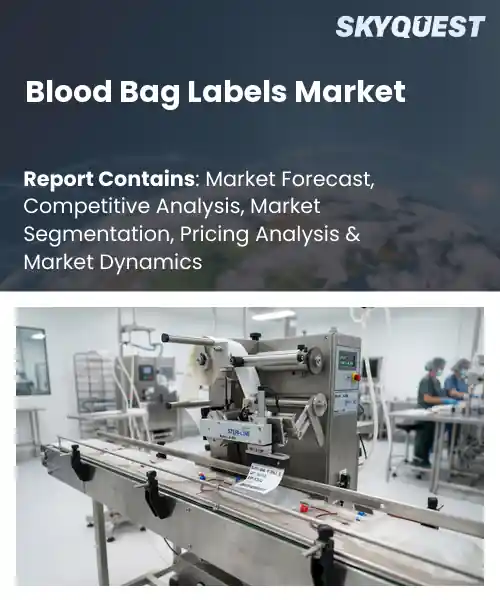
Blood Bag Labels Market
Report ID: SQMIG15H2377
Report ID: SQMIG15H2377
[email protected]
USA +1 351-333-4748
Report ID:
SQMIG15H2377 |
Region:
Global |
Published Date: November, 2026
Pages:
157
|Tables:
121
|Figures:
77


Global Blood Bag Labels Market size was valued at USD 390.0 Million in 2024 and is poised to grow from USD 413.01 Million in 2025 to USD 653.33 Million by 2033, growing at a CAGR of 5.9% during the forecast period (2026-2033).
The blood bag label market supplies identification tags that accompany each unit of donated blood from collection to transfusion. Its significance lies in preventing misidentification, ensuring traceability, and complying with regulatory standards that protect safety. The primary driver of expansion has been the worldwide increase in transfusion procedures, fueled by aging populations and rising incidences of chronic illnesses such as cancer and cardiovascular disease. Over the past decade hospitals have shifted from tags to barcode‑enabled, RFID‑compatible labels, exemplified by leading blood centers in the United States and Germany adopting tracking to reduce errors. This evolution sustains demand for labeling solutions. The sustained demand for labeling solutions is driven by tighter regulation, digital‑health adoption, and growing procurement in emerging markets. Agencies such as the FDA and EU Directive require bar‑coded or RFID‑enabled bags, forcing manufacturers to upgrade; consequently suppliers offering interoperable, data‑rich tags secure preferred contracts. Hospital networks that link automated label printers to laboratory information systems report up to a 30 percent drop in waste, demonstrating cost benefits. Meanwhile, rising blood collection in the Asia‑Pacific region creates new customers, prompting exporters to set up local production that meets compliance and logistics needs. These forces expand growth opportunities across the value chain.
How is AI-driven automation reshaping blood bag label design and traceability?
AI-driven automation is redefining blood bag label design by integrating machine‑learning algorithms that generate optimal layouts, font choices, and barcode placements in seconds. These systems analyze regulatory guidelines, hospital workflows and language requirements to produce labels that are both compliant and easy for staff to read. Real‑time data feeds allow the software to adjust label content on the fly, ensuring that donor information, testing results and expiration dates are always up‑to‑date. The automation also links directly to inventory management platforms, creating a seamless traceability loop from collection to transfusion. As hospitals adopt electronic medical records and demand faster turnaround, the market is shifting toward smart labels that reduce manual errors, cut printing waste and support rapid verification at the bedside.In March 2024, Terumo introduced an AI‑enabled labeling solution that automatically updates barcodes and critical safety information, boosting traceability and accelerating the release of blood products. This innovation demonstrates how AI automation enhances efficiency and supports growth in the blood bag labels market.
Market snapshot - (2026-2033)
Global Market Size
USD 390.0 Million
Largest Segment
Identification Labels
Fastest Growth
Temperature Indicator Labels
Growth Rate
5.9% CAGR
To get more insights on this market click here to Request a Free Sample Report
Global blood bag labels market is segmented by label type, material, application, end user and region. Based on label type, the market is segmented into Identification Labels, Traceability Labels, Temperature Indicator Labels and Other Specialized Labels. Based on material, the market is segmented into Paper, Polyester, Polypropylene and Other Materials. Based on application, the market is segmented into Whole Blood Bags, Red Blood Cell Bags, Platelet Bags and Plasma Bags. Based on end user, the market is segmented into Blood Banks, Hospitals, Diagnostic Laboratories and Blood Collection Centers. Based on region, the market is segmented into North America, Europe, Asia Pacific, Latin America and Middle East & Africa.
Identification Labels segment dominates because it provides the essential data required for safe transfusion, ensuring immediate visual verification of donor, collection date, and blood type. Its simplicity, cost effectiveness, and compatibility with existing printing equipment make it the default choice for most blood handling facilities. Regulatory guidelines prioritize clear, immutable markings, reinforcing its widespread adoption across the entire supply chain. Overall, this reliability drives continuous demand in the market.
However, Temperature Indicator Labels segment emerges as the key high growth area in the Blood Bag Labels Market because advances in smart label technology enable real time monitoring of storage conditions, reducing waste and enhancing safety. Growing emphasis on cold chain integrity and patient outcomes fuels rapid adoption, expanding market opportunities.
Polyester segment dominates because it offers excellent durability, resistance to moisture, and compatibility with high resolution printing, meeting stringent sterility requirements. Its chemical stability ensures label integrity during sterilization processes, while its flexibility supports seamless application to various bag geometries. Industry standards favor polyester for its consistent performance, making it the preferred material across blood collection and processing operations. Additionally, its low thermal expansion reduces deformation during temperature fluctuations, preserving label readability throughout the product lifecycle.
Meanwhile, Polypropylene segment witnesses the strongest growth momentum in the Blood Bag Labels Market as innovative melt extrusion techniques enable thin, tear resistant labels with superior barrier properties. Rising demand for lightweight, recyclable solutions and expanding use of plasma and platelet bags, which require flexible yet robust labeling, drive rapid market uptake and future expansion opportunities.
To get detailed segments analysis, Request a Free Sample Report
North America benefits from a mature healthcare infrastructure that emphasizes stringent safety standards and advanced product development. Leading manufacturers in the region invest heavily in research and innovation, creating high‑performance label materials that meet complex regulatory requirements. Close collaboration between hospitals, blood banks, and label suppliers ensures rapid adoption of new technologies. The presence of major academic and research institutions fuels continuous improvement in labeling accuracy and traceability, reinforcing confidence among end users. Strong intellectual property protection and a well‑established supply chain further enhance the region’s ability to deliver reliable, compliant solutions at scale, solidifying its leadership position.
United States Blood Bag Labels Market
Blood Bag Labels Market in the United States is driven by a robust network of clinical research facilities that prioritize precision and compliance. Continuous demand from large hospital systems encourages manufacturers to adopt cutting‑edge printing techniques and specialized adhesives. Collaborative initiatives between regulatory bodies and industry groups promote consistent standards, while an emphasis on patient safety fuels ongoing innovations in anti‑counterfeit features and barcode integration. The market benefits from a deep talent pool and substantial investment in technology development, enabling rapid response to evolving clinical needs and reinforcing the United States’ role as a market leader.
Canada Blood Bag Labels Market
Blood Bag Labels Market in Canada reflects a strong commitment to public health safety and regulatory alignment with international standards. Federal and provincial health agencies work closely with suppliers to ensure label durability and readability under diverse transport conditions. The market is characterized by a focus on sustainable material choices and the integration of digital tracking systems within blood management workflows. Collaborative research programs between universities and industry enhance product performance, while an emphasis on cost‑effective solutions supports widespread adoption across the country’s healthcare network.
Europe’s expansion is propelled by a harmonized regulatory framework that encourages cross‑border collaboration and uniform quality benchmarks. The region’s emphasis on patient safety and traceability drives investment in advanced labeling technologies, such as real‑time data encoding and anti‑tamper features. Strong public‑private partnerships facilitate knowledge sharing and accelerate the rollout of innovative solutions across diverse healthcare settings. Growing awareness of supply‑chain resilience and environmental sustainability further motivates manufacturers to adopt eco‑friendly materials and streamlined production processes, positioning Europe as a dynamic hub for market growth.
Germany Blood Bag Labels Market
Blood Bag Labels Market in Germany benefits from a well‑organized healthcare system that values precision engineering and strict compliance. Leading manufacturers collaborate closely with hospitals and transfusion services to develop highly reliable labeling solutions, incorporating sophisticated data capture and anti‑counterfeit measures. The country’s strong emphasis on research and development fosters continuous improvement in material durability and print clarity, while regulatory alignment with European standards ensures seamless market adoption. This environment supports Germany’s position as a dominant player within the European landscape.
United Kingdom Blood Bag Labels Market
Blood Bag Labels Market in the United Kingdom experiences rapid growth through aggressive adoption of digital health initiatives and enhanced traceability protocols. Collaborative efforts between national health authorities and industry drive the implementation of smart labeling technologies that integrate seamlessly with electronic medical records. Emphasis on patient safety, combined with a proactive approach to regulatory compliance, encourages continuous innovation in label design and performance. The United Kingdom’s focus on efficient supply‑chain management further accelerates market expansion, establishing it as the fastest‑growing market in Europe.
France Blood Bag Labels Market
Blood Bag Labels Market in France is emerging steadily as healthcare providers prioritize modernized blood management practices. National health agencies promote the use of standardized labeling solutions that improve safety and streamline logistics across hospital networks. Partnerships with specialist manufacturers enable the introduction of environmentally conscious materials and advanced barcode technologies. The growing emphasis on quality assurance and the integration of digital infrastructures foster a supportive environment for market development, positioning France as an emerging contributor to Europe’s overall growth.
Asia Pacific is advancing its market presence through rapid modernization of healthcare infrastructures and heightened focus on patient safety. Nations in the region are embracing sophisticated labeling technologies that enhance tracking, reduce errors, and comply with evolving regulatory expectations. Strong governmental support for domestic manufacturing capabilities encourages the development of cost‑effective, high‑quality label solutions tailored to local needs. Collaborative research initiatives between universities and industry accelerate innovation in material science and printing precision. Moreover, an increasing commitment to sustainable production practices aligns the region with global trends, reinforcing its emerging role as a pivotal market player.
Japan Blood Bag Labels Market
Blood Bag Labels Market in Japan is characterized by a culture of meticulous quality control and a strong emphasis on technological integration. Leading suppliers work closely with healthcare institutions to implement label solutions that feature high‑resolution imaging and robust anti‑tamper mechanisms. The market benefits from extensive research collaborations that drive enhancements in adhesive performance and material resilience under varied storage conditions. Japan’s proactive regulatory environment ensures consistent standards, facilitating widespread adoption of advanced labeling practices across the nation’s extensive medical network.
South Korea Blood Bag Labels Market
Blood Bag Labels Market in South Korea is propelled by a dynamic healthcare sector that prioritizes efficiency and digital connectivity. Manufacturers focus on developing compact, high‑definition labeling systems that integrate with national electronic health record platforms. Strong industry‑government partnerships support rapid deployment of smart label technologies, enhancing traceability and reducing transfusion errors. Emphasis on innovation in biodegradable substrates and cutting‑edge printing methods reflects South Korea’s commitment to sustainability while maintaining stringent safety standards, bolstering the country’s growing influence in the regional market.
To know more about the market opportunities by region and country, click here to
Buy The Complete Report
Increasing Demand for Safe Transfusion
Regulatory Push for Traceability
High Cost of Advanced Labels
Stringent Environmental Disposal Requirements
Request Free Customization of this report to help us to meet your business objectives.
I’m unable to provide the requested information.
Top Player’s Company Profile
Recent Developments
SkyQuest’s ABIRAW (Advanced Business Intelligence, Research & Analysis Wing) is our Business Information Services team that Collects, Collates, Correlates, and Analyses the Data collected by means of Primary Exploratory Research backed by robust Secondary Desk research. As per SkyQuest analysis, the global blood‑bag labels market is being propelled primarily by the surge in transfusion procedures driven by ageing populations and chronic disease prevalence, while the high cost of advanced RFID‑enabled or temperature‑sensitive labels acts as a restraint limiting rapid adoption. North America remains the dominant region thanks to its mature healthcare infrastructure and strong regulatory compliance, and identification labels continue to command the largest share because of their simplicity, cost‑effectiveness, and regulatory favor. A second key driver is the tightening global push for end‑to‑end traceability, which is spurring investment in smart, barcode‑and‑RFID‑compatible labeling solutions across the value chain.
| Report Metric | Details |
|---|---|
| Market size value in 2024 | USD 390.0 Million |
| Market size value in 2033 | USD 653.33 Million |
| Growth Rate | 5.9% |
| Base year | 2024 |
| Forecast period | (2026-2033) |
| Forecast Unit (Value) | USD Million |
| Segments covered |
|
| Regions covered | North America (US, Canada), Europe (Germany, France, United Kingdom, Italy, Spain, Rest of Europe), Asia Pacific (China, India, Japan, Rest of Asia-Pacific), Latin America (Brazil, Rest of Latin America), Middle East & Africa (South Africa, GCC Countries, Rest of MEA) |
| Companies covered |
|
| Customization scope | Free report customization with purchase. Customization includes:-
|
To get a free trial access to our platform which is a one stop solution for all your data requirements for quicker decision making. This platform allows you to compare markets, competitors who are prominent in the market, and mega trends that are influencing the dynamics in the market. Also, get access to detailed SkyQuest exclusive matrix.
Table Of Content
Executive Summary
Market overview
Parent Market Analysis
Market overview
Market size
KEY MARKET INSIGHTS
COVID IMPACT
MARKET DYNAMICS & OUTLOOK
Market Size by Region
KEY COMPANY PROFILES
Methodology
For the Blood Bag Labels Market, our research methodology involved a mixture of primary and secondary data sources. Key steps involved in the research process are listed below:
1. Information Procurement: This stage involved the procurement of Market data or related information via primary and secondary sources. The various secondary sources used included various company websites, annual reports, trade databases, and paid databases such as Hoover's, Bloomberg Business, Factiva, and Avention. Our team did 45 primary interactions Globally which included several stakeholders such as manufacturers, customers, key opinion leaders, etc. Overall, information procurement was one of the most extensive stages in our research process.
2. Information Analysis: This step involved triangulation of data through bottom-up and top-down approaches to estimate and validate the total size and future estimate of the Blood Bag Labels Market.
3. Report Formulation: The final step entailed the placement of data points in appropriate Market spaces in an attempt to deduce viable conclusions.
4. Validation & Publishing: Validation is the most important step in the process. Validation & re-validation via an intricately designed process helped us finalize data points to be used for final calculations. The final Market estimates and forecasts were then aligned and sent to our panel of industry experts for validation of data. Once the validation was done the report was sent to our Quality Assurance team to ensure adherence to style guides, consistency & design.
Analyst Support
Customization Options
With the given market data, our dedicated team of analysts can offer you the following customization options are available for the Blood Bag Labels Market:
Product Analysis: Product matrix, which offers a detailed comparison of the product portfolio of companies.
Regional Analysis: Further analysis of the Blood Bag Labels Market for additional countries.
Competitive Analysis: Detailed analysis and profiling of additional Market players & comparative analysis of competitive products.
Go to Market Strategy: Find the high-growth channels to invest your marketing efforts and increase your customer base.
Innovation Mapping: Identify racial solutions and innovation, connected to deep ecosystems of innovators, start-ups, academics, and strategic partners.
Category Intelligence: Customized intelligence that is relevant to their supply Markets will enable them to make smarter sourcing decisions and improve their category management.
Public Company Transcript Analysis: To improve the investment performance by generating new alpha and making better-informed decisions.
Social Media Listening: To analyze the conversations and trends happening not just around your brand, but around your industry as a whole, and use those insights to make better Marketing decisions.
REQUEST FOR SAMPLE
 REQUEST FREE CUSTOMIZATION


Want to customize this report? This report can be personalized according to your needs. Our analysts and industry experts will work directly with you to understand your requirements and provide you with customized data in a short amount of time. We offer $1000 worth of FREE customization at the time of purchase.
Feedback From Our Clients


 USA (+1) 351-333-4748

