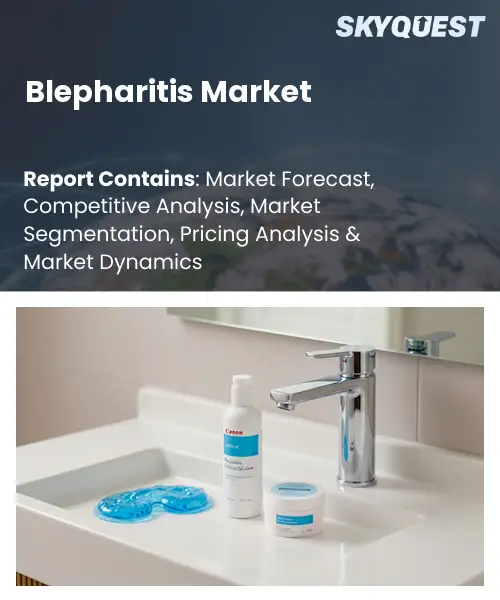
Blepharitis Market
Report ID: SQMIG35I2924
Report ID: SQMIG35I2924
[email protected]
USA +1 351-333-4748
Report ID:
SQMIG35I2924 |
Region:
Global |
Published Date: June, 2026
Pages:
157
|Tables:
116
|Figures:
77


Global Blepharitis Market size was valued at USD 2.52 Billion in 2024 and is poised to grow from USD 2.69 Billion in 2025 to USD 4.52 Billion by 2033, growing at a CAGR of 6.72% during the forecast period (2026-2033).
The global blepharitis market growth is driven by the fact that chronic eye problems are becoming more common, people are getting more aware about ocular hygiene, and there’s a larger need for treatment options that actually work. The aging population is a huge reason too; older adults seem more prone to blepharitis, and then related issues come along like dry eye disease and meibomian gland dysfunction , so it keeps adding pressure on care systems. Also screen time ,and long stretches with digital devices, have been quietly worsening eye irritation and eyelid inflammation , which then pushes demand for quicker diagnosis and proper treatment.
There are also better tools showing up in ophthalmic diagnostics. Things like meibography and slit-lamp imaging help clinicians spot blepharitis earlier and more precisely. On top of that, newer therapies are being rolled out, prescription eye drops, lid hygiene products, thermal pulsation devices, and intense pulsed light (IPL) treatment. Together, these are widening the therapeutic landscape. Favorable healthcare budgets, improved access to ophthalmic care, and ongoing clinical research on fresh anti-inflammatory and antimicrobial treatments keep supporting growth across both developed markets and emerging ones.
AI-driven diagnostic automation is changing the blepharitis market outlook by letting clinicians get faster image analysis , more consistent severity scoring, and earlier recognition of mild or subtle inflammation. Machine learning algorithms can review eyelid photographs and meibomian gland imaging, which helps lessen clinician workload, and also reduces how much depends on subjective interpretation. Over time, these solutions can be integrated into electronic health records, so monitoring can become continuous, and treatment can be adjusted more personally. Since patients often want faster relief , providers are increasingly leaning on these tools to speed up visits and aim for better outcomes. That, in turn, makes AI a catalyst for broader use of targeted therapies across ophthalmology, even when cases look similar but the severity isn’t.
Market snapshot - (2026-2033)
Global Market Size
USD 2.52 Billion
Largest Segment
Eyelid Hygiene Products
Fastest Growth
Intense Pulsed Light (IPL) Therapy
Growth Rate
6.72% CAGR
To get more insights on this market click here to Request a Free Sample Report
The global blepharitis market is segmented by treatment type, cause, distribution channel, end-user, and region. Based on treatment type, the market is segmented into eyelid hygiene products, topical antibiotics, steroid eye drops, omega-3 supplements, and intense pulsed light (IPL) therapy. Based on cause, the market is segmented into anterior blepharitis and posterior blepharitis (meibomian gland dysfunction [MGD]). Based on distribution channel, the market is segmented into retail pharmacies and ophthalmology clinics. Based on end-user, the market is segmented into ophthalmology clinics and optometry practices. Regionally, the market is segmented into North America, Europe, Asia Pacific, Latin America, and the Middle East & Africa.
As per the blepharitis market analysis, the Eyelid hygiene products segment dominates, because patients and clinicians seem to favor those simple, non‑prescription options that go after the debris buildup and bacterial overgrowth root issue. Doing regular cleansing routines is also easy to stick with, which ends up improving symptom control, and it can lower the need for pharmaceuticals too. So there is consistent demand across primary care, and even in specialty settings. The low price, minimal side effects, plus the clear preventive messaging, all of that just keeps reinforcing the leading spot in the blepharitis market, overall patient satisfaction.
Meanwhile, the intense pulsed light therapy segment is showing up as the key high‑growth space. Newer technology allows more targeted thermal reshaping at the lid margin, and that creates an option that tends to appeal to people with chronic or refractory disease. Clinician confidence is rising, and insurance coverage is getting better, and this combination accelerates adoption so the market opportunities keep widening.
According to the blepharitis market forecast, the Posterior blepharitis (MGD) segment, in particular, sits in the lead because dysfunction of the meibomian glands drives chronic ocular surface inflammation, along with that symptomatic irritation. It also explains a big share of cases, so clinicians naturally try to prioritize therapies aimed at restoring lipid secretion and stabilizing the tear film. Due to this, diagnostic attention and treatment algorithms lean heavily into gland health, and that makes MGD a central influence on product development, clinical guidance, and patient management pathways throughout the blepharitis market.
On the other hand, the anterior blepharitis segment is gaining growth momentum inside the blepharitis market. People are getting more aware about bacterial colonization, and since lid hygiene is fairly simple to fit into daily routines, that awareness increases demand for targeted cleansers, wipes, and similar formats. Antimicrobial formulas also expand where these products can be used, and they position this area like a catalyst for market expansion and product innovation, even if it sometimes looks secondary at first.
To get detailed segments analysis, Request a Free Sample Report
As per the blepharitis market regional forecast, North America remains in a top position in the market, mostly because there is a meet up between advanced healthcare infrastructure, high clinician awareness, and easy patient access to specialized treatments. The United States and Canada are also helped by strong research ecosystems, which keep producing newer therapeutic options and diagnostic tools. Reimbursement frameworks are well formed, letting new interventions get adopted faster, and there is this ongoing culture of preventive eye care, plus widespread insurance coverage which makes people seek early diagnosis, and then keep up longer term management. This whole thing makes the market feel deeper. On top of that, collaborative networks among ophthalmologists, dermatologists, and optometrists help knowledge spread quicker, while pharmaceutical and device companies tend to prioritize North America for product launches, due to regulatory clarity and a large patient base.
United States Blepharitis Market
The Blepharitis sector in the United States gets a boost from a huge web of specialized eye care providers, who routinely bring in emerging therapies as they show up. Strong payer systems support coverage for both medicines and device‑based solutions and continuous professional education programs keep clinicians aligned with the latest clinical guidelines. High consumer awareness also pushes demand for effective management, and the presence of leading research institutions supports ongoing product innovation, along with broader market growth.
Canada Blepharitis Market
The Blepharitis industry in Canada benefits from a publicly funded health system, so patients across provinces can access diagnostic and therapeutic services fairly. Integrated ophthalmology networks keep treatment pathways consistent, while provincial formularies provide coverage for a wider set of approved agents. There are ongoing collaborations between academic centers and industry, and that increases clinical trial participation, which means more novel options become available. Patient education efforts also strengthen adherence and long‑term disease control, plus better outcomes overall.
Europe sees rapid blepharitis market penetration, driven by strong regulatory alignment, high clinical expertise, and a growing emphasis on chronic ocular health. Germany is leading, with a mature pharmaceutical landscape and extensive research collaborations that produce advanced treatment modalities. The United Kingdom shows faster adoption, supported by proactive health‑policy initiatives and a lively digital health ecosystem, which helps tele‑ophthalmology work at scale. France adds momentum through up coming biotech ventures, and rising patient awareness campaigns. Across the region, reimbursement models are shifting to better fit innovative therapies, and multidisciplinary care pathways help with early detection and more complete management. This blend of scientific progress, policy movement, and consumer behavior explains why the market trajectory keeps accelerating across Europe.
Germany Blepharitis Market
The Blepharitis Market in Germany is supported by a solid pharmaceutical sector that frequently works with academic institutions on advanced therapeutic development. Broad insurance coverage lets new agents move into clinical practice quickly, and nationwide clinical guidelines keep standards of care fairly uniform. Eye clinics, paired with a strong network of optometrists, also help with early diagnosis, and ongoing professional training reinforces evidence‑based treatment habits, all of which support Germany’s top standing in Europe.
United Kingdom Blepharitis Market
The Blepharitis Market in United Kingdom benefits from health‑policy frameworks that place ocular disease management at the center, and that encourage uptake of innovative treatments. Collaboration between NHS trusts and private research bodies speeds up clinical trial pipelines, while tele‑ophthalmology platforms expand access to specialist care for both city and remote communities. Medical education helps clinicians remain updated as therapeutic guidelines evolve, and patient advocacy groups push awareness, together creating a setting where meaningful, rapid market growth can happen.
France Blepharitis Market
The Blepharitis Market in France is building momentum through biotech companies that explore novel therapeutic modalities, plus more personalized care strategies. National health insurance covers approved treatments, while reimbursement pathways are being adjusted to accommodate new product introductions. Collaborative research networks between university hospitals and industry also help translate scientific findings into clinical practice sooner. Patient education campaigns increase awareness of disease, supporting earlier intervention, and contributing to a steadily expanding market presence.
Asia Pacific is pushing harder into the blepharitis market, not just one thing but a mix of, more people understanding the condition, broader ophthalmic care networks popping up, and faster take‑up of newer treatment technologies. In Japan, the health system is already well developed, with more connected eye‑care routes, plus a big focus on research led therapeutic innovation, the usual idea is that it’s not only care but also better medicines. South Korea keeps that pace going with quick digital health integration, it allows tele consultations and AI assisted diagnostics so the reach goes wider than before. Both places, Japan and South Korea, also seem to benefit from regulations that are smoother for product approvals, and at the same time, middle class populations are expanding so people want better eye health solutions that feel higher quality. Regional academic centers teaming up with global manufacturers keeps the pipeline moving, which makes Asia Pacific feel like a real active base for future market growth.
Japan Blepharitis Market
The blepharitis market in Japan is backed by a mature health infrastructure, it gives comprehensive insurance coverage and a dense set of specialized eye clinics. When research institutes and pharmaceutical companies collaborate, they can build cutting edge therapeutics, while national clinical guidelines help keep management fairly standardized. Digital imaging and tele‑ophthalmology also widen access to experienced clinicians, and patient education pushes early intervention, so demand stays strong for both older established approaches and newer treatment options too.
South Korea Blepharitis Market
In South Korea, the blepharitis market grows through broad health adoption, and there’s also a strong emphasis on eye care aesthetics, not only medical need. Insurance schemes support essential therapies, while many clinics introduce advanced procedures and structured treatment plans. AI diagnostic platforms improve early detection accuracy, and tele medicine services extend specialist availability to less served areas. Joint research efforts between universities and pharmaceutical players speed up the arrival of novel agents, and that seems to match what consumers are asking for, better effectiveness and outcomes that feel more favorable.
To know more about the market opportunities by region and country, click here to
Buy The Complete Report
Increasing Awareness Of Ocular Health
Advancements In Diagnostic Technologies
Limited Reimbursement Policies
Scarcity Of Specialized Clinicians
Request Free Customization of this report to help us to meet your business objectives.
The global blepharitis market, in practice, is getting more competitive, and it feels like the ophthalmic drug companies are going at it harder while newer biotech players start showing up too. This mix can increase M&A, plus strategic alliances that are trying to widen therapeutic pipelines and, in the same breath, better exploit digital diagnostics. Like, recent moves such as Visionary Ventures’ series‑A backing for ocular‑health startups, signals that collaboration is becoming the default path, rather than some side idea. And the big funding rounds reported by Crunchbase in 2024 basically point to consolidation too, since many firms are trying to connect AI enabled imaging platforms with more classic drug development cycles, it’s not always fully clean, but offer the direction.
Top Player’s Company Profile
Recent Developments in the Blepharitis Market
SkyQuest’s ABIRAW (Advanced Business Intelligence, Research & Analysis Wing) is our Business Information Services team that Collects, Collates, Correlates, and Analyses the Data collected by means of Primary Exploratory Research backed by robust Secondary Desk research.
According to SkyQuest analysis, the global blepharitis market is being propelled mainly by rising ocular health awareness, which pushes earlier diagnosis and increases demand for both non‑prescription and prescription solutions. A second meaningful catalyst is the fast advancement of diagnostic technologies, including AI‑enabled imaging that makes severity assessment faster, and also supports more individualized treatment selection, in practice. North America is still the dominant region due to its advanced healthcare setup, stronger reimbursement structures, and a high level of clinician uptake . For treatment types, eyelid hygiene products lead, because they’re simple, low‑cost , preventive care that patients commonly accept. Still, limited reimbursement for many therapies works as a restraint , which curbs wider adoption in cost‑sensitive markets.
| Report Metric | Details |
|---|---|
| Market size value in 2024 | USD 2.52 Billion |
| Market size value in 2033 | USD 4.52 Billion |
| Growth Rate | 6.72% |
| Base year | 2024 |
| Forecast period | (2026-2033) |
| Forecast Unit (Value) | USD Billion |
| Segments covered |
|
| Regions covered | North America (US, Canada), Europe (Germany, France, United Kingdom, Italy, Spain, Rest of Europe), Asia Pacific (China, India, Japan, Rest of Asia-Pacific), Latin America (Brazil, Rest of Latin America), Middle East & Africa (South Africa, GCC Countries, Rest of MEA) |
| Companies covered |
|
| Customization scope | Free report customization with purchase. Customization includes:-
|
To get a free trial access to our platform which is a one stop solution for all your data requirements for quicker decision making. This platform allows you to compare markets, competitors who are prominent in the market, and mega trends that are influencing the dynamics in the market. Also, get access to detailed SkyQuest exclusive matrix.
Table Of Content
Executive Summary
Market overview
Parent Market Analysis
Market overview
Market size
KEY MARKET INSIGHTS
COVID IMPACT
MARKET DYNAMICS & OUTLOOK
Market Size by Region
KEY COMPANY PROFILES
Methodology
For the Blepharitis Market, our research methodology involved a mixture of primary and secondary data sources. Key steps involved in the research process are listed below:
1. Information Procurement: This stage involved the procurement of Market data or related information via primary and secondary sources. The various secondary sources used included various company websites, annual reports, trade databases, and paid databases such as Hoover's, Bloomberg Business, Factiva, and Avention. Our team did 45 primary interactions Globally which included several stakeholders such as manufacturers, customers, key opinion leaders, etc. Overall, information procurement was one of the most extensive stages in our research process.
2. Information Analysis: This step involved triangulation of data through bottom-up and top-down approaches to estimate and validate the total size and future estimate of the Blepharitis Market.
3. Report Formulation: The final step entailed the placement of data points in appropriate Market spaces in an attempt to deduce viable conclusions.
4. Validation & Publishing: Validation is the most important step in the process. Validation & re-validation via an intricately designed process helped us finalize data points to be used for final calculations. The final Market estimates and forecasts were then aligned and sent to our panel of industry experts for validation of data. Once the validation was done the report was sent to our Quality Assurance team to ensure adherence to style guides, consistency & design.
Analyst Support
Customization Options
With the given market data, our dedicated team of analysts can offer you the following customization options are available for the Blepharitis Market:
Product Analysis: Product matrix, which offers a detailed comparison of the product portfolio of companies.
Regional Analysis: Further analysis of the Blepharitis Market for additional countries.
Competitive Analysis: Detailed analysis and profiling of additional Market players & comparative analysis of competitive products.
Go to Market Strategy: Find the high-growth channels to invest your marketing efforts and increase your customer base.
Innovation Mapping: Identify racial solutions and innovation, connected to deep ecosystems of innovators, start-ups, academics, and strategic partners.
Category Intelligence: Customized intelligence that is relevant to their supply Markets will enable them to make smarter sourcing decisions and improve their category management.
Public Company Transcript Analysis: To improve the investment performance by generating new alpha and making better-informed decisions.
Social Media Listening: To analyze the conversations and trends happening not just around your brand, but around your industry as a whole, and use those insights to make better Marketing decisions.
REQUEST FOR SAMPLE
 REQUEST FREE CUSTOMIZATION
Global Blepharitis Market size was valued at USD 2.52 Billion in 2024 and is poised to grow from USD 2.69 Billion in 2025 to USD 4.52 Billion by 2033, growing at a CAGR of 6.72% during the forecast period (2026-2033).
The competitive landscape of the global blepharitis market is shaped by intensified rivalry among ophthalmic‑focused pharmaceutical firms and emerging biotech entrants, driving accelerated M&A activity and strategic alliances that aim to broaden therapeutic pipelines and leverage digital diagnostics. Recent partnerships, such as Visionary Ventures’ series‑A investments in ocular‑health startups, illustrate a clear move toward collaborative innovation, while large‑scale funding rounds reported by Crunchbase in 2024 underscore consolidation trends as companies seek to integrate AI‑enabled imaging platforms with traditional drug development. 'Bausch & Lomb (Bausch Health)', 'Alcon Inc.', 'Novartis AG', 'Allergan (AbbVie) - Restasis', 'Sun Pharmaceutical (Cequa)', 'Shire (Takeda)', 'Théa Pharma', 'NovaBay Pharmaceuticals (Avenova)', 'Sight Sciences', 'Lumenis Ltd. (OptiLight)', 'TearLab Corporation', 'OcuSoft Inc.', 'Scope Ophthalmics', 'I-Med Pharma', 'Eyevance Pharmaceuticals', 'Sun Ophthalmics', 'Akorn Inc.', 'Santen Pharmaceutical', 'Johnson & Johnson Vision', 'CooperVision (CooperCompanies)'
Healthcare providers and patients are becoming more educated about the signs and consequences of blepharitis, fostering earlier detection and proactive management. This heightened awareness drives demand for therapeutic options, including prescription medications, over‑the‑counter lubricants, and procedural interventions. As individuals seek relief from discomfort and cosmetic concerns, market participants experience expanded outreach opportunities. Moreover, educational campaigns by professional societies amplify knowledge dissemination, encouraging clinicians to incorporate comprehensive care pathways, thereby sustaining a steady influx of new users and reinforcing market expansion.
Tele‑Dermatology Adoption Boosts Access: Rapid expansion of tele‑dermatology platforms is reshaping how blepharitis is diagnosed and managed, especially in remote or underserved regions. Virtual consultations enable ophthalmologists to assess eyelid inflammation through high‑resolution imaging, prescribe customized regimens and monitor patient adherence without geographic constraints. This digital bridge reduces appointment delays, improves continuity of care, and encourages early intervention, ultimately fostering better disease control. As insurers broaden coverage for remote services, providers are investing in integrated solutions, driving widespread adoption across the market globally today.
Why does North America Dominate the Global Blepharitis Market? |@12


Want to customize this report? This report can be personalized according to your needs. Our analysts and industry experts will work directly with you to understand your requirements and provide you with customized data in a short amount of time. We offer $1000 worth of FREE customization at the time of purchase.
Feedback From Our Clients


 USA (+1) 351-333-4748

