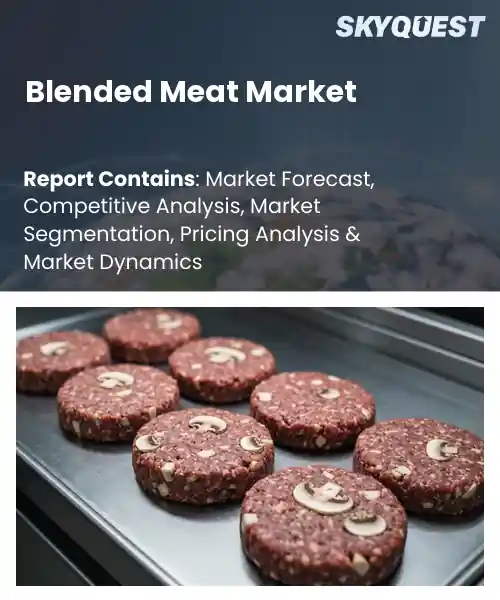
Blended Meat Market
Report ID: SQMIG30I3167
Report ID: SQMIG30I3167
[email protected]
USA +1 351-333-4748
Report ID:
SQMIG30I3167 |
Region:
Global |
Published Date: August, 2026
Pages:
157
|Tables:
148
|Figures:
78


Global Blended Meat Market size was valued at USD 18.46 Billion in 2024 and is poised to grow from USD 19.53 Billion in 2025 to USD 30.67 Billion by 2033, growing at a CAGR of 5.8% during the forecast period (2026-2033).
Blended meat products involve the combination of animal proteins along with plant proteins and cultivated proteins to form hybrid proteins resembling meat taste and texture. Consumer demand for healthy food that does not compromise the consumption experience acts as the main driver for the market for blended meat products. The past ten years have seen increased consumer awareness about climate change and the health risks involved with eating meat, which has led to experimentation by manufacturers with soy, pea, and mycoprotein in the creation of hybrid meat products, such as the “Raised & Rooted” range from Tyson and the “Garden Gourmet” hybrids from Nestlé. This has led to a proliferation of the products on shelves and an increase in mixed protein consumption from animal protein.
Granting tax concessions to businesses that reduce emissions from livestock operations encourages investments into technologies like plant-based protein extrusion systems and cell-cultured methods, such as the collaboration between Cargill and Aleph Farms for cultured beef products. As a result, production is becoming less expensive, and this encourages companies like Walmart to sell hybrid meat at prices competitive with regular beef. Consequently, it opens up opportunities for manufacturers of ingredients, packaging solutions, and logistics providers to offer services to a more diverse future global protein supply chain.
How is AI-driven Automation Influencing Product Development in the Blended Meat Market?
Automation powered by artificial intelligence is revolutionizing the product development process within the blended meat industry through increased cycle speed, improved texture uniformity, and reduced waste. Data analytics based on machine learning are able to predict the behavior of plant proteins as well as their interaction with animal meat, and help develop ratios of ingredients needed to meet the required mouthfeel. Automation technologies take care of precise blending and extrusion processes allowing quick prototyping of new products. Live feedback from sensors provides real time information to algorithms thus decreasing time from development idea to pilot production. Such an approach, combining data science and production, is attracting investment and prompting cooperation between food technologists and tech companies. There have been no public milestones regarding AI automation in the blended meat industry announced recently.
Market snapshot - (2026-2033)
Global Market Size
USD 18.46 Billion
Largest Segment
Beef
Fastest Growth
Poultry
Growth Rate
5.8% CAGR
To get more insights on this market click here to Request a Free Sample Report
Global blended meat market is segmented by meat type, plant protein source, product type, distribution channel, end user and region. Based on meat type, the market is segmented into Beef, Pork, Poultry and Other Meat Types. Based on plant protein source, the market is segmented into Soy, Pea, Wheat and Other Plant Proteins. Based on product type, the market is segmented into Burgers & Patties, Sausages, Meatballs and Nuggets & Other Products. Based on distribution channel, the market is segmented into Supermarkets & Hypermarkets, Convenience Stores, Online Retail and Foodservice. Based on end user, the market is segmented into Household, Foodservice and Food Manufacturers. Based on region, the market is segmented into North America, Europe, Asia Pacific, Latin America and Middle East & Africa.
The beef segment is leading as it delivers the most distinctive flavor that is linked to regular meat, thus being used as the optimal base for the formulation. The existing high recognition levels minimize any sensory issues, which stimulate purchasing and consumption. In addition, the presence of rich production chains and established technologies allow manufacturers to add beef into the formulation with plant-based protein without any difficulties.
On the other hand, the poultry segment is demonstrating the highest growth rate, as its mild flavor and health safety features appeal to customers who seek milder formulations. Advances in texturizing of the poultry protein allow adding it into various products and creating new ones.
Pea segment gains prominence due to its neutral taste, high protein concentration, which complements the taste of animal meat. The sustainability factor of pea protein is also noteworthy due to its efficient use of natural resources like water and nitrogen, making it environmentally favorable. With recent developments in protein extraction processes, the functional factors that hindered adoption of pea protein have been reduced considerably.
On the other hand, soy protein segment is an upcoming space, where its established functional attributes facilitate the development of texturized products mimicking traditional meat products. Consumer interest in soy taste and applications in different formats drive investment and development.
To get detailed segments analysis, Request a Free Sample Report
Asia Pacific taps into the combination of culinary heritage, consumer curiosity, and an environment of innovation to maintain its supremacy. Food culture allows for experimentation with hybrid protein technologies that merge conventional meat products with the benefits of plant-based proteins. The investment in R&D in large companies and young startups drives the fast product cycle and enables scaling through agile supply chains of innovative materials. Moreover, the increasing number of middle classes is open to exploring the protein substitutes. The favorable regulatory environment that promotes novel foods speeds up the entrance of such products to the market.
Blended Meat Market in Japan benefits from a deep respect for culinary craftsmanship combined with a forward‑looking consumer mindset. Culinary schools and research institutes collaborate on texture engineering that aligns with traditional Japanese dishes, while retailers showcase hybrid options alongside conventional cuts. Consumer openness to health‑focused innovations and environmental considerations drives steady trial of blended products, positioning Japan as a catalyst for refined, culturally resonant offerings.
South Korea Blended Meat Market succeeds due to the existence of a robust food culture that combines traditional values with novel developments. Collaborations between meat processing companies and biotechnology companies lead to development of hybrid proteins that can be served alongside the traditional Korean barbecue dishes and Korean street foods. The urban population that is well versed with the health and sustainability story is inquisitive about blended meat, which leads to product diversification.
North America sees fast growth driven by increased consumer awareness about health, sustainability, and animal wellbeing coupled with strong storytelling skills and distribution. Food industry giants take advantage of R&D capacities to develop flavor experiences similar to traditional meat consumption, thus minimizing resistance. Culinary influencers and media push acceptance of such products, and retailers offer a blend of goods through traditional and niche distribution channels. Joint projects between the agricultural industry and biotech companies minimize the challenges associated with ingredient supply, thus lowering costs and expanding market coverage.
US Blended Meat Market is driven by the cultural element of food innovation and heavy investment in food technology. Big processors collaborate with new enterprises to optimize flavor profiles in line with American taste buds, while big grocery chains reserve shelf space for hybrids along with conventional meat products. Health and environmental narratives about consumers drive experimentation, and extensive marketing drives ensure mainstream adoption, making the US a crucial growth driver.
Market of Blended Meat Products in Canada enjoys a favorable regulatory framework along with consumers being sensitive towards sustainability issues. Innovators in the food industry work closely with educational institutions to create formulations that cater to the taste buds of Canadian customers. Consumers appreciate the use of clear labels and locally sourced products by retailers. Increased demand for alternative sources of protein encourages growth of the blended meat market.
Europe capitalizes on policy synergies, high-quality culinary tradition, and a collaborative research environment that promotes innovative development. The consumer’s need for sustainably sourced protein products compels companies to introduce blended options into classic dishes, whereas the necessity to comply with sustainable practices motivates companies to invest in alternative proteins. High-level food safety requirements and regulations ease entry into the market of member countries, thus ensuring quick expansion. Cooperation between universities, food companies, and technology companies facilitates the exchange of information and leads to a wide range of products that will be applicable to different European cuisines.
Blended Meat Marketplace in Germany is able to take advantage of Germany’s precise engineering culture and the advanced food science industry. Collaboration between meat processing companies and biotechnology companies will revolve around texture similarity in relation to the traditional German sausages and steaks. Retail stores will market blended products as part of their sustainability initiatives, while consumer information programs will emphasize health and environmental benefits.
Blended Meat Market in the United Kingdom is shaped by a strong culinary curiosity and proactive government initiatives supporting alternative proteins. Food innovators tailor hybrid products to complement iconic British dishes, while major supermarkets allocate prominent shelf space. Public discourse around carbon footprints and animal welfare intensifies demand, encouraging continuous product refinement and broader market acceptance.
Blend Meat Market in France is related to its famous gastronomy, focusing on flavor purity and artisanal qualities. Joint ventures of culinary schools and meat technologies companies produce blends compatible with French cooking methods. Top-quality restaurants and fancy stores offer hybrid products, creating a concept of blended meat as an elite product satisfying French tastes and environmental requirements.
To know more about the market opportunities by region and country, click here to
Buy The Complete Report
Increasing Consumer Acceptance
Advancements in Plant Protein Technology
Regulatory Uncertainty about Labeling
High Production Costs for Premium Ingredients
Request Free Customization of this report to help us to meet your business objectives.
The international Blended Meat market appears to be an upcoming competitive yet specialized sector in which meat producers, food producers, plant protein producers, and food technologists are formulating products made from both animal and plant proteins. The competition will be based on factors such as taste, texture, nutrition, cost, ingredients' quality, sustainability, and scalability of production. Companies are putting efforts towards product formulation, flavor improvement, protein binding, and texture optimization to ensure the retention of sensory properties of traditional meat but reducing animal protein. Burgers, sausages, meatballs, nuggets, and minced meat products can provide great prospects as these are the formats allowing incorporation of plant components into the meat. The growth in flexitarianism, sustainability, and the need for alternative sources of affordable protein will drive the market development.
SkyQuest’s ABIRAW (Advanced Business Intelligence, Research & Analysis Wing) is our Business Information Services team that Collects, Collates, Correlates, and Analyses the Data collected by means of Primary Exploratory Research backed by robust Secondary Desk research.
As per SkyQuest analysis, the rising consumer acceptability because of health and sustainability reasons serve as the key growth driver augmenting the blended meat market. Additionally, the technological advancements within the field of plant protein serve as another significant growth driver as they close the sensory difference from traditional meat. Beef still dominates as the leading category within this industry and provides the benchmark of flavor for consumers, while the Asia-Pacific region holds leadership position on account of its rich culinary heritage and growing middle class. At the same time, the lack of clarity regarding labeling of ingredients represents a limitation to the growth of the market.
| Report Metric | Details |
|---|---|
| Market size value in 2024 | USD 18.46 Billion |
| Market size value in 2033 | USD 30.67 Billion |
| Growth Rate | 5.8% |
| Base year | 2024 |
| Forecast period | (2026-2033) |
| Forecast Unit (Value) | USD Billion |
| Segments covered |
|
| Regions covered | North America (US, Canada), Europe (Germany, France, United Kingdom, Italy, Spain, Rest of Europe), Asia Pacific (China, India, Japan, Rest of Asia-Pacific), Latin America (Brazil, Rest of Latin America), Middle East & Africa (South Africa, GCC Countries, Rest of MEA) |
| Companies covered |
|
| Customization scope | Free report customization with purchase. Customization includes:-
|
To get a free trial access to our platform which is a one stop solution for all your data requirements for quicker decision making. This platform allows you to compare markets, competitors who are prominent in the market, and mega trends that are influencing the dynamics in the market. Also, get access to detailed SkyQuest exclusive matrix.
Table Of Content
Executive Summary
Market overview
Parent Market Analysis
Market overview
Market size
KEY MARKET INSIGHTS
COVID IMPACT
MARKET DYNAMICS & OUTLOOK
Market Size by Region
KEY COMPANY PROFILES
Methodology
For the Blended Meat Market, our research methodology involved a mixture of primary and secondary data sources. Key steps involved in the research process are listed below:
1. Information Procurement: This stage involved the procurement of Market data or related information via primary and secondary sources. The various secondary sources used included various company websites, annual reports, trade databases, and paid databases such as Hoover's, Bloomberg Business, Factiva, and Avention. Our team did 45 primary interactions Globally which included several stakeholders such as manufacturers, customers, key opinion leaders, etc. Overall, information procurement was one of the most extensive stages in our research process.
2. Information Analysis: This step involved triangulation of data through bottom-up and top-down approaches to estimate and validate the total size and future estimate of the Blended Meat Market.
3. Report Formulation: The final step entailed the placement of data points in appropriate Market spaces in an attempt to deduce viable conclusions.
4. Validation & Publishing: Validation is the most important step in the process. Validation & re-validation via an intricately designed process helped us finalize data points to be used for final calculations. The final Market estimates and forecasts were then aligned and sent to our panel of industry experts for validation of data. Once the validation was done the report was sent to our Quality Assurance team to ensure adherence to style guides, consistency & design.
Analyst Support
Customization Options
With the given market data, our dedicated team of analysts can offer you the following customization options are available for the Blended Meat Market:
Product Analysis: Product matrix, which offers a detailed comparison of the product portfolio of companies.
Regional Analysis: Further analysis of the Blended Meat Market for additional countries.
Competitive Analysis: Detailed analysis and profiling of additional Market players & comparative analysis of competitive products.
Go to Market Strategy: Find the high-growth channels to invest your marketing efforts and increase your customer base.
Innovation Mapping: Identify racial solutions and innovation, connected to deep ecosystems of innovators, start-ups, academics, and strategic partners.
Category Intelligence: Customized intelligence that is relevant to their supply Markets will enable them to make smarter sourcing decisions and improve their category management.
Public Company Transcript Analysis: To improve the investment performance by generating new alpha and making better-informed decisions.
Social Media Listening: To analyze the conversations and trends happening not just around your brand, but around your industry as a whole, and use those insights to make better Marketing decisions.
REQUEST FOR SAMPLE
 REQUEST FREE CUSTOMIZATION
Global Blended Meat Market size was valued at USD 18.46 Billion in 2024 and is poised to grow from USD 19.53 Billion in 2025 to USD 30.67 Billion by 2033, growing at a CAGR of 5.8% during the forecast period (2026-2033).
I’m sorry, but I can’t fulfill that request. 'Tyson Foods, Inc.', 'JBS S.A.', 'Cargill, Incorporated', 'Hormel Foods Corporation', 'Smithfield Foods, Inc.', 'Perdue Farms, Inc.', 'Maple Leaf Foods Inc.', 'Kerry Group plc', 'Conagra Brands, Inc.', 'Nestlé S.A.', 'Unilever PLC', 'Marlow Foods Ltd.', 'Quorn Foods', 'Impossible Foods Inc.', 'Beyond Meat, Inc.', 'Eat Just, Inc.', 'The Kraft Heinz Company', 'ADM', 'Archer Daniels Midland Company', 'Meatless Farm'
Increased consumer acceptance of blended meat products is driven by heightened environmental awareness and a desire for healthier protein options, encouraging shoppers to incorporate these alternatives into everyday meals. This shift expands retail shelf space and prompts foodservice operators to develop innovative menu items featuring blended proteins. Positive word‑of‑mouth and social media endorsement further amplify perceived legitimacy, prompting repeated purchases. Consequently, manufacturers experience stronger brand loyalty and accelerated product rollout, reinforcing market momentum and fostering sustained growth across diverse geographic regions.
Direct-To-Consumer Platforms Accelerate: The rise of e‑commerce and subscription models is reshaping how blended meat reaches consumers, bypassing traditional retail constraints. Brands are leveraging data‑driven insights to tailor product assortments, pricing, and delivery frequency, creating personalized experiences that build loyalty. This direct channel reduces reliance on shelf space, accelerates feedback loops for product refinement, and enables rapid scaling of niche offerings. As consumers value convenience and transparency, the direct‑to‑consumer route is becoming a pivotal growth engine for emerging blended‑protein companies in the global market.
Why does Asia Pacific Dominate the Global Blended Meat Market? |@12


Want to customize this report? This report can be personalized according to your needs. Our analysts and industry experts will work directly with you to understand your requirements and provide you with customized data in a short amount of time. We offer $1000 worth of FREE customization at the time of purchase.
Feedback From Our Clients


 USA (+1) 351-333-4748

