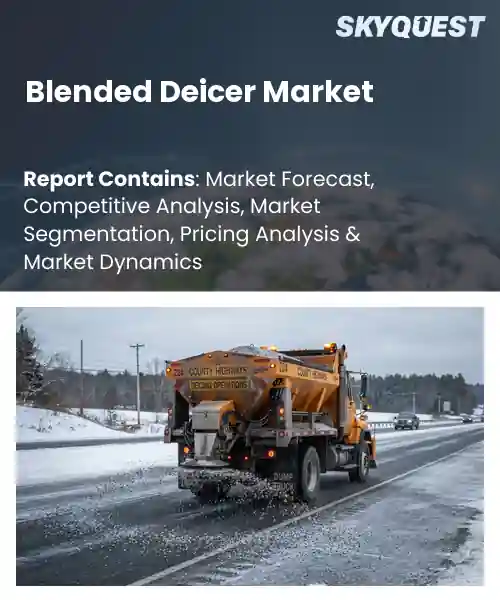
Blended Deicer Market
Report ID: SQMIG15E4262
Report ID: SQMIG15E4262
[email protected]
USA +1 351-333-4748
Report ID:
SQMIG15E4262 |
Region:
Global |
Published Date: August, 2026
Pages:
157
|Tables:
172
|Figures:
79


Global Blended Deicer Market size was valued at USD 2.84 Billion in 2024 and is poised to grow from USD 3.0 Billion in 2025 to USD 4.72 Billion by 2033, growing at a CAGR of 5.8% during the forecast period (2026-2033).
The blended deicer market comprises chemicals that mix salts, organic acids, and corrosion inhibitors to melt ice on roads, runways, and sidewalks. Its importance lies in maintaining safety and mobility during winter, especially where freezing disrupts transport. Historically the market relied on sodium chloride, but rising corrosion concerns and environmental rules prompted the introduction of calcium magnesium acetate and potassium formate blends in the 2000s. European cities such as Stockholm adopted blended solutions to protect bridge steel, while North American highways switched after studies linked salts to vegetation loss. This evolution shows how safety, durability, and pressure drive market growth.Regulatory pressure on chloride emissions is the primary catalyst for growth in the blended deicer market because governments impose limits to protect groundwater and infrastructure. When jurisdictions tighten standards, they replace rock salt with low‑impact blends, sparking demand for specialty formulations and encouraging research into biodegradable additives. Quebec, for example, required a 30 % cut in sodium chloride use in 2021, leading highway agencies to source magnesium‑based blends that melt effectively while reducing metal corrosion. This policy shift opens avenues for manufacturers to prove performance benefits, enter cold‑climate regions, and form public‑private partnerships that support sustainable winter road management and efficiency.
How is AI-driven automation reshaping the blended deicer market?
AI driven automation is redefining the blended deicer market by linking real time weather data with precision dosing systems. Machine learning models predict snowfall intensity and adjust chemical ratios on the fly, reducing waste and improving safety on roads. Robotics handle bulk handling and packaging, cutting labor costs and ensuring consistent product quality. Integrated analytics give producers visibility into inventory levels, enabling just in time manufacturing that matches seasonal demand spikes. These technologies also help firms meet stricter environmental regulations by optimizing the use of glycol based blends and minimizing runoff. The result is a more agile supply chain that can respond quickly to shifting climate patterns.In July 2024 a leading blended deicer manufacturer introduced an AI driven mixing platform that continuously calibrates blend ratios based on sensor feedback. The system speeds production, lowers chemical consumption and supports faster market response, illustrating how automation fuels growth and efficiency in the sector today for customers worldwide globally.
Market snapshot - (2026-2033)
Global Market Size
USD 2.84 Billion
Largest Segment
Chloride-Based Blended Deicers
Fastest Growth
Acetate-Based Blended Deicers
Growth Rate
5.8% CAGR
To get more insights on this market click here to Request a Free Sample Report
Global blended deicer market is segmented by product type, form, application, end user, temperature range, distribution channel and region. Based on product type, the market is segmented into Chloride-Based Blended Deicers, Acetate-Based Blended Deicers, Formate-Based Blended Deicers and Others. Based on form, the market is segmented into Solid and Liquid. Based on application, the market is segmented into Highways, Airports, Parking Areas and Others. Based on end user, the market is segmented into Municipal Authorities, Airport Operators, Commercial Property Owners and Others. Based on temperature range, the market is segmented into Moderate Winter Conditions and Severe Winter Conditions. Based on distribution channel, the market is segmented into Direct Sales, Distributors and Others. Based on region, the market is segmented into North America, Europe, Asia Pacific, Latin America and Middle East & Africa.
Chloride Based Blended Deicers segment dominates because they offer a proven balance of cost efficiency and melting performance that meets the core requirements of most winter maintenance programs. Their long standing chemistry is trusted by operators, leading to widespread adoption across highways and municipal fleets. The familiarity of handling, established supply chains, and compatibility with existing equipment reinforce their market leadership, making them the default choice for routine deicing operations.
However, acetate based blended deicers are emerging as the key growth area because their lower environmental impact and reduced corrosion risk are attracting stricter regulatory support and greener procurement policies. Their ability to perform in moderate winter conditions while protecting infrastructure is prompting broader adoption, opening new opportunities for market expansion.
Solid form segment dominates because it provides stable handling, easy storage, and predictable application rates that align with traditional spreading equipment. The physical robustness of solid granules reduces spillage risks and simplifies logistics for large scale road networks. Operators value the reliability of solid products during peak demand periods, reinforcing their preference for bulk deployment across winter maintenance programs. Low production cost and mature distribution networks also secure its market leadership.
Meanwhile, liquid form is witnessing the strongest growth momentum because its rapid spreading capability meets the increasing demand for quick melt solutions on traffic corridors. The ease of integration with spray systems and the ability to address ice events are driving adoption, positioning liquid deicers as a catalyst for expanding service offerings and new market opportunities.
To get detailed segments analysis, Request a Free Sample Report
North America maintains a leading position due to a combination of extensive cold‑weather infrastructure, advanced formulation capabilities, and robust supply chain networks. The region benefits from mature chemical manufacturing ecosystems that enable rapid innovation and high‑quality product development. Strong regulatory frameworks ensure consistency in performance standards, fostering confidence among municipal and transportation operators. Additionally, widespread adoption across highways, airports, and rail corridors creates sustained demand, reinforcing the market’s depth and resilience. Collaborative research initiatives between academia and industry further enhance the region’s ability to tailor blends for specific climate challenges, solidifying its dominance.
Blended Deicer Market in the United States is driven by expansive interstate transport routes and a long history of winter maintenance practices. The country’s extensive research institutions contribute to continuous improvement of formulation efficiency, while a broad distribution network ensures timely delivery to critical sites. High expectations for safety and reliability among road authorities and aviation managers sustain a vigorous demand environment, encouraging manufacturers to prioritize performance and environmental stewardship.
Blended Deicer Market in Canada reflects a strong emphasis on environmental responsibility and adaptation to severe winter conditions. Government policies encourage the use of less corrosive and more sustainable blend components, prompting producers to innovate accordingly. The nation’s vast rural and northern road networks require dependable deicing solutions, reinforcing the market’s relevance. Collaboration among provincial agencies and industry stakeholders supports the development of region‑specific formulations that balance effectiveness with ecological considerations.
Europe’s rapid expansion is fueled by stringent environmental regulations that push manufacturers toward greener blend chemistries, alongside a pervasive commitment to road safety across diverse climatic zones. The region’s sophisticated logistics frameworks and cross‑border trade agreements streamline product distribution, while collaborative research hubs foster continuous improvement in performance and sustainability. Growing awareness among municipal authorities about the long‑term benefits of advanced blends further accelerates adoption, positioning Europe as a dynamic arena for innovative deicing solutions.
Blended Deicer Market in Germany benefits from a strong engineering tradition and a proactive approach to environmental standards. The country’s emphasis on precision manufacturing ensures high‑quality products, while regulatory incentives promote the integration of biodegradable components. Extensive highway networks and a dense railway system create a steady demand base, encouraging manufacturers to tailor blends for both efficiency and ecological impact.
Blended Deicer Market in the United Kingdom is characterized by a swift uptake driven by heightened safety priorities on busy motorways and major airports. Emerging policy frameworks encourage the transition to low‑impact formulations, prompting suppliers to accelerate product development cycles. Collaborative initiatives between government bodies and industry associations support the dissemination of best practices, fostering a climate of rapid innovation and market responsiveness.
Blended Deicer Market in France is evolving as an emerging segment, guided by a growing focus on sustainable operations within municipal services. The nation’s commitment to reducing environmental footprints steers manufacturers toward cleaner blend alternatives. Strategic investments in research collaborations support the refinement of performance characteristics suited to the country’s varied weather patterns, laying the groundwork for broader market acceptance.
Asia Pacific is strengthening its position through a combination of escalating winter infrastructure development and an increasing emphasis on operational safety across burgeoning economies. The region’s manufacturers are leveraging advanced chemical technologies to produce blends that meet diverse climate demands, while regional trade agreements facilitate broader market access. Growing awareness of environmental impacts encourages the adoption of eco‑friendly formulations, and collaborative research programs across the Pacific corridor drive continuous innovation. These dynamics collectively enhance the region’s capability to serve both domestic and export markets with competitive, high‑performance deicing solutions.
Blended Deicer Market in Japan reflects a meticulous approach to quality and reliability, aligned with the country’s sophisticated transport systems. Strong collaboration between research institutes and manufacturers yields blends optimized for efficiency and low environmental impact. The nation’s extensive network of highways and railways, combined with a proactive safety culture, sustains a consistent demand for high‑performing deicing products.
Blended Deicer Market in South Korea is propelled by rapid urbanization and a commitment to modernizing its transportation corridors. Emphasis on innovative blend formulations that balance efficacy with sustainability drives domestic manufacturers to adopt cutting‑edge technologies. Government initiatives supporting safe winter operations encourage broader implementation across highways and airports, reinforcing the market’s growth trajectory.
To know more about the market opportunities by region and country, click here to
Buy The Complete Report
Increasing Airport Safety Regulations
Growing Demand for Sustainable Operations
High Cost of Specialty Formulations
Environmental Concerns Over Chemical Runoff
Request Free Customization of this report to help us to meet your business objectives.
The blended deicer market is shaped by intense competition among established chemical producers such as Cryotech, Proviron, Perstorp, Clariant, LNT Group, TR Bonnyman Son & Company, Kilfrost, Harmoney Deicing and Esseco, each leveraging product innovation, strategic partnerships with airport operators, and selective acquisitions to expand blended formulation portfolios and meet tightening environmental regulations.
Top Player’s Company Profile
Recent Developments
SkyQuest’s ABIRAW (Advanced Business Intelligence, Research & Analysis Wing) is our Business Information Services team that Collects, Collates, Correlates, and Analyses the Data collected by means of Primary Exploratory Research backed by robust Secondary Desk research. As per SkyQuest analysis, the global blended deicer market is propelled primarily by tightening regulatory limits on chloride emissions, which push municipalities and airports toward low‑impact blends, while the high cost of specialty formulations restrains broader adoption, especially in cost‑sensitive regions. North America remains the dominant region, thanks to its extensive cold‑weather infrastructure and advanced chemical manufacturing base. Within the product landscape, chloride‑based blended deicers continue to dominate due to their proven cost‑efficiency and performance. A second strong driver is the rise of AI‑enabled automation that links real‑time weather data with precision dosing, improving operational efficiency and reducing waste. Together these forces shape market growth.
| Report Metric | Details |
|---|---|
| Market size value in 2024 | USD 2.84 Billion |
| Market size value in 2033 | USD 4.72 Billion |
| Growth Rate | 5.8% |
| Base year | 2024 |
| Forecast period | (2026-2033) |
| Forecast Unit (Value) | USD Billion |
| Segments covered |
|
| Regions covered | North America (US, Canada), Europe (Germany, France, United Kingdom, Italy, Spain, Rest of Europe), Asia Pacific (China, India, Japan, Rest of Asia-Pacific), Latin America (Brazil, Rest of Latin America), Middle East & Africa (South Africa, GCC Countries, Rest of MEA) |
| Companies covered |
|
| Customization scope | Free report customization with purchase. Customization includes:-
|
To get a free trial access to our platform which is a one stop solution for all your data requirements for quicker decision making. This platform allows you to compare markets, competitors who are prominent in the market, and mega trends that are influencing the dynamics in the market. Also, get access to detailed SkyQuest exclusive matrix.
Table Of Content
Executive Summary
Market overview
Parent Market Analysis
Market overview
Market size
KEY MARKET INSIGHTS
COVID IMPACT
MARKET DYNAMICS & OUTLOOK
Market Size by Region
KEY COMPANY PROFILES
Methodology
For the Blended Deicer Market, our research methodology involved a mixture of primary and secondary data sources. Key steps involved in the research process are listed below:
1. Information Procurement: This stage involved the procurement of Market data or related information via primary and secondary sources. The various secondary sources used included various company websites, annual reports, trade databases, and paid databases such as Hoover's, Bloomberg Business, Factiva, and Avention. Our team did 45 primary interactions Globally which included several stakeholders such as manufacturers, customers, key opinion leaders, etc. Overall, information procurement was one of the most extensive stages in our research process.
2. Information Analysis: This step involved triangulation of data through bottom-up and top-down approaches to estimate and validate the total size and future estimate of the Blended Deicer Market.
3. Report Formulation: The final step entailed the placement of data points in appropriate Market spaces in an attempt to deduce viable conclusions.
4. Validation & Publishing: Validation is the most important step in the process. Validation & re-validation via an intricately designed process helped us finalize data points to be used for final calculations. The final Market estimates and forecasts were then aligned and sent to our panel of industry experts for validation of data. Once the validation was done the report was sent to our Quality Assurance team to ensure adherence to style guides, consistency & design.
Analyst Support
Customization Options
With the given market data, our dedicated team of analysts can offer you the following customization options are available for the Blended Deicer Market:
Product Analysis: Product matrix, which offers a detailed comparison of the product portfolio of companies.
Regional Analysis: Further analysis of the Blended Deicer Market for additional countries.
Competitive Analysis: Detailed analysis and profiling of additional Market players & comparative analysis of competitive products.
Go to Market Strategy: Find the high-growth channels to invest your marketing efforts and increase your customer base.
Innovation Mapping: Identify racial solutions and innovation, connected to deep ecosystems of innovators, start-ups, academics, and strategic partners.
Category Intelligence: Customized intelligence that is relevant to their supply Markets will enable them to make smarter sourcing decisions and improve their category management.
Public Company Transcript Analysis: To improve the investment performance by generating new alpha and making better-informed decisions.
Social Media Listening: To analyze the conversations and trends happening not just around your brand, but around your industry as a whole, and use those insights to make better Marketing decisions.
REQUEST FOR SAMPLE
 REQUEST FREE CUSTOMIZATION


Want to customize this report? This report can be personalized according to your needs. Our analysts and industry experts will work directly with you to understand your requirements and provide you with customized data in a short amount of time. We offer $1000 worth of FREE customization at the time of purchase.
Feedback From Our Clients


 USA (+1) 351-333-4748

