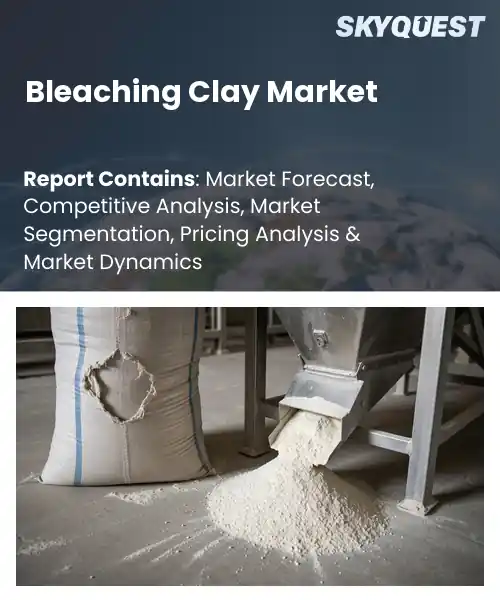
Bleaching Clay Market
Report ID: SQMIG15A2801
Report ID: SQMIG15A2801
[email protected]
USA +1 351-333-4748
Report ID:
SQMIG15A2801 |
Region:
Global |
Published Date: June, 2026
Pages:
157
|Tables:
174
|Figures:
79


Global Bleaching Clay Market size was valued at USD 2.14 Billion in 2024 and is poised to grow from USD 2.26 Billion in 2025 to USD 3.56 Billion by 2033, growing at a CAGR of 5.8% during the forecast period (2026-2033).
The global bleaching clay market is linked to the trading of refined products produced from bentonite and kaolin, chemically treated to improve whiteness, absorption capacity and consistency for cosmetics, pharmaceuticals and industrial processes. This is relevant because there is an increasing demand for high purity pigments and safe and skin friendly ingredients as consumers are moving towards natural and sustainable formulations. The market started in the early 2000s, when European cosmetic companies, due to safety concerns, started to use purified bleaching clay as an alternative to titanium dioxide. In the last decade, China and India boosted their production capacity with lower labour costs and improvements in thermal activation and the sector's imprint was consolidated.
Regulatory pressure on conventional pigments with stricter safety standards is driving market growth, with manufacturers looking for alternatives that meet both performance and compliance needs. This has encouraged investment in the processing of bleaching clay, resulting in a finer particle size which improves stability in cosmetic emulsions. For instance, a French luxury brand replaced synthetic opacifiers with purified clay, decreasing irritancy by 30%. At the same time, eco-certification initiatives are promoting the use of sustainable materials, as Brazilian vendors have earned FSC certification and secured contracts with North American cosmetics companies that require verified green inputs. Regulation and sustainability together are driving rapid upgrades in capacity, expansion of the portfolio and overall significant growth in market valuation.
How is AI-driven automation impacting efficiency in the bleaching clay market?
The bleaching clay market is transforming with AI-powered automation, integrating smart sensors and machine-learning models into production lines. Real-time data collection enables predictive maintenance, minimizing unplanned downtime and prolonging equipment life. The feedstock characteristics are analyzed by advanced algorithms, and the grinding and activation parameters are adjusted automatically so that the product quality is consistent. Integrated supply chain platforms match refinery demand with inventory levels, reducing excess stock and cutting logistics expenses. Dashboards provide operators with dashboards that translate complex analytics into actionable insights, facilitating quicker decision making and a culture of continuous improvement. Together, these capabilities increase operational efficiency, reduce waste and improve profitability across the industry.
February 2026: One of the biggest producers of bleaching clay installed AI-enabled process controls to increase product uniformity and optimize activation cycles, leading to a quicker market expansion and improved efficiency.
Market snapshot - (2026-2033)
Global Market Size
USD 2.14 Billion
Largest Segment
Fastest Growth
Growth Rate
5.8% CAGR
To get more insights on this market click here to Request a Free Sample Report
Global bleaching clay market is segmented by product type, application, end use industry, form, distribution channel, source material and region. Based on product type, no specific sub-segments were identified. Based on application, no specific sub-segments were identified. Based on end use industry, no specific sub-segments were identified. Based on form, no specific sub-segments were identified. Based on distribution channel, no specific sub-segments were identified. Based on source material, no specific sub-segments were identified. Based on region, the market is segmented into North America, Europe, Asia Pacific, Latin America and Middle East & Africa.
The natural bleaching clay segment is leading the way thanks to its natural absorbency and the proven effectiveness manufacturers rely on. Its mineral composition provides consistent whitening performance comparable to traditional industry formulations. This has been so reliable that it has been adopted widely across formulation pipelines and is now the core offering. “So suppliers are focusing on natural grades, meaning stable supply chains and increased confidence in the market. It also has a low environmental impact, meets sustainability criteria, increases confidence in the brand and regulatory compliance, and reinforces its leading position.
But the synthetic bleaching clay segment is especially worth noting, as advanced processing allows for customized particle sizes and higher purity, which are attractive features for innovative formulators. This flexibility allows for rapid application of new applications in high performance coatings and specialty cosmetics. The ability to customize functional properties is fueling market growth, providing new avenues for product differentiation and value creation.
The industrial cleaning segment is the largest, due to bleaching clay, which offers high removal efficiency for tough residues and meets stringent performance standards. Sorption of oils and pigments reduces water consumption and chemical load in the context of sustainability targets . And it has been so good at it that it has dominated the industry by consistently creating a need for economical and environmentally friendly cleaning solutions from manufacturers. Furthermore, the simple integration into current processes promotes broad deployment and additionally urges the market. It is further bolstered by its proven track record in different sectors ranging from metal treatment to food processing.
The cosmetic formulation is the fastest growing segment, with growth being driven by innovative uses of bleaching clay to meet consumer demand for natural skin brightening products. Brands use the allure of gentle exfoliation and the perception of safety to make product lines stand out and to drive a rush to market. This trend opens up new possibilities for clay applications and generates new revenue streams and formulation research.
To get detailed segments analysis, Request a Free Sample Report
North America’s dominance is attributed to its mature chemical manufacturing ecosystem, wide downstream applications, and a strong focus on sustainability in personal care and household cleaning sectors. Sophisticated supply chains ensure a steady flow of raw materials, and top research institutes continuously innovate products. The demand is being propelled by consumer preference for high-performance, environmentally responsible formulations. Regulatory frameworks are promoting the use of safer biodegradable bleaching agents. Furthermore, the significant investment in innovative processing technologies enables cost-effective large-scale production, thereby enhancing the region’s competitive position and reinforcing its reputation as a global standard-bearer of quality and dependability.
The United States Bleaching Clay Market is driven by its developed industrial base and large consumer base with a preference for green cleaning solutions. Continuing partnerships between makers and research labs and wide distribution through retail outlets speed up improvements to formulations. "As consumers become more aware of health and environmental impacts, demand for clay-based bleach alternatives is expected to continue in both residential and commercial applications.
A proactive regulatory environment that promotes the development of greener chemical products and a consumer base that is conscious of sustainability is driving the Canada Bleaching Clay market. Strong links between academic research institutions and industry are stimulating innovation in the processing and functionalization of clays. Distribution networks provide access to remote communities from large urban centres. “Market interest for low impact cleaning solutions that align with national environmental goals has been consistent.
Europe's rapid growth is powered by a mix of stringent environmental regulations, increasing consumer demand for natural ingredients and massive investment in research and development across the continent. Traditional chlorine-based agents are being phased out by major manufacturers, who are incorporating bleaching clay into various formulations to meet eco-label standards. The collaborative industry alliances enable a knowledge sharing and standardization and the dominant cosmetic and household cleaning hubs enable product rollout. Taken together, these ingredients offer a rich field for the development of novel, sustainable bleaching solutions that will appeal to regulators and end-users alike.
Germany Bleaching Clay Market is characterized by a strong engineering tradition and a well-developed chemical industry with high quality standards. Industry is situated in the main industrial zones for efficient production, and collaborative research efforts are focused on improving the functional properties of bleaching clay. Stringent directives from the European Union are propelling the market growth owing to the growing consumer demand for sustainable household and personal care products.
United Kingdom Bleaching Clay Market is Growing at Fastest Rate due to Growing Beauty & Hygiene Market Focused on Natural & Environmentally Friendly Ingredients. Major cities are developing innovation hubs that facilitate quick product development and retailers are increasingly highlighting clay-based bleach alternatives. Consumer awareness campaigns on the benefits of reduced chemical exposure have driven demand and the UK has led the way in the adoption of progressive cleaning technology.
France Bleaching Clay Market is emerging as a prominent segment owing to cultural focus on natural beauty and clean living. French cosmetic and personal care brands are at the forefront of incorporating bleaching clay into their high-end lines, taking advantage of its gentle yet effective properties. The manufacturers are moving towards clay-based solutions, fuelled by government incentives for green chemistry. Market momentum is also gathering pace with consumer trends for eco-friendly packaging.
Asia Pacific is consolidating its position through concentrated industrial diversification, growing environmental awareness and rapid adoption of innovative processing techniques. Growing consumer demand for safer and high-efficacy cleaning agents is driving countries in the region to invest in modern extraction and activation techniques to improve the performance of bleaching clay. Strategic partnerships with global technology providers can fast track knowledge transfer and increasing retail networks can improve product visibility, according to local manufacturers. This joint effort underscores Asia Pacific as a strong and lively player in the global bleaching clay scene.
Japan Bleaching Clay Market has a rich history of high-tech manufacturing and consumer demand for rigorous hygiene solutions. Academia and industry are collaborating to improve the properties of clay to be more compatible with higher formulations. Japanese consumers’ preference for quality and sustainability is mirrored in retail channels’ emphasis on premium and eco-friendly products.
South Korea Bleaching Clay Market is driven by the fast expanding cosmetics industry which is always looking for innovative ingredients from natural sources. The development of clay-based bleaches is being driven by the government’s support for green chemistry initiatives. Technology-driven manufacturers are using advanced processing to create a better efficacy. Consumer demand for innovative, skin friendly products leads to rapid market adoption.
To know more about the market opportunities by region and country, click here to
Buy The Complete Report
Growing Demand For Natural Products
Adoption Of Eco‑Friendly Formulations
Limited Raw Material Availability
Regulatory Scrutiny Over Chemical Content
Request Free Customization of this report to help us to meet your business objectives.
Incumbents are defending their positions through capacity additions and brand reinforcement, while a few nimble players are gaining market share through strategic M&A, distribution partnerships and technology-enabled product improvements. Recent examples are the acquisition of a regional producer of clay by a larger chemical group, and the joint venture of two European companies to develop high purity bleaching clay formulations for textile applications.
SkyQuest’s ABIRAW (Advanced Business Intelligence, Research & Analysis Wing) is our Business Information Services team that Collects, Collates, Correlates, and Analyses the Data collected by means of Primary Exploratory Research backed by robust Secondary Desk research. As per SkyQuest analysis the bleaching clay market is being propelled primarily by the growing demand for natural products as consumers seek gentle, sustainable ingredients, while a second strong catalyst is the adoption of eco‑friendly formulations that replace synthetic bleaches with clay to meet corporate sustainability goals. The natural bleaching clay segment remains dominant because of its proven absorbency and low environmental impact. North America leads the market thanks to its mature chemical industry, robust supply chains and strong regulatory push for safer ingredients. However, limited raw‑material availability poses a restraint, as concentrated deposits and mining capacity constraints can disrupt supply and slow growth.
| Report Metric | Details |
|---|---|
| Market size value in 2024 | USD 2.14 Billion |
| Market size value in 2033 | USD 3.56 Billion |
| Growth Rate | 5.8% |
| Base year | 2024 |
| Forecast period | (2026-2033) |
| Forecast Unit (Value) | USD Billion |
| Segments covered |
|
| Regions covered | North America (US, Canada), Europe (Germany, France, United Kingdom, Italy, Spain, Rest of Europe), Asia Pacific (China, India, Japan, Rest of Asia-Pacific), Latin America (Brazil, Rest of Latin America), Middle East & Africa (South Africa, GCC Countries, Rest of MEA) |
| Companies covered |
|
| Customization scope | Free report customization with purchase. Customization includes:-
|
To get a free trial access to our platform which is a one stop solution for all your data requirements for quicker decision making. This platform allows you to compare markets, competitors who are prominent in the market, and mega trends that are influencing the dynamics in the market. Also, get access to detailed SkyQuest exclusive matrix.
Table Of Content
Executive Summary
Market overview
Parent Market Analysis
Market overview
Market size
KEY MARKET INSIGHTS
COVID IMPACT
MARKET DYNAMICS & OUTLOOK
Market Size by Region
KEY COMPANY PROFILES
Methodology
For the Bleaching Clay Market, our research methodology involved a mixture of primary and secondary data sources. Key steps involved in the research process are listed below:
1. Information Procurement: This stage involved the procurement of Market data or related information via primary and secondary sources. The various secondary sources used included various company websites, annual reports, trade databases, and paid databases such as Hoover's, Bloomberg Business, Factiva, and Avention. Our team did 45 primary interactions Globally which included several stakeholders such as manufacturers, customers, key opinion leaders, etc. Overall, information procurement was one of the most extensive stages in our research process.
2. Information Analysis: This step involved triangulation of data through bottom-up and top-down approaches to estimate and validate the total size and future estimate of the Bleaching Clay Market.
3. Report Formulation: The final step entailed the placement of data points in appropriate Market spaces in an attempt to deduce viable conclusions.
4. Validation & Publishing: Validation is the most important step in the process. Validation & re-validation via an intricately designed process helped us finalize data points to be used for final calculations. The final Market estimates and forecasts were then aligned and sent to our panel of industry experts for validation of data. Once the validation was done the report was sent to our Quality Assurance team to ensure adherence to style guides, consistency & design.
Analyst Support
Customization Options
With the given market data, our dedicated team of analysts can offer you the following customization options are available for the Bleaching Clay Market:
Product Analysis: Product matrix, which offers a detailed comparison of the product portfolio of companies.
Regional Analysis: Further analysis of the Bleaching Clay Market for additional countries.
Competitive Analysis: Detailed analysis and profiling of additional Market players & comparative analysis of competitive products.
Go to Market Strategy: Find the high-growth channels to invest your marketing efforts and increase your customer base.
Innovation Mapping: Identify racial solutions and innovation, connected to deep ecosystems of innovators, start-ups, academics, and strategic partners.
Category Intelligence: Customized intelligence that is relevant to their supply Markets will enable them to make smarter sourcing decisions and improve their category management.
Public Company Transcript Analysis: To improve the investment performance by generating new alpha and making better-informed decisions.
Social Media Listening: To analyze the conversations and trends happening not just around your brand, but around your industry as a whole, and use those insights to make better Marketing decisions.
REQUEST FOR SAMPLE
 REQUEST FREE CUSTOMIZATION
Global Bleaching Clay Market size was valued at USD 2.14 Billion in 2024 and is poised to grow from USD 2.26 Billion in 2025 to USD 3.56 Billion by 2033, growing at a CAGR of 5.8% during the forecast period (2026-2033).
The competitive landscape is shaped by a handful of agile players leveraging strategic M&A, distribution partnerships, and technology‑driven product enhancements to capture market share as demand for sustainable bleaching solutions rises, while incumbents defend positions through capacity expansions and brand reinforcement. Recent examples include a notable acquisition of a regional clay producer by a larger chemical group and a joint venture between two European firms to co‑develop high‑purity bleaching clay formulations for textile applications. 'Clariant AG', 'EP Minerals, LLC', 'Taiko Group of Companies', 'Oil-Dri Corporation of America', 'Musim Mas Holdings Pte. Ltd.', 'AMC (UK) Limited', 'Ashapura Group', '20 Microns Limited', 'Refoil Earth Pvt. Ltd.', 'Phoenix Chemicals Pvt. Ltd.', 'Manek Active Clay Pvt. Ltd.', 'Aqua Bleaching Pvt. Ltd.', 'Indian Clay & Mineral Co.', 'HRP Industries', 'Bentonite Performance Minerals LLC', 'Tolsa Group', 'W Clay Industries Sdn. Bhd.', 'Amcol International Corporation', 'Laviosa Chimica Mineraria S.p.A.', 'Global Bleach Chem Pvt. Ltd.'
Growing Consumer Awareness About Skin Health And Environmental Impact is Prompting Manufacturers To Integrate Bleaching Clay Into Formulations That Are Perceived As Gentle And Sustainable. This Shift Enhances Product Appeal Across Diverse Demographics, Encouraging Brands To Expand Their Portfolios And Invest In Research That Leverages The Clay’s Absorbent Properties. Consequently, Market Participants Experience Heightened Demand, Reinforcing The Overall Growth Trajectory Of The Global Bleaching Clay Market. Retailers Are Also Prioritizing Shelf‑Space For Such Products, Further Amplifying Consumer Exposure And Reinforcing Brand Commitment To Natural Alternatives.
Natural Ingredient Preference Surge: Consumers are increasingly favoring products that emphasize naturally derived bleaching clays, driven by heightened awareness of chemical exposure and a desire for environmentally responsible skincare. Brands are reformulating lines to showcase raw bentonite or kaolin sourced with minimal processing, promoting transparency in ingredient provenance. This shift encourages manufacturers to invest in sustainable extraction practices, certify organic status, and highlight clean‑beauty narratives, ultimately expanding market appeal among health‑conscious demographics and differentiating premium offerings from conventional chemical‑intensive alternatives in the global market
Why does North America Dominate the Global Bleaching Clay Market? |@12


Want to customize this report? This report can be personalized according to your needs. Our analysts and industry experts will work directly with you to understand your requirements and provide you with customized data in a short amount of time. We offer $1000 worth of FREE customization at the time of purchase.
Feedback From Our Clients


 USA (+1) 351-333-4748

