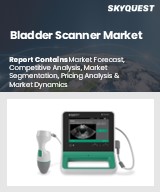
Bladder Scanner Market
Report ID: SQMIG35A3003
Report ID: SQMIG35A3003
[email protected]
USA +1 351-333-4748
Report ID:
SQMIG35A3003 |
Region:
Global |
Published Date: May, 2025
Pages:
199
|Tables:
92
|Figures:
73


Global Bladder Scanner Market size was valued at USD 174.57 Million in 2024 and is poised to grow from USD 184.7 Million in 2025 to USD 289.96 Million by 2033, growing at a CAGR of 5.8% during the forecast period (2026–2033).
The global bladder scanner market is experiencing consistent growth due to the rise in the incidences of urological disorders like bladder cancer. the rise in the occurrence of urinary tract cancers has resulted in increasing the demand for non-invasive and accurate diagnostic tools which has been reported by organizations like the American Society of Clinical oncology and the national cancer Institute. Therefore, propelling the adoption of bladder scanners in hospitals and diagnostics centers. Furthermore, the rise in the expansion of geriatric population which is more prone to bladder disorders is contributing considerably to the increased demand for bladder scanners around the world.
The technological advancements in bladder scanning products have also increased the growth of the market. The portable and handheld ultrasound scanners are the product innovations which include devices like the biocon-1100 and Lilium One, transforming the clinical landscape by providing ease of operation, rapid results, and reduced patient discomfort. These developments have enhanced diagnostic precision and also enhanced early detection and monitoring of bladder-related conditions, particularly in home-care and outpatient environments.
However, the market faces a number of restraints that might slow down the expansion of the market. Firstly, high equipment cost and limited healthcare budgets, especially in developing countries, continue to challenge widespread adoption. Secondly, rising advancements in technology create concerns regarding product obsolescence, compelling hospitals to make cautious investment decisions. Some regulatory hurdles are also the reason for the delay of introduction of new products which further complicates market dynamics.
Overall, the future of the market remains promising and will stop the rising preference for minimally invasive diagnostic tools along with a push toward patient-centered care that is likely to sustain market momentum. Also, the expansion of awareness regarding bladder health and the integration of based technologies into scanning devices are expected to open new growth avenues which makes bladder scanners more efficient and accessible in the upcoming future.
How Are Technological Advancements Enhancing Scanner Accuracy and Usability?
The technological innovations are considerably helping in improving the performance of bladder scanners. The new models have features such as 3D imaging, AI-powered volume calculations, and touchscreen interfaces which results in better visualization and accuracy. These features help in reducing operator dependency and training time which ensures continuous diagnostic outcomes across different skill levels. The integration of AI-enabled features helps in detecting automated anomaly and real-time outcome which enhances diagnostic confidence. Also, healthcare providers seek tools which are precise and easy to operate, therefore, technological advancements are key differentiators in encouraging hospitals and clinics to replace older systems with advanced solutions.
Market snapshot - 2026-2033
Global Market Size
USD 165 Million
Largest Segment
Portable Bladder Scanner
Fastest Growth
Handheld Bladder Scanner
Growth Rate
5.8% CAGR
To get more insights on this market click here to Request a Free Sample Report
The global bladder scanner market is segmented on the basis of Product, Application, End-User, and region. By Product, the market is segmented into Bench Top Bladder Scanner, Portable Bladder Scanner, and Handheld Bladder Scanner. By Application, the market is segmented into Urology, Obstetrics-Gynecology, Rehabilitation, Surgery, and Others. Based on End-User, the market is segmented into Hospitals and Clinics, Diagnostic Centers, and Ambulatory Surgical Centers. By region, the market is segmented into North America, Europe, Asia Pacific, the Middle East and Africa, and Latin America.
The portable bladder scanner has the largest market share by product in the bladder scanners market as it is versatile and used largely in all types of healthcare facilities. These are found in hospitals and clinics on a large scale due to their capacity to deliver precise and non-invasive bladder volume measurements. Along with the advantage of mobility, they have advanced features like 3D imaging and AI integration which has improved their diagnostic efficiency. Due to the rising need of efficient and easily available diagnostic devices, portable bladder scanners continue to be the largest segment.
Handheld bladder scanners are growing at a faster rate in the market and are expected to grow at a CAGR of 5.8% during the forecasted period. They are portable and simple which makes them suitable for usage in emergency and outpatient departments. The rising prevalence of urological disorders and necessity of rapid and precise diagnosis is further driving their continuous adoption. Furthermore, the technological advancements and increasing focus on comfort of the patient are driving the demand for handheld system Como contributing to their faster growth in the market.
Urology is the largest application area in the global bladder scanner market. The segment holds around 56% of the market share. The reason behind this dominance lies in the high prevalence of urinary conditions like urinary incontinence, benign prostatic hyperplasia (BPH), and urinary tract infection (UTI), especially in the aging population. These are important urology tools which are used for non-invasive assessment of bladder volume and post-wide residual measurements, facilitating accurate diagnosis and treatment planning. The rising need for efficient and patient-friendly diagnosis in urology continues to fuel the growth of this segment.
Obstetrics-gynecology is the fastest-growing application segment in the bladder scanner market. The demand is growing by the rising awareness and emphasis on maternal health during and after pregnancy as well as post-surgical recovery where bladder scanners are used for monitoring bladder function. The non-invasive nature of the bladder scanners Are well suited for obstetric as well as gynecological use which help in providing patient comfort and reduces the risk of catheter-associated complications. In addition, technological advancements and increased adoption in women healthcare facilities contribute to the rapid expansion of this segment.
To get detailed segments analysis, Request a Free Sample Report
North America is the largest region in the global bladder scanner market and held a share of 35.5% of the total global market share. This has been driven by a wide prevalence of urological diseases, strong healthcare infrastructure, and high spending on healthcare. The availability of leading players in the market and research and development activities further support the market in this region. The market will grow at a CAGR of 4.1% during the forecast period.
The United States is a considerable contributor and have a well-established healthcare infrastructure and a high rate of adoption of advanced medical technologies. these advanced tools help in the ease to diagnose and early detection helps to lower down risks.
The Asia-Pacific region is also expected to be the fastest-growing market for bladder scanner and is anticipated to increase at a CAGR of 4.5% during the forecasted year. Reasons behind such growth are rapid economic growth, enhancing health infrastructure, and enhanced awareness regarding sophisticated diagnosis equipment. These nations, such as China, India, and Japan, are significant contributors to the regional market. The expanding geriatric population and increasing prevalence of urological conditions also boost the demand for bladder scanners in this region. Government policies that promote improved access and quality of healthcare are also anticipated to create rewarding opportunities for market participants.
Europe is the third-largest market for bladder scanners. The growth in the region is fueled by a high focus on health and fitness, an increase in the population of elderly people, and growing consumer demand for sophisticated diagnostic equipment. A significant trend is the proactive nature of companies in seeking out and capitalizing on new growth opportunities, setting the European bladder scanner market for a positive growth path, creating domestic as well as international interest.
To know more about the market opportunities by region and country, click here to
Buy The Complete Report
Rising Prevalence of Urological Disorders and Aging Population
Growing Emphasis on Non-Invasive and Point-of-Care Diagnostics
High Cost of Equipment and Maintenance
Limited Awareness and Training in Emerging Markets
Request Free Customization of this report to help us to meet your business objectives.
The global bladder scanner market is continuously growing through the inventions of new products in the competitive diversified environment and strategic innovation. The organizations like Verathon, LABORIE, Vitacon, and dBMEDx are at the forefront, with a focus on AI integration and device miniaturization to increase diagnostic precision and mobility. For instance, Verathon launched a portable bladder scanner with sophisticated AI features, while LABORIE diversified into wearable bladder monitoring by acquiring VitalConnect.
Therefore, these are indications of an aggressive competitive market that is determined by technological advancement, strategic alliance, and regional expansion.
Why Are Infection Control and Catheter-Associated UTI Prevention Boosting Scanner Usage?
Bladder scanners are continuously becoming popular as efficient tools as these are helping in reducing the need for catheters which is a major source of hospital-acquired urinary tract infections (CAUTIs). By providing accurate, non-invasive bladder volume measurements, these devices help clinicians to determine when catheterization is required or when it can be avoided. Hospitals are facing growing pressure to achieve infection control targets and minimize readmission rates attributed to CAUTIs. In turn, numerous institutions have incorporated bladder scanning protocols into their overall patient safety and infection prevention programs, rendering the device a necessary instrument in contemporary urological and critical care practices.
Why is the Adoption of Portable Bladder Scanners Increasing?
The demand for portable bladder scanners is increasing continuously due to the rising need of care diagnostics and easy usage in the healthcare environment. These devices are handy, lightweight, and provide precise and non-invasive bladder volume measurements which makes them ideal for the usage in emergency rooms, nursing homes, and home care. Portability allows caregivers increased mobility and eliminates patient transfer needs, particularly among elderly or bedridden patients. Additionally, with expanding instances of urinary retention and incontinence disorders, clinicians are leaning toward transportable models to enhance the quality of patients while reducing catheter use and the related risk of urinary tract infections (UTIs).
SkyQuest’s ABIRAW (Advanced Business Intelligence, Research & Analysis Wing) is our Business Information Services team that Collects, Collates, Correlates, and Analyses the Data collected by means of Primary Exploratory Research backed by robust Secondary Desk research.
As per SkyQuest analysis, the rise in the occurrence of urological disorders like urinary tract infections and incontinence, especially in the older population, is driving demand for non-invasive diagnostic technologies. The growing advancements in portable ultrasound technology are facilitating point-of-care diagnosis due to which bladder scanners become more accessible and efficient across different healthcare environments. High expenses related to advanced bladder scanner equipment and specialized training requirements can restrict adoption in growing regions. The portable bladder scanners segment dominates the market because it is easy to use. The handheld bladder scanner will grow rapidly as it offers accurate diagnosis and is portable. A main trend is the artificial intelligence (AI) integration in bladder scanners which is improving diagnostic accuracy and efficiency, allowing real-time analysis of data and better patient outcomes. Verathon, is still at the forefront in terms of innovations in bladder scanner technology, contributing to market expansion through its advanced products.
| Report Metric | Details |
|---|---|
| Market size value in 2024 | USD 174.57 Million |
| Market size value in 2033 | USD 289.96 Million |
| Growth Rate | 5.8% |
| Base year | 2024 |
| Forecast period | 2026-2033 |
| Forecast Unit (Value) | USD Million |
| Segments covered |
|
| Regions covered | North America (US, Canada), Europe (Germany, France, United Kingdom, Italy, Spain, Rest of Europe), Asia Pacific (China, India, Japan, Rest of Asia-Pacific), Latin America (Brazil, Rest of Latin America), Middle East & Africa (South Africa, GCC Countries, Rest of MEA) |
| Companies covered |
|
| Customization scope | Free report customization with purchase. Customization includes:-
|
To get a free trial access to our platform which is a one stop solution for all your data requirements for quicker decision making. This platform allows you to compare markets, competitors who are prominent in the market, and mega trends that are influencing the dynamics in the market. Also, get access to detailed SkyQuest exclusive matrix.
Table Of Content
Executive Summary
Market overview
Parent Market Analysis
Market overview
Market size
KEY MARKET INSIGHTS
COVID IMPACT
MARKET DYNAMICS & OUTLOOK
Market Size by Region
KEY COMPANY PROFILES
Methodology
For the Bladder Scanner Market, our research methodology involved a mixture of primary and secondary data sources. Key steps involved in the research process are listed below:
1. Information Procurement: This stage involved the procurement of Market data or related information via primary and secondary sources. The various secondary sources used included various company websites, annual reports, trade databases, and paid databases such as Hoover's, Bloomberg Business, Factiva, and Avention. Our team did 45 primary interactions Globally which included several stakeholders such as manufacturers, customers, key opinion leaders, etc. Overall, information procurement was one of the most extensive stages in our research process.
2. Information Analysis: This step involved triangulation of data through bottom-up and top-down approaches to estimate and validate the total size and future estimate of the Bladder Scanner Market.
3. Report Formulation: The final step entailed the placement of data points in appropriate Market spaces in an attempt to deduce viable conclusions.
4. Validation & Publishing: Validation is the most important step in the process. Validation & re-validation via an intricately designed process helped us finalize data points to be used for final calculations. The final Market estimates and forecasts were then aligned and sent to our panel of industry experts for validation of data. Once the validation was done the report was sent to our Quality Assurance team to ensure adherence to style guides, consistency & design.
Analyst Support
Customization Options
With the given market data, our dedicated team of analysts can offer you the following customization options are available for the Bladder Scanner Market:
Product Analysis: Product matrix, which offers a detailed comparison of the product portfolio of companies.
Regional Analysis: Further analysis of the Bladder Scanner Market for additional countries.
Competitive Analysis: Detailed analysis and profiling of additional Market players & comparative analysis of competitive products.
Go to Market Strategy: Find the high-growth channels to invest your marketing efforts and increase your customer base.
Innovation Mapping: Identify racial solutions and innovation, connected to deep ecosystems of innovators, start-ups, academics, and strategic partners.
Category Intelligence: Customized intelligence that is relevant to their supply Markets will enable them to make smarter sourcing decisions and improve their category management.
Public Company Transcript Analysis: To improve the investment performance by generating new alpha and making better-informed decisions.
Social Media Listening: To analyze the conversations and trends happening not just around your brand, but around your industry as a whole, and use those insights to make better Marketing decisions.
REQUEST FOR SAMPLE
 REQUEST FREE CUSTOMIZATION


Want to customize this report? This report can be personalized according to your needs. Our analysts and industry experts will work directly with you to understand your requirements and provide you with customized data in a short amount of time. We offer $1000 worth of FREE customization at the time of purchase.
Feedback From Our Clients


 USA (+1) 351-333-4748

