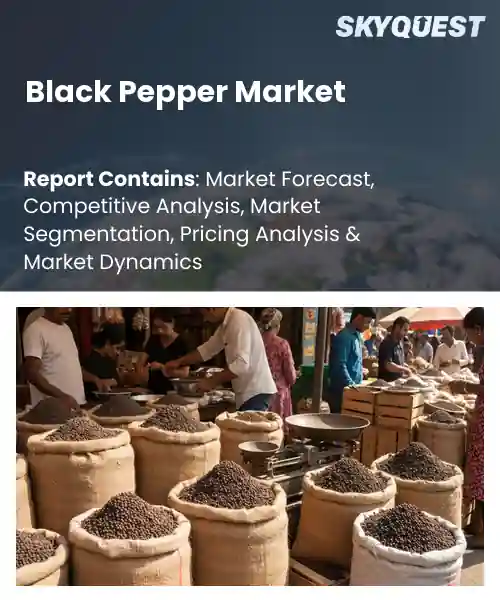
Black Pepper Market
Report ID: SQMIG30H2424
Report ID: SQMIG30H2424
[email protected]
USA +1 351-333-4748
Report ID:
SQMIG30H2424 |
Region:
Global |
Published Date: June, 2026
Pages:
157
|Tables:
172
|Figures:
79


Global Black Pepper Market size was valued at USD 4.5 Billion in 2024 and is poised to grow from USD 4.68 Billion in 2025 to USD 6.4 Billion by 2033, growing at a CAGR of 4.0% during the forecast period (2026-2033).
Black pepper market is driven primarily by evolving global food preferences and expanding processed-food industries, which have increased demand for spice-driven flavoring and preservation. As a commodity, black pepper matters because it links culinary traditions, international trade and rural incomes; its market has evolved from colonial-era spice routes to a modern global market dominated by producers such as Vietnam and India. Rising demand has prompted intensification of cultivation and investment in processing infrastructure, yet weather, pests and commodity speculation have periodically disrupted supply and amplified price volatility; Vietnam’s rapid expansion since 1990s shifted export balances, thereby altering global price dynamics.Building on supply dynamics and price volatility from expanding production, a critical growth factor is downstream value addition, which transforms raw pepper into higher-margin derivatives like essential oils, oleoresins and branded ground blends. When processors invest in extraction and certification, they open access to food manufacturers, nutraceutical firms and cosmetics companies that require consistent quality and traceability, driving demand beyond raw spices. In practice, food processors incorporate standardized pepper oleoresin to ensure uniform flavor in snacks, while pharmaceutical developers use piperine extracts to enhance bioavailability of supplements, creating off-take agreements that incentivize farmers to adopt improved agronomy and cooperative marketing.
How is AI transforming supply chain transparency in the black pepper market?
AI is improving supply chain transparency in the black pepper market by digitizing the first mile and linking farm level signals to buyers. Key aspects include remote sensing and in field sensors that feed machine learning models to verify origin and detect quality risks. AI also helps reconcile shipment documents and lab tests with immutable traceability records so brands can spot adulteration and validate sustainability claims. In a market built on fragmented smallholder supply and export driven channels these tools make sourcing more reliable and allow processors to prefer verified suppliers and premium product lines.ofi December 2025, launched the Spice Maps sustainability framework to digitize pepper supply chains in Vietnam and Cambodia. AI driven analytics in that program help validate provenance, improve farm resilience and make traceable sourcing practical, supporting more efficient procurement and stronger market trust.
Market snapshot - (2026-2033)
Global Market Size
USD 4.5 Billion
Largest Segment
Whole Black Pepper
Fastest Growth
Ground / Powdered Black Pepper
Growth Rate
4.0% CAGR
To get more insights on this market click here to Request a Free Sample Report
Global black pepper market is segmented by product type, nature, form, distribution channel, application, end use and region. Based on product type, the market is segmented into Whole Black Pepper and Ground / Powdered Black Pepper. Based on nature, the market is segmented into Organic and Conventional. Based on form, the market is segmented into Dried, Fresh and Crushed. Based on distribution channel, the market is segmented into Supermarkets & Hypermarkets, Convenience Stores, Online Retail and Specialty Stores. Based on application, the market is segmented into Food & Beverages, Pharmaceuticals and Personal Care & Cosmetics. Based on end use, the market is segmented into Household / Retail, Food Processing Industry and Foodservice (Hotels, Restaurants, Catering). Based on region, the market is segmented into North America, Europe, Asia Pacific, Latin America and Middle East & Africa.
Whole Black Pepper segment dominates because its perceived higher quality, longer shelf stability, and versatility in culinary and industrial uses sustain premium positioning in the Black Pepper Market. Buyers and manufacturers prefer whole berries for uniform flavor release, longer storage life, and suitability for grinding to specification, which drives consistent demand. This preference prompts supply chains to prioritize whole pepper grading, preserving value and supporting premium pricing and steady procurement strategies across buyers.
However, Ground / Powdered Black Pepper is the most rapidly expanding area, driven by consumer demand for convenience and food processors’ need for standardized, easy to blend spice forms. Advances in fine milling and shelf-stable packaging, plus inclusion in spice blends and convenience foods, accelerate adoption and open opportunities across retail and industrial product lines.
Supermarkets & Hypermarkets segment dominates because they aggregate high-volume consumer demand, enable broad product visibility, and enforce strict quality and packaging standards that favor established suppliers in the Black Pepper Market. Their centralized procurement and promotion power create predictable purchase cycles and economies of scale, encouraging manufacturers to optimize production and distribution for these channels. This concentration of retail influence steers assortment, pricing strategies, and private label growth, shaping supplier investments and market structure.
However, Online Retail is the fastest growing channel, propelled by digital discovery, direct to consumer sourcing, and demand for diverse pack sizes. Ecommerce platforms enable niche suppliers, private label launches, and dynamic pricing experiments, accelerating trial and repeat purchases. Enhanced logistics and targeted marketing expand reach to specialty buyers and convenience shoppers, creating agile routes to market and new growth opportunities for producers.
To get detailed segments analysis, Request a Free Sample Report
Asia Pacific dominates the global black pepper market due to a convergence of deep culinary affinity, established import and distribution networks, and strong industrial demand from food manufacturers and processors. Regional taste preferences favor robust spice use across household and foodservice channels, while proximity to major producing nations supports reliable sourcing and cost-efficient logistics. Investment in blending and value added processing strengthens product differentiation, and retailers offer wide assortments that drive continuous consumer experimentation. Public and private sector cooperation in quality standards and traceability enhances buyer confidence, and innovation in packaging and convenience formats broadens appeal beyond traditional markets. Moreover, growing urbanization and expanding modern retail clusters create scalable channels for premium and specialty pepper offerings, while foodservice trends toward global flavors further entrench black pepper as a kitchen staple across diverse cuisines.
Black Pepper Market Japan features discerning consumer palates, sophisticated retail channels, and a strong focus on quality and food safety. Demand stems from culinary experimentation and premiumization as global flavors integrate into daily cooking. Importers and specialty distributors curate high quality supply while processors emphasize refined grinding and packaging to meet local standards. Industrial buyers seek consistent specifications, supporting regular use of black pepper in prepared foods and seasoning blends.
Black Pepper Market South Korea is characterized by evolving culinary trends, growing interest in global cuisines, and sophisticated retail channels. Consumers favor convenient and premium seasoning options, prompting importers and processors to offer diverse origin and grind formats. Quality assurance and traceability are important for retail and industrial buyers, while innovation in ready to use blends supports adoption across quick service and prepared meal segments. Distribution networks enable market reach.
Europe is experiencing rapid expansion in the black pepper market due to a combination of sophisticated consumer tastes, strong institutional demand, and evolving retail and culinary landscapes. Adventurous home cooking, growth in prepared and convenience foods, and emphasis on flavor layering drive increased use across households and foodservice. Retailers and distributors are investing in assortment variety, including single origin and specialty grind options, while private label and artisanal brands elevate perceived value. Regulatory focus on quality and traceability, along with supplier partnerships, improves supply chain transparency. Pan regional distribution hubs and specialized spice processors support consistent availability and product innovation, while culinary tourism and restaurant experimentation expose consumers to varied pepper profiles, reinforcing market momentum across different European markets.
Black Pepper Market Germany benefits from strong industrial demand, extensive food processing infrastructure, and a large retail landscape that emphasizes assortment and quality. Buyers prioritize consistency and traceability, prompting suppliers to offer standardized grades and blended solutions. Innovation in private label seasoning and convenience meals drives inclusion of black pepper, while specialty retailers and culinary professionals sustain interest in premium and single origin offerings across urban channels and regional outlets.
Black Pepper Market United Kingdom is shaped by dynamic consumer trends, growth of online and specialty retail, and an adventurous culinary scene. Demand for premium and artisanal spice offerings has increased interest in origin specific and novel grind formats. Foodservice innovation and ready meal development support usage, while focus on provenance, sustainability, and convenience encourages suppliers to enhance traceability and offer differentiated packaging appealing to discerning consumers across urban channels.
Black Pepper Market France is influenced by a strong culinary tradition, high standards for ingredient quality, and a vibrant restaurant culture that values nuanced seasoning. Consumers and chefs seek premium and artisanal variants, encouraging importers and niche distributors to supply single origin and specialty grind options. Retail gourmet channels raise awareness, while processors focus on flavor preservation, blending expertise, and packaging that aligns with refined local expectations and premium positioning.
North America is strengthening its position in the black pepper market through a combination of retail innovation, expanding food processing capacity, and evolving consumer tastes that favor bold and authentic flavors. Retailers and online channels are widening assortments to include premium, organic, and convenience oriented formats, while large processors integrate black pepper into a growing array of prepared and packaged foods. Investment in supply chain transparency and quality assurance fosters trust among food manufacturers and consumers. Collaboration between importers and domestic distributors optimizes logistics and inventory management, enabling faster response to culinary trends. Foodservice innovation and culinary education elevate usage patterns, while research into shelf life and grind technology drives product refinement and convenience that resonate with time pressured consumers.
Black Pepper Market United States is driven by a diverse culinary landscape, strong food manufacturing sector, and sophisticated retail channels that prioritize convenience and flavor innovation. Demand for premium, organic, and single origin options grows alongside expansion of prepared foods inspired by global cuisines. Importers and distributors focus on supply chain reliability and traceability, while processors develop grind formats and blends that support widespread use across retail and foodservice applications.
Black Pepper Market Canada reflects a blend of multicultural culinary demand, growing premiumization, and an emphasis on provenance and sustainable sourcing. Retailers and importers expand offerings to satisfy diverse taste profiles, while processors focus on maintaining flavor integrity through grind and packaging choices. Foodservice innovation and cooking trends sustain regular usage, and collaboration between distributors and retailers enhances reach into urban and regional markets, supporting product differentiation and consumer education.
To know more about the market opportunities by region and country, click here to
Buy The Complete Report
Rising Demand From Food Industry
Expansion Of Foodservice Channels
Supply Chain Vulnerability To Weather
Price Volatility And Quality Concerns
Request Free Customization of this report to help us to meet your business objectives.
Competitive landscape in the global black pepper market is shaped by consolidation among multinationals, vertical integration into origin processing, and a push for traceability that drives differentiation. Large ingredient firms pursue targeted M&A and origin partnerships while investing in bioactive research and AI to create value added pepper ingredients. At the same time, financed origin processors scale capacity to compete on quality and sustainability.
Top Player’s Company Profile
Recent Developments
SkyQuest’s ABIRAW (Advanced Business Intelligence, Research & Analysis Wing) is our Business Information Services team that Collects, Collates, Correlates, and Analyses the Data collected by means of Primary Exploratory Research backed by robust Secondary Desk research. As per SkyQuest analysis, the global black pepper market is driven primarily by evolving global food preferences and expanding processed-food and foodservice industries, with a secondary driver from downstream value addition such as oleoresins and branded ground blends that open higher-margin channels. The market faces a significant restraint from supply chain vulnerability to weather and related price volatility that can disrupt yields and sourcing. Asia Pacific remains the dominating region due to production proximity, strong culinary demand and established supply networks, while the whole black pepper segment dominates because of its perceived higher quality, longer shelf life and suitability for standardized grinding that serves industrial and retail buyers.
| Report Metric | Details |
|---|---|
| Market size value in 2024 | USD 4.5 Billion |
| Market size value in 2033 | USD 6.4 Billion |
| Growth Rate | 4.0% |
| Base year | 2024 |
| Forecast period | (2026-2033) |
| Forecast Unit (Value) | USD Billion |
| Segments covered |
|
| Regions covered | North America (US, Canada), Europe (Germany, France, United Kingdom, Italy, Spain, Rest of Europe), Asia Pacific (China, India, Japan, Rest of Asia-Pacific), Latin America (Brazil, Rest of Latin America), Middle East & Africa (South Africa, GCC Countries, Rest of MEA) |
| Companies covered |
|
| Customization scope | Free report customization with purchase. Customization includes:-
|
To get a free trial access to our platform which is a one stop solution for all your data requirements for quicker decision making. This platform allows you to compare markets, competitors who are prominent in the market, and mega trends that are influencing the dynamics in the market. Also, get access to detailed SkyQuest exclusive matrix.
Table Of Content
Executive Summary
Market overview
Parent Market Analysis
Market overview
Market size
KEY MARKET INSIGHTS
COVID IMPACT
MARKET DYNAMICS & OUTLOOK
Market Size by Region
KEY COMPANY PROFILES
Methodology
For the Black Pepper Market, our research methodology involved a mixture of primary and secondary data sources. Key steps involved in the research process are listed below:
1. Information Procurement: This stage involved the procurement of Market data or related information via primary and secondary sources. The various secondary sources used included various company websites, annual reports, trade databases, and paid databases such as Hoover's, Bloomberg Business, Factiva, and Avention. Our team did 45 primary interactions Globally which included several stakeholders such as manufacturers, customers, key opinion leaders, etc. Overall, information procurement was one of the most extensive stages in our research process.
2. Information Analysis: This step involved triangulation of data through bottom-up and top-down approaches to estimate and validate the total size and future estimate of the Black Pepper Market.
3. Report Formulation: The final step entailed the placement of data points in appropriate Market spaces in an attempt to deduce viable conclusions.
4. Validation & Publishing: Validation is the most important step in the process. Validation & re-validation via an intricately designed process helped us finalize data points to be used for final calculations. The final Market estimates and forecasts were then aligned and sent to our panel of industry experts for validation of data. Once the validation was done the report was sent to our Quality Assurance team to ensure adherence to style guides, consistency & design.
Analyst Support
Customization Options
With the given market data, our dedicated team of analysts can offer you the following customization options are available for the Black Pepper Market:
Product Analysis: Product matrix, which offers a detailed comparison of the product portfolio of companies.
Regional Analysis: Further analysis of the Black Pepper Market for additional countries.
Competitive Analysis: Detailed analysis and profiling of additional Market players & comparative analysis of competitive products.
Go to Market Strategy: Find the high-growth channels to invest your marketing efforts and increase your customer base.
Innovation Mapping: Identify racial solutions and innovation, connected to deep ecosystems of innovators, start-ups, academics, and strategic partners.
Category Intelligence: Customized intelligence that is relevant to their supply Markets will enable them to make smarter sourcing decisions and improve their category management.
Public Company Transcript Analysis: To improve the investment performance by generating new alpha and making better-informed decisions.
Social Media Listening: To analyze the conversations and trends happening not just around your brand, but around your industry as a whole, and use those insights to make better Marketing decisions.
REQUEST FOR SAMPLE
 REQUEST FREE CUSTOMIZATION


Want to customize this report? This report can be personalized according to your needs. Our analysts and industry experts will work directly with you to understand your requirements and provide you with customized data in a short amount of time. We offer $1000 worth of FREE customization at the time of purchase.
Feedback From Our Clients


 USA (+1) 351-333-4748

