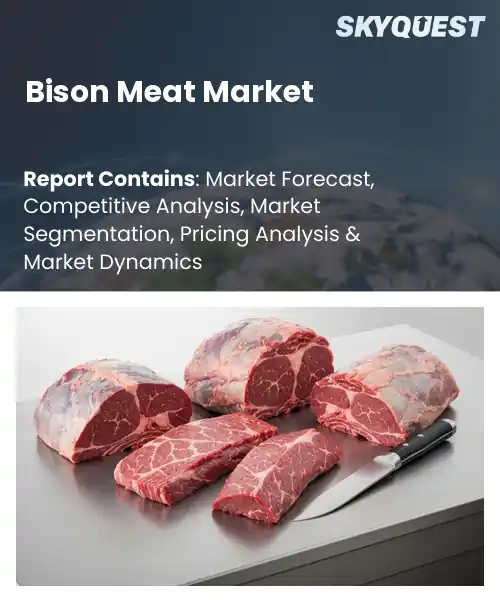
Bison Meat Market
Report ID: SQMIG30I2863
Report ID: SQMIG30I2863
[email protected]
USA +1 351-333-4748
Report ID:
SQMIG30I2863 |
Region:
Global |
Published Date: February, 2026
Pages:
157
|Tables:
143
|Figures:
78


Global Bison Meat Market size was valued at USD 421.30 Million in 2024 and is poised to grow from USD 445.74 Million in 2025 to USD 699.78 Million by 2033, growing at a CAGR of 5.8% during the forecast period (2026-2033).
Rising consumer demand for lean, nutrient-dense red meats that have a reputation for being sustainable alternatives to beef has driven the bison meat market growth. Gaining popularity in North America and parts of Europe as consumers opt for lower-fat choices combined with distinctive flavour profiles. Over the past 20 years, production has small-scale ranching to controlled, traceable supply chains with USDA inspection, and branded value-added bison products such as grass-fed steaks and bison burgers. This evolution matters since it made wider retail distribution, restaurant acceptance, and premium pricing possible.
The primary driver of global growth continues to be scaling the supply chain through production expansion and product diversification, generating a cyclical loop between suppliers and markets. As ranchers adopt and use rotational grazing and herd management principles to maximize output, processors can provide uniform cuts and value-added products such as bison sausages, jerky and common cuts, which leads supermarkets and fast-casual restaurants to provide these SKUS in their stores. This commercial progression facilitates investment, lowers unit costs, and enables export opportunities into European and Asian markets with existing lean red meat niches.
How is Blockchain Improving Traceability in the Bison Meat Market?
The traceability of the bison meat market has improved because of the presence of an unalterable record within the blockchain system that links each bison back to its farm of origin, as well as demonstrating how the animal was handled at every step in the supply chain. Some key elements of this include the establishment of secure and permanent ledgers containing information about each bison paper trail. Today, many producers and consumers of bison prefer to purchase traceable bison due to the value placed on sustainable grazing and ethical stewardship of the animals their businesses are producing. Blockchain provides additional speed in terms of recalls, diminishes fraud, and provides proof of regenerative raised animal products for niche brands to be able to attract premium pricing at retail.
In September 2022, Frasier Bison LLC became a part of the USDA-backed Verified Regenerative Bison Products initiative whose purpose is to establish supply chain verification for bison production. Connecting pasture management practices to the harvested products supports consumer confidence in their purchases, while also growing the bison market by creating clear records and providing a smoother verification process for bison processors and retailers.
Market snapshot - 2026-2033
Global Market Size
USD 421.3 Million
Largest Segment
Fresh Bison Meat
Fastest Growth
Processed Bison Meat
Growth Rate
5.8% CAGR
To get more insights on this market click here to Request a Free Sample Report
Global bison meat market is segmented into product type, form, formulation type, distribution channel, end-use and region. Based on product type, the market is segmented into fresh bison meat and processed bison meat. Based on form, the market is segmented into whole carcass, half carcass and packaged meat (retail-ready). Based on formulation type, the market is segmented into grass-fed bison and grain-fed bison.
Based on distribution channel, the market is segmented into supermarkets / hypermarkets, specialty meat stores, online retail / e-commerce and foodservice / restaurants. Based on end-use, the market is segmented into household, foodservice / commercial use and industrial use. Based on region, the market is segmented into North America, Europe, Asia Pacific, Latin America and Middle East & Africa.
As per bison meat market analysis, packaged meat (retail-ready) segment dominates because retailers and processors prioritize convenience, consistent portioning, and branded presentation that align with modern purchasing habits. Pre-packaged allows for less handling complexity for both retailers and consumers, greater average shelf life, and labels that comply with standardized compliance and traceability regulations. All of these factors reduce barriers to stocking bison in all retail channels, increase retailer confidence, and enable stable supply agreements, thereby making products more readily available and more visible.
As per bison meat market forecast, whole carcass continues to grow at the fastest pace because of the demand from both artisanal butcher shops and chefs who have a preference for sourcing whole animals to create custom cuts of meat for value recovery purposes. Producers benefit from purchasing meat in bulk and selling it directly to their customers at a higher profit for providing direct sales. This leads to the development of niche channels and provides the opportunity for a diversified product offering, leading to the potential for premium pricing and supply diversification.
As per bison meat market outlook, the supermarkets/hypermarkets dominate this segment because they provide consistent and high-volume shelf space, as well as refrigeration infrastructure, to generate shopper traffic to the shelves that can provide the ability for mainstream consumers to view bison products. Through category management and promotional programs, retailers are able to reduce risks for distributors, which allows them to normalize bison as an alternative red meat. In addition, retailers' buying power through their category management systems ensures that retailers have predictable supply contracts for bison products.
On the other hand, online retail/e-commerce is experiencing the most explosive growth because the digital channel reduces barriers for access to niche bison brands, allowing them to engage in direct-to-consumer sales, subscription and box models, as well as targeted marketing to consumers. Improvements in cold-chain logistics/fulfillment and increasing consumer trust in online meat purchases are the catalyst for the unlocking of new consumer segments and for accelerating market expansion opportunities.
To get detailed segments analysis, Request a Free Sample Report
The bison meat industry across the globe is led by North America, due to its in-depth supply chain, established production systems and high levels of consumer awareness. Ongoing private and public investment in herding practices, processing facilities, and food safety legislation delivers consistent product quality. The variety of product development and premium product positioning in the retail and food services sectors relates directly to growing demand for protein sources with respect to energy needs.
As per bison meat market regional forecast, United States meat market shows the widest penetration of any retail channel, a range of culinary applications, and an extensive supply base that places a high value on product safety and consistency. The increased consumer interest in lean as well as premium red meat, which is supported by chefs’ menus and by specialty grocery stores, has led to an expansion of the market beyond niche markets. The strength of industry associations, along with supply chain partners working together, strengthen marketing, breeding, and traceability for global bison meat exports.
As per bison meat market regional outlook, Canada market is characterized by strong pasture-based production, the implementation of good animal welfare practices, and the proximity of specialized processing facilities that support the premium positioning for Canadian bison meat. The significant proportion of products consumed by healthy-minded consumers and gourmet outlets add by creating a demand that also meets the needs. By implementing an industry-wide approach to research and breed development, all Canadian bison meat products benefit from increased differentiation of product.
The European bison meat market is growing quickly due to changes in eating habits, increasing demand for high-quality and different types of red protein, and more specialty markets. There are new cutting-edge techniques to manage farms and develop breeding programs, which are both contributing to an increase in herd size and improvement in the quality of the meat that is produced. The growth of artisanal processing companies and retailers focusing on value has led to many different types of products that can be made from bison, ranging from fresh meat cuts to prepared meal options.
The culinary support for using bison has expanded due to the influence of chefs and food bloggers in the creation of new recipes featuring bison that are offered on contemporary menus. Furthermore, cross-border trade facilitation and cooperative marketing among producers has increased the availability of bison to consumers while also providing producers with access to a greater number of consumers through improved food safety and labeling policies that enhance transparency about where the food came from and its nutrition profile to consumers that are willing to pay for higher-quality food products.
As per bison meat industry analysis, Germany market is characterized by strong consumer interest in food provenance and product quality being supported by existing specialty retailers and artisanal food processors. Farmers are committed to using sustainable grazing methods as well as traceability to comply with regulatory requirements and meet retailer standards. As a consequence of broad culinary acceptance of bison meat in restaurants, there is greater awareness among a larger number of consumers, creating a foundation for continued development of the bison meat market. Strong collaborative working relationships between cattle breeders and processors are fostering brand standardization and product branding for bison that helps position bison as a high-end meat protein option in German retail meat assortments.
The bison meat market in the UK is seeing increased interest from consumers due to both increased consumer curiosity around new proteins as well as the rise in artisan food culture. Specialty butcher shops, premium grocery stores and restaurants are beginning to experiment with bison products, creating more demand for this type of meat in urban areas. In addition to this, small scale bison producers and processors are building their market recognition by creating distinct brands, communicating provenance, and establishing niche retail partnerships. Collaborating with culinary media and participating in food events helps to enhance market acceptance of bison meat among consumers who consider themselves "discerning" shoppers.
The bison meat market in France is benefiting from significant new momentum driven by chefs and other artisanal producers who are introducing bison into their offerings due to its unique taste / flavour profile and its appeal to being a premium protein alternative. Regional bison producers are using their traditional knowledge of gastronomy, combined with local distribution channels, to introduce their bison products into the specialty charcuterie, fine dining and retail markets. The emphasis placed on producing bison meat in accordance with very high animal welfare and making the sourcing of their bison easily traceable through the supply chain allows regional bison producers to establish mutually beneficial partnerships with chefs and consumers who primarily operate in the luxury goods sector. In addition, promoting regional bison meat products through culinary festivals and partnerships with chefs will increase the visibility of bison meat products within culinary segments beyond using traditional cooking methods.
The bison meat market trends in the Asia Pacific is being propelled forward with an inclination towards premium and unique proteins within the urban, culinary, conscious, demographic. Bison meat has made its way into fine-dining restaurants and gourmet grocery stores as more consumers seek high-end and unique proteins. Cold chain distribution systems are being increased by importers and distributors to create a consistent supply of high-quality products.
The bison meat market in Japan continues to grow as chefs and retailers look for unique protein sources that will complement their highly developed culinary practices. Factors such as quality presentation and cut quality, which leads to effective portioning of products, will likely lead to further market development. As importers and distributors focus on product provenance and traceability, they can provide a higher level of service and support to the end-users. Various culinary collaborations and promotional sampling-related events that promote bison meat will continue to raise the level of product awareness among both culinary professionals and consumers who desire something new.
The bison meat market in South Korea continues to grow as consumers and food professionals desire premium, international proteins. Foodservice providers and specialty retailers are testing bison products in a wide variety of applications ranging from fusion dishes to barbecue formats; however, they are also adapting the presentation of bison meat to the local taste profile. Importers are focused on ensuring that the cold chain delivery method is consistent and that there is a high level of communication regarding product provenance to establish trust.
To know more about the market opportunities by region and country, click here to
Buy The Complete Report
Rising Demand for Healthy Protein
Premium Pricing Reinforces Value Perception
Limited Consumer Awareness and Availability
High Production Costs and Scalability Challenges
Request Free Customization of this report to help us to meet your business objectives.
The competitive landscape of the global bison meat industry is characterized by consolidation, competition from alternative proteins, and supply chain alliances that alter the pricing and access of products to consumers. Major meat processors are pursuing mergers and acquisitions (M&A) and testing cellular meat units. For instance, JBS purchased BioTech Foods and has formed investment divisions to invest in cultured meat companies such as Tyson Venturing.
SkyQuest’s ABIRAW (Advanced Business Intelligence, Research & Analysis Wing) is our Business Information Services team that Collects, Collates, Correlates, and Analyses the Data collected by means of Primary Exploratory Research backed by robust Secondary Desk research.
As per SkyQuest analysis, rising consumer demand for lean, nutrient dense red meats is a key driver for the global bison meat market, and scalable supply expansion combined with product diversification serves as a second driver by enabling broader retail and foodservice adoption. A major restraint remains with high production costs and scalability challenges that limit herd expansion and consistent supply. North America continues to dominate the market due to mature supply chains, consumer awareness, and strong retail and foodservice channels, while packaged meat retail ready formats are the dominating segment because they offer convenience, traceability and easier retail stocking that accelerate mainstream acceptance. The bison meat market share is characterized by a moderately consolidated structure, where established producers dominate premium supply chains while small-scale and regional farms are steadily increasing their presence through direct-to-consumer channels and niche organic offerings. The bison meat market trend is driven by rising demand for lean, high-protein alternatives, with growing consumer preference for grass-fed and sustainable livestock practices accelerating adoption globally.
| Report Metric | Details |
|---|---|
| Market size value in 2024 | USD 421.30 Million |
| Market size value in 2033 | USD 699.78 Million |
| Growth Rate | 5.8% |
| Base year | 2024 |
| Forecast period | 2026-2033 |
| Forecast Unit (Value) | USD Million |
| Segments covered |
|
| Regions covered | North America (US, Canada), Europe (Germany, France, United Kingdom, Italy, Spain, Rest of Europe), Asia Pacific (China, India, Japan, Rest of Asia-Pacific), Latin America (Brazil, Rest of Latin America), Middle East & Africa (South Africa, GCC Countries, Rest of MEA) |
| Companies covered |
|
| Customization scope | Free report customization with purchase. Customization includes:-
|
To get a free trial access to our platform which is a one stop solution for all your data requirements for quicker decision making. This platform allows you to compare markets, competitors who are prominent in the market, and mega trends that are influencing the dynamics in the market. Also, get access to detailed SkyQuest exclusive matrix.
Table Of Content
Executive Summary
Market overview
Parent Market Analysis
Market overview
Market size
KEY MARKET INSIGHTS
COVID IMPACT
MARKET DYNAMICS & OUTLOOK
Market Size by Region
KEY COMPANY PROFILES
Methodology
For the Bison Meat Market, our research methodology involved a mixture of primary and secondary data sources. Key steps involved in the research process are listed below:
1. Information Procurement: This stage involved the procurement of Market data or related information via primary and secondary sources. The various secondary sources used included various company websites, annual reports, trade databases, and paid databases such as Hoover's, Bloomberg Business, Factiva, and Avention. Our team did 45 primary interactions Globally which included several stakeholders such as manufacturers, customers, key opinion leaders, etc. Overall, information procurement was one of the most extensive stages in our research process.
2. Information Analysis: This step involved triangulation of data through bottom-up and top-down approaches to estimate and validate the total size and future estimate of the Bison Meat Market.
3. Report Formulation: The final step entailed the placement of data points in appropriate Market spaces in an attempt to deduce viable conclusions.
4. Validation & Publishing: Validation is the most important step in the process. Validation & re-validation via an intricately designed process helped us finalize data points to be used for final calculations. The final Market estimates and forecasts were then aligned and sent to our panel of industry experts for validation of data. Once the validation was done the report was sent to our Quality Assurance team to ensure adherence to style guides, consistency & design.
Analyst Support
Customization Options
With the given market data, our dedicated team of analysts can offer you the following customization options are available for the Bison Meat Market:
Product Analysis: Product matrix, which offers a detailed comparison of the product portfolio of companies.
Regional Analysis: Further analysis of the Bison Meat Market for additional countries.
Competitive Analysis: Detailed analysis and profiling of additional Market players & comparative analysis of competitive products.
Go to Market Strategy: Find the high-growth channels to invest your marketing efforts and increase your customer base.
Innovation Mapping: Identify racial solutions and innovation, connected to deep ecosystems of innovators, start-ups, academics, and strategic partners.
Category Intelligence: Customized intelligence that is relevant to their supply Markets will enable them to make smarter sourcing decisions and improve their category management.
Public Company Transcript Analysis: To improve the investment performance by generating new alpha and making better-informed decisions.
Social Media Listening: To analyze the conversations and trends happening not just around your brand, but around your industry as a whole, and use those insights to make better Marketing decisions.
REQUEST FOR SAMPLE
 REQUEST FREE CUSTOMIZATION
Global Bison Meat Market size was valued at USD 421.3 Million in 2024 and is poised to grow from USD 445.74 Million in 2025 to USD 699.78 Million by 2033, growing at a CAGR of 5.8% during the forecast period (2026-2033).
Competitive dynamics in the global bison meat market centre on consolidation, alternative-protein entrants, and supply chain partnerships that shift pricing and product access. Large processors pursue M&A and pilot cultivated meat units, for example JBS’s acquisition of BioTech Foods, while meat incumbents deploy venture arms and strategic investments such as Tyson Ventures’ backing of cultured-meat firms; startups including Orbillion advance cell cultured bison offerings. 'Northfork Bison', 'Wild Idea Buffalo Company', 'Black Bison Meat', 'Buffalo Creek Bison', 'Prickly Pear Bison', 'Bison World', 'Northern Plains Bison', 'The Bison Company', 'Colorado Bison Company', 'Prairie Breeze Bison', 'Tumblewood Teff', 'Bison Butte', 'Custer County Bison', 'Canadian Bison', 'Hyland Bison', 'American Bison Company', 'Blue Sky Bison', 'Bison Ridge Farm', 'Elk Mountain Bison', 'Sweet Grass Bison'
Bison meat's reputation as a lean, nutrient-dense protein encourages health-conscious consumers to choose it over fattier red meats, directly expanding market demand. Retailers and foodservice operators respond by increasing shelf space and menu offerings, which motivates producers to scale operations and introduce value-added products. This cycle of consumer preference influencing retail assortment and production capability strengthens market visibility and accessibility, enabling broader adoption across demographic groups and creating sustained growth momentum driven by perceived health benefits and diversified product availability.
Premiumization Through Product Innovation: Producers and retailers are elevating bison meat from niche commodity to premium culinary ingredient through new product formats, value added offerings, and collaborations. Emphasis on gourmet cuts, ready to cook meals, and clean label ingredients supports higher price positioning while appealing to health and quality focused consumers. Strategic partnerships with chefs and foodservice operators accelerate gastronomic visibility, encouraging repeat purchases and enabling broader shelf placement beyond specialty outlets into retail channels and culinary storytelling builds loyalty.
The bison meat industry across the globe is led by North America, due to its in-depth supply chain, established production systems and high levels of consumer awareness. Ongoing private and public investment in herding practices, processing facilities, and food safety legislation delivers consistent product quality.


Want to customize this report? This report can be personalized according to your needs. Our analysts and industry experts will work directly with you to understand your requirements and provide you with customized data in a short amount of time. We offer $1000 worth of FREE customization at the time of purchase.
Feedback From Our Clients


 USA (+1) 351-333-4748

