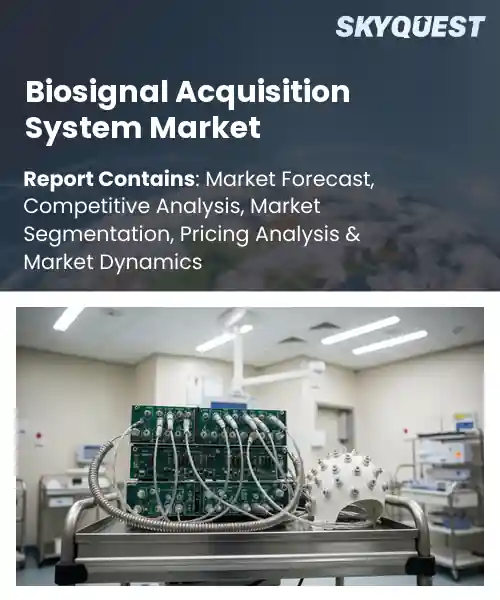
Biosignal Acquisition System Market
Report ID: SQMIG35A3286
Report ID: SQMIG35A3286
[email protected]
USA +1 351-333-4748
Report ID:
SQMIG35A3286 |
Region:
Global |
Published Date: February, 2026
Pages:
157
|Tables:
181
|Figures:
79


Global Biosignal Acquisition System Market size was valued at USD 548.9 Million in 2024 and is poised to grow from USD 619.16 Million in 2025 to USD 1622.84 Million by 2033, growing at a CAGR of 12.8% during the forecast period (2026-2033).
Growing demand for continuous health monitoring, rising adoption of wearable medical devices, increasing prevalence of chronic diseases, advancements in biosensor technologies, and growing emphasis on remote patient monitoring are driving sales of biosignal acquisition systems.
The rising rates of cardiovascular and neurological disorders drive more people to use these systems which provide both early detection and ongoing disease management. The development of smaller sensors and better wireless connections together with cloud-based analytics systems has made it possible to create small portable devices that can monitor activities in real time. The increasing use of wearable health technologies combined with telemedicine platforms creates new business opportunities in the market. Growing need for accurate and continuous physiological monitoring across clinical and consumer healthcare settings is expected to primarily drive biosignal acquisition system market growth. Expanding geriatric population and rising chronic disease burden are also expected to create new business scope in the long run.
On the contrary, high costs of advanced monitoring systems, concerns regarding data privacy and cybersecurity, complexity in signal processing and interpretation, and regulatory challenges for medical devices are anticipated to slow down biosignal acquisition system market penetration through 2033 and beyond.
How is AI Improving Signal Quality and Analytics in the Biosignal Acquisition System Market?
Improving signal quality is achieved by incorporating artificial intelligence into biosignal acquisition devices. The quality of signals is being improved by incorporating machine learning algorithms that perform better at signal reduction and feature extraction. The algorithms use adaptive filters that remove motion and environmental noise while keeping important physiological signals intact. In signal analysis, artificial intelligence is used to automate signal labeling, event detection, and signal fusion to provide more health-related insights.
Market snapshot - 2026-2033
Global Market Size
USD 548.9 Million
Largest Segment
Hardware
Fastest Growth
Software
Growth Rate
12.8% CAGR
To get more insights on this market click here to Request a Free Sample Report
Global biosignal acquisition system market is segmented by component, signal type, system type, application, end user, connectivity, and region. Based on component, the market is segmented into hardware, software, and services. Based on signal type, the market is segmented into Electrocardiogram (ECG), Electroencephalogram (EEG), Electromyography (EMG), Near-Infrared Spectroscopy (NIRS), Magnetoencephalography (MEG), Electrooculography (EOG), respiratory signals, and others. Based on system type, the market is segmented into wearable devices and non-wearable systems. Based on application, the market is segmented into clinical diagnostics, patient monitoring, research & academic use, home healthcare, sports & fitness monitoring, and neurorehabilitation. Based on end user, the market is segmented into hospitals, specialty clinics, diagnostic laboratories, academic & research institutes, biotechnology & pharmaceutical companies, homecare settings, and sports & fitness centers. Based on connectivity, the market is segmented into wired systems and wireless systems. Based on region, the market is segmented into North America, Europe, Asia Pacific, Latin America, and Middle East & Africa.
The hardware segment is estimated to spearhead the global biosignal acquisition system market revenue generation in the long run. Use of hardware to form the indispensable signal front end that determines data fidelity and clinical credibility in biosignal acquisition systems, which cements their dominance. High performing sensors, amplifiers and electrode technologies reduce noise and enable reliable diagnostics, prompting adoption by clinical and research buyers. Robust manufacturing, established supply chains and long device lifecycles create entrenched vendor relationships, driving investment in hardware innovation and integration into complex monitoring workflows and regulatory alignment.
However, software is emerging as the most rapidly expanding segment as per this biosignal acquisition system industry analysis. The high demand for AI analytics, cloud-enabled remote monitoring, and modular platforms to unlock diagnostic insights is creating business scope. The high demand for interoperable data solutions and real-time analytics is accelerating business commercialization.
The electroencephalogram segment is slated to account for the highest global biosignal acquisition system market share in the future. The ability of EEG to offer direct, high temporal resolution measurement of neural activity that underpins a wide array of clinical diagnostics is helping this segment hold sway over others. Mature electrode technologies, standardized acquisition protocols, as well as demand from neurology and sleep medicine, ensure continued investment. Integration into signal processing toolchains further enhances adoption as well as drives continued supplier investment in channel density, noise rejection, and signal quality.
However, fNIRS is the most dynamically developing segment because of the portability and tolerance to movements that allow cortical monitoring outside the lab. The increasing interest in cognitive monitoring and neurorehabilitation stimulates the development of wearable products. New opportunities are being created through the integration of modalities and the facilitation of the technology.
To get detailed segments analysis, Request a Free Sample Report
Presence of an advanced clinical infrastructure, concentrated industry leadership, and an innovation ecosystem are supporting high demand for biosignal acquisition system in the future. Favorable reimbursement policies and established regulatory pathways facilitate the market entry of products from these manufacturers, as do large amounts of private investment and strategic partnerships that promote commercialization. Well-developed supply chains and established pathways for clinically adopting devices provide for rapid scale-up of devices in the region. Furthermore, the presence of leading academic institutions significantly enhances the ability of industry to validate its products through collaborations across the three major segments of the health industry (medtech, software, and cloud analytics), thereby greatly enhancing product refinement and expanding market reach.
Presence of concentrated innovation hubs, leading medtech companies, and extensive clinical trial ecosystems are boosting biosignal acquisition system adoption in the United States. The market is highly integrated into digital health platforms and has robust venture funding options that enable rapid development of biosignal acquisition system wearables and bedside monitors. Presence of a highly developed medical community that enables device adoption, as well as robust reimbursement models further enhance clinical device adoption.
Integrated public healthcare networks, strong clinical research infrastructure, and innovation programs are shaping biosignal acquisition system demand in the country. Interoperability and training initiatives for healthcare professionals also help in the integration of biosignal acquisition systems in Canadian hospitals and community settings. Its proximity to major manufacturers in North America and its favorable innovation ecosystem enables partnerships for pilots, testing, and deployment.
Integrated healthcare systems, a deep industrial base in medical technology, and collaborative research networks collectively influence biosignal acquisition system demand in Europe. Integrated clinical infrastructures offer standardized regulations and an established ecosystem of clinical centres, equipment manufacturer partners and regulatory bodies. As a result, there is a strong emphasis on improving interoperability, ensuring data security, ensuring clinical validation promotes R&D investments among biosignal acquisition system companies. By promoting cross-border collaboration and by encouraging the utilization of wearable and bedside monitoring technologies throughout hospitals and community care, pan-European partnerships, with increasing uptake of virtual health, facilitate expanded use of these types of technologies at hospital and community care.
Robust medtech manufacturing sector, a dense clinical research network, and focus on product refinement boost biosignal acquisition system adoption in Germany. Collaborative clusters provide a link between industries, universities, and specialized medical research facilities to test innovative biosignal acquisition products. Regulatory expertise and distribution networks provide a springboard for product adoption in hospitals, rehabilitation facilities, and ambulatory care settings to further consolidate Germany as a leading innovation hub.
Biosignal acquisition system demand in the United Kingdom is shaped by a vibrant startup ecosystem, agile regulatory engagement, and strong digital health adoption. Service providers are available to aid in commercialization readiness and further validate United Kingdom as a high-growth market. Collaboration between academic centers, healthcare providers and technology firms enables rapid prototyping of novel biosignal acquisition systems. The focus on user-centricity and integrated care is likely to drive adoption in healthcare settings.
Increasing public–private collaboration, growing medtech startups, and targeted innovation support drive consistent biosignal acquisition system demand in France. . Clinical networks and specialist hospitals are helpful in validating, while manufacturing and service companies support localization. Emphasis on interoperability, user-centeredness, and integration with telemedicine platforms facilitates adoption in clinical and community settings. Strategic partnerships with European counterparts are also beneficial in improving and positioning products.
Advanced electronics manufacturing, strong consumer electronics expertise, and growing clinical adoption of monitoring technologies are boosting biosignal acquisition system demand in this region. Manufacturers in the Asia Pacific region use deep component supply chains and system integration capabilities to create biosignal platforms that are cost competitive and loaded with features while public and private programs support clinical validation and pilot system deployment. The rapid growth of mobile health, wearable sensors, and cloud analytics used by hospitals allows for an even greater reach of health care into communities, patients' homes, and beyond. Strategic relationships between global medtech companies and investment in capacity for interoperability and regulatory compliance position the Asia Pacific region as high rewarding market through 2033.
The presence of well-established clinical institutions and research centers has provided validation processes, while Japanese companies focus on reliable signal sensing and user-friendliness. The focus on quality and relationship building with medical staff is useful for hospital and home healthcare settings. Integration with technology companies has helped to solidify Japan’s leadership in Asia Pacific.
Presence of world-class electronics supply chains, strong systems integration capability and a dynamic technology startup scene are boosting biosignal acquisition system innovation in South Korea. Strong ties between device manufacturers, telecom operators, and hospitals facilitate rapid prototyping and connectivity-based deployments. Emphasis on miniaturization, sensor technology, and mobile connectivity is advantageous for its adoption in various settings. Innovation-driven strategies by governments and industry players add to its maturity and global connectivity.
To know more about the market opportunities by region and country, click here to
Buy The Complete Report
Rising Focus on Remote Patient Monitoring
Advances In Wearable Sensor Technology
Regulatory Approval Complexity
High Integration And Interoperability Challenges
Request Free Customization of this report to help us to meet your business objectives.
Competitive dynamics in the global biosignal acquisition system market are shaped by focused M&A, targeted partnerships, and rapid product innovation that directly influence platform consolidation and channel access. Large vendors have acquired remote-monitoring specialists to broaden ambulatory and cloud capabilities, for example Philips acquiring BioTelemetry, while startups form content and OEM collaborations to accelerate integration, as Wisear did with Qobuz, and AAVAA moved products toward direct consumer wearables.
In December 2025, Nihon Kohden introduced the JE-940 EEG amplifier and showcased the aireeg wireless EEG system at AES emphasizing enhanced signal reliability, upgraded cybersecurity and connectivity, an internal battery for uninterrupted monitoring, and wearable mobility that supports continuous clinical neurodiagnostic workflows.
In December 2025, BIOPAC released AcqKnowledge 6.0.2 with full integration of MedelOpt+ fNIRS and EEG functionality enabling combined hemodynamic and electrophysiological acquisition within a single workflow, expanded device compatibility and streamlined study management including real-time visualization, workflow automation, and cloud-enabled study organization to accelerate setup and reproducibility across research and clinical settings.
In August 2025, Compumedics announced strengthened US commercial focus for Somfit and advanced plans for the Somfit-D disposable home sleep testing device highlighting expanded sales investment, a shift toward scalable at-home monitoring solutions, and a product strategy aimed at simplifying sleep diagnostics and supporting broader adoption by clinicians and diagnostic providers.
SkyQuest’s ABIRAW (Advanced Business Intelligence, Research & Analysis Wing) is our Business Information Services team that Collects, Collates, Correlates, and Analyses the Data collected by means of Primary Exploratory Research backed by robust Secondary Desk research.
As per SkyQuest analysis, rising demand for continuous physiological monitoring and increasing adoption of wearable health technologies are anticipated to drive the demand for biosignal acquisition systems going forward. However, high costs of advanced monitoring devices, data privacy concerns, and complexities in signal processing are slated to slow down the adoption of biosignal acquisition systems in the future. North America is slated to spearhead the demand for biosignal acquisition systems owing to strong healthcare infrastructure and high adoption of digital health technologies. Integration of AI-driven signal analytics and expansion of remote patient monitoring solutions are anticipated to be key trends driving the biosignal acquisition system market across the study period.
| Report Metric | Details |
|---|---|
| Market size value in 2024 | USD 548.9 Million |
| Market size value in 2033 | USD 1622.84 Million |
| Growth Rate | 12.8% |
| Base year | 2024 |
| Forecast period | 2026-2033 |
| Forecast Unit (Value) | USD Million |
| Segments covered |
|
| Regions covered | North America (US, Canada), Europe (Germany, France, United Kingdom, Italy, Spain, Rest of Europe), Asia Pacific (China, India, Japan, Rest of Asia-Pacific), Latin America (Brazil, Rest of Latin America), Middle East & Africa (South Africa, GCC Countries, Rest of MEA) |
| Companies covered |
|
| Customization scope | Free report customization with purchase. Customization includes:-
|
To get a free trial access to our platform which is a one stop solution for all your data requirements for quicker decision making. This platform allows you to compare markets, competitors who are prominent in the market, and mega trends that are influencing the dynamics in the market. Also, get access to detailed SkyQuest exclusive matrix.
Table Of Content
Executive Summary
Market overview
Parent Market Analysis
Market overview
Market size
KEY MARKET INSIGHTS
COVID IMPACT
MARKET DYNAMICS & OUTLOOK
Market Size by Region
KEY COMPANY PROFILES
Methodology
For the Biosignal Acquisition System Market, our research methodology involved a mixture of primary and secondary data sources. Key steps involved in the research process are listed below:
1. Information Procurement: This stage involved the procurement of Market data or related information via primary and secondary sources. The various secondary sources used included various company websites, annual reports, trade databases, and paid databases such as Hoover's, Bloomberg Business, Factiva, and Avention. Our team did 45 primary interactions Globally which included several stakeholders such as manufacturers, customers, key opinion leaders, etc. Overall, information procurement was one of the most extensive stages in our research process.
2. Information Analysis: This step involved triangulation of data through bottom-up and top-down approaches to estimate and validate the total size and future estimate of the Biosignal Acquisition System Market.
3. Report Formulation: The final step entailed the placement of data points in appropriate Market spaces in an attempt to deduce viable conclusions.
4. Validation & Publishing: Validation is the most important step in the process. Validation & re-validation via an intricately designed process helped us finalize data points to be used for final calculations. The final Market estimates and forecasts were then aligned and sent to our panel of industry experts for validation of data. Once the validation was done the report was sent to our Quality Assurance team to ensure adherence to style guides, consistency & design.
Analyst Support
Customization Options
With the given market data, our dedicated team of analysts can offer you the following customization options are available for the Biosignal Acquisition System Market:
Product Analysis: Product matrix, which offers a detailed comparison of the product portfolio of companies.
Regional Analysis: Further analysis of the Biosignal Acquisition System Market for additional countries.
Competitive Analysis: Detailed analysis and profiling of additional Market players & comparative analysis of competitive products.
Go to Market Strategy: Find the high-growth channels to invest your marketing efforts and increase your customer base.
Innovation Mapping: Identify racial solutions and innovation, connected to deep ecosystems of innovators, start-ups, academics, and strategic partners.
Category Intelligence: Customized intelligence that is relevant to their supply Markets will enable them to make smarter sourcing decisions and improve their category management.
Public Company Transcript Analysis: To improve the investment performance by generating new alpha and making better-informed decisions.
Social Media Listening: To analyze the conversations and trends happening not just around your brand, but around your industry as a whole, and use those insights to make better Marketing decisions.
REQUEST FOR SAMPLE
 REQUEST FREE CUSTOMIZATION
Global Biosignal Acquisition System Market size was valued at USD 548.9 Million in 2024 and is poised to grow from USD 619.16 Million in 2025 to USD 1622.84 Million by 2033, growing at a CAGR of 12.8% during the forecast period (2026-2033).
Competitive dynamics in the global biosignal acquisition system market are shaped by focused M&A, targeted partnerships, and rapid product innovation that directly influence platform consolidation and channel access. Large vendors have acquired remote-monitoring specialists to broaden ambulatory and cloud capabilities, for example Philips acquiring BioTelemetry, while startups form content and OEM collaborations to accelerate integration, as Wisear did with Qobuz, and AAVAA moved products toward direct consumer wearables. 'BioSignal Technologies', 'Cognevo', 'NeuroSky', 'MEDLITE', 'BioTrace', 'BrainVision', 'Thought Technology', 'MindMedia', 'Advantech', 'VitalConnect', 'Neuroelectrics', 'Zeto', 'BioSensics', 'Emotiv', 'g.tec medical engineering', 'eVokai', 'Nexus Bioengineering', 'Aesculap Meditec', 'Synapse Biomedical', 'AliveCor'
Remote patient monitoring programs increase demand for biosignal acquisition systems by enabling continuous, noninvasive collection of physiological data outside hospitals. Healthcare providers prioritize technologies that support longitudinal tracking of heart rate, respiratory patterns, and electrophysiological signals to manage chronic conditions and reduce readmissions. Device manufacturers respond by improving sensor integration, wireless connectivity, and interoperability with clinical platforms. This focus on remote care expands deployment scenarios, accelerates procurement decisions, and encourages investment in scalable acquisition solutions that align with care delivery models emphasizing patient-centered monitoring.
Wearable Remote Monitoring: Adoption of wearable and remote biosignal monitoring is shifting care delivery toward decentralized, continuous patient observation, enabling proactive management of chronic conditions and rehabilitation. Devices designed for comfort and long term use promote higher adherence and integration with telemedicine platforms. Healthcare providers and technology partners are collaborating to create interoperable care pathways and service models that emphasize patient experience, secure data flow, and remote clinical decision support, driving broader acceptance across clinical and consumer segments.
North America Dominate the Global Biosignal Acquisition System Market?


Want to customize this report? This report can be personalized according to your needs. Our analysts and industry experts will work directly with you to understand your requirements and provide you with customized data in a short amount of time. We offer $1000 worth of FREE customization at the time of purchase.
Feedback From Our Clients


 USA (+1) 351-333-4748

