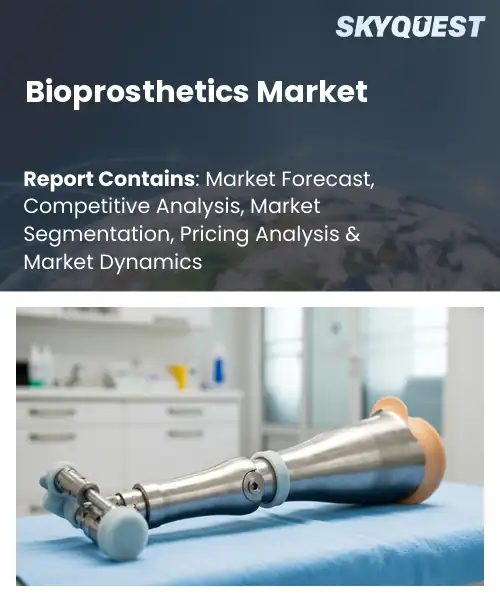
Bioprosthetics Market
Report ID: SQMIG20I2800
Report ID: SQMIG20I2800
[email protected]
USA +1 351-333-4748
Report ID:
SQMIG20I2800 |
Region:
Global |
Published Date: April, 2026
Pages:
157
|Tables:
118
|Figures:
77


Global Bioprosthetics Market size was valued at USD 5.12 Billion in 2024 and is poised to grow from USD 5.64 Billion in 2025 to USD 5.1 Billion by 2033, growing at a CAGR of 10.1% during the forecast period (2026-2033).
Bioprosthetics market comprises implanted devices and tissue based substitutes that replace or repair damaged organs using biologically derived materials, and it matters because these solutions often restore function while reducing complications associated with mechanical alternatives. The primary driver is demographic and disease burden shifts, with aging populations and rising cardiovascular disease and chronic wounds increasing demand for heart valves, vascular grafts and soft tissue replacements, while advances in biomaterials, decellularization and minimally invasive delivery have significantly transformed offerings over decades. Historically the field moved from rigid mechanical prostheses to porcine and bovine pericardial valves to transcatheter aortic valve replacement globally.Building on these technological and demographic trends, the most influential growth factor is clinical adoption driven by minimally invasive delivery and improved patient outcomes, because easier procedures and lower complication rates expand eligible patient populations and attract payer support. For example, transcatheter valve programs that reduce hospital stay have increased case volumes, prompting manufacturers to invest in durable biomaterials and scalable decellularization processes, which lower unit costs and accelerate regulatory approvals. Similarly, prepackaged extracellular matrix grafts for chronic wound care and biologic vascular grafts for peripheral artery disease translate research into repeatable clinical use, creating commercial opportunities globally with collaborations.
How is AI transforming product development in the bioprosthetics market?
AI is reshaping product development in the bioprosthetics market by making design more data driven and development cycles more iterative. Key aspects include machine learning driven control systems, sensor fusion and personalized manufacturing through 3D scanning and printing. Today companies use AI to translate muscle and neural signals into intuitive prosthesis control and to run virtual tests that reduce bench time. This creates faster refinement of biomaterials and sockets and tighter clinician feedback loops. Market demand for smarter, connected implants and exoskeletons is rising as AI enables safer, more adaptive devices and more efficient engineering workflows.Ottobock April 2026, announced AI supported exoskeleton and digital ergonomics offerings that pair sensor data with analytics to tailor support and accelerate product iteration, showing how AI reduces prototyping time and improves real world performance validation which supports faster market adoption and operational efficiency.
Market snapshot - (2026-2033)
Global Market Size
USD 5.12 Billion
Largest Segment
Xenograft Bioprosthetics (Bovine/Porcine)
Fastest Growth
Porcine Flushing & Cardiovascular Patches
Growth Rate
10.1% CAGR
To get more insights on this market click here to Request a Free Sample Report
Global bioprosthetics market is segmented by product type, clinical application, end-user facility, source material and region. Based on product type, the market is segmented into Xenograft Bioprosthetics (Bovine/Porcine), Allograft Bioprosthetics (Human Tissue) and Porcine Flushing & Cardiovascular Patches. Based on clinical application, the market is segmented into Cardiovascular (Heart Valves/Arterial Grafts), Orthopedic & Spinal Reconstruction, Plastic Surgery & Wound Care and Dental Implants & Bone Repair. Based on end-user facility, the market is segmented into Specialized Cardiac & Orthopedic Hospitals, Ambulatory Surgical Centers (ASCs) and Academic Medical Research Institutes. Based on source material, the market is segmented into Bovine (Cattle) Sourced, Porcine (Pig) Sourced and Equine (Horse) & Human Donor Tissue. Based on region, the market is segmented into North America, Europe, Asia Pacific, Latin America and Middle East & Africa.
Xenograft Bioprosthetics (Bovine/Porcine) segment dominates because it offers well established clinical performance across a broad range of indications and benefits from abundant, scalable raw material supply and reproducible processing workflows that reduce manufacturing complexity. Clinicians favor these devices for predictable handling and proven durability in cardiovascular and soft tissue repairs, driving procurement preference; established regulatory pathways and manufacturer experience further entrench xenografts as the default choice for many surgical applications.
However, Allograft Bioprosthetics (Human Tissue) is the fastest growing area driven by clinical demand for native tissue integration, advances in sterilization and preservation, and surgeon preference for regenerative scaffolds. Evolving regulatory frameworks and innovations in processing are widening clinical indications and unlocking opportunities in complex reconstructive procedures.
Cardiovascular (Heart Valves/Arterial Grafts) segment dominates because it addresses critical, high impact clinical needs with mature bioprosthetic solutions that demonstrate reliable hemodynamic performance and surgical familiarity. Persistent clinical demand and concentrated research investment have driven optimization of tissue processing and device design, directing manufacturers and regulators to prioritize cardiovascular product refinement; this focus channels clinical trials, funding, and commercialization efforts into cardiovascular applications.
However, Orthopedic & Spinal Reconstruction is the most rapidly expanding application due to broader indications for biologic implants, advances in load bearing tissue engineering, and rising surgeon adoption of biologically active grafts that support fusion. Improved scaffold designs and minimally invasive delivery approaches are accelerating clinical uptake and creating new commercial pathways for bioprosthetic technologies.
To get detailed segments analysis, Request a Free Sample Report
North America commands leadership in bioprosthetics due to a synergistic blend of advanced clinical infrastructure, concentrated research capabilities, and a well established medical device industry. Robust collaboration between academic centers, specialized hospitals, and industry drives rapid translation of novel biomaterials and implant technologies into clinical practice. Favorable reimbursement frameworks and strong regulatory pathways that support incremental innovation encourage investment and commercialization. A deep talent pool of clinicians and bioengineers combined with active venture and corporate funding fosters maturation of companies across the value chain. Close collaboration with global partners and active participation in international clinical trial networks further extend market reach and enable cross border diffusion of best practices and technologies, reinforcing a self reinforcing leadership position.
Bioprosthetics Market United States plays a central role as a hub for innovation, driven by leading research institutions, specialized surgical centers, and a dense network of clinical investigators. Strong private investment and mature commercialization expertise accelerate product development and market entry. Regulatory engagement and collaboration between manufacturers and clinicians support iterative design improvements. The ecosystem favors rapid clinical translation, broad adoption by specialists, and leadership in setting clinical practice standards.
Bioprosthetics Market Canada reflects a complementary environment with strong public research institutions, cooperative clinical networks, and a focus on evidence based adoption. Health system structures emphasize rigorous evaluation and clinician led pilot programs that inform wider implementation. Collaboration between universities, hospitals, and domestic manufacturers supports niche innovation and adaptation of global technologies to local care pathways. Policy dialogue and cross border partnerships further facilitate access to advanced bioprosthetic solutions consistently.
Europe is experiencing rapid expansion in the bioprosthetics market through a combination of strong biomedical research, coordinated regulatory harmonization, and proactive healthcare institutions. Pan European collaboration among academic centers and industry accelerates knowledge exchange and standardization of clinical protocols. National health systems that prioritize minimally invasive and durable implant options create receptive markets for novel bioprosthetic solutions. Growing domestic manufacturing capabilities and strategic partnerships with global firms enhance local production and supply resilience. A skilled workforce, established reimbursement frameworks in many markets, and focused investment in translational research further support commercialization. Increasing engagement with patient advocacy groups and clinician societies helps align product development with unmet clinical needs and accelerates clinical acceptance, reinforcing Europe position as a major arena for bioprosthetic advancement.
Bioprosthetics Market Germany holds a dominant position driven by leading engineering capabilities, strong medical technology clusters, and robust hospital research programs. Close ties between industrial manufacturers and clinical centers enable iterative product refinement and early clinical evaluation. A developed manufacturing base emphasizing quality and regulatory compliance supports high standards in device production. Germany focus on technology driven reimbursement and academic collaboration underpins leadership and broader influence on European clinical practice.
Bioprosthetics Market United Kingdom is characterized by rapid expansion supported by dynamic startup ecosystems, strong translational research, and clinical adoption. Flexible funding mechanisms and close interaction between academic innovators and NHS pilot programs facilitate proof of concept and scaling. Emphasis on multidisciplinary collaboration and regulatory engagement reduces time from bench to bedside for promising technologies. The market climate encourages entrepreneurship, strategic partnerships, and experimentation in service models that accelerate uptake.
Bioprosthetics Market France is emerging through focused investment in translational centers, stronger links between clinicians and industry, and targeted support for medical innovation. Regional clusters cultivate expertise in biomaterials and surgical techniques, enabling pilot implementations in select hospitals. Emphasis on evidence generation and health technology assessment informs adoption and builds confidence among payers and providers. Collaborative initiatives bridging academic research, smaller enterprises, and larger manufacturers are strengthening the domestic ecosystem.
Asia Pacific is strengthening its position in the bioprosthetics market through concentrated advancement in research capabilities, policy support for medical innovation, and expanding clinical capacity. Industrial investment in biomaterials and precision manufacturing is enhancing regional supply chains and reducing barriers to scale. Increasing collaboration between local companies and global firms brings technology transfer and joint development. Enhanced clinical training programs and growing networks of specialized hospitals enable broader clinical evaluation and adoption. Governmental and private initiatives that prioritize translational research and regulatory streamlining create a more favorable environment for commercialization. Emerging centers of excellence and cross border research partnerships are helping to align clinical needs with product development and accelerating regional leadership in specialized applications.
Bioprosthetics Market Japan combines deep materials science expertise, precision manufacturing, and strong hospital networks to advance clinical translation. Research institutes collaborate with industry to refine biomaterials and implant design. Emphasis on quality, regulatory rigor, and extended clinical evaluation supports clinician confidence and payer acceptance. Strategic partnerships with overseas firms and targeted investment in specialized manufacturing capabilities help Japan move toward greater self reliance and sustained leadership in niche bioprosthetic applications.
Bioprosthetics Market South Korea is strengthening through concentrated investment in high precision manufacturing, integration between technology firms and clinical centers, and focused innovation. Robust engineering capabilities enable rapid prototyping and scaling of advanced biomaterial solutions tailored to surgical practice. Collaborative consortia link universities, hospitals, and industry to validate clinical performance. Focus on export orientation and strategic partnerships with multinational companies enhances South Korea role in supply chains and knowledge networks.
To know more about the market opportunities by region and country, click here to
Buy The Complete Report
Technological Advancements In Biomaterials
Advances in biomaterials and fabrication techniques have improved the biocompatibility, durability, and performance of bioprosthetic devices, reducing tissue rejection and long term complications. These material improvements enable more reliable integration with host anatomy and simplify surgical handling, which increases clinician confidence and broadens indications for use. As device performance becomes more predictable and easier to use, healthcare providers are more likely to adopt bioprosthetics, driving demand and encouraging further investment in research and commercialization of next generation products and market expansion.
Growing Demand For Minimally Invasive Procedures
Shifting surgical practice toward less invasive approaches increases preference for bioprosthetic solutions that can be delivered with reduced operative trauma and shorter recovery expectations. When devices are compatible with catheter based or limited access techniques, clinicians can offer treatment to a wider patient population including those at elevated operative risk. This expanded candidacy and favorable patient outcomes reinforce clinician adoption, stimulate hospital procurement decisions, and motivate manufacturers to develop delivery optimized bioprosthetics, collectively accelerating product availability and market uptake growth.
Complex Regulatory Approval Pathways
Extensive and variable regulatory requirements across jurisdictions create significant uncertainty and prolong the time required to bring bioprosthetic products to market. Manufacturers must navigate diverse clinical evidence expectations, postmarket surveillance obligations, and quality system audits, which can be resource intensive and divert attention from innovation. This elevated regulatory burden disproportionately affects smaller developers, limits the number of entrants, and slows introduction of new device iterations, thereby constraining availability and slowing overall adoption rates despite clinical need and technological readiness and investment.
Limited Long Term Durability Evidence
Insufficient long term clinical evidence demonstrating consistent durability and functional performance can reduce clinician confidence and payer willingness to support broad use of bioprosthetic devices. Concerns about structural degradation, need for future reintervention, and uncertain longevity in diverse patient populations make clinicians and health systems cautious when selecting prosthetic options for younger or more active patients. This evidence gap slows widespread adoption, discourages aggressive procurement strategies, and tempers investment in large scale production until more definitive real world outcomes are available.
Request Free Customization of this report to help us to meet your business objectives.
Competitive landscape in global bioprosthetics is shaped by consolidation, vertical integration and platform innovation, where incumbents use acquisitions and licensing to secure valve platforms and tissue supply, while challengers pursue device differentiation through robotics and biomaterial leaflets. Edwards Lifesciences recent portfolio realignment and acquisitions exemplify M&A focus, and startups like Capstan Medical target robotic delivery to displace legacy implantation methods.
Top Player’s Company Profile
Recent Developments
SkyQuest’s ABIRAW (Advanced Business Intelligence, Research & Analysis Wing) is our Business Information Services team that Collects, Collates, Correlates, and Analyses the Data collected by means of Primary Exploratory Research backed by robust Secondary Desk research. As per SkyQuest analysis, the global bioprosthetics market is propelled primarily by aging populations and rising cardiovascular and chronic wound disease burden, which expand demand for heart valves and grafts. A second driver is adoption of minimally invasive delivery and improved patient outcomes that broaden candidacy and payer support. Growth is, however, constrained by complex and variable regulatory approval pathways that lengthen time to market and raise development costs. North America remains the dominant region thanks to advanced clinical infrastructure, research networks and favorable reimbursement. Xenograft bioprosthetics led by bovine and porcine products are the prevailing segment due to scalable supply, established clinical performance and streamlined manufacturing.
| Report Metric | Details |
|---|---|
| Market size value in 2024 | USD 5.12 Billion |
| Market size value in 2033 | USD 5.1 Billion |
| Growth Rate | 10.1% |
| Base year | 2024 |
| Forecast period | (2026-2033) |
| Forecast Unit (Value) | USD Billion |
| Segments covered |
|
| Regions covered | North America (US, Canada), Europe (Germany, France, United Kingdom, Italy, Spain, Rest of Europe), Asia Pacific (China, India, Japan, Rest of Asia-Pacific), Latin America (Brazil, Rest of Latin America), Middle East & Africa (South Africa, GCC Countries, Rest of MEA) |
| Companies covered |
|
| Customization scope | Free report customization with purchase. Customization includes:-
|
To get a free trial access to our platform which is a one stop solution for all your data requirements for quicker decision making. This platform allows you to compare markets, competitors who are prominent in the market, and mega trends that are influencing the dynamics in the market. Also, get access to detailed SkyQuest exclusive matrix.
Table Of Content
Executive Summary
Market overview
Parent Market Analysis
Market overview
Market size
KEY MARKET INSIGHTS
COVID IMPACT
MARKET DYNAMICS & OUTLOOK
Market Size by Region
KEY COMPANY PROFILES
Methodology
For the Bioprosthetics Market, our research methodology involved a mixture of primary and secondary data sources. Key steps involved in the research process are listed below:
1. Information Procurement: This stage involved the procurement of Market data or related information via primary and secondary sources. The various secondary sources used included various company websites, annual reports, trade databases, and paid databases such as Hoover's, Bloomberg Business, Factiva, and Avention. Our team did 45 primary interactions Globally which included several stakeholders such as manufacturers, customers, key opinion leaders, etc. Overall, information procurement was one of the most extensive stages in our research process.
2. Information Analysis: This step involved triangulation of data through bottom-up and top-down approaches to estimate and validate the total size and future estimate of the Bioprosthetics Market.
3. Report Formulation: The final step entailed the placement of data points in appropriate Market spaces in an attempt to deduce viable conclusions.
4. Validation & Publishing: Validation is the most important step in the process. Validation & re-validation via an intricately designed process helped us finalize data points to be used for final calculations. The final Market estimates and forecasts were then aligned and sent to our panel of industry experts for validation of data. Once the validation was done the report was sent to our Quality Assurance team to ensure adherence to style guides, consistency & design.
Analyst Support
Customization Options
With the given market data, our dedicated team of analysts can offer you the following customization options are available for the Bioprosthetics Market:
Product Analysis: Product matrix, which offers a detailed comparison of the product portfolio of companies.
Regional Analysis: Further analysis of the Bioprosthetics Market for additional countries.
Competitive Analysis: Detailed analysis and profiling of additional Market players & comparative analysis of competitive products.
Go to Market Strategy: Find the high-growth channels to invest your marketing efforts and increase your customer base.
Innovation Mapping: Identify racial solutions and innovation, connected to deep ecosystems of innovators, start-ups, academics, and strategic partners.
Category Intelligence: Customized intelligence that is relevant to their supply Markets will enable them to make smarter sourcing decisions and improve their category management.
Public Company Transcript Analysis: To improve the investment performance by generating new alpha and making better-informed decisions.
Social Media Listening: To analyze the conversations and trends happening not just around your brand, but around your industry as a whole, and use those insights to make better Marketing decisions.
REQUEST FOR SAMPLE
 REQUEST FREE CUSTOMIZATION


Want to customize this report? This report can be personalized according to your needs. Our analysts and industry experts will work directly with you to understand your requirements and provide you with customized data in a short amount of time. We offer $1000 worth of FREE customization at the time of purchase.
Feedback From Our Clients


 USA (+1) 351-333-4748

