
Bioplastics Market
Report ID: SQMIG15E2773
Report ID: SQMIG15E2773
[email protected]
USA +1 351-333-4748
Report ID:
SQMIG15E2773 |
Region:
Global |
Published Date: August, 2025
Pages:
171
|Tables:
90
|Figures:
69


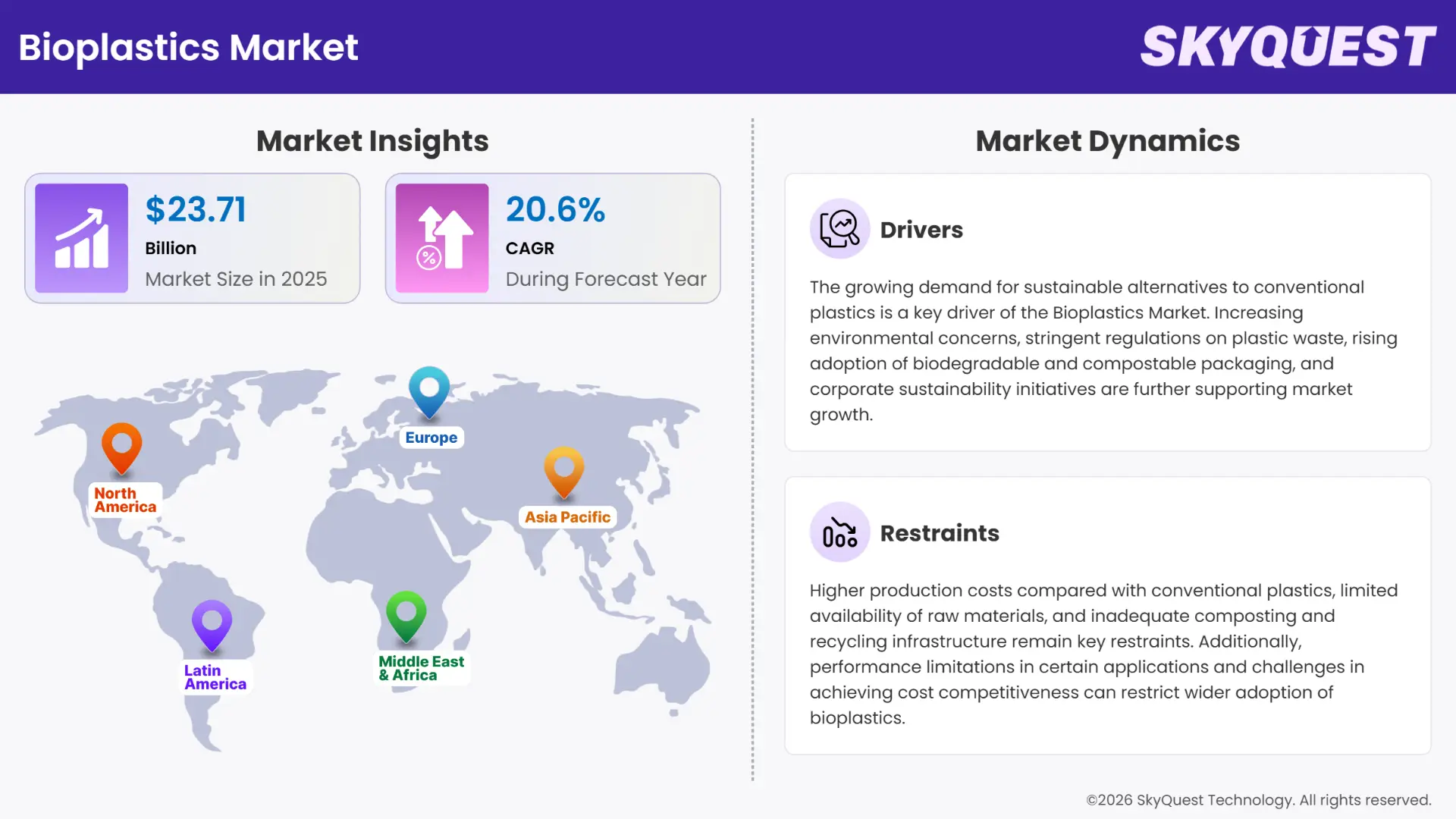
Global Bioplastics Market size was valued at USD 19.66 Billion in 2024 and is poised to grow from USD 23.71 Billion in 2025 to USD 106.10 Billion by 2033, growing at a CAGR of 20.6% during the forecast period (2026–2033).
Key Takeaways: Market Trends & Insights
Growing public awareness of environmental sustainability, stricter enforcement of waste management and emissions regulations, and consumer demand for eco-friendly products are some of the key drivers driving the global bioplastics market growth. The market's prospects are also being enhanced by the expanding use of flexible bioplastics in the food and beverage sector. Bioplastics derived from cornstarch can be utilized in flexible and loose-fill packaging. Additionally, consumers' busy lifestyles, the world's growing working population, and their increasing purchasing power are driving the bioplastics industry for packaging by increasing demand for ready-to-cook food packages.
Technological innovation is a key driver of the bioplastics market. Additionally, advancements in polymer science, material engineering, and manufacturing processes are creating bioplastics that are increasingly comparable to their petroleum-based counterparts in terms of price and functionality. Furthermore, several well-known businesses are working together to benefit from advanced technologies for the manufacturing of bioplastics.
What Role Does AI Play in Enhancing Bioplastics Manufacturing Efficiency?
Artificial intelligence (AI) is transforming the bioplastics market outlook because it accelerates material discovery, production optimization, forecasting of demand, and consumer demand understanding. AI algorithms reduce R&D time and cost by helping to discover new biopolymer formulations that have desirable properties such as heat resistance and biodegradability. Artificial Intelligence (AI) improves industrial process efficiency, reduces waste, and improves quality assurance by monitoring in real-time.
To get more insights on this market click here to Request a Free Sample Report
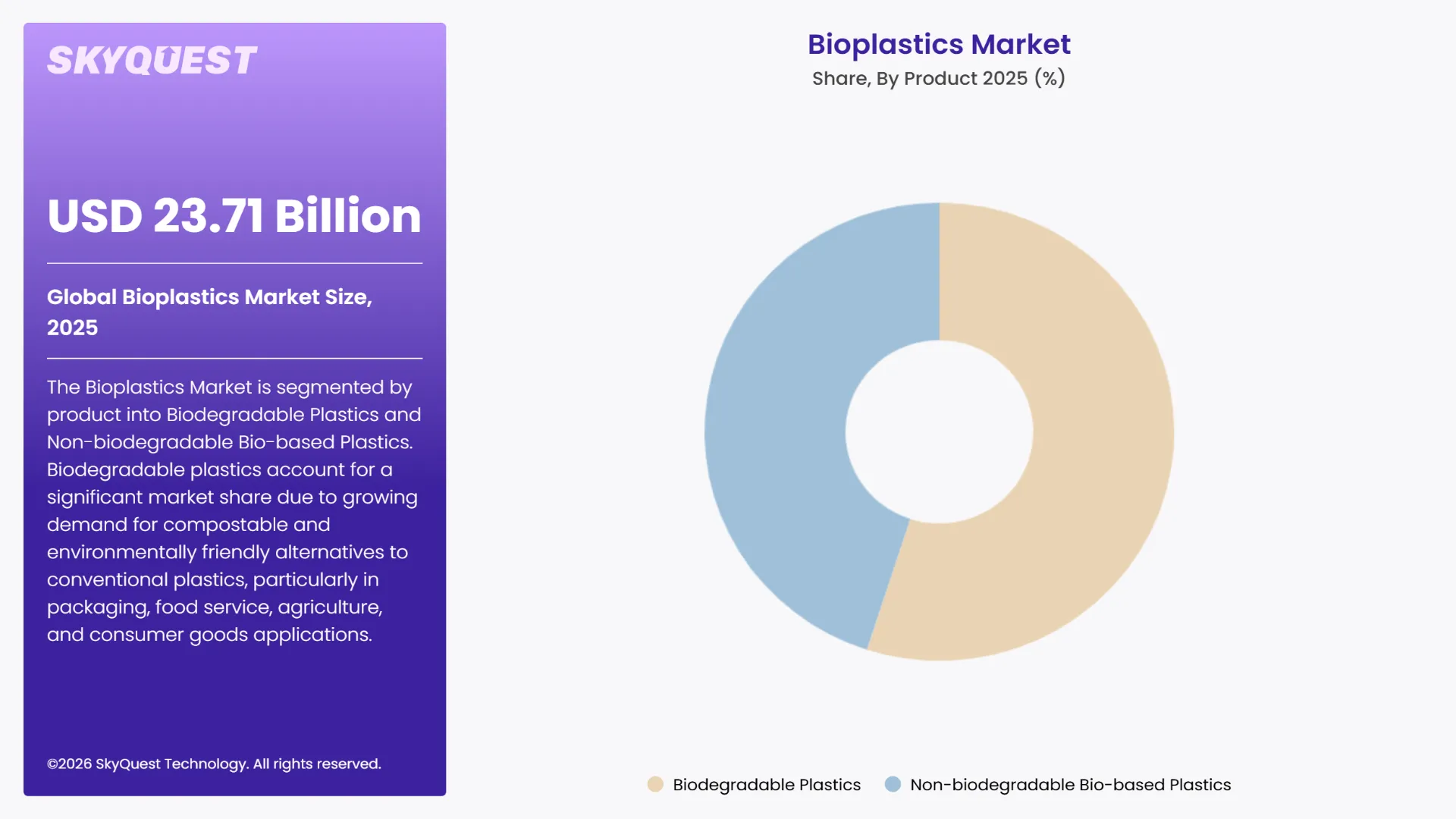
The global bioplastics market is segmented into product, application, distribution channel, and region. By product, the market is bifurcated into biodegradable and non-biodegradable. Depending on the application, it is divided into packaging, agriculture, automotive & transportation, electronics, and textiles. According to distribution channel, the market is classified into online and offline. Regionally, it is analyzed across North America, Europe, Asia-Pacific, Latin America, and the Middle East and Africa.
As per the 2024 bioplastics market analysis, the biodegradable segment had the largest revenue share (50.02%). This expansion is primarily driven by the growing need for bio-based plastics in packaging, healthcare, and agriculture. The surge in packaged foods and personal protective equipment use continues to drive demand.
The non-biodegradable segment is expected to expand its bioplastics market share during the forecast period. Carry bags, electronics, food packaging, and car interiors all make extensive use of these bioplastics. Companies like NatureWorks increased their production of non-biodegradable PLA-based bioplastics in 2024 to provide sustainable alternatives to conventional plastics and satisfy the need for long-lasting applications in the electronics and automotive industries.
As per the 2024 bioplastics market forecast, the packaging segment had the highest revenue share of 61.36% as a result of the growing use of bioplastics in films, sheets, and personal care packaging. Common materials include PLA, PBAT, PET, starch blends, and PBS. In May 2025, Danone switched to PLA-based bottles for its yogurt drinks in Europe, citing lower emissions and better compostability as proof of the expanding use of bioplastics in food packaging.
The automotive & transportation segment is expected to grow at the fastest compound annual growth rate (CAGR) in the coming years. Bioplastics are increasingly being used in under-the-hood parts and interior trims due to their lightweight nature and environmental friendliness. In 2024, Ford Motor Company teamed up with NatureWorks to develop dashboard panels made of non-biodegradable PLA blends in an attempt to reduce overall vehicle emissions and material waste.
To get detailed segments analysis, Request a Free Sample Report
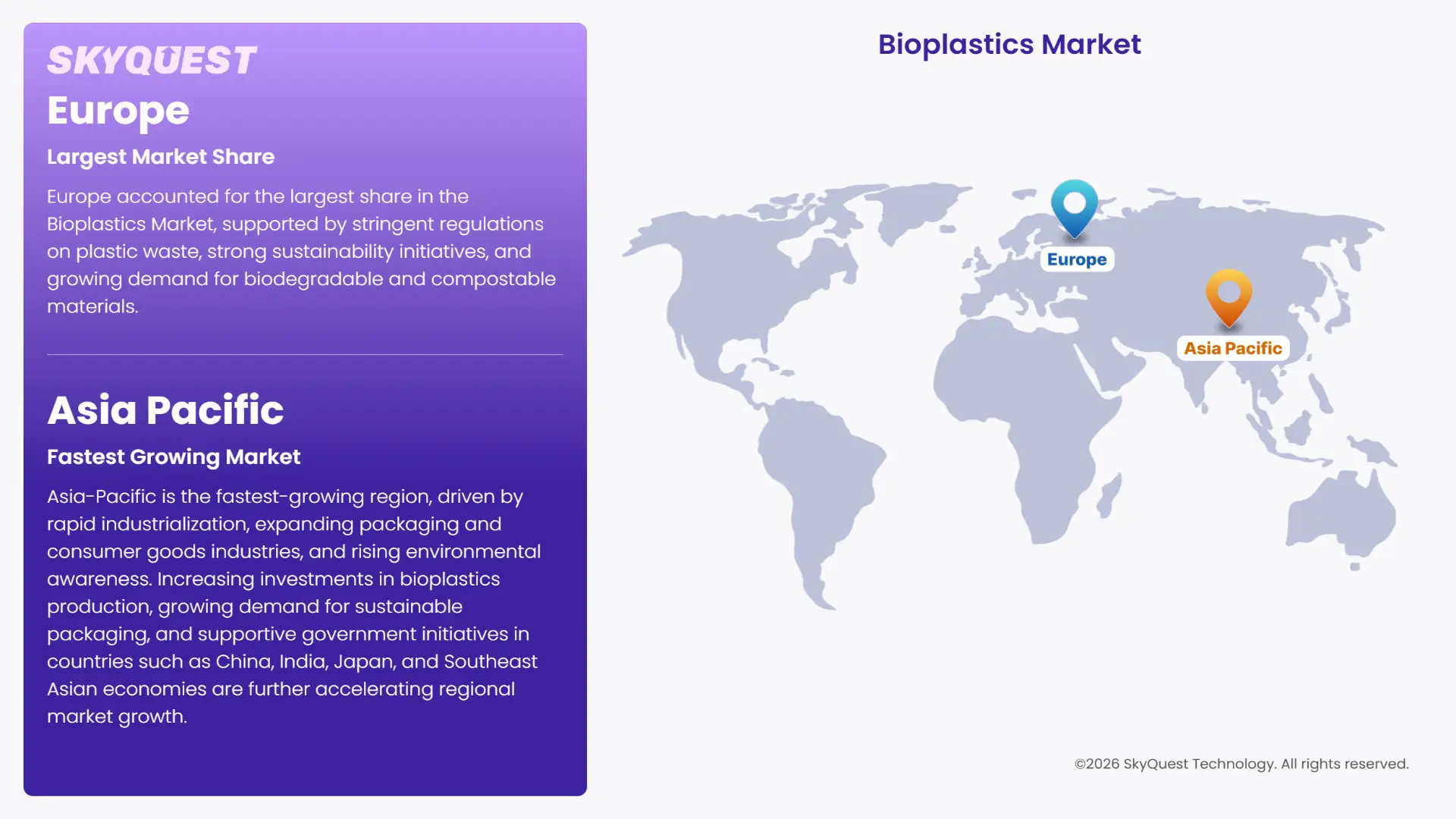
As per the bioplastics market regional analysis, Europe continues to lead the bioplastics market due to its strict environmental laws and circular economy initiatives. The EU revised the Packaging and Packaging Waste Regulation (PPWR) in March 2025, requiring a greater use of bioplastics that can be composted. The market momentum is strengthened by big-box retailers like Lidl and Carrefour expanding their biodegradable packaging lines.
UK Bioplastics Market
The UK bioplastics sector is driven due to government initiatives in the country. As part of its Extended Producer Responsibility (EPR) policies in 2024, the UK government offered tax breaks to companies that used biodegradable packaging materials. Bioplastic packaging for private-label food was introduced by companies such as Tesco. Manufacturers and retailers in the FMCG and e-commerce sectors are being pushed to switch to recyclable and biodegradable bioplastics by the mounting pressure to meet net-zero targets by 2050.
France Bioplastics Market
The demand for bioplastics increased after France outlawed single-use plastic packaging for fruits and vegetables in January 2024. In 2025, the local business Lactips, which specializes in water-soluble bioplastics made from milk protein, increased collaborations throughout Europe. Scaling up innovation in bio-based materials, especially in food and personal care packaging, has been made possible by government support through its Green Industry Plan.
Germany Bioplastics Market
Germany is still at the forefront of bioplastics research and development in Europe. New biodegradable polymer solutions for food service packaging were introduced by BASF in 2024. Adoption has been driven by strong consumer demand and legislation that aligns with EU climate targets, particularly in the automotive and packaging industries. The government's bioeconomy initiative has led to a surge in public-private investment in the development of biodegradable materials.
The bioplastics market in Asia-Pacific is expanding at the fastest rate due to rapid industrialization, environmentally conscious consumer demand, and favorable government regulations. Bioplastics are emphasized as a crucial element of circular economy transitions at the Asia Plastics Sustainability Summit in 2025, which also witnessed increased cooperation between global FMCG companies and local suppliers.
South Korea Bioplastics Market
The bioplastics market in South Korea is driven significantly. In 2024, South Korea imposed mandatory bioplastic packaging quotas on large retail chains. To keep up with the growing demand for PLA both domestically and internationally, CJ CheilJedang increased its production capacity. Government funding under the "Green New Deal" is accelerating the development of high-strength biodegradable plastics, particularly for use in food packaging and electronics.
Japan Bioplastics Market
The bioplastics market in Japan is growing at a notable rate. By 2030, Japan wants to use 25% less plastic and more bioplastics. Mitsubishi Chemical introduced beverage bottle solutions and bio-based polyethylene detergent in 2025. Retail behemoths like Aeon were the first to introduce bioplastic shopping bags across the country. Sustainable material alternatives are steadily gaining traction due to consumer eco-awareness and governmental regulations.
In North America, bioplastics is becoming increasingly popular as a result of state-level laws and business environmental pledges. The packaging and automotive industries are experiencing high demand. In 2024, Canada invested USD 50 million in clean-tech businesses that made bioplastics, and a number of American towns increased their composting facilities to encourage biodegradable packaging.
US Bioplastics Market
The demand for biodegradable films and containers increased in 2024 when California and New York required certain businesses to use compostable packaging. To satisfy the demands of well-known companies like PepsiCo, Danimer Scientific increased the size of its PHA production facilities. Numerous states have seen an increase in the production of bio-based materials as a result of the federal incentives provided by the Inflation Reduction Act.
Canada Bioplastics Market
Investment in bioplastics increased after Canada banned six types of single-use plastics in 2024. In 2025, the Canadian government started experimenting with biodegradable food packaging at national parks and public institutions in collaboration with regional businesses. Government pressure and consumers' growing preference for environmentally friendly options are driving the market.
To know more about the market opportunities by region and country, click here to
Buy The Complete Report
Growing Environmental Concerns and Bans on Plastic
Rising Demand in Packaging Sector
High Production Costs
Inadequate Industrial Composting Facilities
Request Free Customization of this report to help us to meet your business objectives.
Businesses are concentrating on creating novel bio-based polymers, increasing their production capabilities, and establishing strategic alliances in the fiercely competitive bioplastics sector. BASF and Novamont concentrate on biodegradable chemicals, while NatureWorks and TotalEnergies Corbion scale PLA production. To incorporate bioplastics into shared supply chains, players are working with packaging and fast-moving consumer goods companies and investing in feedstock innovation. Joint ventures and M&A operations continue to be important strategic levers.
Improvements in Use of Lignocellulosic Biomass, Algae and Agricultural Residues as Feedstocks
Leading Firms Making the Switch to Sustainable Packaging
SkyQuest’s ABIRAW (Advanced Business Intelligence, Research & Analysis Wing) is our Business Information Services team that Collects, Collates, Correlates, and Analyses the Data collected by means of Primary Exploratory Research backed by robust Secondary Desk research.
As per SkyQuest analysis, the bioplastics market is expanding because of customer preferences for greener products, regulation on traditional plastics, and global efforts towards sustainability. Bioplastics are already being adopted in products from the packaging, food service, and agricultural regions. However, consumer and institutional concerns about costs and composting avenues need to be addressed in order to realize the total market opportunity. Startups are taking bioplastics into new territory by using new feedstocks such as seaweed and casein while other businesses are staking growth on scaling production and improving material performance. More research and development, government favors, and coordinated initiatives and investments can make bioplastics an important solution for a future low-carbon and circular economy over the next decade.
| Report Metric | Details |
|---|---|
| Market size value in 2024 | USD 19.66 Billion |
| Market size value in 2033 | USD 106.10 Billion |
| Growth Rate | 20.6% |
| Base year | 2024 |
| Forecast period | 2026–2033 |
| Forecast Unit (Value) | USD Billion |
| Segments covered |
|
| Regions covered | North America (US, Canada), Europe (Germany, France, United Kingdom, Italy, Spain, Rest of Europe), Asia Pacific (China, India, Japan, Rest of Asia-Pacific), Latin America (Brazil, Rest of Latin America), Middle East & Africa (South Africa, GCC Countries, Rest of MEA) |
| Companies covered |
|
| Customization scope | Free report customization with purchase. Customization includes:-
|
To get a free trial access to our platform which is a one stop solution for all your data requirements for quicker decision making. This platform allows you to compare markets, competitors who are prominent in the market, and mega trends that are influencing the dynamics in the market. Also, get access to detailed SkyQuest exclusive matrix.
Table Of Content
Executive Summary
Market overview
Parent Market Analysis
Market overview
Market size
KEY MARKET INSIGHTS
COVID IMPACT
MARKET DYNAMICS & OUTLOOK
Market Size by Region
KEY COMPANY PROFILES
Methodology
For the Bioplastics Market, our research methodology involved a mixture of primary and secondary data sources. Key steps involved in the research process are listed below:
1. Information Procurement: This stage involved the procurement of Market data or related information via primary and secondary sources. The various secondary sources used included various company websites, annual reports, trade databases, and paid databases such as Hoover's, Bloomberg Business, Factiva, and Avention. Our team did 45 primary interactions Globally which included several stakeholders such as manufacturers, customers, key opinion leaders, etc. Overall, information procurement was one of the most extensive stages in our research process.
2. Information Analysis: This step involved triangulation of data through bottom-up and top-down approaches to estimate and validate the total size and future estimate of the Bioplastics Market.
3. Report Formulation: The final step entailed the placement of data points in appropriate Market spaces in an attempt to deduce viable conclusions.
4. Validation & Publishing: Validation is the most important step in the process. Validation & re-validation via an intricately designed process helped us finalize data points to be used for final calculations. The final Market estimates and forecasts were then aligned and sent to our panel of industry experts for validation of data. Once the validation was done the report was sent to our Quality Assurance team to ensure adherence to style guides, consistency & design.
Analyst Support
Customization Options
With the given market data, our dedicated team of analysts can offer you the following customization options are available for the Bioplastics Market:
Product Analysis: Product matrix, which offers a detailed comparison of the product portfolio of companies.
Regional Analysis: Further analysis of the Bioplastics Market for additional countries.
Competitive Analysis: Detailed analysis and profiling of additional Market players & comparative analysis of competitive products.
Go to Market Strategy: Find the high-growth channels to invest your marketing efforts and increase your customer base.
Innovation Mapping: Identify racial solutions and innovation, connected to deep ecosystems of innovators, start-ups, academics, and strategic partners.
Category Intelligence: Customized intelligence that is relevant to their supply Markets will enable them to make smarter sourcing decisions and improve their category management.
Public Company Transcript Analysis: To improve the investment performance by generating new alpha and making better-informed decisions.
Social Media Listening: To analyze the conversations and trends happening not just around your brand, but around your industry as a whole, and use those insights to make better Marketing decisions.
REQUEST FOR SAMPLE
 REQUEST FREE CUSTOMIZATION
Global Bioplastics Market size was valued at USD 19.66 Billion in 2024 and is poised to grow from USD 23.71 Billion in 2025 to USD 106.1 Billion by 2033, growing at a CAGR of 20.6% during the forecast period (2026–2033).
Key vendors in the Bioplastics Market include NatureWorks LLC, BASF SE, TotalEnergies Corbion, Novamont S.p.A., Biome Bioplastics Limited, Braskem S.A., Mitsubishi Chemical Group Corporation, Toray Industries, Inc., FKuR Kunststoff GmbH, Plantic Technologies Limited, Corbion N.V., Danimer Scientific, and Green Dot Bioplastics. These companies are focusing on bio-based polymers, biodegradable materials, PLA production, compostable packaging, and advanced sustainable plastic solutions.
The key driver of the Bioplastics Market is the growing demand for sustainable alternatives to conventional petroleum-based plastics. Increasing environmental concerns, stringent regulations on plastic waste and single-use plastics, rising consumer preference for eco-friendly packaging, and corporate sustainability initiatives are further accelerating market growth.
The key market trend in the Bioplastics Market is the increasing adoption of bio-based, biodegradable, and compostable plastics. Manufacturers are developing advanced materials with improved mechanical performance, heat resistance, and barrier properties for packaging, automotive, agriculture, and consumer goods, while investing in circular-economy and sustainable production technologies.
Europe accounted for the largest share in the Bioplastics Market, supported by stringent regulations on plastic waste, strong sustainability initiatives, growing demand for biodegradable and compostable materials, and increasing adoption of eco-friendly packaging solutions. Government policies promoting circular-economy practices and investments in bio-based materials further strengthen the region’s market leadership.


Want to customize this report? This report can be personalized according to your needs. Our analysts and industry experts will work directly with you to understand your requirements and provide you with customized data in a short amount of time. We offer $1000 worth of FREE customization at the time of purchase.
Feedback From Our Clients


 USA (+1) 351-333-4748

