Biopharma Plastics Market
Report ID: SQMIG15E3442
Report ID: SQMIG15E3442
[email protected]
USA +1 351-333-4748
Report ID:
SQMIG15E3442 |
Region:
Global |
Published Date: May, 2026
Pages:
157
|Tables:
118
|Figures:
72


Global Biopharma Plastics Market size was valued at USD 22.52 Billion in 2024 and is poised to grow from USD 24.19 Billion in 2025 to USD 42.85 Billion by 2033, growing at a CAGR of 7.42% during the forecast period (2026-2033).
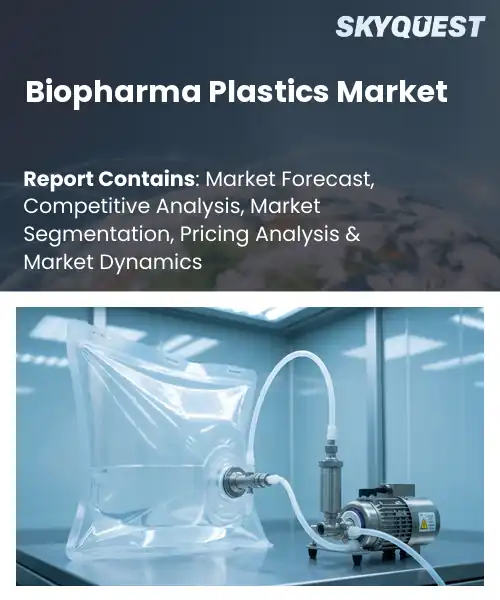
As a biopharma analyst, I identify the accelerating demand for single-use systems that minimize contamination risk and enhance manufacturing flexibility as the principal driver for the biopharma plastics market growth. Drug development, biologics manufacturing, and clinical supply all contain polymeric components used in these three areas, and thus they are important because sterility, scalability, and regulatory compliance all have direct impacts on product safety and time to market. Over the last 20 years, manufacturers have transitioned away from stainless steel to disposable bag, tubing, and connector systems; companies such as Sartorius and Cytiva have scaled up their production rate of sterile assembly equipment. This change has provided a reduction in capital expenditure and has provided the ability to expand production capacity during globally driven vaccine development campaigns due to the COVID-19 pandemic.
The necessity for supply chain agility and increased regulation will be significant drivers of growth in the global biopharma plastics market trends. Stringent contamination control requirements will result in manufacturers adopting validated disposable products which will streamline cleaning processes and reduce documentation requirements. Manufacturers that invest in gamma stable polymers and aseptic connectors will experience accelerated batch turnover rates due to faster, more reliable method of manufacturing and have fewer, if any, liabilities associated with cross-contamination which will lower their operational risks and associated insurance costs. Real-world use cases (such as single-use bioreactor systems that expedite monoclonal antibody scale-up production and pre-filled polymer syringes that improve logistical support for clinical trials) highlight the relationship between material innovations and supplier qualifications driving exponential growth opportunities by reducing time to clinic and reducing cost per dose.
How is Automation Enhancing Quality Control in the Biopharma Plastics Market?
The rise of automation in biopharma plastics industry trends has led to improved quality control standards through the implementation of a combination of technologies such as machine vision, robotics, inline sensors and AI to catch and ensure the sterility of defects prior to leaving the production line. Manufacturers today have a increased level of regulatory scrutiny than previously experienced, as well as an increase in demand for single use products, making consistent inspection and traceability extremely important. Automated vision systems assist in detecting subtle surface and assembly defects, while robotic handling eliminates human contact and reduces the risk of contamination. The use of digital traceability allows for inspection results to be associated with batches of product, thereby reducing the time it takes to carry out investigations related to defective batches after production, as well as allowing for quicker release of product. The combination of these technologies will create greater reliability in manufacturing as well as simplifying the ability for both customers and regulators to validate the production process.
SEA Vision's release in May 2026 of the AI based inspection and automated line clearance features will greatly improve the ability of biopharma plastics manufacturers to detect defects and will allow for faster changeovers, thereby creating faster and more efficient quality control processes that will allow for increased confidence in the ability of biopharma plastics suppliers to scale their production operations.
Market snapshot - (2026-2033)
Global Market Size
USD 22.52 Billion
Largest Segment
Single-Use Bags
Fastest Growth
Single-Use Bags
Growth Rate
7.42% CAGR
To get more insights on this market click here to Request a Free Sample Report
Global biopharma plastics market is segmented by product type, material, application, end-user and region. Based on product type, the market is segmented into single-use bags, bioprocess containers, tubing & connectors and bottles & vials. Based on material, the market is segmented into polyethylene (PE), polypropylene (PP) and ethylene vinyl acetate (EVA). Based on application, the market is segmented into upstream bioprocessing, downstream bioprocessing and drug storage & packaging. Based on end-user, the market is segmented into biopharmaceutical companies, CDMOs and research institutes. Based on region, the market is segmented into North America, Europe, Asia Pacific, Latin America and Middle East & Africa.
The biopharmaceutical manufacturers section of single use bags for biopharmaceutical manufacturing dominates the biopharma plastics market forecast as biopharmaceutical manufacturers prefer disposable products to reduce the risk of contamination and reduce validation timeframes. Also, single use bags provide compatibility with flexible production operations and easy incorporation into single-use manufacturing and supply chain processes result in minimal downtime for the facility and ease of scale up. Supplier advancements in sterile assembly and standard connection interfaces will increase reliability and bulk use, and regulatory approval of disposable systems combined with increased adoption of disposable systems by biopharmaceutical companies and CDMOs will continue to fuel the growing demand for bag-based solutions and allow for accelerated product launches.
However, the tubing & connectors are experiencing the greatest compound annual growth due to the increased demand for closed sterile fluid pathways and quick connect connecting technology. New product designs for connectors, material compatibility, and the integration of automated assembly techniques will enable faster assembly and substantially decrease the risk of contamination, thus creating new customization opportunities for both manufacturers and service providers.
Upstream bioprocessing segment dominates because it concentrates early production tasks that rely heavily on disposable fluid handling and containment solutions to maintain sterile conditions and accelerate campaign turnover. The need for flexible, scalable setups encourages adoption of bags, tubing, and single-use containers that simplify validation and reduce cross contamination. Process intensification trends and bioreactor modularity further raise requirements for adaptable plastic components, reinforcing upstream demand across manufacturers and CDMOs.
Meanwhile, drug storage & packaging is the strongest growth area as demand rises for bottles and vials with improved barrier and material compatibility for biologics. Regulatory focus on stability and serialization, together with varied dosage forms, spurs material development and production innovations, unlocking opportunities for plastics suppliers and packaging service providers.
To get detailed segments analysis, Request a Free Sample Report
The combination of advanced biopharmaceutical infrastructures available in North America, along with established regulatory procedures and an integrated connection among manufacturers of plastic components and manufacturers of drugs, has resulted in North America being the clear leader for single-use systems. The emergence of numerous contractor manufacturing organizations and specialty suppliers promoting single-use systems, engineered polymers and sterile disposable assemblies, along with collaborative relationships among many research facilities, suppliers, and end-users that foster innovation in material science and provide documentation for scalable validation processes, has supported the rapid adoption of these types of systems. There is also a strong quality culture and regulatory compliant investment in traceable, biocompatible plastics, as well as a comprehensive qualification process for suppliers. The existing capabilities to manufacture medical devices and packaging, coupled with sophisticated logistics and strong end-user pressures to have controlled supply chains, further support North America's leadership position and competitive advantage in providing advanced polymer solutions for use in biologics and cell therapy products.
Biopharma plastics market regional forecast in the United States is rich in specialized knowledge and supportive manufacturing hubs with a high level of willingness to accept new polymer-based technologies. The presence of strict regulations and standards for single-use items has also supported high-level supply chain capabilities. Through robust collaboration between contract manufacturers and device manufacturers and research and academic institutions, there is more rapid movement from the development of innovative materials into commercial use. As a result, many organizations are now able to fulfill the needs of biologic processed food and packaging; as well as the needs for sterile clinical environments; across many therapeutic areas.
Biopharma plastics market share in Canada benefits from an interactive regulatory framework, the existence of manufacturing hubs, and strong emphasis on quality control systems used by all suppliers. Many companies are producing single use systems ( assembly ) / sterilizable components that conform to global packaging standards. Existing relationships between research institutions and manufacturers, help facilitate the introduction of new polymer blends to the marketplace. By creating these two relationships, manufacturers can qualify suppliers, source materials, and easily incorporate biocompatible plastics into their biopharmaceutical and vaccine production processes.
The rapid expansion of Europe is being fueled by several factors, including strengthened pharmaceutical manufacturing networks, policy alignment supporting material qualification, and the growing uptake of flexible single-use technologies. Specifically, suppliers in Europe are focusing on providing customized solutions that are ready for regulatory approval and that include validated polymer grades and assembly services specifically to meet the requirements of complex biologic processes. Additionally, collaborations across borders between manufacturers, contract service providers, and academic centres help accelerate validation pathways and improve supply chain resilience. There is also significant investment being made in local production capacity and sustainable material innovations, combined with an increasingly sophisticated customer base, providing momentum in the marketplace and creating a competitive environment for advanced biopharma plastic solutions. Centres of excellence in Europe are developing skills in aseptic processing, contamination control and material testing, allowing for quicker adoption of novel polymer formulations. Additionally, there is an emphasis on traceability, supplier audits and lifecycle management, which aids in integrating complex biologic supply chains, while also having sustainability considerations driving the development of recyclable or lower-footprint material options that meet regulatory requirements and customer demands.
Biopharma plastics market in Germany is s characterized by an experienced workforce, an extensive and capable manufacturing infrastructure as well as an emphasis on designing reliable sterile systems through engineering. Most suppliers concentrate on providing extremely high quality polymer grades, validated tubing and containment assemblies that have been engineered specifically for use in complex biologic processes. The close collaboration among equipment builders, material scientists and contract manufacturers allows for rapid process qualification. An environment of technical excellence and large-scale capabilities enables customers to obtain high-quality, reliable materials for demanding applications within the biophar plastics industry.
Biopharma plastics market in the United Kingdom is built on active pharmaceutical biotech centres and CDMOs along with a supply chain that welcomes innovative materials. Supplier partners place priority on modular single-use systems, custom assemblies, and regulatory support services to expedite market entry. There is a high degree of collaboration between therapeutic product developers and responsive contract manufacturers that aids in speeding up adoption. The environment encourages suppliers' responsiveness, innovation in novel polymer products and sourcing solutions that respond to change within biologic production methods.
Biopharma plastics market in France is growing due to strategic investments into specialized production processes, working together on new technologies between research institutions and industry, and having an emphasis on regulatory and material compliance. Suppliers are creating custom single-use items and sterilized packaging that meet the requirements of international quality standards. The desire for sustainable material options and good lifecycle management positions the industry for innovation. The continued development of domestic capacity will benefit the qualification of suppliers and lead to more widespread use of advanced polymer technologies in biological manufacturing markets.
Companies in the Asia Pacific region are making great strides in establishing their local manufacturing capacity by growing their expertise in material science and developing partnerships with global suppliers and contract manufacturers. The region's businesses are making investments in scalable production methods, contamination control, and validated manufacturing practices that are consistent with international quality standards so they can export into complex biologic supply chains. As a result of these developments, regional businesses will be well positioned to enter into complex manufactured goods supply chains. Cross border cooperation, technology transfer, and targeted capability-building initiatives are supporting the rapid growth of polymer processing and single-use component manufacturing. Automation, supplier qualification, and lifecycle management have become key areas of focus and are helping to create competitive production ecosystems, enabling the region to provide compelling alternatives to plastics used in biopharma and facilitate innovation in this area. Government and industry association support for skills development, standards harmonization, and focused incentive programs will assist domestic suppliers with meeting the rigorous validation requirements demanded by the marketplace.
Biopharma plastics industry in Japan, advanced material research, sophisticated production capabilities, and a strong commitment to both quality assurance (QA) as well as regulatory compliance has created a solid foundation. With specialized domestic suppliers that can provide high purity polymer materials; precise molded parts; and sterile connector systems developed specifically for the multifaceted complexities of biologic-transfer workflows, cooperative endeavors between manufacturers and academia have expedited both the process of material qualification and application testing. In addition to the strong relationship between manufacturers and academia, a culture rooted in both innovation and optimizing processes assures both supplier reliability and integration within the global biopharmaceutical supply chain.
Biopharma plastics market regional outlook in South Korea has been supported by a strong manufacturing base, a high level of polymer processing adoption, and cooperation between developers and engineers throughout the supply chain. In addition, local businesses have focused on the production of precision-extruded, sterile assembled, and validated components for producing biologics. The combination of various government and industry programs focused on quality system and supplier certification creates an ecosystem that encourages fast, flexible innovation, scalable production, and the ability to deliver single-use products and high-integrity packaging to customers around the world.
To know more about the market opportunities by region and country, click here to
Buy The Complete Report
Regulatory Compliance And Safety Standards
Rising Demand For Single Use Systems
Material Compatibility And Leachables Concerns
Limited Recycling And Sustainability Infrastructure
Request Free Customization of this report to help us to meet your business objectives.
A dominant theme of global competition within the biopharma plastics sector is focused on developing single use systems; however, supply chain resilience and the establishment of high compliance standards are also major areas of competitive differentiation. In this respect, companies are increasingly pursuing strategic consolidations or vertical integrations as primary sources of growth. For example, their consolidating acquisitions of suppliers like ARTeSYN and NMS by Repligen will support the acquisition of components for single use assemblies (e.g., single use pumps, pinch valves, etc.). Meanwhile, specialty manufacturers as well as newer companies looking to scale up their businesses will increasingly use partnerships or collaborations through innovative material generation to achieve sustainability goals.
Top Player’s Company Profile
Recent Developments in the Biopharma Plastics Market
SkyQuest’s ABIRAW (Advanced Business Intelligence, Research & Analysis Wing) is our Business Information Services team that Collects, Collates, Correlates, and Analyses the Data collected by means of Primary Exploratory Research backed by robust Secondary Desk research.
As per SkyQuest analysis, the global biopharma plastic market analysis is predominantly expanding due to the increasing usage of single-use systems as they offer an opportunity to decrease contamination risk and scale up in a shorter amount of time. Another category driving the global biopharma plastic market is the increased amount of automation and use of digital traceability, which allows for improved inspection, validation and better visibility throughout the supply chain. Material compatibility and concerns regarding leachables are major restraints, therefore delaying the adoption of new polymer alternatives. North America will continue to be the leading region because of the large number of suppliers, mature infrastructure and alignment with regulations; likewise, the single-use bag segment will continue to lead the segment because they simplify the validation process and provide a disposable, flexible workflow. Overall, opportunities exist for the development of new materials, qualifying suppliers and developing sustainable solutions.
| Report Metric | Details |
|---|---|
| Market size value in 2024 | USD 22.52 Billion |
| Market size value in 2033 | USD 42.85 Billion |
| Growth Rate | 7.42% |
| Base year | 2024 |
| Forecast period | (2026-2033) |
| Forecast Unit (Value) | USD Billion |
| Segments covered |
|
| Regions covered | North America (US, Canada), Europe (Germany, France, United Kingdom, Italy, Spain, Rest of Europe), Asia Pacific (China, India, Japan, Rest of Asia-Pacific), Latin America (Brazil, Rest of Latin America), Middle East & Africa (South Africa, GCC Countries, Rest of MEA) |
| Companies covered |
|
| Customization scope | Free report customization with purchase. Customization includes:-
|
To get a free trial access to our platform which is a one stop solution for all your data requirements for quicker decision making. This platform allows you to compare markets, competitors who are prominent in the market, and mega trends that are influencing the dynamics in the market. Also, get access to detailed SkyQuest exclusive matrix.
Table Of Content
Executive Summary
Market overview
Parent Market Analysis
Market overview
Market size
KEY MARKET INSIGHTS
COVID IMPACT
MARKET DYNAMICS & OUTLOOK
Market Size by Region
KEY COMPANY PROFILES
Methodology
For the Biopharma Plastics Market, our research methodology involved a mixture of primary and secondary data sources. Key steps involved in the research process are listed below:
1. Information Procurement: This stage involved the procurement of Market data or related information via primary and secondary sources. The various secondary sources used included various company websites, annual reports, trade databases, and paid databases such as Hoover's, Bloomberg Business, Factiva, and Avention. Our team did 45 primary interactions Globally which included several stakeholders such as manufacturers, customers, key opinion leaders, etc. Overall, information procurement was one of the most extensive stages in our research process.
2. Information Analysis: This step involved triangulation of data through bottom-up and top-down approaches to estimate and validate the total size and future estimate of the Biopharma Plastics Market.
3. Report Formulation: The final step entailed the placement of data points in appropriate Market spaces in an attempt to deduce viable conclusions.
4. Validation & Publishing: Validation is the most important step in the process. Validation & re-validation via an intricately designed process helped us finalize data points to be used for final calculations. The final Market estimates and forecasts were then aligned and sent to our panel of industry experts for validation of data. Once the validation was done the report was sent to our Quality Assurance team to ensure adherence to style guides, consistency & design.
Analyst Support
Customization Options
With the given market data, our dedicated team of analysts can offer you the following customization options are available for the Biopharma Plastics Market:
Product Analysis: Product matrix, which offers a detailed comparison of the product portfolio of companies.
Regional Analysis: Further analysis of the Biopharma Plastics Market for additional countries.
Competitive Analysis: Detailed analysis and profiling of additional Market players & comparative analysis of competitive products.
Go to Market Strategy: Find the high-growth channels to invest your marketing efforts and increase your customer base.
Innovation Mapping: Identify racial solutions and innovation, connected to deep ecosystems of innovators, start-ups, academics, and strategic partners.
Category Intelligence: Customized intelligence that is relevant to their supply Markets will enable them to make smarter sourcing decisions and improve their category management.
Public Company Transcript Analysis: To improve the investment performance by generating new alpha and making better-informed decisions.
Social Media Listening: To analyze the conversations and trends happening not just around your brand, but around your industry as a whole, and use those insights to make better Marketing decisions.
REQUEST FOR SAMPLE
 REQUEST FREE CUSTOMIZATION
Global Biopharma Plastics Market size was valued at USD 22.52 Billion in 2024 and is poised to grow from USD 24.19 Billion in 2025 to USD 42.85 Billion by 2033, growing at a CAGR of 7.42% during the forecast period (2026-2033).
Competition in the global biopharma plastics market centers on single use systems, supply chain resilience and high compliance standards; strategic consolidation and vertical integration are primary drivers. Large suppliers pursue acquisitions to secure component supply for single use assemblies, for example Repligen's acquisitions of ARTeSYN and NMS, while specialty manufacturers and startups scale through targeted partnerships and material innovation. 'Sartorius AG', 'Cytiva (Danaher)', 'Thermo Fisher Scientific', 'Merck KGaA', 'Parker Hannifin', 'Saint-Gobain (Tygon)', 'Avantor Inc.', 'Meissner Filtration Products', 'Entegris Inc.', 'Lonza Group', 'Repligen Corporation', 'Novatek International', 'Corning Life Sciences', 'Pall Corporation (Danaher)', 'Genentech (Roche)'
Regulatory mandates and stringent safety standards compel biopharmaceutical manufacturers to adopt high-quality polymer solutions that minimize contamination risk and ensure process integrity. This requirement increases demand for specialty plastics designed for sterile single use systems and validated material performance, prompting suppliers to expand product portfolios and invest in quality assurance. The emphasis on compliance fosters long-term procurement relationships and encourages adoption of purpose-built components, which together support market growth by aligning industry practices with regulatory expectations and reducing process variability significantly.
Single-Use Systems Expansion: Adoption of single-use systems is reshaping manufacturing strategies by enabling flexible, scalable bioprocesses with reduced cross-contamination risk and faster campaign turnaround. Manufacturers and CMOs seek specialized polymer assemblies, bags, connectors and aseptic components that support rapid line changes and lower upfront investment. Suppliers are responding with tailored formulations and integrated components designed for reliability, ease of use, and compatibility with automated filling and cleaning workflows. Collaborative development between plastics makers and end users is expanding, creating opportunities across supply chains.
Why does North America Dominate the Global Biopharma Plastics Market? |@12


Want to customize this report? This report can be personalized according to your needs. Our analysts and industry experts will work directly with you to understand your requirements and provide you with customized data in a short amount of time. We offer $1000 worth of FREE customization at the time of purchase.
Feedback From Our Clients


 USA (+1) 351-333-4748

