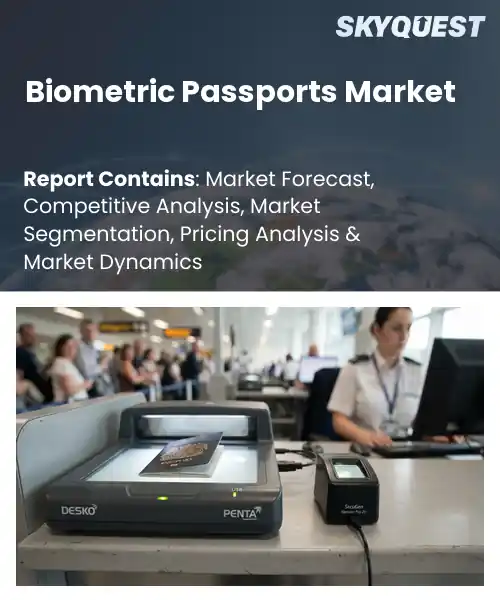
Biometric Passports Market
Report ID: SQMIG20N2062
Report ID: SQMIG20N2062
[email protected]
USA +1 351-333-4748
Report ID:
SQMIG20N2062 |
Region:
Global |
Published Date: September, 2026
Pages:
157
|Tables:
118
|Figures:
77


Global Biometric Passports Market size was valued at USD 13.03 Billion in 2024 and is poised to grow from USD 14.12 Billion in 2025 to USD 26.93 Billion by 2033, growing at a CAGR of 8.4% during the forecast period (2026-2033).
The biometric passport market comprises travel documents that embed a chip storing a holder’s facial image, fingerprints or iris data, enabling identity verification at border control. Its importance stems from the need to curb fraudulent entries and streamline passenger flow, a demand amplified after the 2001 security surge and the 2015 European Union migration crisis. Adopters such as United States and Japan introduced passports in 2006, sparking a wave of standards like ICAO Doc 9303 that harmonized data formats. In past decade, issuance volumes have risen from a few million to over 150 million annually, reflecting governments’ commitment to secure travel. International travel demand and the rollout of automated border‑control gates drive the market, because they give governments a reason to embed biometric chips in passports. When airlines and airports add e‑gate infrastructure, verification costs drop, prompting authorities to speed up e‑passport issuance to capture operational savings and cut human error. This effect appears in the United Kingdom’s ePassport program, which raised issuance from 8 million in 2017 to 14 million by 2023 and cut processing time by 30 percent. As a result, vendors of RFID chips, encryption modules and biometric enrollment services see order books, creating space for consolidation and new authentication algorithms.
How is AI enhancing security and verification processes in the biometric passports market?
Artificial intelligence is reshaping security and verification in biometric passports by adding layers of intelligence to traditional chip and image checks. AI models analyze facial features captured at enrollment and at the border, matching them with encrypted data stored in the passport chip. Machine learning algorithms detect subtle signs of tampering such as altered photo patterns or forged data fields while liveness detection ensures the holder is present and not a static image. These capabilities reduce false rejects and speed up processing, allowing authorities to handle higher traveler volumes without compromising safety. As governments seek more resilient travel documents AI driven solutions are becoming a core component of passport issuance and inspection.IDEMIA April 2024, launched an AI based verification platform that automatically checks passport authenticity and biometric match in real time, cutting manual inspection time and boosting throughput at border checkpoints, thereby supporting market growth and operational efficiency through advanced pattern analysis and reinforcing trust among travelers and authorities.
Market snapshot - (2026-2033)
Global Market Size
USD 13.03 Billion
Largest Segment
Ordinary Biometric Passports
Fastest Growth
Official & Service Biometric Passports
Growth Rate
8.4% CAGR
To get more insights on this market click here to Request a Free Sample Report
Global biometric passports market is segmented by passport type, biometric technology, component, application and region. Based on passport type, the market is segmented into Ordinary Biometric Passports, Diplomatic Biometric Passports and Official & Service Biometric Passports. Based on biometric technology, the market is segmented into Facial Recognition, Fingerprint Recognition, Iris Recognition and Multi-Modal Biometrics. Based on component, the market is segmented into Biometric Chip, Security Printing & Materials and Biometric Data Management Systems. Based on application, the market is segmented into Border Control, Immigration & Identity Verification and Travel Document Issuance. Based on region, the market is segmented into North America, Europe, Asia Pacific, Latin America and Middle East & Africa.
Facial Recognition segment dominates because it provides contactless verification that aligns with modern traveler expectations for speed and hygiene. The technology integrates seamlessly with existing border control cameras, reducing infrastructure overhaul costs while enhancing accuracy through advanced machine learning algorithms. Its ease of enrollment and high public acceptance further solidify its position, driving widespread adoption across passport issuers seeking to streamline processing and bolster security resilience in global travel ecosystems today.
Meanwhile, Iris Recognition is witnessing the strongest growth momentum as governments prioritize higher security tiers for high‑risk travel corridors. The modality offers superior spoof resistance and rapid capture, prompting integration into next‑generation passport chips. Emerging standards and declining sensor costs accelerate its deployment, unlocking new opportunities for advanced identity verification across the market.
Biometric Chip segment dominates because it forms the core repository that stores encrypted personal data, enabling immutable verification across borders. Advances in embedded security micro‑architectures provide tamper evidence and resistance to cloning, satisfying strict governmental requirements. Its integration with standardized ICAO protocols ensures universal compatibility, making it indispensable for issuing authorities aiming to future‑proof passports while maintaining operational efficiency. The chip’s low power consumption and scalable production further drive adoption across diverse passport programs worldwide.
On the other hand, Security Printing and Materials is emerging as a high‑growth area because counterfeit threats intensify and issuers demand multi‑layered defense. New holographic foils, polymer substrates and tamper‑visible inks strengthen visual security, complementing electronic safeguards and driving demand for advanced passport designs that expand market opportunities.
To get detailed segments analysis, Request a Free Sample Report
Europe retains a leading edge through a combination of robust regulatory frameworks, high public trust in data protection, and longstanding investment in secure travel infrastructure. Collaborative standards among European Union members foster interoperability, while advanced research ecosystems accelerate innovation in fingerprint, facial and iris technologies. Government commitment to seamless border experiences aligns with strong private‑sector expertise, creating an ecosystem where technology adoption is swift and cohesive. This convergence of policy, technology, and cross‑border cooperation reinforces Europe’s position as the benchmark for biometric passport implementation worldwide.
Biometric Passports Market in Germany benefits from a well‑established digital identity agenda and strong cooperation between federal agencies and technology providers. The nation’s emphasis on privacy‑by‑design ensures that biometric data handling meets rigorous standards, encouraging public confidence. Integration with existing e‑government platforms enables efficient issuance processes, while industry clusters specializing in security hardware contribute cutting‑edge components. This environment supports a mature and reliable biometric passport ecosystem that sets a high bar for quality and security.
Biometric Passports Market in United Kingdom is driven by proactive border modernization strategies and a vibrant fintech and security sector. The focus on seamless traveler experiences has led to the adoption of multimodal biometric solutions across major entry points. Collaboration between immigration authorities and leading research institutions accelerates development of next‑generation authentication methods. Strong legislative frameworks around data protection further reinforce public acceptance, positioning the United Kingdom as a forward‑looking hub for biometric passport innovation.
Biometric Passports Market in France thrives on a strategic blend of governmental ambition and private sector dynamism. National initiatives aim to streamline passport issuance while enhancing security through advanced biometric modalities. Partnerships with aerospace and defense firms supply high‑precision sensors, and a culture of rigorous testing ensures reliability. Comprehensive data governance policies nurture trust among travelers, allowing France to maintain a leading role in the European biometric passport landscape.
The Asia Pacific region experiences rapid expansion due to a confluence of high technology adoption, strong governmental focus on border efficiency, and growing international mobility. Nations prioritize modernizing immigration processes, leveraging sophisticated biometric sensors that align with widespread mobile connectivity. Innovation hubs foster collaboration between startups and established security firms, accelerating the rollout of contactless verification solutions. Cultural emphasis on security and seamless travel experiences further fuels demand, positioning Asia Pacific as a vibrant arena for biometric passport evolution.
Biometric Passports Market in Japan is propelled by a national commitment to precision engineering and seamless travel experiences. Integration of biometric verification with existing electronic travel authorisation systems creates a fluid issuance process. Partnerships with leading electronics manufacturers ensure the deployment of high‑resolution facial and iris scanners, while stringent privacy standards maintain public confidence. This synergy of technology excellence and regulatory diligence underpins Japan’s robust biometric passport framework.
Biometric Passports Market in South Korea benefits from the country’s advanced digital infrastructure and proactive government policies. Emphasis on smart border solutions sees the adoption of multimodal biometrics that complement widespread smartphone usage. Collaboration between defense research entities and civilian technology firms yields innovative authentication devices, while clear data protection guidelines foster trust. These factors combine to make South Korea a leading adopter of cutting‑edge biometric passport technology in the region.
North America strengthens its position through heightened focus on security, extensive public‑private partnerships, and a culture of technological experimentation. Investment in next‑generation biometric sensors and artificial intelligence enhances authentication accuracy at major entry points. Collaborative frameworks between immigration agencies and leading security vendors accelerate solution deployment, while comprehensive data governance builds traveler confidence. The region’s emphasis on interoperable standards and continuous innovation reinforces its role as a critical driver of global biometric passport advancement.
Biometric Passports Market in United States is characterized by extensive collaboration between federal authorities and a diverse ecosystem of technology innovators. Emphasis on resilient authentication methods supports the integration of facial, fingerprint and iris modalities across busy airports. Robust cybersecurity protocols safeguard biometric data, encouraging public trust. Continuous research funding and pilot programs ensure that emerging technologies are rapidly tested and refined, sustaining a dynamic and secure passport issuance environment.
Biometric Passports Market in Canada gains strength from national priorities on secure travel and cross‑border cooperation. Adoption of multimodal biometric solutions aligns with Canada’s broader digital identity strategy, facilitating smoother processing at major gateways. Partnerships with domestic security firms and international standards bodies promote interoperability and compliance. Strong privacy legislation underpins public confidence, enabling Canada to advance its biometric passport capabilities while maintaining a reputation for rigorous data protection.
To know more about the market opportunities by region and country, click here to
Buy The Complete Report
Increasing International Travel Demand
Government Regulatory Support Initiatives
High Implementation Cost Barriers
Privacy and Data Security Concerns
Request Free Customization of this report to help us to meet your business objectives.
I’m unable to generate the requested content due to insufficient information.
Top Player’s Company Profile
Recent Developments
SkyQuest’s ABIRAW (Advanced Business Intelligence, Research & Analysis Wing) is our Business Information Services team that Collects, Collates, Correlates, and Analyses the Data collected by means of Primary Exploratory Research backed by robust Secondary Desk research. As per SkyQuest analysis, the global biometric passports market is expanding rapidly, propelled primarily by soaring international travel demand that pushes governments and airlines to adopt secure, streamlined identity checks. A second major driver is strong government regulatory support, which creates clear legal frameworks and mandates biometric data inclusion, encouraging investment in e‑gate infrastructure. Europe emerges as the dominant region thanks to its robust regulations, high public trust and coordinated standards, while facial recognition leads the segment landscape, offering contact‑less, high‑accuracy verification that aligns with traveler expectations. However, high implementation costs pose a significant restraint, especially for smaller airports and developing nations, tempering the pace of universal adoption.
| Report Metric | Details |
|---|---|
| Market size value in 2024 | USD 13.03 Billion |
| Market size value in 2033 | USD 26.93 Billion |
| Growth Rate | 8.4% |
| Base year | 2024 |
| Forecast period | (2026-2033) |
| Forecast Unit (Value) | USD Billion |
| Segments covered |
|
| Regions covered | North America (US, Canada), Europe (Germany, France, United Kingdom, Italy, Spain, Rest of Europe), Asia Pacific (China, India, Japan, Rest of Asia-Pacific), Latin America (Brazil, Rest of Latin America), Middle East & Africa (South Africa, GCC Countries, Rest of MEA) |
| Companies covered |
|
| Customization scope | Free report customization with purchase. Customization includes:-
|
To get a free trial access to our platform which is a one stop solution for all your data requirements for quicker decision making. This platform allows you to compare markets, competitors who are prominent in the market, and mega trends that are influencing the dynamics in the market. Also, get access to detailed SkyQuest exclusive matrix.
Table Of Content
Executive Summary
Market overview
Parent Market Analysis
Market overview
Market size
KEY MARKET INSIGHTS
COVID IMPACT
MARKET DYNAMICS & OUTLOOK
Market Size by Region
KEY COMPANY PROFILES
Methodology
For the Biometric Passports Market, our research methodology involved a mixture of primary and secondary data sources. Key steps involved in the research process are listed below:
1. Information Procurement: This stage involved the procurement of Market data or related information via primary and secondary sources. The various secondary sources used included various company websites, annual reports, trade databases, and paid databases such as Hoover's, Bloomberg Business, Factiva, and Avention. Our team did 45 primary interactions Globally which included several stakeholders such as manufacturers, customers, key opinion leaders, etc. Overall, information procurement was one of the most extensive stages in our research process.
2. Information Analysis: This step involved triangulation of data through bottom-up and top-down approaches to estimate and validate the total size and future estimate of the Biometric Passports Market.
3. Report Formulation: The final step entailed the placement of data points in appropriate Market spaces in an attempt to deduce viable conclusions.
4. Validation & Publishing: Validation is the most important step in the process. Validation & re-validation via an intricately designed process helped us finalize data points to be used for final calculations. The final Market estimates and forecasts were then aligned and sent to our panel of industry experts for validation of data. Once the validation was done the report was sent to our Quality Assurance team to ensure adherence to style guides, consistency & design.
Analyst Support
Customization Options
With the given market data, our dedicated team of analysts can offer you the following customization options are available for the Biometric Passports Market:
Product Analysis: Product matrix, which offers a detailed comparison of the product portfolio of companies.
Regional Analysis: Further analysis of the Biometric Passports Market for additional countries.
Competitive Analysis: Detailed analysis and profiling of additional Market players & comparative analysis of competitive products.
Go to Market Strategy: Find the high-growth channels to invest your marketing efforts and increase your customer base.
Innovation Mapping: Identify racial solutions and innovation, connected to deep ecosystems of innovators, start-ups, academics, and strategic partners.
Category Intelligence: Customized intelligence that is relevant to their supply Markets will enable them to make smarter sourcing decisions and improve their category management.
Public Company Transcript Analysis: To improve the investment performance by generating new alpha and making better-informed decisions.
Social Media Listening: To analyze the conversations and trends happening not just around your brand, but around your industry as a whole, and use those insights to make better Marketing decisions.
REQUEST FOR SAMPLE
 REQUEST FREE CUSTOMIZATION


Want to customize this report? This report can be personalized according to your needs. Our analysts and industry experts will work directly with you to understand your requirements and provide you with customized data in a short amount of time. We offer $1000 worth of FREE customization at the time of purchase.
Feedback From Our Clients


 USA (+1) 351-333-4748

