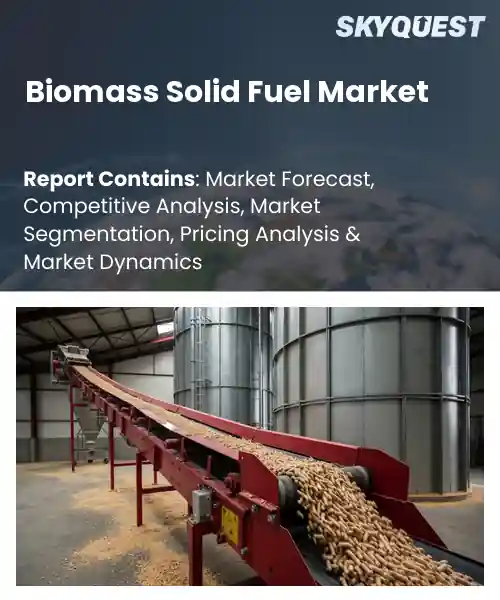
Biomass Solid Fuel Market
Report ID: SQMIG10G2073
Report ID: SQMIG10G2073
[email protected]
USA +1 351-333-4748
Report ID:
SQMIG10G2073 |
Region:
Global |
Published Date: June, 2026
Pages:
157
|Tables:
120
|Figures:
77


Global Biomass Solid Fuel Market size was valued at USD 28.77 Billion in 2024 and is poised to grow from USD 31.74 Billion in 2025 to USD 69.69 Billion by 2033, growing at a CAGR of 10.33% during the forecast period (2026-2033).
The global biomass solid fuel market supplies wood pellets, bark, agricultural residues, and fuels to power generation, industrial heating, and residential boilers. This has significantly increased the size of the biomass fuel market since its beginning in early 2000, when European countries began subsidising pellet stoves, and as a result of which global production capacity soared. During the next ten years, China's rural electrification program also adopted low grade chip wood in its development of energy use – this illustrates how the impact of policy initiatives can translate into demand. Today, the sector is valued at several billions of dollars, driven primarily by climate‑policy mandates that require measurable emission reductions.
Building on these policy‑driven foundations, the strongest growth driver is the integration of biomass solid fuel into hybrid energy systems that deliver heat, power, and storage. When a plant co‑fires biomass with natural gas, carbon intensity drops sharply, prompting utilities to retrofit turbines instead of building new fossil units. This effect has spurred investment in pellet‑fueled combined‑heat‑and‑power plants in Germany, where surplus agricultural residues are turned into electricity that feeds the grid and supplies district‑heating networks. Similarly, Brazilian waste‑to‑energy projects capture sugar‑cane bagasse to generate reliable baseload power for remote factories, creating demand for pellet manufacturers and logistics firms globally.
How is AI Enhancing Combustion Efficiency in the Biomass Solid Fuel Market?
AI is changing the way the Biomass Solid Fuel Industry operates by providing actionable insights from large volumes of sensor data. Machine-learning models continuously offer real-time predictions of the optimal air-fuel mixture and adjust fuel feed rates and burner settings, reducing unburned fuel and emissions. Current analytic capabilities give plants an increased ability to respond to variability in feedstock materials, which leads to enhanced heat recovery and an overall longer useful life of all associated equipment. As the market for Biomass Solid Fuels continues to grow, and as pressure for sustainability continues to drive change within business, operators are looking to use AI in order to produce greater efficiency without additional capital expenditures for hardware upgrade, thereby further enhancing the competitiveness of Biomass as a renewable energy source.
In May 2025, Woodchuck officially opened its AI-powered biomass processing and innovation facility in Michigan. The company utilizes artificial intelligence to analyze wood waste streams, optimize feedstock selection, and improve biomass-to-energy conversion efficiency. The AI-driven system enhances resource recovery, reduces operational waste, and supports sustainable solid biomass fuel production.
Market snapshot - (2026-2033)
Global Market Size
USD 28.77 Billion
Largest Segment
Woody Biomass
Fastest Growth
Solid Waste Biomass
Growth Rate
10.33% CAGR
To get more insights on this market click here to Request a Free Sample Report
Global biomass solid fuel market is segmented by source type, product form, energy generation application, end-use sector and region. Based on source type, the market is segmented into woody biomass, agricultural biomass and solid waste biomass. Based on product form, the market is segmented into wood pellets, biomass briquettes, wood chips, charcoal and others. Based on energy generation application, the market is segmented into power generation, heat generation and combined heat and power systems. Based on end-use sector, the market is segmented into power utilities, industrial sector, residential sector and commercial sector. Based on region, the market is segmented into North America, Europe, Asia Pacific, Latin America and Middle East & Africa.
Woody biomass segment dominates because it offers a plentiful and renewable feedstock derived from forest residues, thinning operations, and sawmill offcuts. An advantage of wood fiber is its homogeneousness, which gives us predictable energy content and low moisture, allowing us to economically convert the material into solid fuel. Established logistics networks and a long history of the industry have helped lower the cost of handling, while wood's importance to the biomass solid fuel market continues to grow due to the many supportive forestry policies that promote sustainable harvesting.
However, agricultural biomass is witnessing the strongest growth momentum as crop residues and energy crops gain attention for their low land-use impact and ability to diversify farmer income. The latest advancements in the technology that preprocess fuels make them more uniform, while a growing number of renewable mandates will make non-woody sources the preferred choice for the future expansion of this market.
Wood pellets segment dominates because it provides a standardized, high energy density product that readily meets the handling requirements of modern combustion equipment. Storing and moving the pellets is easy because of their uniform size and low ash count. Automated processes used to make pellets produce the same quality each time. The company has good certifications, which give people confidence when they buy this type of fuel. Since it works with existing equipment, people will use these products quickly for many applications, thus helping to lead the way in this category.
Meanwhile, biomass briquettes emerge as the key high growth area as innovators harness diverse feedstocks, including agricultural residues and municipal waste, to create dense fuel blocks. Additionally, continuous research will yield more effective binding agents, with decreased emissions and longer-lasting properties; these advances have resulted in an increase in adoption and will create new avenues for decentralized energy solutions.
To get detailed segments analysis, Request a Free Sample Report
Europe maintains a leading position through a combination of mature policy frameworks, extensive renewable energy targets, and a deeply integrated supply chain that connects forest management, agricultural residues, and industrial waste streams. Investment in advanced combustion technologies due to strong government incentives supports the adoption of circular economy approaches. International collaboration among research networks produces ongoing technological advances in both feedstock processing efficiency and emission control. The industrial base within the region has a high density of manufacturers that engage in solid biomass use for heating, power generation, and co-firing, creating a robust and resilient marketplace.
Biomass solid fuel market in Germany is propelled by comprehensive energy transition strategies that prioritize renewable heating for both industrial and residential sectors. Robust forestry management supplies a steady flow of wood residues, while agricultural by‑products supplement feedstock diversity. Industry clusters and research institutes focus on high‑efficiency boilers and emissions reduction, ensuring that supply aligns with stringent environmental standards. Strong public‑private partnerships support scaling of projects and reinforce Germany’s role as a benchmark for biomass utilization.
Biomass solid fuel market in the United Kingdom benefits from clear government decarbonization roadmaps that encourage the substitution of fossil fuels with solid biomass in heating and power applications. Incentive schemes for sustainable wood fuel and waste‑derived biomass stimulate domestic production and import diversification. Increased awareness of climate change among businesses & homeowners increases demand for low-emission heating systems while pellet technology advancements improve both handling and combustion efficiency throughout the entire supply network.
Biomass solid fuel market in France is supported by a strategic emphasis on circular economy principles that integrate forest residues, agricultural waste, and municipal solid waste into energy production. Policies regarding renewable energy at the national level for encouraging solid materials including tree logs, wood chips, and agri byproducts as a source of heat in homes and industry generate a continuing market for these forms of renewable energy. Several collaborations between government, academia and industry have been established to work together on improving the processing of feedstocks.
In Asia Pacific, the expansion of solid biomass is driven by a pressing need for energy security, heightened environmental awareness, and supportive regulatory environments that encourage renewable alternatives to imported fossil fuels. Many governments in the region are capitalising on their abundant forest resources, agricultural residues and rapidly advancing waste-to-energy technologies to create an energy mix that is diversifying its supply. The combination of government incentives and the demand from industrial sectors for low-carbon heat has generated interest in using modern combustion technologies as investments. Collaboration regionally with respect to the logistics of feedstocks and emissions controls has resulted in the Asia Pacific becoming an increasingly important centre for developing sustainable solid fuels.
Biomass solid fuel market in Japan focuses on converting municipal and industrial waste streams into high‑quality solid fuels to offset limited domestic wood resources. Government policies implement best practices for residential and commercial renewable energy systems through their encouragement of new pellet and gasification technologies. Through joint efforts between academic institutions and businesses, research is being conducted to continue improving fuel quality and combustion efficiency; additionally, public awareness campaigns are underway to promote use of biomass fuel as a clean energy alternative in urban centers.
Biomass solid fuel market in South Korea is shaped by strategic utilization of forest thinning residues and agricultural by‑products to meet national renewable energy commitments. Policy measures provide fiscal incentives for small‑scale heating projects and larger industrial applications, encouraging the deployment of high‑efficiency boilers. Industry partnerships focus on refining supply chain logistics and developing low‑emission combustion technologies, thereby strengthening South Korea’s capacity to replace oil and coal with domestically sourced solid biomass.
North America reinforces its role in the global biomass arena through abundant domestic feedstock, a diversified policy landscape that supports renewable heating, and a vibrant private sector driving technological innovation. The abundant cover of woods and agriculture provides many sources to produce wood chips, pellets, and residues, plus state/federal programs provide incentives for adopting clean energy in residential, commercial, and industrial applications. Ongoing upgrades to combustion technology combined with the strong demand for low carbon solutions have facilitated the expansion of solid fuel use in the region while at the same time meeting very strict environmental regulation.
Biomass solid fuel market in the United States benefits from a vast array of forest and agricultural residues that feed a growing network of pellet plants and bio‑energy facilities. State‑level renewable portfolio standards and tax incentives encourage utilities and industrial users to integrate solid biomass into their fuel mix. Private investment in advanced boiler designs and emissions monitoring systems enhances efficiency and regulatory compliance, positioning the United States as a leader in scaling sustainable solid fuel solutions.
Biomass solid fuel market in Canada draws on its expansive forest resources, providing a consistent supply of high‑quality wood fuel for heating and power generation. Policies at both the national and provincial levels promote the use of renewable solid fuels to reduce our dependence on energy imports and to lower greenhouse gas emissions. Research institutions and industry are working together on projects aimed at optimizing the production of pellets, improving combustion performance, and facilitating access to clean sources of heating for remote communities.
To know more about the market opportunities by region and country, click here to
Buy The Complete Report
Rising Renewable Energy Demand
Government Policy Support
High Feedstock Collection Costs
Technological Maturity Challenges
Request Free Customization of this report to help us to meet your business objectives.
The global biomass solid fuel market is shaped by intense competition as firms race to secure feedstock and expand capacity, driven by rising demand for renewable energy and supportive policy frameworks. Companies are accelerating technology innovation to improve fuel quality and efficiency, while forging strategic partnerships and joint ventures to access regional biomass resources; the World Economic Forum report highlights a surge in clean‑fuel production investments in 2025 as a concrete illustration of this competitive push.
Top Player’s Company Profile
Recent Developments
SkyQuest’s ABIRAW (Advanced Business Intelligence, Research & Analysis Wing) is our Business Information Services team that Collects, Collates, Correlates, and Analyses the Data collected by means of Primary Exploratory Research backed by robust Secondary Desk research.
As per SkyQuest analysis, the global biomass solid fuel market is propelled primarily by rising renewable energy demand, which is spurring utilities and industrial users to adopt carbon‑neutral fuels, while strong government policy support provides tax credits and feedstock subsidies that further accelerate project pipelines. Europe remains the dominant region thanks to mature policy frameworks, extensive forestry resources and a well‑integrated supply chain. The woody biomass segment leads the market, offering abundant, low‑moisture feedstock that translates into high‑quality wood pellets and briquettes. However, high feedstock collection costs pose a significant restraint by inflating logistics expenses and limiting competitiveness against conventional fuels
| Report Metric | Details |
|---|---|
| Market size value in 2024 | USD 28.77 Billion |
| Market size value in 2033 | USD 69.69 Billion |
| Growth Rate | 10.33% |
| Base year | 2024 |
| Forecast period | (2026-2033) |
| Forecast Unit (Value) | USD Billion |
| Segments covered |
|
| Regions covered | North America (US, Canada), Europe (Germany, France, United Kingdom, Italy, Spain, Rest of Europe), Asia Pacific (China, India, Japan, Rest of Asia-Pacific), Latin America (Brazil, Rest of Latin America), Middle East & Africa (South Africa, GCC Countries, Rest of MEA) |
| Companies covered |
|
| Customization scope | Free report customization with purchase. Customization includes:-
|
To get a free trial access to our platform which is a one stop solution for all your data requirements for quicker decision making. This platform allows you to compare markets, competitors who are prominent in the market, and mega trends that are influencing the dynamics in the market. Also, get access to detailed SkyQuest exclusive matrix.
Table Of Content
Executive Summary
Market overview
Parent Market Analysis
Market overview
Market size
KEY MARKET INSIGHTS
COVID IMPACT
MARKET DYNAMICS & OUTLOOK
Market Size by Region
KEY COMPANY PROFILES
Methodology
For the Biomass Solid Fuel Market, our research methodology involved a mixture of primary and secondary data sources. Key steps involved in the research process are listed below:
1. Information Procurement: This stage involved the procurement of Market data or related information via primary and secondary sources. The various secondary sources used included various company websites, annual reports, trade databases, and paid databases such as Hoover's, Bloomberg Business, Factiva, and Avention. Our team did 45 primary interactions Globally which included several stakeholders such as manufacturers, customers, key opinion leaders, etc. Overall, information procurement was one of the most extensive stages in our research process.
2. Information Analysis: This step involved triangulation of data through bottom-up and top-down approaches to estimate and validate the total size and future estimate of the Biomass Solid Fuel Market.
3. Report Formulation: The final step entailed the placement of data points in appropriate Market spaces in an attempt to deduce viable conclusions.
4. Validation & Publishing: Validation is the most important step in the process. Validation & re-validation via an intricately designed process helped us finalize data points to be used for final calculations. The final Market estimates and forecasts were then aligned and sent to our panel of industry experts for validation of data. Once the validation was done the report was sent to our Quality Assurance team to ensure adherence to style guides, consistency & design.
Analyst Support
Customization Options
With the given market data, our dedicated team of analysts can offer you the following customization options are available for the Biomass Solid Fuel Market:
Product Analysis: Product matrix, which offers a detailed comparison of the product portfolio of companies.
Regional Analysis: Further analysis of the Biomass Solid Fuel Market for additional countries.
Competitive Analysis: Detailed analysis and profiling of additional Market players & comparative analysis of competitive products.
Go to Market Strategy: Find the high-growth channels to invest your marketing efforts and increase your customer base.
Innovation Mapping: Identify racial solutions and innovation, connected to deep ecosystems of innovators, start-ups, academics, and strategic partners.
Category Intelligence: Customized intelligence that is relevant to their supply Markets will enable them to make smarter sourcing decisions and improve their category management.
Public Company Transcript Analysis: To improve the investment performance by generating new alpha and making better-informed decisions.
Social Media Listening: To analyze the conversations and trends happening not just around your brand, but around your industry as a whole, and use those insights to make better Marketing decisions.
REQUEST FOR SAMPLE
 REQUEST FREE CUSTOMIZATION
Global Biomass Solid Fuel Market size was valued at USD 28.77 Billion in 2024 and is poised to grow from USD 31.74 Billion in 2025 to USD 69.69 Billion by 2033, growing at a CAGR of 10.33% during the forecast period (2026-2033).
The global biomass solid fuel market is shaped by intense competition as firms race to secure feedstock and expand capacity, driven by rising demand for renewable energy and supportive policy frameworks. Companies are accelerating technology innovation to improve fuel quality and efficiency, while forging strategic partnerships and joint ventures to access regional biomass resources; the World Economic Forum report highlights a surge in clean‑fuel production investments in 2025 as a concrete illustration of this competitive push. 'Enviva Inc.', 'Graanul Invest', 'Drax Group plc', 'Pinnacle Renewable Energy Inc.', 'Fram Americas LLC', 'Anviet Control LLC', 'Energex Pellet Fuel Inc.', 'Lignetics Inc.', 'Mallard Creek Inc.', 'Pacific BioEnergy Corporation', 'Westervelt Company', 'Stora Enso Oyj', 'Mondi Group', 'Suez S.A.', 'Veolia Environnement S.A.', 'Moelven Industrier ASA', 'Solvay S.A.', 'Rentech Inc.', 'Wood Pellet Energy UK Ltd', 'German Pellets GmbH'
The growing emphasis on renewable energy across industrial and residential sectors is fueling interest in biomass solid fuel as a carbon‑neutral alternative to fossil fuels, encouraging utilities and large energy consumers to incorporate it into their fuel mix, thereby expanding market opportunities and prompting investments in supply chain infrastructure, conversion facilities and distribution networks, which collectively enhance market visibility and encourage broader adoption of solid biomass solutions worldwide. Stakeholders are responding to consumer expectations for greener energy options, which reinforces the shift toward biomass solid fuel usage in diverse applications.
Rising Renewable Energy Policies: Governments worldwide are strengthening renewable energy mandates, positioning biomass solid fuel as a component for meeting decarbonization targets. Policy frameworks increasingly prioritize domestic feedstock utilization, grid stability, and rural development, encouraging utilities and industrial users to substitute coal with sustainably sourced biomass. Incentive schemes, tax credits, and streamlined permitting accelerate project pipelines, while long‑term purchase agreements provide market certainty. This regulatory momentum is driving heightened investor confidence and fostering cross‑sector collaborations that expand the market’s geographic reach and significant product diversification.
Why does Europe Dominate the Global Biomass Solid Fuel Market? |@12


Want to customize this report? This report can be personalized according to your needs. Our analysts and industry experts will work directly with you to understand your requirements and provide you with customized data in a short amount of time. We offer $1000 worth of FREE customization at the time of purchase.
Feedback From Our Clients


 USA (+1) 351-333-4748

