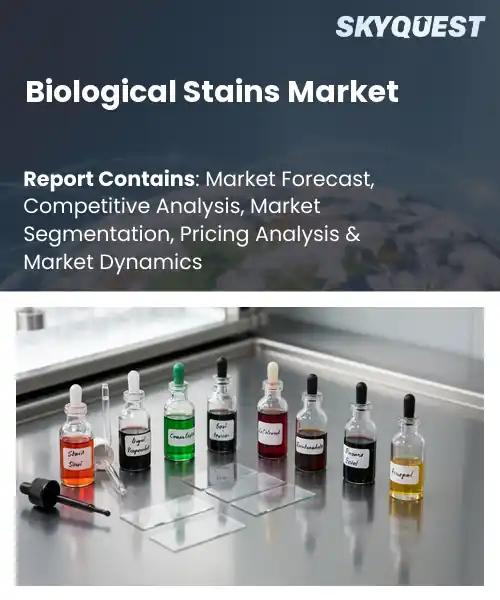
Biological Stains Market
Report ID: SQMIG35J2444
Report ID: SQMIG35J2444
[email protected]
USA +1 351-333-4748
Report ID:
SQMIG35J2444 |
Region:
Global |
Published Date: June, 2026
Pages:
157
|Tables:
120
|Figures:
77


Global Biological Stains Market size was valued at USD 9.16 Billion in 2024 and is poised to grow from USD 9.77 Billion in 2025 to USD 16.42 Billion by 2033, growing at a CAGR of 6.7% during the forecast period (2026-2033).
The biological stains industry offers chemicals that stain cell components and allow for microscopy, histological and flow cytometry analyses, which help researchers and healthcare professionals detect disease and aid in the process of discovering new drugs. The industry is significant because it plays a role in ensuring proper visualization of results. This industry originated in the 1950s when the market was introduced to hematoxylin-eosin stains and has evolved through immunohistochemistry techniques that include chromogenic and fluorescent stains in the 1990s. Increased usage of imaging systems has further increased demand as the NIH utilizes such panels to understand microenvironments.
Regulatory pressures for diagnostic accuracy are what spur growth in the market for biological stains since there is increasing need for validated staining procedures to support the approval of companion diagnostics by healthcare agencies. With a pharmaceutical company requesting approval of a particular drug treatment, it means that the diagnostic biomarker test should be capable of delivering staining results in a reproducible manner, and this will encourage laboratories to use stain kits that offer batch-to-batch consistency. In the process, there is increased demand for photostable stains, encouraging companies such as Roche and Thermo Fisher to conduct research that reduces waiting times for pathology labs.
How is AI-driven Automation Influencing Product Development In The Biological Stains Market?
Formulations through AI powered automation are evolving through fast cycle times, improved prediction capabilities and stricter quality checks in the biological stains sector. AI algorithms study historical data related to the dyes involved to predict the right combinations for new biological stains which take just days instead of weeks. Automated robotic dispensers help in ensuring precise reagents combination with minimum variation between batches and allow scientists to concentrate more on innovation. Feedback from real time image analysis will keep the performance of the AI in check relative to the target tissue types. Higher demand for specific and consistent stains is served by this technology with faster development cycles and reduced costs.
Market snapshot - (2026-2033)
Global Market Size
USD 9.16 Billion
Largest Segment
Stains and Dyes
Fastest Growth
Instruments
Growth Rate
6.7% CAGR
To get more insights on this market click here to Request a Free Sample Report
Global biological stains market is segmented by product type, application, stain modality, end user and region. Based on product type, the market is segmented into Stains and Dyes, Reagents and Kits and Instruments. Based on application, the market is segmented into Histology, Cytology, Microbiology, Hematology, Immunology and Others. Based on stain modality, the market is segmented into In-Vitro Staining and In-Vivo Staining. Based on end user, the market is segmented into Diagnostic Laboratories, Academic and Research Institutes, Pharmaceutical and Biotechnology Companies and Others. Based on region, the market is segmented into North America, Europe, Asia Pacific, Latin America and Middle East & Africa.
Dominance of Stains and Dyes segment is attributed to the fact that it constitutes the basic component for all the microscopical examination by providing the requisite color contrasts. Its extensive variation in chemistry ensures the ability to customize the product for various types of samples in line with the colorimetry needs of pathologists and scientists. Ongoing development in terms of multiplexing and fluorescent capability reinforces its dominant position.
On the other hand, rapid expansion of the Reagents and Kits segment can be attributed to the fact that integrated testing kits make processes easy and efficient for laboratories. This further confirms that this segment with continue to generate the fastest growth rate in the coming years.
The Immunology segment stands out due to the growing use of immunohistochemistry for identifying targeted therapies, which requires higher specificity of antibodies and stained specimens. With advanced multiplexing staining, multiple biomarkers can be detected at once, which improves diagnosis accuracy and contributes to the personalized medicine trend. This clinical requirement is driving high demand for staining products related to immunology in oncology and autoimmune diseases testing.
On the other hand, Hematology segment is highlighted as the fastest growing one, because at this point stain-based morphology evaluation becomes an essential part of point-of-care blood analysis. Demand for more sophisticated methods of automated complete blood counts and digital imaging drives the development of new stains in hematology, and opens up great market opportunities.
To get detailed segments analysis, Request a Free Sample Report
North America continues to lead in the Biological Stains Market owing to a host of factors that include advanced research facilities, effective financing, and established regulatory policies. The availability of top-notch universities and biotech companies results in the development of innovative dyes and methods of staining. Cooperation among hospitals, labs, and industry helps in speeding up the process of validation and implementation of the products. In addition, the already existing network helps in penetrating the market at a fast pace. The focus on precision diagnosis and personalized treatment adds to the demand for biological stains.
United States Biological Stains Market is boosted by the high availability of federal research funding and the presence of multiple biotech centers which ensure constant innovations in products. Intellectual property protection ensures the commercial success of innovations in dyes, whereas academic institutions offer validation and education to customers. Integration of supply chains provides rapid delivery to labs ensuring broad adoption in diagnostics and treatment, as well as research centers with emphasis on methodology.
Canadian Biological Stains Market is boosted by initiatives taken by governments along with the industries, focusing on sustainable manufacturing. High awareness towards environmental management results in the creation of environmentally safe stains, following current regulatory trends. Academic hubs located in the provinces provide new formulations, which are promptly adopted in clinical pathology due to well-developed healthcare infrastructure. Effective export capabilities are one more reason for Canada’s position as a market player in the neighboring regions.
The Biological Stains Market in Europe is witnessing significant growth due to robust collaboration between the public and private sector organizations, emphasis on innovations in diagnostic tools, and quality requirements that increase the reliability of products. Research facilities throughout Europe work together with biotechnology companies in order to develop highly accurate reagents for staining in line with new approaches in microscopy. Well-developed regulatory systems promote coordinated procedures of approvals and help with cross-border movement of goods. Increasing interest in personalized medicine and pathology laboratories drives the need for more efficient stains.
The Biological Stain Market in Germany enjoys a well-developed research university system and an excellent reputation for chemical engineering. The government offers incentives for translational research to transfer knowledge from academia to industry applications. High standards set by quality certification systems in Germany make biological stains suitable for use in clinical and academic labs. Clusters in industrial areas help scale up production quickly, enhancing Germany’s dominance in the European region.
Biological Stains Market in the United Kingdom is driven by research funding from academic sources and an entrepreneurial environment based on diagnostic innovation. Cooperation between NHS labs and biotech companies speeds up validation of novel staining technologies for clinical applications. Regulatory conformity to EU standards ensures quick market access, while the focus on personalized medicine increases the need for highly-specific reagents. Investment into pathology systems increases the demand for advanced staining technologies even more.
France Biological Stains Market has started playing its part as a contributor to this industry through various research activities and green chemistry. There are national policies for the creation of biodegradable stain ingredients which comply withvery stringent environmental standards. The collaboration between the laboratories of universities and specialized manufacturing companies helps in prototype development and market testing. The use of modern microscopic procedures in clinical and educational sectors provides an atmosphere favorable to new stains.
Asia Pacific is establishing itself as a strong contender in the Biological Stains Market through the rapid progress made in biomedical research, building up the clinical infrastructure, and adopting digital pathology platforms. The initiative taken by the governments through their healthcare development initiatives promotes the use of advanced staining reagents at hospitals and laboratories. There is an increasing trend of collaborations among academic institutions and young biotechnology companies which is fast-tracking the process of developing specific biological stains for the region. Also, the concentration on producing low-cost biological stains will help the region compete globally due to increased demand for low-cost yet quality products.
Japan’s Biological Stain Market is one that places high importance on the engineering and quality control aspects of their operations. Collaboration between university laboratories and manufacturers facilitates rapid development of new dyes into commercially available products. The policies of the government to support more advanced diagnosis techniques facilitate the implementation of staining techniques in the clinical field. Automation and robotics in the laboratory increase the need for stain solutions, contributing to the reputation of Japan as a consistent performer.
South Korean Biological Stain Market is growing due to development of biotech incubators and cooperation of hospitals with research organizations. Rapid prototyping leads to faster commercialization of novel staining agents optimized for new diagnostic techniques. Health campaigns in the country focus on modern laboratory practices and promote the use of superior biological stains widely. The national manufacturing industry provides cost-effective solutions without sacrificing quality.
To know more about the market opportunities by region and country, click here to
Buy The Complete Report
Increasing Demand for Precision Diagnostics
Increased importance of cellular identification leads to an increase in the use of high-quality biological stains. The need for reagents offering reliable and high-quality contrast is felt by laboratories, which results in the production of new products and innovations in formulation. As a result, market expansion is stimulated because the use of such products becomes preferable to traditional ones. Also, the compatibility of contemporary stains with automated imaging systems decreases the time spent on workflow and thus increases laboratory productivity.
Advancements in Fluorescent Staining Technologies
Advancements in fluorescent dye chemistry and conjugations make fluorescent staining more sensitive and versatile. Scientists can tag different targets with specific emission spectra, allowing them to discover new cellular interactions which were not possible before. Such a breakthrough makes it more attractive to use advanced staining kits in academic and industrial labs, as it allows us to save time and obtain more informative data. Therefore, there is an increasing need for the development of a new generation of fluorescent stains, which motivates companies to invest in developing more efficient and stable dyes.
Stringent Regulatory Approval Processes
The validation of biological stains by regulatory agencies is necessary to guarantee safety, consistency, and compatibility in clinical diagnostic applications. The time taken for toxicological assessment and documentation of biological stains is quite lengthy, hence increasing the expenses incurred by the manufacturer. In order to meet the requirements of multiple regulatory authorities, there is added complexity since there may be unique submission requirements for every market served. This results in discouragement of smaller players from penetrating the market and innovation of new biological stains, thus hindering market growth even though there is increased demand.
High Cost of Specialized Stains
Most biological stains, which are highly specialized, involve complicated synthesis processes and also use unique raw materials that make them expensive. These high costs get passed on to the user, hence making the chemicals more expensive for laboratories operating on tight budgets, especially those from developing countries. As such, their uptake might be hindered since laboratories would prefer cheaper options or reduce the number of tests using the highly-pricedstains. Moreover, the need for special storage facilities adds up to the cost of running a laboratory that uses the advanced stains.
Request Free Customization of this report to help us to meet your business objectives.
The competition is heating up in the diagnostic industry through mergers and acquisitions, as seen in the merger and acquisition of a specialized stain manufacturer in order to enhance the offerings of histology, while leaders in the field of stains are partnering with laboratory scientists to develop new generation of stains.
Precision Diagnostics Expansion: The use of high-resolution imaging tools has led to a need for more accurate biological stains that can identify subcellular structures with less background noise. There is a desire for multiplexable reagents that help visualize more than one marker at a time, helping to understand more about the mechanisms of diseases. With the rise of personalized medicine, doctors are demanding stains that work on smaller biopsy samples and have faster turnarounds, leading to the development of stain formulas that are specific, stable, and easy to automate.
Sustainable Stain Development: The need to practice environmental stewardship is affecting the demand for stains that are less harmful and do not pose much harm to the environment. There is a growing preference for reagents made from sustainable sources using biodegradable solvents and environmentally friendly solvents. This change calls for a new approach in manufacturing of products with an emphasis on minimal carbon footprint and cooperation with universities to produce stains that will maintain their performance levels.
SkyQuest’s ABIRAW (Advanced Business Intelligence, Research & Analysis Wing) is our Business Information Services team that Collects, Collates, Correlates, and Analyses the Data collected by means of Primary Exploratory Research backed by robust Secondary Desk research.
As per SkyQuest analysis the global biological stains market is driven mainly by the increasing need for precise diagnosis which requires very reproducible staining agents. The other driver is the fast pace of innovation in fluorescence technology for multiplexing and enhanced sensitivity. The Stains and Dyes segment forms the backbone of the market as it provides the necessary contrast for microscopy. North America dominates the market due to its well-developed research facilities and funding. However, tough regulatory requirements act as barriers to entry through increased cost of development.
| Report Metric | Details |
|---|---|
| Market size value in 2024 | USD 9.16 Billion |
| Market size value in 2033 | USD 16.42 Billion |
| Growth Rate | 6.7% |
| Base year | 2024 |
| Forecast period | (2026-2033) |
| Forecast Unit (Value) | USD Billion |
| Segments covered |
|
| Regions covered | North America (US, Canada), Europe (Germany, France, United Kingdom, Italy, Spain, Rest of Europe), Asia Pacific (China, India, Japan, Rest of Asia-Pacific), Latin America (Brazil, Rest of Latin America), Middle East & Africa (South Africa, GCC Countries, Rest of MEA) |
| Companies covered |
|
| Customization scope | Free report customization with purchase. Customization includes:-
|
To get a free trial access to our platform which is a one stop solution for all your data requirements for quicker decision making. This platform allows you to compare markets, competitors who are prominent in the market, and mega trends that are influencing the dynamics in the market. Also, get access to detailed SkyQuest exclusive matrix.
Table Of Content
Executive Summary
Market overview
Parent Market Analysis
Market overview
Market size
KEY MARKET INSIGHTS
COVID IMPACT
MARKET DYNAMICS & OUTLOOK
Market Size by Region
KEY COMPANY PROFILES
Methodology
For the Biological Stains Market, our research methodology involved a mixture of primary and secondary data sources. Key steps involved in the research process are listed below:
1. Information Procurement: This stage involved the procurement of Market data or related information via primary and secondary sources. The various secondary sources used included various company websites, annual reports, trade databases, and paid databases such as Hoover's, Bloomberg Business, Factiva, and Avention. Our team did 45 primary interactions Globally which included several stakeholders such as manufacturers, customers, key opinion leaders, etc. Overall, information procurement was one of the most extensive stages in our research process.
2. Information Analysis: This step involved triangulation of data through bottom-up and top-down approaches to estimate and validate the total size and future estimate of the Biological Stains Market.
3. Report Formulation: The final step entailed the placement of data points in appropriate Market spaces in an attempt to deduce viable conclusions.
4. Validation & Publishing: Validation is the most important step in the process. Validation & re-validation via an intricately designed process helped us finalize data points to be used for final calculations. The final Market estimates and forecasts were then aligned and sent to our panel of industry experts for validation of data. Once the validation was done the report was sent to our Quality Assurance team to ensure adherence to style guides, consistency & design.
Analyst Support
Customization Options
With the given market data, our dedicated team of analysts can offer you the following customization options are available for the Biological Stains Market:
Product Analysis: Product matrix, which offers a detailed comparison of the product portfolio of companies.
Regional Analysis: Further analysis of the Biological Stains Market for additional countries.
Competitive Analysis: Detailed analysis and profiling of additional Market players & comparative analysis of competitive products.
Go to Market Strategy: Find the high-growth channels to invest your marketing efforts and increase your customer base.
Innovation Mapping: Identify racial solutions and innovation, connected to deep ecosystems of innovators, start-ups, academics, and strategic partners.
Category Intelligence: Customized intelligence that is relevant to their supply Markets will enable them to make smarter sourcing decisions and improve their category management.
Public Company Transcript Analysis: To improve the investment performance by generating new alpha and making better-informed decisions.
Social Media Listening: To analyze the conversations and trends happening not just around your brand, but around your industry as a whole, and use those insights to make better Marketing decisions.
REQUEST FOR SAMPLE
 REQUEST FREE CUSTOMIZATION
Global Biological Stains Market size was valued at USD 9.16 Billion in 2024 and is poised to grow from USD 9.77 Billion in 2025 to USD 16.42 Billion by 2033, growing at a CAGR of 6.7% during the forecast period (2026-2033).
Competitive dynamics are sharpening as major diagnostics groups pursue M&A, exemplified by the 2024 acquisition of a specialty stain producer to broaden histology portfolios, while leading stain manufacturers form partnerships with academic labs to co‑develop next‑generation fluorescent stains, driving product differentiation and intensifying market rivalry. 'Sigma-Aldrich Corporation', 'Thermo Fisher Scientific Inc.', 'Merck KGaA', 'Agilent Technologies Inc.', 'Bio-Rad Laboratories Inc.', 'Becton Dickinson and Company', 'Polysciences Inc.', 'Macsen Labs', 'Waldeck GmbH & Co. KG', 'Karan Laborates', 'Biomarq Life Sciences Private Limited', 'Alpha Chemika', 'Kem Light Spechem Labs Private Limited', 'Hardy Diagnostics', 'Pro Lab Diagnostics Inc.', 'New England Biolabs Inc.', 'Vector Laboratories Inc.', 'Abcam plc', 'Santa Cruz Biotechnology Inc.', 'LGC Clinical Diagnostics'
The growing emphasis on precise cellular identification in clinical and research settings fuels the adoption of high‑performance biological stains. Laboratories seek reagents that provide clear, reproducible contrast, enabling accurate interpretation of microscopic observations. This demand encourages manufacturers to expand product portfolios and invest in innovative formulations that meet exacting standards, thereby driving market expansion as users prioritize reliability and diagnostic confidence over legacy alternatives. Furthermore, the ability of modern stains to integrate with automated imaging platforms reduces workflow time, enhancing laboratory efficiency and supporting broader implementation across diverse research fields.
Precision Diagnostics Expansion: The adoption of high‑resolution imaging platforms is driving laboratories to seek more precise biological stains that can delineate subcellular structures with minimal background interference. Researchers prioritize multiplexable reagents that enable simultaneous visualization of multiple biomarkers, fostering deeper insight into disease pathways. As personalized medicine gains traction, clinicians demand stains compatible with small‑sample biopsies and rapid turnaround times, prompting manufacturers to innovate formulations that combine specificity, stability, and ease of integration into automated workflows and cost-effective production processes for broader adoption.
Why does North America Dominate the Global Biological Stains Market? |@12


Want to customize this report? This report can be personalized according to your needs. Our analysts and industry experts will work directly with you to understand your requirements and provide you with customized data in a short amount of time. We offer $1000 worth of FREE customization at the time of purchase.
Feedback From Our Clients


 USA (+1) 351-333-4748

