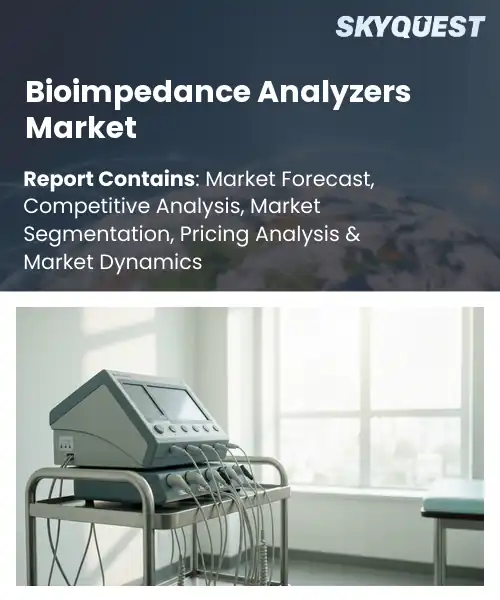
Bioimpedance Analyzers Market
Report ID: SQMIG35A3979
Report ID: SQMIG35A3979
[email protected]
USA +1 351-333-4748
Report ID:
SQMIG35A3979 |
Region:
Global |
Published Date: June, 2026
Pages:
157
|Tables:
145
|Figures:
78


Global Bioimpedance Analyzers Market size was valued at USD 568.9 Million in 2024 and is poised to grow from USD 628.07 Million in 2025 to USD 1385.98 Million by 2033, growing at a CAGR of 10.4% during the forecast period (2026-2033).
The primary driver of the bioimpedance analyzers market is growing demand for noninvasive, accurate body composition data driven by rising obesity rates, chronic disease burdens and an aging population. These devices quantify tissue resistance and reactance to estimate fat mass, lean mass and fluid distribution, which supports clinical nutrition plans, cardiology diagnostics and dialysis management as well as fitness tracking. Over the last twenty years the sector moved from single frequency laboratory instruments toward multi frequency, segmental and portable analyzers that offer higher precision, faster throughput and integration with platforms. InBody, Tanita and Bodystat showcase clinical and consumer advancement today.
Building on device evolution and rising clinical need, the integration of bioimpedance analyzers with telehealth, cloud analytics and mobile applications is accelerating global adoption because clinicians can monitor body composition and fluid shifts remotely and act earlier to prevent complications. For example remote monitoring of heart failure patients using serial impedance measurements enables timely diuretic adjustment, which reduces readmissions and creates measurable cost savings for health systems. Similarly portable analyzers support home dialysis and nutrition counseling programs, so providers can personalize therapies and demonstrate outcomes that justify reimbursement and procurement investments. Expanding into emerging markets and AI analytics offers growth.
How is AI enhancing diagnostic accuracy in the bioimpedance analyzers market?
Bioimpedance analyzers measure tissue composition and fluid status by sending small electrical currents through the body. AI enhances diagnostic accuracy by cleaning signals, reducing measurement noise, and creating personalized models that adjust for individual physiology. Machine learning finds subtle patterns in impedance spectra and can combine those signals with other sensor inputs to improve clinical context. These advances reduce false alarms and make trends more reliable for clinicians and consumers. Market pressure for home based and point of care solutions is accelerating investment in smarter algorithms and improved sensor fusion to deliver clearer, clinically useful readings.
Withings January 2026, unveiled Body Scan 2 with embedded AI analysis of bioimpedance and impedance cardiography, showing how models can flag early metabolic and cardiovascular risk. This real world release highlights how AI enabled bioimpedance products improve diagnostic confidence and speed wider adoption by delivering more actionable insights to users and providers.
Market snapshot - (2026-2033)
Global Market Size
USD 568.9 Million
Largest Segment
Wired
Fastest Growth
Wireless
Growth Rate
10.4% CAGR
To get more insights on this market click here to Request a Free Sample Report
Global bioimpedance analyzers market is segmented by modality, application, end-user, technology type, sales channel and region. Based on modality, the market is segmented into Wired and Wireless. Based on application, the market is segmented into Body Composition Analysis, Clinical Fluid Management, Fitness and Wellness Assessment and Others. Based on end-user, the market is segmented into Hospitals and Clinics, Fitness Clubs and Wellness Centers, Homecare Settings and Others. Based on technology type, the market is segmented into Single-frequency Systems, Multi-frequency Systems and Segmental Systems. Based on sales channel, the market is segmented into Direct Institutional Sales, Medical Device Distributors and Online Platforms. Based on region, the market is segmented into North America, Europe, Asia Pacific, Latin America and Middle East & Africa.
Wired segment dominates because its consistent electrical connectivity and stable signal integrity engender clinician trust and reproducible measurements in institutional workflows. Reliable physical connections simplify integration with existing patient monitors and diagnostic suites, reducing data loss and validation hurdles. This reliability lowers barriers for regulatory clearance and institutional procurement, prompting buyers to prioritize wired devices for critical care and diagnostic applications, driving vendor investment and interoperability across the Bioimpedance Analyzers Market.
However, Wireless segment is emerging as the most rapidly expanding area because demand for wearable monitoring and patient mobility supports remote body composition tracking and home clinical assessments. Improvements in low power radios and secure cloud connectivity accelerate adoption by telehealth and fitness providers, enabling new product innovation and distribution channels that expand market reach.
Body Composition Analysis segment dominates because widespread clinical and consumer demand for actionable fat, lean mass, and hydration metrics makes these measurements a primary use case for bioimpedance analyzers. Established utility in weight management, sports performance and preventative health encourages manufacturers to optimize user interfaces and algorithms for reliable home and clinic use. This focus on user experience and validated outputs drives adoption across clinical practices and wellness markets, supporting sustained product development and sales within the Bioimpedance Analyzers Market.
Meanwhile, Clinical Fluid Management segment is witnessing the strongest growth momentum as demand for precise fluid status monitoring grows in acute and chronic care management. Advances in multi frequency analysis and integration with electronic records enable timely therapeutic decisions, prompting hospitals to adopt devices for heart failure and dialysis pathways, thereby unlocking procurement opportunities and clinical workflow innovation.
To get detailed segments analysis, Request a Free Sample Report
North America leads the global bioimpedance analyzers market due to a convergence of advanced clinical infrastructure, concentrated device manufacturers, and active research networks. Established reimbursement pathways and clearer regulatory frameworks encourage adoption by healthcare providers and private clinics, while prominent academic medical centers validate technology through clinical studies and pilot deployments. Strong venture funding and strategic partnerships between industry and clinical stakeholders accelerate innovation, enabling frequent product introductions and service models that emphasize usability, data integration, and patient monitoring across acute and outpatient settings. A mature commercial ecosystem supports widespread distribution and postmarket services, while clinician training programs and integration with electronic health records facilitate routine clinical use. Growing interest in remote patient management and personalized nutrition solutions further expands demand across hospital and consumer channels.
Bioimpedance Analyzers Market benefits from a dense concentration of clinical research centers, device manufacturers, and specialist clinics that drive early adoption and product validation. Large private healthcare networks and progressive clinical guidelines support integration of bioimpedance into diagnostic and monitoring workflows. A sophisticated distribution and service ecosystem, combined with active industry-academic collaborations, underpins commercialization and postmarket support while fostering incremental innovation in device usability and data analytics for care settings.
Bioimpedance Analyzers Market in Canada benefits from a collaborative landscape of provincial healthcare systems, university hospitals, and clinical networks that champion evidence generation. Emphasis on integrated care pathways and community health programs encourages adoption in outpatient contexts. Local distributors and service providers enable reach across urban and remote settings, while partnerships between innovators and healthcare organizations actively support adaptation of devices to national clinical practice patterns and patient management needs.
Europe is experiencing rapid expansion of the bioimpedance analyzers market as a result of coordinated healthcare priorities, robust clinical research, and a mature regulatory environment that supports device commercialization across member states. Regional networks of hospitals and academic centers validate clinical utility through multicenter collaborations, while a growing commercial base of specialized manufacturers and distributors enhances availability. Clinical interest in body composition assessment for chronic disease management, rehabilitation, and preventive care aligns with expanding outpatient and physiotherapy services. Cross-border partnerships, tailored product adaptations for diverse care settings, and increasing integration with digital health platforms further stimulate uptake by clinicians and consumers across public and private sectors. Significant industry investment into product refinement, clinician education, and aftersales support strengthens purchaser confidence. Local regulatory clarity and reimbursement pathways in several markets, combined with active professional societies endorsing best practices, guide clinical adoption.
Bioimpedance Analyzers Market in Germany is characterized by strong industrial capabilities, well established clinical research institutions, and close collaboration between manufacturers and university hospitals. High standards in medical device engineering and rigorous clinical validation support product credibility. Health technology assessment frameworks and structured procurement channels encourage adoption in hospitals and rehabilitation centers. Local manufacturers and distributors maintain service networks that support clinical integration and device improvements tailored to care pathways.
Bioimpedance Analyzers Market in United Kingdom is propelled by dynamic private healthcare provision, active clinical innovation hubs, and a receptive environment for digital health solutions. Rapid adoption is supported by multidisciplinary research in nutrition, sports medicine, and community care models that favor portable devices. Strong ties between developers and service providers enable market entry and expansion, while clinician training initiatives and consumer wellness interest amplify demand across diverse care settings.
Bioimpedance Analyzers Market in France is emerging through targeted initiatives in preventive health, sports science, and primary care networks that seek practical assessment tools. Adoption is supported by collaborations between research institutes, rehabilitation centers, and innovators adapting devices to local clinical routines. Emphasis on clinician education, standardized measurement protocols, and integration with patient care pathways fosters uptake in both hospital and community settings, with interest from wellness and physiotherapy providers.
Asia Pacific is strengthening its role in the bioimpedance analyzers market through a blend of technological innovation, growing clinical adoption, and strategic manufacturing capabilities. Leading markets in the region invest in advanced device engineering and sensor integration that align with strong electronics and medical device industries. Partnerships between regional manufacturers and global firms accelerate knowledge transfer and market entry, while clinical centers validate use cases across acute care, rehabilitation, and home monitoring. Increasing focus on aging care, preventive health, and consumer wellness expands application areas. Supportive domestic regulatory processes and localized product adaptations enable broader deployment across diverse healthcare systems, while cost efficient manufacturing and skilled engineering talent underpin competitive positioning in regional and export markets. Regional focus on integration with telehealth platforms and wearable ecosystems further enhances product relevance for remote patient management and wellness monitoring.
Bioimpedance Analyzers Market in Japan leverages advanced electronics, precision engineering, and strong clinical research networks to refine device performance and reliability. Collaboration between medical device manufacturers and academic hospitals advances validation across rehabilitation and hospital applications. Established distribution channels and emphasis on quality assurance enable adoption in hospital and outpatient settings. Investment in user interface design and data interoperability supports integration with electronic records and telehealth platforms used by providers.
Bioimpedance Analyzers Market in South Korea is driven by strong electronics manufacturing, medical device companies, and rapid technology adoption in clinical sectors. Local firms focus on miniaturization, sensor accuracy, and connectivity features suited to home monitoring and fitness applications. Collaboration with hospitals and research institutions supports clinical validation for rehabilitation and outpatient care. Established distribution channels and proactive product adaptation to user preferences enable commercialization across healthcare and wellness channels.
To know more about the market opportunities by region and country, click here to
Buy The Complete Report
Increasing Adoption In Clinical Settings
Rising Demand For Home Monitoring
Regulatory Approval Complexity And Compliance
High Variability In Measurement Accuracy
Request Free Customization of this report to help us to meet your business objectives.
Competition in the global bioimpedance analyzers market is intensifying as incumbents pursue regulatory milestones and platform partnerships while deep tech entrants push sensor miniaturization and ASIC innovations. Market drivers tied to competition include clinical validation and integration into care pathways. Examples include ImpediMed securing FDA breakthrough recognition for its SOZO dialysis indication, textile and ASIC innovation from specialist suppliers, and early-stage clinical collaborations by novel scanner vendors.
SkyQuest’s ABIRAW (Advanced Business Intelligence, Research & Analysis Wing) is our Business Information Services team that Collects, Collates, Correlates, and Analyses the Data collected by means of Primary Exploratory Research backed by robust Secondary Desk research.
As per SkyQuest analysis, the global bioimpedance analyzers market is driven primarily by rising demand for noninvasive, accurate body composition data to manage obesity, chronic disease and an aging population, while a second major driver is rapid integration with telehealth, cloud analytics and mobile applications that enable remote monitoring and actionable insights. Growth is constrained by complex and variable regulatory approval and compliance requirements that lengthen time to market. North America remains the dominating region due to advanced clinical infrastructure and strong commercial ecosystems, and the body composition analysis segment dominates usage across clinical, fitness and consumer channels as the primary application supporting market expansion.
| Report Metric | Details |
|---|---|
| Market size value in 2024 | USD 568.9 Million |
| Market size value in 2033 | USD 1385.98 Million |
| Growth Rate | 10.4% |
| Base year | 2024 |
| Forecast period | (2026-2033) |
| Forecast Unit (Value) | USD Million |
| Segments covered |
|
| Regions covered | North America (US, Canada), Europe (Germany, France, United Kingdom, Italy, Spain, Rest of Europe), Asia Pacific (China, India, Japan, Rest of Asia-Pacific), Latin America (Brazil, Rest of Latin America), Middle East & Africa (South Africa, GCC Countries, Rest of MEA) |
| Companies covered |
|
| Customization scope | Free report customization with purchase. Customization includes:-
|
To get a free trial access to our platform which is a one stop solution for all your data requirements for quicker decision making. This platform allows you to compare markets, competitors who are prominent in the market, and mega trends that are influencing the dynamics in the market. Also, get access to detailed SkyQuest exclusive matrix.
Table Of Content
Executive Summary
Market overview
Parent Market Analysis
Market overview
Market size
KEY MARKET INSIGHTS
COVID IMPACT
MARKET DYNAMICS & OUTLOOK
Market Size by Region
KEY COMPANY PROFILES
Methodology
For the Bioimpedance Analyzers Market, our research methodology involved a mixture of primary and secondary data sources. Key steps involved in the research process are listed below:
1. Information Procurement: This stage involved the procurement of Market data or related information via primary and secondary sources. The various secondary sources used included various company websites, annual reports, trade databases, and paid databases such as Hoover's, Bloomberg Business, Factiva, and Avention. Our team did 45 primary interactions Globally which included several stakeholders such as manufacturers, customers, key opinion leaders, etc. Overall, information procurement was one of the most extensive stages in our research process.
2. Information Analysis: This step involved triangulation of data through bottom-up and top-down approaches to estimate and validate the total size and future estimate of the Bioimpedance Analyzers Market.
3. Report Formulation: The final step entailed the placement of data points in appropriate Market spaces in an attempt to deduce viable conclusions.
4. Validation & Publishing: Validation is the most important step in the process. Validation & re-validation via an intricately designed process helped us finalize data points to be used for final calculations. The final Market estimates and forecasts were then aligned and sent to our panel of industry experts for validation of data. Once the validation was done the report was sent to our Quality Assurance team to ensure adherence to style guides, consistency & design.
Analyst Support
Customization Options
With the given market data, our dedicated team of analysts can offer you the following customization options are available for the Bioimpedance Analyzers Market:
Product Analysis: Product matrix, which offers a detailed comparison of the product portfolio of companies.
Regional Analysis: Further analysis of the Bioimpedance Analyzers Market for additional countries.
Competitive Analysis: Detailed analysis and profiling of additional Market players & comparative analysis of competitive products.
Go to Market Strategy: Find the high-growth channels to invest your marketing efforts and increase your customer base.
Innovation Mapping: Identify racial solutions and innovation, connected to deep ecosystems of innovators, start-ups, academics, and strategic partners.
Category Intelligence: Customized intelligence that is relevant to their supply Markets will enable them to make smarter sourcing decisions and improve their category management.
Public Company Transcript Analysis: To improve the investment performance by generating new alpha and making better-informed decisions.
Social Media Listening: To analyze the conversations and trends happening not just around your brand, but around your industry as a whole, and use those insights to make better Marketing decisions.
REQUEST FOR SAMPLE
 REQUEST FREE CUSTOMIZATION
Global Bioimpedance Analyzers Market size was valued at USD 568.9 Million in 2024 and is poised to grow from USD 628.07 Million in 2025 to USD 1385.98 Million by 2033, growing at a CAGR of 10.4% during the forecast period (2026-2033).
Competition in the global bioimpedance analyzers market is intensifying as incumbents pursue regulatory milestones and platform partnerships while deep tech entrants push sensor miniaturization and ASIC innovations. Market drivers tied to competition include clinical validation and integration into care pathways. Examples include ImpediMed securing FDA breakthrough recognition for its SOZO dialysis indication, textile and ASIC innovation from specialist suppliers, and early-stage clinical collaborations by novel scanner vendors. 'InBody', 'Tanita', 'Omron', 'Seca', 'Jawon Medical', 'Akern', 'Maltron International', 'Bodystat', 'RJL Systems', 'GE HealthCare', 'Biodynamics Corporation', 'Cosmed', 'Sino-Hero', 'Maltron', 'Lumsail Industrial', 'Comed Medical Systems', 'Medisana', 'Beurer', 'Xiaomi', 'Huawei'
Increasing adoption of bioimpedance analyzers in hospitals and specialty clinics strengthens market growth because clinicians increasingly integrate noninvasive body composition and fluid management tools into care pathways to improve diagnostic confidence and treatment personalization. Their ease of use supports routine monitoring, enabling clinicians to track therapy response and optimize interventions without invasive procedures. Improved workflow efficiency and closer alignment with clinical decision making encourage procurement and broader deployment across departments, creating sustained demand for devices, associated software, and training services throughout healthcare systems.
Integration With Remote Monitoring: Devices are increasingly integrated into remote patient monitoring ecosystems and telehealth workflows, enabling continuous, noninvasive body composition and fluid status tracking outside traditional settings. This shift supports care continuity for chronic conditions, enhances clinician visibility through cloud-based data sharing, and improves patient engagement by providing actionable insights between visits. Emphasis on interoperability and secure data transfer fosters smoother workflow integration with electronic health records and care coordination platforms, encouraging adoption across care providers and virtual clinics offering patient-centered monitoring solutions.
Why does North America Dominate the Global Bioimpedance Analyzers Market? |@12


Want to customize this report? This report can be personalized according to your needs. Our analysts and industry experts will work directly with you to understand your requirements and provide you with customized data in a short amount of time. We offer $1000 worth of FREE customization at the time of purchase.
Feedback From Our Clients


 USA (+1) 351-333-4748

