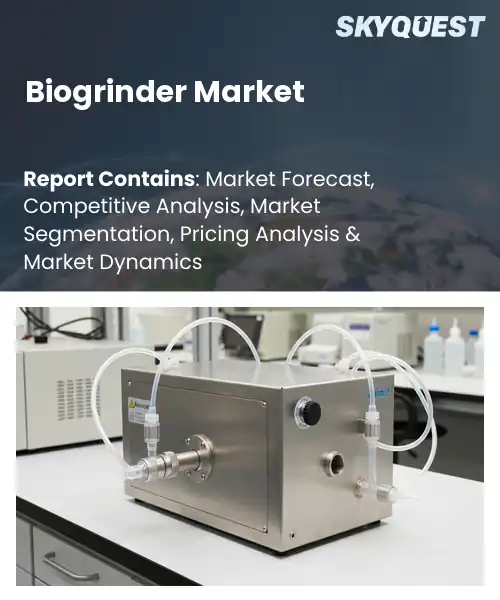
Biogrinder Market
Report ID: SQMIG35J2638
Report ID: SQMIG35J2638
[email protected]
USA +1 351-333-4748
Report ID:
SQMIG35J2638 |
Region:
Global |
Published Date: July, 2026
Pages:
157
|Tables:
149
|Figures:
78


Global Biogrinder Market size was valued at USD 487.3 Million in 2024 and is poised to grow from USD 522.39 Million in 2025 to USD 911.07 Million by 2033, growing at a CAGR of 7.2% during the forecast period (2026-2033).
Increasing demand for rapid molecular diagnostics, increasing adoption of automated sample preparation systems, rising investments in biopharmaceutical research, advancements in laboratory automation technologies, and expanding applications in vaccine and infectious disease research are driving demand for biogrinders.
High adoption of molecular diagnostic testing coupled with increasing demand for rapid sample preparation is expected to primarily drive biogrinder market growth. Rising use of automated cell disruption technologies in microbiology, biopharmaceutical manufacturing, and clinical research is also accelerating product adoption. Continuous advancements in bead-based mechanical homogenization and laboratory automation have improved sample processing speed, reproducibility, and contamination control. Increasing deployment of point-of-care molecular diagnostics, infectious disease testing, and nucleic acid amplification technologies is further supporting market expansion by enabling faster clinical decision-making. Growing investments in life sciences research, vaccine development, and integrated diagnostic platforms are also expected to create new growth opportunities for the biogrinder market.
On the contrary, high equipment costs, complex maintenance requirements, limited adoption among small laboratories, and availability of alternative sample preparation technologies are anticipated to slow down biogrinder market penetration across the study period and beyond.
How is AI-driven Automation Reshaping Biogrinder Demand Outlook?
AI is revolutionizing the biogrinder industry through greater automation, improved processing efficiency, and increased consistency in the output products. By use of sensors and machine learning technology, the speed and pressure of grinding is regulated depending on the sample, leading to increased accuracy in the process and lesser manual involvement. Predictive maintenance is used in the identification of potential equipment problems before they occur, decreasing downtime and the risk of contamination.
Market snapshot - (2026-2033)
Global Market Size
USD 487.3 Million
Largest Segment
Stationary Biogrinders
Fastest Growth
Electric Biogrinders
Growth Rate
7.2% CAGR
To get more insights on this market click here to Request a Free Sample Report
Global biogrinder market is segmented by product type, feedstock, application, capacity, end user, and region. Based on product type, the market is segmented into stationary biogrinders, mobile biogrinders, electric biogrinders, and diesel biogrinders. Based on feedstock, the market is segmented into green waste, wood waste, municipal organic waste, agricultural residues, and others. Based on application, the market is segmented into composting, biomass fuel production, waste recycling, and land clearing. Based on capacity, the market is segmented into small capacity, medium capacity, and large capacity. Based on end user, the market is segmented into waste management companies, biomass processors, municipal authorities, and forestry companies. Based on region, the market is segmented into North America, Europe, Asia Pacific, Latin America, and Middle East & Africa.
The electric biogrinders segment is forecasted to lead the global biogrinder market revenue generation through 2033. These machines not only have very high efficiency in terms of processing but also very quiet operation which makes them meet the tough standards set by the waste management industry. The absence of any fuel requirement, zero emissions, and easy to maintain due to their compact design make them preferred choices for stationary as well as modular facilities. Ease of maintenance and digital interface increases productivity making them highly desirable machines in the eyes of buyers.
Meanwhile, mobile biogrinders segment witnesses the strongest growth momentum as per this biogrinder market forecast, due to its portability that makes it easy for use in remote or emergency situations, which help in meeting the demands of reducing wastes on a quick basis. The ability to service temporary facilities increases the demand, prompting manufacturers to come up with more lightweight designs.
The green waste segment is estimated to account for the highest global biogrinder market share going forward. It is the most abundant and continuous source of organic matter, making it a dependable raw material for biogrinding processes. The presence of a lot of moisture in the substance makes the process of size reduction easier, while the output produced is perfect for composting, thus creating a cycle of value generation that supports environmental policies as well as regular use of machinery.
Conversely, municipal organic waste is emerging as the key high growth segment because municipal authorities are mandating mandatory source separation, ensuring a constant stream of processed organics that need special grinding for proper recycling. Such regulation drives equipment upgrades and innovative grinder designs, increasing market possibilities.
To get detailed segments analysis, Request a Free Sample Report
North America maintains its dominance in the biogrinder sector because of a combination of advanced research infrastructure, sound funding systems, and an effective regulatory framework, which promotes quick uptake of products. The existence of top biotech companies and universities results in constant innovations and high demand from industries ensures scalability of the processes. Collaboration among government bodies, venture capitals, and technology partners speeds up the time-to-market and reinforces the competitive advantage of the area. Besides, the presence of sound supply chain and experience in downstream processing is another factor that helps the region stay at the forefront. In addition, there is an active collaboration among material science, chemical engineering, and environmental sustainability that enables the development of innovative bioconversion technologies. Furthermore, there are some proactive policies that motivate green manufacturing and make North America a center for sustainable industrial revolution.
Biogrinder Market in the United States benefits from a dense ecosystem of research universities and venture capital that fuels early‑stage innovation. Strong industrial demand across sectors such as agriculture, waste management, and biofuel production creates a broad customer base. Regulatory pathways are well‑defined, allowing swift product approvals, while collaborative platforms between government labs and private firms streamline technology transfer. This synergy sustains a high pace of product introduction and market expansion.
Biogrinder Market in Canada leverages strong governmental support for green technology and a collaborative research landscape that includes national labs and university consortia. The country’s emphasis on renewable energy and circular economy initiatives drives demand for sustainable bioprocessing solutions. Favorable policy incentives reduce entry barriers for emerging enterprises, while established supply chains ensure reliable feedstock availability. Together, these factors nurture a resilient market environment and encourage continuous adoption of advanced Biogrinder technologies.
There has been a rapid growth in demand for biogrinders in Europe owing to the synergy between tough sustainability laws, large investments in biotechnology made by both government and private parties, as well as the practice of cooperation between countries that allows for quicker dissemination of information. Germany serves as an excellent industrial base and has developed supply chain infrastructure, thus making it a leading market. The UK is a leading startup nation with excellent research facilities and policies that favor commercialization, making it one of the fastest-growing regions. France prioritizes the green transition and supports new projects and early adopters. All these factors contribute to the development of a conducive environment where bioconversion technology innovations flourish, leading to a continent-wide market boom.
Biogrinder sales in Germany rest on a robust manufacturing sector, extensive research infrastructure, and well‑established logistics networks that support large‑scale deployment. Government incentives target renewable processes, encouraging companies to adopt bioconversion solutions. Strong collaborations between chemical industry clusters and academic labs drive continuous improvement of technologies. The country's focus on energy independence and carbon reduction further integrates Biogrinder applications into both traditional and emerging industrial pathways. This comprehensive ecosystem positions Germany as a benchmark for market excellence.
Biogrinder market in the United Kingdom thrives on a dynamic innovation pipeline fueled by world‑renowned universities and a supportive venture capital environment. Policy frameworks prioritize low‑carbon technologies, creating incentives for rapid commercialization of bioconversion processes. Collaborative hubs linking academic research with industrial partners accelerate technology transfer and scale‑up. The emphasis on sustainable manufacturing across sectors such as chemicals, food, and energy drives broad market adoption and reinforces the UK’s reputation as a fast‑growing leader.
Biogrinder demand in France is emerging through focused governmental programs that champion circular economy and renewable resource utilization. Strong academic networks and specialized research institutes nurture early‑stage technology development. Fiscal incentives encourage startups to pilot bioconversion solutions within existing industrial clusters. Growing consumer demand for sustainable products creates a favorable market climate, while collaborations with European partners amplify knowledge exchange and accelerate the integration of Biogrinder technologies into the French industrial landscape.
Asia Pacific is making its mark through smart investments in state-of-the-art bioprocessing, government backing for renewable technology development, and a spirit of innovation combining tradition and modern bioconversion processes. Japan utilizes its engineering skills and well-developed chemical processing industry to create highly efficient Biogrinder technologies and form partnerships between research centers and multinational companies. South Korea focuses on fast implementation of new technologies and an innovative venture capital network, thus promoting commercial use of groundbreaking bioprocessing techniques. Both countries value sustainability and circular economy principles, which creates a favorable regulation environment and accelerates market entrance. The export orientation and involvement in global supply chains are additional factors giving Asia Pacific a greater influence, and thus, making it an emerging center for Biogrinders.
Biogrinder demand in Japan benefits from a legacy of high‑precision manufacturing and a strong emphasis on research excellence in biotechnology. Governmental programs provide targeted funding for sustainable process development, encouraging collaboration between industrial conglomerates and academic labs. The country’s focus on energy security and waste valorization drives demand for efficient bioconversion technologies. Integrated supply chains and advanced automation capabilities enable rapid scale‑up, positioning Japan as a leader in deploying sophisticated Biogrinder solutions across multiple sectors.
Biogrinder sales in South Korea are propelled by an aggressive innovation agenda and strong public‑private partnerships that accelerate technology commercialization. Incentives for green manufacturing attract both startups and established firms to invest in bioconversion platforms. The nation’s advanced digital infrastructure supports real‑time process optimization, enhancing efficiency and scalability. Growing environmental awareness among consumers and regulators fuels demand for sustainable solutions, while export‑focused strategies expand the reach of Korean Biogrinder technologies into international markets.
To know more about the market opportunities by region and country, click here to
Buy The Complete Report
Rising Demand for Personalized Medicine
Advancements in Genetic Sequencing
High Costs of Equipment Procurement
Regulatory Uncertainty Across Regions
Request Free Customization of this report to help us to meet your business objectives.
The global biogrinder market is shaped by intense competition among established manufacturers and emerging innovators. Companies are accelerating growth through strategic M&A, such as the recent acquisition of a leading homogenizer producer by a larger life‑science conglomerate, and forming partnerships with specialty glass suppliers to secure high‑precision consumables. Technological innovation is evident in the launch of next‑generation bead‑mill systems that integrate AI‑driven process optimization, enhancing throughput and product consistency.
SkyQuest’s ABIRAW (Advanced Business Intelligence, Research & Analysis Wing) is our Business Information Services team that Collects, Collates, Correlates, and Analyses the Data collected by means of Primary Exploratory Research backed by robust Secondary Desk research.
As per SkyQuest analysis, growing demand for rapid molecular diagnostics, increasing adoption of automated sample preparation systems, and rising investments in biopharmaceutical research are anticipated to drive the demand for biogrinders going forward. However, high equipment costs, complex maintenance requirements, and availability of alternative sample preparation technologies are slated to slow down the adoption of biogrinders in the future. North America is slated to spearhead the demand for biogrinders owing to strong life sciences research infrastructure, high adoption of molecular diagnostics, and increasing investments in biopharmaceutical manufacturing. Development of AI-powered laboratory automation, integration of biogrinders with point-of-care diagnostic platforms, and advancements in high-throughput sample preparation technologies are anticipated to be key trends driving the biogrinder market over the coming years.
| Report Metric | Details |
|---|---|
| Market size value in 2024 | USD 487.3 Million |
| Market size value in 2033 | USD 911.07 Million |
| Growth Rate | 7.2% |
| Base year | 2024 |
| Forecast period | (2026-2033) |
| Forecast Unit (Value) | USD Million |
| Segments covered |
|
| Regions covered | North America (US, Canada), Europe (Germany, France, United Kingdom, Italy, Spain, Rest of Europe), Asia Pacific (China, India, Japan, Rest of Asia-Pacific), Latin America (Brazil, Rest of Latin America), Middle East & Africa (South Africa, GCC Countries, Rest of MEA) |
| Companies covered |
|
| Customization scope | Free report customization with purchase. Customization includes:-
|
To get a free trial access to our platform which is a one stop solution for all your data requirements for quicker decision making. This platform allows you to compare markets, competitors who are prominent in the market, and mega trends that are influencing the dynamics in the market. Also, get access to detailed SkyQuest exclusive matrix.
Table Of Content
Executive Summary
Market overview
Parent Market Analysis
Market overview
Market size
KEY MARKET INSIGHTS
COVID IMPACT
MARKET DYNAMICS & OUTLOOK
Market Size by Region
KEY COMPANY PROFILES
Methodology
For the Biogrinder Market, our research methodology involved a mixture of primary and secondary data sources. Key steps involved in the research process are listed below:
1. Information Procurement: This stage involved the procurement of Market data or related information via primary and secondary sources. The various secondary sources used included various company websites, annual reports, trade databases, and paid databases such as Hoover's, Bloomberg Business, Factiva, and Avention. Our team did 45 primary interactions Globally which included several stakeholders such as manufacturers, customers, key opinion leaders, etc. Overall, information procurement was one of the most extensive stages in our research process.
2. Information Analysis: This step involved triangulation of data through bottom-up and top-down approaches to estimate and validate the total size and future estimate of the Biogrinder Market.
3. Report Formulation: The final step entailed the placement of data points in appropriate Market spaces in an attempt to deduce viable conclusions.
4. Validation & Publishing: Validation is the most important step in the process. Validation & re-validation via an intricately designed process helped us finalize data points to be used for final calculations. The final Market estimates and forecasts were then aligned and sent to our panel of industry experts for validation of data. Once the validation was done the report was sent to our Quality Assurance team to ensure adherence to style guides, consistency & design.
Analyst Support
Customization Options
With the given market data, our dedicated team of analysts can offer you the following customization options are available for the Biogrinder Market:
Product Analysis: Product matrix, which offers a detailed comparison of the product portfolio of companies.
Regional Analysis: Further analysis of the Biogrinder Market for additional countries.
Competitive Analysis: Detailed analysis and profiling of additional Market players & comparative analysis of competitive products.
Go to Market Strategy: Find the high-growth channels to invest your marketing efforts and increase your customer base.
Innovation Mapping: Identify racial solutions and innovation, connected to deep ecosystems of innovators, start-ups, academics, and strategic partners.
Category Intelligence: Customized intelligence that is relevant to their supply Markets will enable them to make smarter sourcing decisions and improve their category management.
Public Company Transcript Analysis: To improve the investment performance by generating new alpha and making better-informed decisions.
Social Media Listening: To analyze the conversations and trends happening not just around your brand, but around your industry as a whole, and use those insights to make better Marketing decisions.
REQUEST FOR SAMPLE
 REQUEST FREE CUSTOMIZATION
Global Biogrinder Market size was valued at USD 487.3 Million in 2024 and is poised to grow from USD 522.39 Million in 2025 to USD 911.07 Million by 2033, growing at a CAGR of 7.2% during the forecast period (2026-2033).
The global biogrinder market is shaped by intense competition among established manufacturers and emerging innovators. Companies are accelerating growth through strategic M&A, such as the recent acquisition of a leading homogenizer producer by a larger life‑science conglomerate, and forming partnerships with specialty glass suppliers to secure high‑precision consumables. Technological innovation is evident in the launch of next‑generation bead‑mill systems that integrate AI‑driven process optimization, enhancing throughput and product consistency. 'Bioretec Ltd.', 'Vecoplan AG', 'ZERMA Machinery & Recycling Technology', 'WEIMA Maschinenbau GmbH', 'UNTHA shredding technology GmbH', 'SSI Shredding Systems, Inc.', 'Genox Recycling Tech (China) Co., Ltd.', 'Jordan Reduction Solutions', 'Morbark, LLC', 'Vermeer Corporation', 'Terex Ecotec', 'Lindner-Recyclingtech GmbH', 'Doppstadt Umwelttechnik GmbH', 'Komptech GmbH', 'Bandit Industries, Inc.', 'Pronar Sp. z o.o.', 'Harden Machinery Ltd.', 'CM Shredders LLC', 'Rotochopper, Inc.', 'Williams Patent Crusher & Pulverizer Co., Inc.'
Rising demand for personalized medicine drives expansion of the biogrinder market as researchers seek efficient tools to isolate specific cell populations for targeted therapies. The need for high‑purity samples accelerates adoption of specialized grinding equipment, encouraging manufacturers to enhance product capabilities and support services. This focus on individualized treatment strategies creates a sustained preference for advanced biogrinding solutions that can handle diverse biological matrices while preserving sample integrity, thereby fostering continuous market growth. Industry collaborations also reinforce this momentum by sharing best practices.
Sustainable Material Integration: Manufacturers are increasingly substituting traditional polymers with biodegradable or recycled biopolymers, responding to heightened consumer demand for environmentally responsible products and the push for circular economy practices across supply chains. This shift is encouraging equipment suppliers to develop grinder models capable of handling a broader range of feedstock viscosities and particle size distributions, while maintaining energy efficiency and low noise profiles. Consequently, end‑users report smoother integration into production lines and faster time‑to‑market for green portfolios, reinforcing sustainability as a differentiator.
Why does North America Dominate the Global Biogrinder Market? |@12


Want to customize this report? This report can be personalized according to your needs. Our analysts and industry experts will work directly with you to understand your requirements and provide you with customized data in a short amount of time. We offer $1000 worth of FREE customization at the time of purchase.
Feedback From Our Clients


 USA (+1) 351-333-4748

