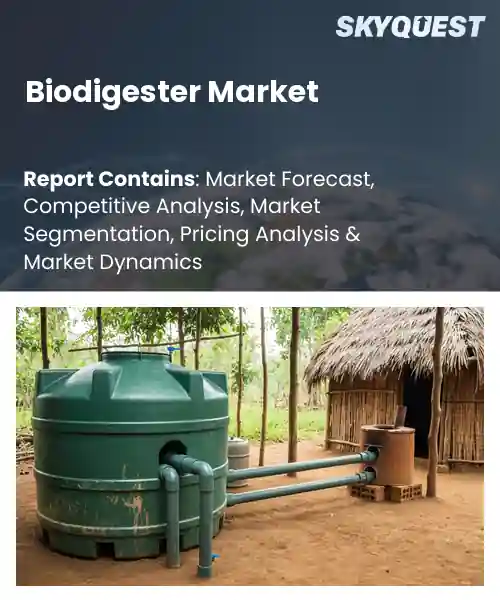
Biodigester Market
Report ID: SQMIG30C2197
Report ID: SQMIG30C2197
[email protected]
USA +1 351-333-4748
Report ID:
SQMIG30C2197 |
Region:
Global |
Published Date: March, 2026
Pages:
157
|Tables:
153
|Figures:
78


Global Biodigester Market size was valued at USD 3.6 Billion in 2024 and is poised to grow from USD 3.95 Billion in 2025 to USD 8.35 Billion by 2033, growing at a CAGR of 9.8% during the forecast period (2026-2033).
Growing demand for renewable energy, stringent waste management regulations, rising focus on circular economy practices, increasing adoption of sustainable farming inputs, and government incentives for biogas production are driving sales of biodigesters.
The growing use of biodigesters across large municipal and industrial systems worldwide, including regions like Europe, Asia, and Latin America, has resulted in the scalability and efficiency of these systems. The growing demand for renewable energy, along with the implementation of stringent waste management practices, has changed the perspective on organic waste. Waste is now viewed as a resource, which is harnessed through biodigesters for biofuels, heat, power, and biofertilizers. The economic viability of the project, which has been realized through the creation of multiple income streams from biofuel sales, sales of digestate, and carbon credits, is also contributing to the popularity of this technology.
Technological advancements, such as the incorporation of modular technology, have ensured cost savings, thus enhancing the viability of the project. In addition, the growing financing options are helping the deployment of the technology on a larger scale. Growing emphasis on converting organic waste into valuable resources coupled with a shift toward sustainable energy generation is expected to primarily drive biodigester market growth.
On the contrary, high initial investment costs, lack of technical expertise in developing regions, operational and maintenance challenges, feedstock supply inconsistencies, and regulatory complexities are estimated to impede biodigester market penetration going forward.
How is IoT Improving Operational Efficiency of Modern Biodigesters?
The IoT technology is contributing significantly to the improvement of operational efficiency in the biodigester industry by ensuring real-time monitoring and control of the digestion process. In modern biodigesters, temperature, pH level, and gas production are monitored using sensors, and edge technology is used to collect data from sensors. This data is then used to generate insights using cloud-based analytics. There is a growing trend of using remote monitoring in farm-based and industrial biodigesters to reduce manual intervention in the digestion process.
In January 2025, Sistema.bio secured investment and expanded its digital monitoring capabilities. This advancement strengthened remote diagnostics and predictive maintenance, showing how IoT-enabled systems can scale biodigester deployments by improving uptime, simplifying servicing, and increasing confidence among buyers and investors.
Market snapshot - (2026-2033)
Global Market Size
USD 3.6 Billion
Largest Segment
Fixed Dome Biodigesters
Fastest Growth
Complete Mix Biodigesters
Growth Rate
9.8% CAGR
To get more insights on this market click here to Request a Free Sample Report
Global biodigester market is segmented by product type, feedstock type, application, end-user, distribution channel, and region. Based on product type, the market is segmented into fixed dome biodigesters, floating drum biodigesters, plug flow biodigesters, complete mix biodigesters, and other biodigester types. Based on feedstock type, the market is segmented into agricultural waste, animal manure, food & kitchen waste, industrial organic waste, and municipal solid waste.
Based on application, the market is segmented into renewable energy (biogas production), waste management, organic fertilizer production, industrial process energy, and others. Based on end-user, the market is segmented into agricultural farms, municipal & government projects, industrial facilities, residential / community installations, and waste management companies. Based on distribution channel, the market is segmented into direct project sales, dealers & distributors, EPC contractors, and online sales. Based on region, the market is segmented into North America, Europe, Asia Pacific, Latin America, and Middle East & Africa.
The fixed dome biodigesters segment is forecasted to account for the highest global biodigester market share going forward. Simple, robust design delivers low lifecycle costs and high operational reliability, makes them a preferred choice for long-term biogas projects. Their structure also makes them more resistant to maintenance and environmental stress, which eases their adoption. Their successful use with different feedstocks and decentralized systems encourages their procurement by farms and organizations in need of stable energy and income.
However, floating drum biodigesters are the most rapidly expanding segment as per this biodigester industry analysis. The presence of an external gas holder makes it easier to measure the gas output and regulate the pressure, thus facilitating its adoption. Improvements in lightweight materials and module fabrication reduce installation costs and time; however, the need for a scalable unit for mid-sized businesses increases its adoption rate.
The food & kitchen waste segment is estimated to lead the global biodigester market revenue generation across the study period. High biodegradability and consistently high organic content make biodigester projects economically attractive, which helps this segment hold sway over others. The availability of centralized and commercialized systems for collecting feedstock from restaurants and institutions can simplify feedstock logistics, thereby increasing return on investment. Additionally, the focus on organic waste diversion from regulatory agencies, as well as corporate sustainability initiatives, creates a sense of urgency for deploying technologies that are specifically designed for this feedstock type at all scales of operation.
However, industrial organic waste is now an emerging area of high growth potential, given large and consistent volumes from food processors and manufacturers that allow for large-capacity digesters. Improved corporate waste management requirements and investments in technologies to address onsite waste management drive dedicated anaerobic solutions, which unlock scale efficiencies and drive partnerships between industry and biodigester suppliers.
To get detailed segments analysis, Request a Free Sample Report
Mature policy environment, comprehensive waste management frameworks, and strong integration with renewable energy targets are supporting consistent sales of biodigesters in Europe. Ongoing research and development of new technologies at institutions and pilot programs contribute to performance improvements, while consistent standards and cross-border sharing of knowledge allow other countries throughout the region to quickly adopt commercial applications and reduce barriers for deployment. The use of modular systems and maximum flexibility in using various sources of feedstock add value to farms, food processors and municipalities.
Local project replication, however, is made possible through financial support and public support for projects within every component of the circular economy. Investments from many manufacturers in the biogas sector, and the presence of multiple long-term service partners at local level, provide confidence to investors and reduce the life cycle cost of the products they sell.
A strong industrial base, a well-developed agriculture sector, and a robust engineering sector are contributing to a consistent demand for biodigesters. Research organizations play a role in driving improvements in process efficiency and upgrading technologies, particularly for larger projects with high environmental demands. The policy environment for biodigester systems is conducive for integrating with district heat schemes or farm energy schemes. It has a highly skilled workforce with manufacturers close at hand to ensure fast implementation.
Innovation in modular systems and urban organic waste treatment, coupled with rise in collaboration between local governments and private operators supports biodigester adoption in the country. Public sector initiatives and pilot programs increase awareness for emerging technologies, allowing partnerships that simplify permitting and community engagement. push for circular economy projects also enables aggregation and energy production for commercial customers. Strong service industries and engineering consultancies are key factors in facilitating project development and optimizing biodigester performance across the United Kingdom.
New regional programs for agricultural waste valorization and collection of urban organic waste have provided a favorable context for biodigester vendors in France to operate in. There is also research to improve plant robustness and fertilizer yields. Alignment with regulations and favorable procurement systems have also facilitated the replication of existing technologies. There are engineering companies and specialized companies with expertise in adapting to local feedstock availability and distribution structures, with cooperatives for community-based ownership structures for the biodigester plants.
Strong private sector investment, corporate sustainability commitments, and municipal interest in organic waste diversion supports steady biodigester demand in the region. Technology providers are customizing solutions for food processing and livestock and urban organics, allowing them to deploy solutions in a manner that is highly flexible and adaptable to all geographic locations. The well-developed engineering and contracting capabilities in the industry reduce the risks associated with developing projects as well. An emphasis on renewable natural gas upgrading as well as a range of offtake options has resulted in a more certain revenue stream. Strategic partnerships between utility companies, agribusiness cooperatives, and technology companies are helping companies scale their operations more quickly.
A dedicated service network creates ongoing support for ongoing operations and optimization of projects. Regional programs and corporate offtake channels provide a stable demand for upgraded biogas. At the same time, local manufacturing of components and easier feedstock logistics make it simpler to deploy solutions. Additionally, the adoption of emerging financing structures will help to mobilize more capital for the continued scale-up of this industry.
Diverse feedstock availability across agricultural and industrial sectors, a mature ecosystem of engineering and construction firms are supporting biodigester adoption in the United States. Financial innovations and service companies have helped to de-risk project execution, thereby facilitating rural and urban deployment. Renewable gas and renewable power solutions have seen an increase in demand with corporate sustainability targets and government initiatives. Technology companies are focusing on modular and scalable solutions, as well as biogas upgrading to accommodate different off-take opportunities.
Strong alignment between provincial waste strategies and renewable energy objectives are boosting biodigester deployment across Canada. High emphasis on reducing methane emissions creates opportunities for solutions that provide fertilizer as a by-product. There are manufacturers and service providers in the region that are adapting solutions for cold climates. There are collaborative efforts between different organizations, research centers, and cooperatives for scaling pilot projects.
Targeted industrial adoption, technological modernization, and strategic integration with broader decarbonization agendas make this region a highly rewarding one for biodigester companies. Governments and organizations are focusing more on organic waste management and energy independence, thus encouraging investments in small and highly efficient digester systems, which can fit in a small spatial footprint. The focus for manufacturers is to develop modifications/adaptations to accommodate urban and industrial facilities, whereas different universities have been focusing on developing feedstock flexibility and control systems. Modular, automated, and nutrient recovery designs to enhance the project economics of biodigestion, facilitate a higher level of biodigester deployment in densely populated areas that have the greatest need for circular economy-type solutions.
Policy innovations, such as using pilot cluster projects to prove the viability of biodigestion technology, reduce barriers to adoption of the technology. Financing schemes in local communities and training schemes for the workforce also help in preparing for operation. Furthermore, the use of export-oriented manufacturing and collaborative cross-border manufacturing adds to the regional capability for manufacturing biodigesters.
High demand for compact automated systems suited to urban density and limited agricultural land is shaping biodigester procurement in Japan. Technology providers engineer control and material technologies to comply with stringent requirements. Research institutes and utilities implement upgrading and recycling technologies for nutrient management, and procurement mechanisms and funding opportunities are provided for technology verification in different scenarios. Food processing plants and municipal initiatives emphasize performance and odor management, thus requiring integrated technologies for treatment and energy production.
Growing industrial interest in waste to energy solutions and collaboration between manufacturers, and technology licensors supports steady biodigester adoption in South Korea. Public private partnerships are also helpful for commercializing biodigester systems, with a focus on designs that accommodate regional climatic and regulatory demands. Initiatives such as urban organic collection programs and industrial food processing activities provide a high concentration of feedstock for modular biodigester systems. Emphasis on automation, commissioning, and integration with district energy systems make projects more attractive.
To know more about the market opportunities by region and country, click here to
Buy The Complete Report
Favorable Renewable Energy Policies
The increase in support for renewable energy projects and climate change mitigation measures from the government creates an environment where there is an increase in investment in biodigester projects. This creates an incentive for the projects, thereby motivating the private sector to take up the projects. The increase in support for biodigester projects from the government creates an environment where there is an increase in investment in biodigester projects. The increase in support for biodigester projects from the government creates an environment where there is an increase in investment in biodigester projects.
Increasing Agricultural Waste Availability
The increased interest in circular agriculture and resource utilization has resulted in an increased use of crop residues, manure, and other organic agricultural waste materials for biodigestion systems, thus improving the practical viability of such schemes. The availability of biomass at the farm and community levels helps minimize feedstock risks and encourages the design of schemes that can be integrated with current agricultural practices, thus promoting decentralized systems, community participation by creating a new revenue or cost-saving opportunity, and technology providers seeking to design solutions that suit specific waste streams and scales of implementation.
High Capital Investment Requirements
The high capital costs associated with acquiring a biodigester, undertaking civil works, as well as integrating with energy systems, are a significant barrier to many potential adopters. For smallholder farmers or community-based operators, for instance, access to affordable finance as well as perceived lengthy payback periods may discourage investors from proceeding with projects. The high capital costs make stakeholders hesitant to invest in biodigesters, thereby delaying or reducing investment in emerging technologies as well as opting for alternative technologies for managing waste. The high capital costs also make stakeholders dependent on subsidies or government support.
Feedstock Supply Chain Challenges
The inconsistency in the quality of feedstocks used in the biodigesters, the seasonality of the feedstocks available, and the possibility of contaminants affecting the quality of the feedstocks pose a problem in the reliability of the biodigesters and the maintenance thereof, which creates a level of doubt in the minds of investors who are looking at the possibility of investing in the technology. The possibility of inconsistency in the quality of the feedstocks used in the biodigesters creates a level of doubt regarding the amount of biogas produced and the level of maintenance required for the biodigesters.
Request Free Customization of this report to help us to meet your business objectives.
Competitive dynamics in the global biodigester market are driven by strategic M&A, corporate venture investments, and targeted technology partnerships that accelerate scale and retrofit adoption. Examples include ENGIE New Ventures investing in a UK electro-methanogenic innovator, large project divestments of developed biogas assets to infrastructure investors, and corporate acquisitions of operating organic waste to energy facilities, each forcing incumbents to compete on modular technology and feedstock flexibility.
SkyQuest’s ABIRAW (Advanced Business Intelligence, Research & Analysis Wing) is our Business Information Services team that Collects, Collates, Correlates, and Analyses the Data collected by means of Primary Exploratory Research backed by robust Secondary Desk research.
As per SkyQuest analysis, rising demand for renewable energy, stringent waste management regulations, and increasing focus on circular economy practices are anticipated to drive the demand for biodigesters going forward. However, high initial investment costs, operational complexities, feedstock supply inconsistencies, and regulatory challenges are slated to slow down the adoption of biodigesters in the future. Europe is slated to spearhead the demand for biodigesters owing to strong policy support for biogas production, advanced waste management infrastructure, and presence of established renewable energy markets. Integration of IoT-enabled monitoring systems, development of modular and scalable biodigester designs, and advancements in revenue generation through carbon credits and biofertilizer sales are anticipated to be key trends driving the biodigester sector in the future.
| Report Metric | Details |
|---|---|
| Market size value in 2024 | USD 3.6 Billion |
| Market size value in 2033 | USD 8.35 Billion |
| Growth Rate | 9.8% |
| Base year | 2024 |
| Forecast period | (2026-2033) |
| Forecast Unit (Value) | USD Billion |
| Segments covered |
|
| Regions covered | North America (US, Canada), Europe (Germany, France, United Kingdom, Italy, Spain, Rest of Europe), Asia Pacific (China, India, Japan, Rest of Asia-Pacific), Latin America (Brazil, Rest of Latin America), Middle East & Africa (South Africa, GCC Countries, Rest of MEA) |
| Companies covered |
|
| Customization scope | Free report customization with purchase. Customization includes:-
|
To get a free trial access to our platform which is a one stop solution for all your data requirements for quicker decision making. This platform allows you to compare markets, competitors who are prominent in the market, and mega trends that are influencing the dynamics in the market. Also, get access to detailed SkyQuest exclusive matrix.
Table Of Content
Executive Summary
Market overview
Parent Market Analysis
Market overview
Market size
KEY MARKET INSIGHTS
COVID IMPACT
MARKET DYNAMICS & OUTLOOK
Market Size by Region
KEY COMPANY PROFILES
Methodology
For the Biodigester Market, our research methodology involved a mixture of primary and secondary data sources. Key steps involved in the research process are listed below:
1. Information Procurement: This stage involved the procurement of Market data or related information via primary and secondary sources. The various secondary sources used included various company websites, annual reports, trade databases, and paid databases such as Hoover's, Bloomberg Business, Factiva, and Avention. Our team did 45 primary interactions Globally which included several stakeholders such as manufacturers, customers, key opinion leaders, etc. Overall, information procurement was one of the most extensive stages in our research process.
2. Information Analysis: This step involved triangulation of data through bottom-up and top-down approaches to estimate and validate the total size and future estimate of the Biodigester Market.
3. Report Formulation: The final step entailed the placement of data points in appropriate Market spaces in an attempt to deduce viable conclusions.
4. Validation & Publishing: Validation is the most important step in the process. Validation & re-validation via an intricately designed process helped us finalize data points to be used for final calculations. The final Market estimates and forecasts were then aligned and sent to our panel of industry experts for validation of data. Once the validation was done the report was sent to our Quality Assurance team to ensure adherence to style guides, consistency & design.
Analyst Support
Customization Options
With the given market data, our dedicated team of analysts can offer you the following customization options are available for the Biodigester Market:
Product Analysis: Product matrix, which offers a detailed comparison of the product portfolio of companies.
Regional Analysis: Further analysis of the Biodigester Market for additional countries.
Competitive Analysis: Detailed analysis and profiling of additional Market players & comparative analysis of competitive products.
Go to Market Strategy: Find the high-growth channels to invest your marketing efforts and increase your customer base.
Innovation Mapping: Identify racial solutions and innovation, connected to deep ecosystems of innovators, start-ups, academics, and strategic partners.
Category Intelligence: Customized intelligence that is relevant to their supply Markets will enable them to make smarter sourcing decisions and improve their category management.
Public Company Transcript Analysis: To improve the investment performance by generating new alpha and making better-informed decisions.
Social Media Listening: To analyze the conversations and trends happening not just around your brand, but around your industry as a whole, and use those insights to make better Marketing decisions.
REQUEST FOR SAMPLE
 REQUEST FREE CUSTOMIZATION
Global Biodigester Market size was valued at USD 3.6 Billion in 2024 and is poised to grow from USD 3.95 Billion in 2025 to USD 8.35 Billion by 2033, growing at a CAGR of 9.8% during the forecast period (2026-2033).
Competitive dynamics in the global biodigester market are driven by strategic M&A, corporate venture investments, and targeted technology partnerships that accelerate scale and retrofit adoption. Examples include ENGIE New Ventures investing in a UK electro-methanogenic innovator, large project divestments of developed biogas assets to infrastructure investors, and corporate acquisitions of operating organic waste to energy facilities, each forcing incumbents to compete on modular technology and feedstock flexibility. 'Biogest', 'Xylem', 'Anaergia', 'Veolia', 'EIT InnoEnergy', 'Ecolotech', 'BioEnergy', 'SUEZ', 'EnviTec Biogas', 'WELTEC BIOPOWER', 'Green Waste Solutions', 'BioFrigate', 'ReEnergy Holdings', 'StormFisher', 'Agraferm Technologies', 'PowerCell', 'BioEnzyme', 'Biome Technologies', 'Bluefield Biogas', 'BioCycle'
Growing government support for renewable energy initiatives and climate mitigation policies encourages investment in biodigester installations, creating clearer demand signals and improving project bankability. Incentive schemes, renewable energy targets, and favorable permitting frameworks reduce perceived policy risk and motivate private sector participation. This regulatory encouragement enables developers to plan larger and longer term projects, stimulates technology adoption by reducing barriers to entry, and fosters partnerships between municipalities, farmers, and energy companies, thereby expanding deployment opportunities and accelerating market maturation across regions prioritizing sustainable waste to energy solutions.
Circular Economy Integration: The biodigester market is increasingly defined by integration into circular economy frameworks, where organic waste is valorized into energy and nutrient rich biosolids for agricultural reuse. Developers and end users collaborate to close resource loops, monetizing residues as biofertilizer and soil amendments while reducing landfill dependency. Municipal and corporate sustainability strategies prioritize closed loop solutions, driving demand for systems that deliver multiple byproducts and service models that link waste producers, waste managers, and agricultural buyers for shared economic and environmental benefits.
Europe Dominates the Global Biodigester Market. Mature policy environment, comprehensive waste management frameworks, and strong integration with renewable energy targets are supporting consistent sales of biodigesters in Europe.


Want to customize this report? This report can be personalized according to your needs. Our analysts and industry experts will work directly with you to understand your requirements and provide you with customized data in a short amount of time. We offer $1000 worth of FREE customization at the time of purchase.
Feedback From Our Clients


 USA (+1) 351-333-4748

