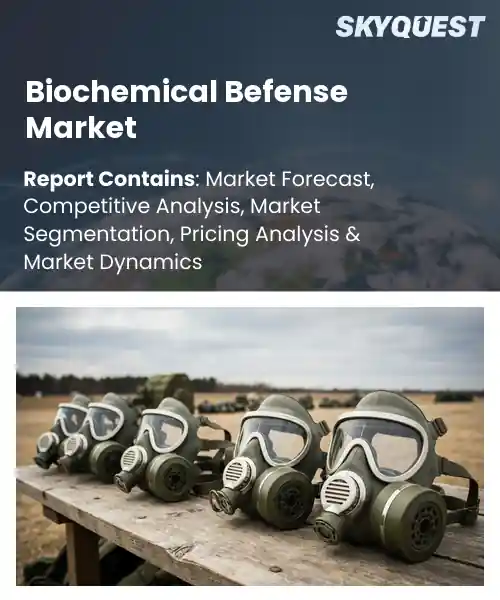
Biochemical Befense Market
Report ID: SQMIG15A2682
Report ID: SQMIG15A2682
[email protected]
USA +1 351-333-4748
Report ID:
SQMIG15A2682 |
Region:
Global |
Published Date: February, 2026
Pages:
157
|Tables:
113
|Figures:
77


Global Biochemical Befense Market size was valued at USD 229.0 Million in 2024 and is poised to grow from USD 237.47 Million in 2025 to USD 317.57 Million by 2033, growing at a CAGR of 3.7% during the forecast period (2026-2033).
Biochemical defense comprises technologies, diagnostics, therapeutics and preparedness systems designed to protect populations from biological and chemical threats. The primary driver is growing geopolitical instability together with recognition of pandemic vulnerabilities, which has pushed governments to increase funding and to partner with industry and NGOs. Over decades the market moved beyond Cold War civil defense into a diverse ecosystem of biosurveillance platforms, rapid point of care testing and decontamination capabilities, as seen in widespread genomic sequencing deployment during the COVID nineteen pandemic. This transformation matters because earlier detection and coordinated response reduce morbidity, preserve critical infrastructure and limit economic disruption.Building on that transformation, the dominant growth factor is rapid technological innovation in detection and data analytics because improved sensors, sequencing and artificial intelligence create earlier and more actionable threat insights. Consequently governments fund national genomics centers and real time biosurveillance networks, opening commercial opportunities for companies providing cloud analytics and laboratory workflows. Practical use cases include wastewater monitoring programs that detected SARS CoV two outbreaks ahead of clinical reporting, and mobile rapid test platforms used by hospitals to triage patients during surges. These causal dynamics expand addressable markets for diagnostics, software and integrated response services and public private partnerships.
How is AI enhancing detection capabilities in the biochemical defense market?
AI is enhancing detection in the biochemical defense market through improved pattern recognition and multimodal data fusion that spot subtle signatures across sequencing outputs, environmental sensors, and clinical reports. Key aspects include rapid processing of diverse biological data, machine learning models that learn normal baselines, and anomaly detection that prioritizes signals for expert review. The market is moving toward integrated biosurveillance systems that reduce false alarms and enable faster, more targeted responses. Examples include AI applied to metagenomic reads to reveal novel pathogens and edge analytics that make field sensors more reliable. This shift is supported by government biosurveillance modernization efforts.Lunai Bioworks January 2026, announced Sentinel which embeds toxicology intelligence inside large language models. This innovation strengthens early detection of novel chemical threat signatures and prevents risky outputs, supporting market growth by making AI driven discovery safer and by reducing time and friction in operational response.
Market snapshot - (2026-2033)
Global Market Size
USD 229.0 Million
Largest Segment
Biological Products
Fastest Growth
Biological Products
Growth Rate
3.7% CAGR
To get more insights on this market click here to Request a Free Sample Report
Global biochemical befense market is segmented by product type, application area, end user, formulation type and region. Based on product type, the market is segmented into Enzymatic Products and Biological Products. Based on application area, the market is segmented into Medical Applications and Industrial Applications. Based on end user, the market is segmented into Pharmaceutical Companies and Research Institutes. Based on formulation type, the market is segmented into Liquid Formulations and Solid Formulations. Based on region, the market is segmented into North America, Europe, Asia Pacific, Latin America and Middle East & Africa.
Enzymatic Products segment dominates because enzymes provide rapid, specific biochemical amplification that underpins many frontline detection and neutralization platforms, enabling faster threat identification and response. Their adaptability through protein engineering allows customization for diverse agents, reducing development timelines and integration friction with diagnostic devices. Strong supplier networks, established manufacturing processes, and compatibility with automated assay workflows further drive adoption, creating a virtuous cycle of investment, refinement, and widespread incorporation into biochemical befense solutions.
However, Biological Products are emerging as the most rapidly expanding area due to increasing demand for vaccines, antibody therapies, and engineered biologics tailored to counter diverse threats. Regulatory incentives and advances in bioprocessing accelerate development and scale up, unlocking new therapeutic and preventive use cases and expanding deployment options across preparedness and response programs.
Liquid Formulations segment dominates because liquids enable immediate preparation of injectables and topical preparations, simplifying administration routes vital during rapid response operations. Their compatibility with automated filling, aseptic manufacturing, and existing cold chain logistics reduces time to deployment and encourages integration with emergency stockpiles and clinical pathways. This operational convenience, combined with established regulatory familiarity and supply chain readiness, reinforces procurement preference and widespread use in biochemical befense applications.
However, Solid Formulations are witnessing the strongest growth momentum driven by advances in stabilization technologies and cold chain independent storage, enabling longer shelf life and simplified logistics for stockpiling. Innovations in dry powder inhalation and room temperature stable vaccines expand application scenarios, making solids a high growth area for distribution flexibility and future readiness.
To get detailed segments analysis, Request a Free Sample Report
North America commands the global Biochemical Befense market due to a combination of sustained public private investment, integrated innovation ecosystems, and mature regulatory frameworks that prioritize biodefense readiness. Concentrated research institutions and corporate R&D create rapid technology translation from laboratory to deployed solutions, while established procurement pathways enable adoption of advanced detection, therapeutics, and response platforms. Collaboration between government agencies, academic centers, and industry stakeholders fosters standardized protocols and interoperability across systems. A robust network of specialized suppliers and skilled workforce supports scalable manufacturing and supply chain resilience. Strong public private partnerships further accelerate commercialization and market penetration.
Biochemical Befense Market in United States is characterized by integration of federal research priorities with commercial innovation and concentration of specialized manufacturers. Public agencies coordinate procurement and capability gaps, while private sector partners accelerate product maturation through clinical and operational validation. A sophisticated ecosystem of testing facilities, talent pools, and strategic contractors supports deployment of complex platforms. Market dynamics emphasize interoperability, regulatory alignment, and term partnerships to sustain capability improvements.
Biochemical Befense Market in Canada is shaped by a collaborative approach between federal agencies, provincial health bodies with technology firms, supporting deployment of surveillance and response tools. Investment in regional centers of excellence supports translation of research into operational capabilities, while supply partnerships enhance procurement flexibility. Emphasis on interoperability and cross border cooperation with neighbors strengthens resilience. Policy frameworks encourage private collaboration and development to address evolving biological risk scenarios.
Europe is experiencing rapid expansion in Biochemical Befense market due to cohesive policy alignment among national authorities and regional institutions that prioritize collaborative preparedness and harmonized standards. A dense network of research institutes, specialized manufacturers, and technology incubators accelerates commercialization of detection, diagnostic, and medical countermeasure solutions. Cross border procurement initiatives and joint procurement mechanisms enable pooled demand and faster adoption, while public private partnerships drive targeted capability development. Emphasis on interoperability, standardized protocols, and clinical validation across multiple markets reduces barriers to scale. Commitment to building resilient supply chains and nurturing domestic manufacturing complements ongoing investment in workforce skills and translational infrastructure, positioning Europe as a dynamic growth region with increasing influence on global biodefense practices. Stronger collaboration among small and large companies fosters rapid iteration and market readiness.
Biochemical Befense Market in Germany benefits from a strong industrial base, advanced manufacturing capabilities, and research networks that accelerate product development and scaling. Cooperation between academic centers and specialized firms fosters technology transfer and validation. Regulatory clarity and strategic procurement channels support adoption of innovative detection and therapeutic platforms. Focus on supply chain resilience and manufacturing enables capability development, positioning the market as a key innovation hub in the region.
Biochemical Befense Market in United Kingdom links top academic research centers, a strong biotech sector, and coordinated national strategies that drive translation of innovations into practice. Government procurement pathways and ties between defense and health agencies enable adoption of advanced diagnostics and countermeasures. An active investor community and clinical trial networks support validation and scale. Focus on standards, interoperability, and international collaboration cements the market role and influence across Europe.
Biochemical Befense Market in France is emerging through strengthened research commercialization, growing biotech startup activity, and public support for translational projects. Regional innovation clusters and specialized manufacturers are expanding capabilities for diagnostics and therapeutic development, while evolving regulatory pathways align with market needs. Cooperation between public institutions and private innovators fosters deployment and testing. Emphasis on workforce development and supply diversification supports the market transition from research to operational capacity.
Asia Pacific is strengthening its position in the Biochemical Befense market through a strategic combination of capacity building, technology adoption, and cross sector collaboration. Governments and industry are investing in laboratory infrastructure, clinical validation networks, and industrial production capabilities to reduce reliance on external supply sources. Regional firms are partnering with global innovators to adapt advanced detection and countermeasure technologies to local needs, while regulatory agencies are enhancing pathways for clinical and operational approval. Focus on workforce development, standards alignment, and interoperable systems enables smoother integration into national emergency frameworks. Growing manufacturing competence and export orientation further position the region as a resilient, rapidly maturing contributor to global biodefense supply chains and operational capabilities. Strategic public private consortia and regional cooperation mechanisms accelerate innovation diffusion and market access.
Biochemical Befense Market in Japan draws on advanced technological capability, precision manufacturing, and strong applied biomedical research to develop quality diagnostics and countermeasure platforms. Collaboration between industry leaders, research institutions, and government agencies promotes rigorous clinical validation and regulatory harmonization. Emphasis on manufacturing excellence and quality management supports reliable production and export readiness. Partnerships with international firms and focus on interoperability enable integration of Japanese solutions into regional response architectures.
Biochemical Befense Market in South Korea is propelled by agile innovation ecosystems, biotech startups, and strong government support for translational research and scaling. Close collaboration among conglomerates, specialized manufacturers, and research institutions expedites production and distribution of diagnostic and therapeutic solutions. Regulatory agencies are advancing streamlined approval pathways to facilitate market entry, while export manufacturing and international partnerships broaden market reach. Emphasis on digital integration and rapid prototyping enhances responsiveness.
To know more about the market opportunities by region and country, click here to
Buy The Complete Report
Advancements In Diagnostic Technologies
Expanded Public Health Initiatives
Regulatory Approval Complexities
Limited Skilled Workforce Availability
Request Free Customization of this report to help us to meet your business objectives.
Competitive dynamics in the global biochemical defense market emphasize consolidation through targeted M&A, competition for government procurement, and rapid tech differentiation as firms pursue manufacturing capacity and detection advantage; for example, CDMOs have acquired niche providers to secure medical countermeasure capabilities while sensor startups commercialize novel rapid detection platforms to win public sector pilots.
Top Player’s Company Profile
Recent Developments
SkyQuest’s ABIRAW (Advanced Business Intelligence, Research & Analysis Wing) is our Business Information Services team that Collects, Collates, Correlates, and Analyses the Data collected by means of Primary Exploratory Research backed by robust Secondary Desk research. As per SkyQuest analysis, the global biochemical befense market is being driven by rapid technological innovation in detection and data analytics, which improves early threat identification, while regulatory approval complexities remain a key restraint that slows product development and global commercialization. North America remains the dominating region thanks to concentrated public private investment and mature procurement pathways, and Enzymatic Products are the dominating segment due to their essential role in rapid biochemical amplification for frontline diagnostics. A second important driver is expanded public health initiatives that increase surveillance funding and procurement, creating sustained demand for diagnostics, therapeutics and integrated response platforms.
| Report Metric | Details |
|---|---|
| Market size value in 2024 | USD 229.0 Million |
| Market size value in 2033 | USD 317.57 Million |
| Growth Rate | 3.7% |
| Base year | 2024 |
| Forecast period | (2026-2033) |
| Forecast Unit (Value) | USD Million |
| Segments covered |
|
| Regions covered | North America (US, Canada), Europe (Germany, France, United Kingdom, Italy, Spain, Rest of Europe), Asia Pacific (China, India, Japan, Rest of Asia-Pacific), Latin America (Brazil, Rest of Latin America), Middle East & Africa (South Africa, GCC Countries, Rest of MEA) |
| Companies covered |
|
| Customization scope | Free report customization with purchase. Customization includes:-
|
To get a free trial access to our platform which is a one stop solution for all your data requirements for quicker decision making. This platform allows you to compare markets, competitors who are prominent in the market, and mega trends that are influencing the dynamics in the market. Also, get access to detailed SkyQuest exclusive matrix.
Table Of Content
Executive Summary
Market overview
Parent Market Analysis
Market overview
Market size
KEY MARKET INSIGHTS
COVID IMPACT
MARKET DYNAMICS & OUTLOOK
Market Size by Region
KEY COMPANY PROFILES
Methodology
For the Biochemical Befense Market, our research methodology involved a mixture of primary and secondary data sources. Key steps involved in the research process are listed below:
1. Information Procurement: This stage involved the procurement of Market data or related information via primary and secondary sources. The various secondary sources used included various company websites, annual reports, trade databases, and paid databases such as Hoover's, Bloomberg Business, Factiva, and Avention. Our team did 45 primary interactions Globally which included several stakeholders such as manufacturers, customers, key opinion leaders, etc. Overall, information procurement was one of the most extensive stages in our research process.
2. Information Analysis: This step involved triangulation of data through bottom-up and top-down approaches to estimate and validate the total size and future estimate of the Biochemical Befense Market.
3. Report Formulation: The final step entailed the placement of data points in appropriate Market spaces in an attempt to deduce viable conclusions.
4. Validation & Publishing: Validation is the most important step in the process. Validation & re-validation via an intricately designed process helped us finalize data points to be used for final calculations. The final Market estimates and forecasts were then aligned and sent to our panel of industry experts for validation of data. Once the validation was done the report was sent to our Quality Assurance team to ensure adherence to style guides, consistency & design.
Analyst Support
Customization Options
With the given market data, our dedicated team of analysts can offer you the following customization options are available for the Biochemical Befense Market:
Product Analysis: Product matrix, which offers a detailed comparison of the product portfolio of companies.
Regional Analysis: Further analysis of the Biochemical Befense Market for additional countries.
Competitive Analysis: Detailed analysis and profiling of additional Market players & comparative analysis of competitive products.
Go to Market Strategy: Find the high-growth channels to invest your marketing efforts and increase your customer base.
Innovation Mapping: Identify racial solutions and innovation, connected to deep ecosystems of innovators, start-ups, academics, and strategic partners.
Category Intelligence: Customized intelligence that is relevant to their supply Markets will enable them to make smarter sourcing decisions and improve their category management.
Public Company Transcript Analysis: To improve the investment performance by generating new alpha and making better-informed decisions.
Social Media Listening: To analyze the conversations and trends happening not just around your brand, but around your industry as a whole, and use those insights to make better Marketing decisions.
REQUEST FOR SAMPLE
 REQUEST FREE CUSTOMIZATION


Want to customize this report? This report can be personalized according to your needs. Our analysts and industry experts will work directly with you to understand your requirements and provide you with customized data in a short amount of time. We offer $1000 worth of FREE customization at the time of purchase.
Feedback From Our Clients


 USA (+1) 351-333-4748

