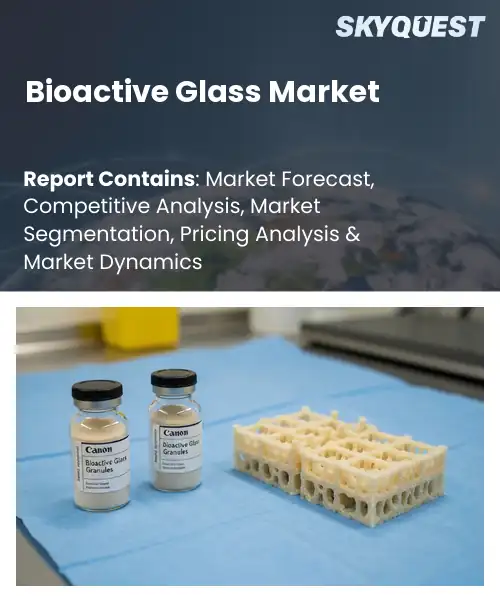
Bioactive Glass Market
Report ID: SQMIG35A4010
Report ID: SQMIG35A4010
[email protected]
USA +1 351-333-4748
Report ID:
SQMIG35A4010 |
Region:
Global |
Published Date: June, 2026
Pages:
157
|Tables:
118
|Figures:
77


Global Bioactive Glass Market size was valued at USD 382.5 Million in 2024 and is poised to grow from USD 413.94 Million in 2025 to USD 782.4 Million by 2033, growing at a CAGR of 8.22% during the forecast period (2026-2033).
One of the major driving factors for the global bioactive glass market is the combination of manufacturing techniques and medicine to produce customized scaffolds for defects. The surgeons can use additive manufacturing to control porosity and composition so that the implant geometry matches the patient anatomy. The operating time is shortened and osseointegration is improved. 45S5 glass-ceramic cages printed for lumbar fusion in Germany. Countries such as China and Brazil are purchasing more of the technology for healing bones, as they offer government incentives and as the technology works better. Material suppliers, for their part, are forging R&D partnerships, expanding product portfolios and creating revenue streams in orthopedics, dentistry and chronic wound care.
How is AI driving innovation and growth in the bioactive glass market?
AI is transforming the bioactive glass industry, speeding up the discovery of materials as well as manufacturing. Machine learning algorithms sift through thousands of compositional permutations to find formulations of glass that bond faster with bone, while still having strength. They also predict the long term dissolution behavior which allows the manufacturer to tailor the degradation rate for a specific clinical application. At the same time, AI-driven process control reduces waste, sintering cycles and improves batch consistency, lowering costs and time to market. Technology allows us to virtually test the design of the implant, reducing the regulatory loops and enabling personalized therapies. With clinicians looking for more reliable regenerative options, AI-enhanced glass products are emerging as a major growth engine.
A novel bioactive glass formulation was introduced to market in October 2025 with AI optimized degradation rates to offer clinicians a more granular control over the healing timelines. We demonstrate how data driven design can improve product performance and market adoption. The launch demonstrated less waste in manufacturing and a faster scale up, further cementing AI’s role in driving efficiency and extending the reach of the market.
Market snapshot - (2026-2033)
Global Market Size
USD 382.5 Million
Largest Segment
Silicate Bioactive Glass
Fastest Growth
Borate Bioactive Glass
Growth Rate
8.22% CAGR
To get more insights on this market click here to Request a Free Sample Report
Global bioactive glass market is segmented by type, form, application, end-user and region. Based on type, the market is segmented into 45S5 Bioglass, Silicate Bioactive Glass, Phosphate Bioactive Glass and Borate Bioactive Glass. Based on form, the market is segmented into Granules & Particles, Scaffolds and Coatings. Based on application, the market is segmented into Bone & Dental Grafts, Wound Care and Drug Delivery. Based on end-user, the market is segmented into Orthopedic Clinics, Dental Clinics and Research Institutes. Based on region, the market is segmented into North America, Europe, Asia Pacific, Latin America and Middle East & Africa.
45S5 Bioglass segment is the leader because of its well established composition that reliably bonds to living bone, providing a predictable dissolution rate that stimulates hydroxyapatite formation. Such chemistry is consistent with clinicians’ preferences for materials that can provide both structural support and bioactivity, minimizing the need for additional coatings. The long established clinical data and proven safety profile inspire confidence driving wider utilisation in orthopaedic and dental procedures and promoting faster post operative recovery for patients in clinical settings.
However, Borate Bioactive Glass segment is witnessing highest growth momentum due to its faster degradation rate which allows a rapid release of ions and is attractive to tissue engineering strategies that require temporary scaffolding. Interest is fuelled by research into wound healing and angiogenesis. Manufacturers are customising compositions to take advantage of these properties. This creates new product pipelines and expands market opportunity.
The Bone & Dental Grafts segment is dominating owing to the continuous demand of bioactive glass solutions due to direct relation with high volume clinical procedures. The material attaches to native tissue and gives it structural support, fulfilling the two surgeon requirements of safety and function. It also has demonstrated long-term results and approved pathways for reimbursement. In this important application area, the manufacturers of orthopedic and dental practices have given highest priority to product development and production.
On the other hand, the Drug Delivery is the major high growth area as it has ability to encapsulate therapeutics within a bioactive matrix to provide controlled release and localized treatment. The advances in particle engineering and coating technologies broaden the spectrum of drugs that can be loaded attracting pharmaceutical partners. This growing utility drives investment, stimulates innovation in product pipelines, and positions bioactive glass as a versatile platform for next generation therapies.
To get detailed segments analysis, Request a Free Sample Report
North America remains a leader with its mature healthcare ecosystems, strong research and development networks and a regulatory environment that encourages innovation while ensuring safety. Academic centers of excellence partner with commercial manufacturers to speed the translation of new glass compositions into clinical products. Reimbursement policies favor advanced regenerative therapies, generating a regular demand from hospitals and specialty clinics. The presence of established multinational suppliers also guarantees a reliable supply chain and wide product portfolio, which helps to further boost the confidence of surgeons and dentists. The inflow of huge amounts of venture capital and partnerships of biotech firms with medical device companies further fuel development pipelines. Increased patient awareness of minimally invasive regenerative therapies is also affecting clinicians’ preference for bioactive glass solutions. Together, these factors create a virtuous cycle of innovation, adoption, and market growth.
The US Bioactive Glass Market is propelled by the presence of major research hospitals and a network of specialized manufacturers. Close collaboration with commercial partners can speed up product development for academic researchers, and reimbursement structures that support advanced tissue engineering solutions can facilitate clinical adoption. Other incentives to invest in glass formulations are strong intellectual property protection and an entrepreneurial culture. The United States is a hotbed of innovation and commercial scale.
Support for the Bioactive Glass Market in Canada comes from a collaborative public-private research ecosystem and a regulatory system that balances safety with swift market access. Provincial health authorities are advocating for the use of advanced regenerative therapies in orthopedic and dental practices. Domestic manufacturers have close links to university spin-offs and can therefore adapt novel compositions quickly. This environment, conducive to nurturing, creates an ongoing flow of products tailored to care pathways in the Canadian clinical context.
Rapid growth in Europe is being powered by integrated research initiatives, harmonised regulatory frameworks and a growing emphasis on sustainable healthcare solutions. Joint funding programs enable universities, hospitals and industry partners to develop bioactive glass compositions that meet the requirements of both bone regeneration and dental restoration. The region’s well-established medical device directives make it easy for products to get approval without compromising safety standards, allowing the region to attract manufacturers to invest in advanced manufacturing capabilities. The clinical uptake is augmented by a health-conscious population and demographic trends escalating the need for orthopedic interventions. Furthermore European companies focus on environmentally friendly production processes with product innovation aligned with larger sustainability objectives. This juncture of scientific collaboration, regulatory efficiency, market demand and green manufacturing is catapulting Europe’s bio-active glass industry towards accelerated significant growth.
Germany’s Bioactive Glass market is bolstered by the country’s robust engineering traditions and clinical research infrastructure. Funding is available for projects translational between material science and medical application. Surveillance. The national implant registry. The best glass product manufacturers rely on precision machining and high purity raw materials to meet demanding quality levels. This blend of technical expertise and evaluation is the basis of Germany’s leading spot in the arena.
UK Bioactive Glass Market to Flourish on the Back of Research Universities and Startup Ecosystem: Ken Research Government innovation grants support early stage development of new glass formulations for minimally invasive procedures. The National Health Service is leading the clinical uptake of regenerative therapies in orthopaedics and dentistry by focusing on cost-effective solutions. Collaborative networks between clinicians, materials scientists and manufacturers help to shorten feedback loops and position the UK as a hub for bioactive glass development.
In France, the market for bioactive glass is growing, as partnerships between dental schools and material science institutes are picking up steam. Pilot programs to test the glass-based bone grafts in orthopedic clinics are encouraged by national health agencies to develop clinical evidence. French manufacturers are concentrating on niche applications like craniofacial reconstruction, based on expertise in glass manufacture. The targeted approach, combined with incentives, contributes to the establishment of bioactive glass technologies in the French healthcare sector.
Use of rapid developments in materials engineering, broader clinical adoption and supportive government activities in key economies is strengthening the position in the Asia Pacific. Investment in partnerships between universities and industry accelerates the discovery of glass compositions tailored to the region’s specific orthopedic and dental needs. New reimbursement models in some markets are supporting regenerative solutions and encouraging hospitals to integrate bioactive glass in treatment protocols. Also manufacturers are using precision fabrication methods which improve product consistency and at the same time reduce environmental footprint, in line with local sustainability goals. The combination of technology leadership, supportive policy environments and increasing clinician confidence is driving a sustained increase in the adoption of bioactive glass across the Asia Pacific region. Best practices are shared via collaborative regional conferences which promotes cross border knowledge sharing and accelerates market maturity.
Japan’s Bioactive Glass Market has strong cooperation between leading medical universities and a mature implant manufacturing industry. Encouraged by government health programs to pursue minimally invasive bone regeneration, clinicians are being urged to adopt glass-based solutions. Domestic manufacturers pay attention to the high-purity silica sources and the complex sintering processes, providing products that satisfy stringent quality demands. This synergy of academic research, policy support and manufacturing excellence maintains Japan’s growing influence in the regional bioactive glass arena.
South Korea Bioactive Glass Market: Government R&D Incentives and Support from Biomedical Device Industry Collaborative clusters of universities, research institutes and start-ups are speeding up the translation of new glass formulations into marketable products. Reimbursement reform that incentivizes regenerative therapies creates a space for clinicians to seek alternatives for bone grafts. South Korea leads the Asia Pacific in bioactive glass, supported by its focus on innovation and manufacturing capabilities.
To know more about the market opportunities by region and country, click here to
Buy The Complete Report
Increasing Clinical Acceptance leveraging Research
Regulatory Pathways driven By Harmonization
High Material Cost being A Barrier
Limited Long‑Term Clinical Data
Request Free Customization of this report to help us to meet your business objectives.
The competitive landscape is characterized by the entry of established biomaterials companies in M&A to acquire niche glass-ceramic technologies and emerging players entering into strategic partnerships with dental and orthopedic manufacturers to accelerate product launches. Recent collaborations include joint R&D agreements to find faster solutions for bone regeneration and using proprietary glass formulations in existing implant lines.
SkyQuest’s ABIRAW (Advanced Business Intelligence, Research & Analysis Wing) is our Business Information Services team that Collects, Collates, Correlates, and Analyses the Data collected by means of Primary Exploratory Research backed by robust Secondary Desk research.
As per SkyQuest analysis, the global bioactive glass market is propelled primarily by growing clinical acceptance, where surgeons and patients trust the material’s regenerative performance, and secondarily by harmonized regulatory pathways that shorten approval times and encourage cross‑border launches. The 45S5 Bioglass type continues to dominate because of its reliable bone bonding and extensive safety record, while North America leads the market thanks to its mature healthcare system, strong R&D networks and supportive reimbursement policies. However, the premium price of bioactive glass remains a restraint, limiting adoption in cost‑sensitive settings and slowing broader diffusion despite the strong demand across multiple therapeutic areas.
| Report Metric | Details |
|---|---|
| Market size value in 2024 | USD 382.5 Million |
| Market size value in 2033 | USD 782.4 Million |
| Growth Rate | 8.22% |
| Base year | 2024 |
| Forecast period | (2026-2033) |
| Forecast Unit (Value) | USD Million |
| Segments covered |
|
| Regions covered | North America (US, Canada), Europe (Germany, France, United Kingdom, Italy, Spain, Rest of Europe), Asia Pacific (China, India, Japan, Rest of Asia-Pacific), Latin America (Brazil, Rest of Latin America), Middle East & Africa (South Africa, GCC Countries, Rest of MEA) |
| Companies covered |
|
| Customization scope | Free report customization with purchase. Customization includes:-
|
To get a free trial access to our platform which is a one stop solution for all your data requirements for quicker decision making. This platform allows you to compare markets, competitors who are prominent in the market, and mega trends that are influencing the dynamics in the market. Also, get access to detailed SkyQuest exclusive matrix.
Table Of Content
Executive Summary
Market overview
Parent Market Analysis
Market overview
Market size
KEY MARKET INSIGHTS
COVID IMPACT
MARKET DYNAMICS & OUTLOOK
Market Size by Region
KEY COMPANY PROFILES
Methodology
For the Bioactive Glass Market, our research methodology involved a mixture of primary and secondary data sources. Key steps involved in the research process are listed below:
1. Information Procurement: This stage involved the procurement of Market data or related information via primary and secondary sources. The various secondary sources used included various company websites, annual reports, trade databases, and paid databases such as Hoover's, Bloomberg Business, Factiva, and Avention. Our team did 45 primary interactions Globally which included several stakeholders such as manufacturers, customers, key opinion leaders, etc. Overall, information procurement was one of the most extensive stages in our research process.
2. Information Analysis: This step involved triangulation of data through bottom-up and top-down approaches to estimate and validate the total size and future estimate of the Bioactive Glass Market.
3. Report Formulation: The final step entailed the placement of data points in appropriate Market spaces in an attempt to deduce viable conclusions.
4. Validation & Publishing: Validation is the most important step in the process. Validation & re-validation via an intricately designed process helped us finalize data points to be used for final calculations. The final Market estimates and forecasts were then aligned and sent to our panel of industry experts for validation of data. Once the validation was done the report was sent to our Quality Assurance team to ensure adherence to style guides, consistency & design.
Analyst Support
Customization Options
With the given market data, our dedicated team of analysts can offer you the following customization options are available for the Bioactive Glass Market:
Product Analysis: Product matrix, which offers a detailed comparison of the product portfolio of companies.
Regional Analysis: Further analysis of the Bioactive Glass Market for additional countries.
Competitive Analysis: Detailed analysis and profiling of additional Market players & comparative analysis of competitive products.
Go to Market Strategy: Find the high-growth channels to invest your marketing efforts and increase your customer base.
Innovation Mapping: Identify racial solutions and innovation, connected to deep ecosystems of innovators, start-ups, academics, and strategic partners.
Category Intelligence: Customized intelligence that is relevant to their supply Markets will enable them to make smarter sourcing decisions and improve their category management.
Public Company Transcript Analysis: To improve the investment performance by generating new alpha and making better-informed decisions.
Social Media Listening: To analyze the conversations and trends happening not just around your brand, but around your industry as a whole, and use those insights to make better Marketing decisions.
REQUEST FOR SAMPLE
 REQUEST FREE CUSTOMIZATION
Global Bioactive Glass Market size was valued at USD 382.5 Million in 2024 and is poised to grow from USD 413.94 Million in 2025 to USD 782.4 Million by 2033, growing at a CAGR of 8.22% during the forecast period (2026-2033).
The competitive landscape is shaped by established biomaterials firms leveraging M&A to acquire niche glass‑ceramic technologies, while emerging players form strategic partnerships with dental and orthopedic manufacturers to accelerate product rollout; recent collaborations include joint R&D agreements targeting faster bone‑regeneration solutions and the integration of proprietary glass formulations into existing implant lines. 'Mo-Sci Corporation', 'Schott AG (BonAlive)', 'Vitryxx (Bioactive Glass)', 'NovaBone Products', 'BioVitrum AB', 'Novabone (NovaBone)', 'Orthovita (Stryker)', 'OsteoScience Foundation', 'ApaTech (Baxter)', 'Bonalive Biomaterials', 'VITOSS (Orthovita/Stryker)', 'GRAFTYS', 'CAM Bioceramics', 'InVivo Therapeutics', 'Xpand Biotechnology', 'Fluidinova SA', 'Ceram-O International', 'Biomatlante SAS', 'ICx Technologies', 'Synergy BioMedical'
The growing confidence of surgeons and patients in bioactive glass stems from its demonstrated ability to support tissue regeneration while minimizing inflammatory responses. This perception encourages wider incorporation into treatment protocols across orthopedics, dentistry, and wound care. As clinicians observe reliable outcomes in real‑world settings, they recommend the material more frequently, prompting manufacturers to expand product portfolios and invest in educational initiatives. Consequently, market demand rises as adoption becomes embedded in standard therapeutic pathways. The trust also drives collaborative research between academia and industry, refining product performance and expanding indications.
Regenerative Medicine Synergy: The convergence of bioactive glass technology with cellular therapies is reshaping tissue engineering, as manufacturers partner with biotech firms to embed stem‑cell niches within glass scaffolds. This collaborative approach accelerates healing timelines and expands clinical applications beyond bone repair to soft‑tissue regeneration, fostering a new ecosystem of co‑development agreements that drive product differentiation and create entry points into emerging therapeutic segments, positioning bioactive glass as a cornerstone of next‑generation regenerative solutions for global healthcare providers seeking sustainable outcomes.
Why does North America Dominate the Global Bioactive Glass Market? |@12


Want to customize this report? This report can be personalized according to your needs. Our analysts and industry experts will work directly with you to understand your requirements and provide you with customized data in a short amount of time. We offer $1000 worth of FREE customization at the time of purchase.
Feedback From Our Clients


 USA (+1) 351-333-4748

