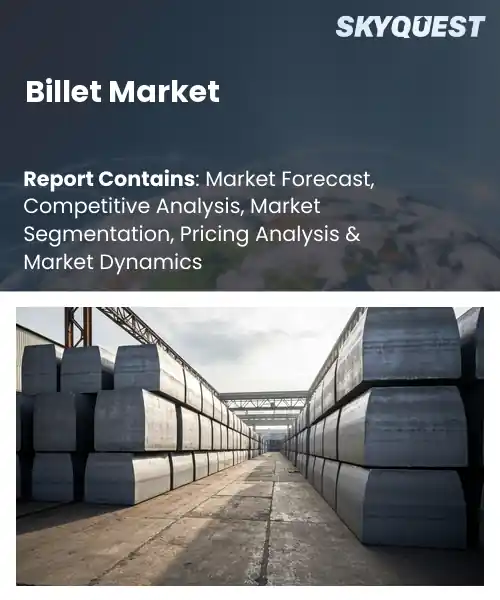
Billet Market
Report ID: SQMIG15O2057
Report ID: SQMIG15O2057
[email protected]
USA +1 351-333-4748
Report ID:
SQMIG15O2057 |
Region:
Global |
Published Date: July, 2026
Pages:
157
|Tables:
115
|Figures:
77


Global Billet Market size was valued at USD 362.9 Billion in 2024 and is poised to grow from USD 382.5 Billion in 2025 to USD 582.58 Billion by 2033, growing at a CAGR of 5.4% during the forecast period (2026-2033).
The billet market is driven by the adoption of lightweight high strength alloys driven by emissions standards and demand for fuel efficient cars. When car manufacturers replace traditional steel with the steel or aluminum billets, equipment manufacturers get orders, and then the equipment gets upgraded to increase tolerance and cycle speed, thus reducing cost. A European manufacturer moved to a chassis cut in an effort to reduce vehicle weight by 15 percent, which forced its billet supplier to add extrusion presses and increase its export capacity to Asian OEMs. This chain allows alloy billets and processing regions to increase their market share, while ancillary services such as surface treatment and recycling benefit from throughput.
How is AI-driven Automation Reshaping The Billet Market?
AI-powered automation is changing the way billets are made by using real-time sensor data and predictive algorithms that can make adjustments to furnace settings, rolling speeds and cooling rates on the fly. Machine-learning models identify minute differences in raw material composition, enabling plants to adjust processes and reduce scrap. Material handling and inspection robotics are combined to free operators for higher value tasks and improve the safety of the workplace. This leads to a more responsive supply chain that can quickly adjust production schedules to meet changing demand, and achieve consistent quality without adding manual control points. These advances are transforming traditional labor-intensive foundries into data-centric hubs that yield higher throughput with lower energy consumption.
In April 2024 ArcelorMittal unveiled an AI-enabled system for the heating of billets, demonstrating how intelligent control can reduce cycle time and improve overall plant efficiency.
Market snapshot - (2026-2033)
Global Market Size
USD 362.9 Billion
Largest Segment
Steel Billets
Fastest Growth
Aluminum Billets
Growth Rate
5.4% CAGR
To get more insights on this market click here to Request a Free Sample Report
Global billet market is segmented by material type, manufacturing process, end-use industry, distribution channel and region. Based on material type, the market is segmented into Steel Billets, Aluminum Billets and Copper Billets. Based on manufacturing process, the market is segmented into Continuous Casting Method and Ingot Forging Extrusion Method. Based on end-use industry, the market is segmented into Building & Construction, Automotive & Transportation and Industrial Machinery & Manufacturing. Based on distribution channel, the market is segmented into Direct and Indirect. Based on region, the market is segmented into North America, Europe, Asia Pacific, Latin America and Middle East & Africa.
The steel billets segment holds the highest market share as they form the core raw material base for a wide range of high strength applications, offering superior tensile properties and cost effective scalability. Their use in construction, automotive frames and heavy machinery is widespread and guarantees a steady demand which supports continuous production cycles. Moreover, their mature processing technologies and well-developed supply chains boost their market leadership and their guaranteed availability, and build confidence among downstream manufacturers.
Aluminum billets, however, are witnessing the strongest growth momentum, with the lightweighting imperatives driving the use of aluminum in the structures of electric vehicles and aerospace components. The natural corrosion resistance and ease of extrusion opens up new design possibilities, leading manufacturers to increase sourcing. This rapid adoption accelerates broader market development and creates new processing opportunities.
The continuous casting method is the leader, as it transforms molten metal into uniform billets, with minimum handling, resulting in less energy loss and scrap generation. The streamlined workflow increases throughput while maintaining tight dimensional tolerances, a welcome prospect for high volume producers seeking cost efficiency. Integrated automation and real time monitoring further enhances its reliability, making it the preferred route for production in multiple industries.
Meanwhile, demand for custom shape billets for advanced components is increasing, with ingot forging extrusion method emerging as the key high growth area. Its ability to offer better mechanical properties by means of controlled deformation is attractive to sectors that need high strength and fatigue resistance. Such flexibility stimulates the growth of niche markets and the investment in specialized equipment, thus creating new sources of revenue for manufacturers.
To get detailed segments analysis, Request a Free Sample Report
Asia Pacific’s market leadership is supported by a combination of advanced manufacturing capabilities, deep engineering expertise and a robust supply chain ecosystem. The region has a long tradition of precision metalworking supported by world-class research institutions that are constantly driving process innovation. Close proximity to major downstream industries including automotive, aerospace and heavy equipment drives faster adoption of high performance billets. Additionally, government incentives encourage investments in state-of-the-art production facilities, creating a competitive environment conducive to technology transfer and talent development. These strengths create a virtuous cycle for quality improvement and cost efficiency that make Asia Pacific the preferred source of premium billet solutions worldwide.
Japan’s Billet Market is steeped in tradition of painstaking craftsmanship and an emphasis on quality control. State-of-the-art metallurgical research labs collaborate with manufacturers to optimize alloy compositions and heat-treatment practices. The Company has strong links to the automotive and high-tech markets which create stable demand for high-precision billets. A disciplined supply chain creates on-time delivery. This environment supports Japan’s reliability and technical excellence in billet production.
The South Korean Billet Market is driven by a strong industrial base which is geared towards rapid innovation and export orientation. Producers who invest heavily in smart manufacturing and automation are better positioned to respond efficiently to the various specification requirements. Demand continues to be driven by partnerships with shipbuilders and heavy equipment manufacturers, which is spurring continuous improvement in metallurgy and processing techniques. The collaborative ecosystem of academia and industry further enhances the country’s ability to provide high-quality billets globally.
Europe’s billet market expansion is driven by a strategic focus on sustainability, high‑value engineering, and integrated value chains across the continent. Leading manufacturers are adopting greener production methods, responding to stringent environmental regulations that encourage resource efficiency and reduced emissions. A concentrated cluster of automotive, aerospace, and renewable energy firms creates a persistent demand for specialized alloy billets, prompting firms to invest in advanced processing technologies. Collaborative research initiatives among universities and industry accelerate material innovation, while cross‑border trade agreements facilitate seamless movement of products within the region. This combination of regulatory impetus, technological advancement, and market connectivity fuels a robust growth trajectory for billets across Europe.
Billet Market in Germany is distinguished by a deep engineering culture and a strong emphasis on precision manufacturing. Close ties with automotive and machinery sectors ensure a constant need for high‑quality, custom‑specification billets. Investment in digital manufacturing platforms and rigorous quality standards reinforces Germany’s reputation as a benchmark for reliability and performance in the billet industry.
Billet Market in United Kingdom is characterized by rapid adoption of innovative production methods and a focus on high‑performance applications. The country’s vibrant aerospace and defense sectors generate significant demand for specialized alloys, encouraging manufacturers to pursue continuous process improvements. Collaborative initiatives between research institutions and industry accelerate the development of next‑generation billet solutions.
Billet Market in France is emerging through a blend of traditional metallurgical expertise and a growing emphasis on renewable energy components. Partnerships with automotive and wind‑energy manufacturers support the creation of tailored alloy billets, while governmental support for green technologies spurs investment in cleaner production processes.
North America advances its billet market position through a combination of technological leadership, diversified end‑use applications, and strategic investment in supply chain resilience. Companies leverage cutting‑edge digital manufacturing tools and additive‑process integration to enhance product flexibility and reduce lead times. The region’s expansive aerospace, defense, and infrastructure sectors generate persistent demand for high‑strength, lightweight billets, prompting manufacturers to refine alloy formulations and heat‑treatment cycles. Collaborative ecosystems linking research universities with industrial partners drive ongoing material science breakthroughs. Additionally, a focus on domestic sourcing and logistical optimization mitigates external disruptions, reinforcing a reliable supply framework that supports both regional and global customers.
Billet Market in United States is propelled by a strong culture of innovation and substantial investment in advanced manufacturing. Close collaboration with aerospace, defense, and automotive leaders drives the development of high‑performance alloys, while adoption of digital twins and AI‑guided process controls enhances efficiency. The emphasis on domestic production and supply chain robustness further consolidates the United States as a central hub for premium billet offerings.
Billet Market in Canada benefits from a resource‑rich environment and a commitment to sustainable production practices. Integration with the country’s robust mining sector ensures access to high‑quality raw materials, while partnerships with renewable‑energy and transportation firms stimulate demand for specialized billets. Ongoing research collaborations promote continuous improvement in alloy design and processing techniques.
To know more about the market opportunities by region and country, click here to
Buy The Complete Report
Growing Aerospace Demand
Adoption Of Additive Manufacturing
Stringent Environmental Regulations
Fluctuating Raw Material Prices
Request Free Customization of this report to help us to meet your business objectives.
The competitive landscape of the global billet market is shaped by intensified consolidation, with private‑equity firms actively targeting mid‑size billet producers to expand capacity and geographic reach. Strategic partnerships are emerging between material‑science innovators and traditional manufacturers to integrate advanced alloy technologies, while several players are accelerating digital twins and AI‑driven process optimization to reduce waste and improve yield. These moves are driven by the need to secure supply chains and meet rising demand for high‑performance billets across automotive and aerospace sectors.
SkyQuest’s ABIRAW (Advanced Business Intelligence, Research & Analysis Wing) is our Business Information Services team that Collects, Collates, Correlates, and Analyses the Data collected by means of Primary Exploratory Research backed by robust Secondary Desk research.
As per SkyQuest analysis, the global billet market is being propelled primarily by growing aerospace demand, which pushes manufacturers toward high‑strength, lightweight billets, while the adoption of additive manufacturing serves as a second catalyst by enabling complex geometries and reducing waste. The market is led by steel billets, which remain the largest segment due to their broad use across construction, automotive and machinery. Asia Pacific dominates the market, leveraging advanced manufacturing capabilities and strong supply‑chain links. However, stringent environmental regulations act as a restraint, increasing compliance costs and slowing capacity expansion for some producers.
| Report Metric | Details |
|---|---|
| Market size value in 2024 | USD 362.9 Billion |
| Market size value in 2033 | USD 582.58 Billion |
| Growth Rate | 5.4% |
| Base year | 2024 |
| Forecast period | (2026-2033) |
| Forecast Unit (Value) | USD Billion |
| Segments covered |
|
| Regions covered | North America (US, Canada), Europe (Germany, France, United Kingdom, Italy, Spain, Rest of Europe), Asia Pacific (China, India, Japan, Rest of Asia-Pacific), Latin America (Brazil, Rest of Latin America), Middle East & Africa (South Africa, GCC Countries, Rest of MEA) |
| Companies covered |
|
| Customization scope | Free report customization with purchase. Customization includes:-
|
To get a free trial access to our platform which is a one stop solution for all your data requirements for quicker decision making. This platform allows you to compare markets, competitors who are prominent in the market, and mega trends that are influencing the dynamics in the market. Also, get access to detailed SkyQuest exclusive matrix.
Table Of Content
Executive Summary
Market overview
Parent Market Analysis
Market overview
Market size
KEY MARKET INSIGHTS
COVID IMPACT
MARKET DYNAMICS & OUTLOOK
Market Size by Region
KEY COMPANY PROFILES
Methodology
For the Billet Market, our research methodology involved a mixture of primary and secondary data sources. Key steps involved in the research process are listed below:
1. Information Procurement: This stage involved the procurement of Market data or related information via primary and secondary sources. The various secondary sources used included various company websites, annual reports, trade databases, and paid databases such as Hoover's, Bloomberg Business, Factiva, and Avention. Our team did 45 primary interactions Globally which included several stakeholders such as manufacturers, customers, key opinion leaders, etc. Overall, information procurement was one of the most extensive stages in our research process.
2. Information Analysis: This step involved triangulation of data through bottom-up and top-down approaches to estimate and validate the total size and future estimate of the Billet Market.
3. Report Formulation: The final step entailed the placement of data points in appropriate Market spaces in an attempt to deduce viable conclusions.
4. Validation & Publishing: Validation is the most important step in the process. Validation & re-validation via an intricately designed process helped us finalize data points to be used for final calculations. The final Market estimates and forecasts were then aligned and sent to our panel of industry experts for validation of data. Once the validation was done the report was sent to our Quality Assurance team to ensure adherence to style guides, consistency & design.
Analyst Support
Customization Options
With the given market data, our dedicated team of analysts can offer you the following customization options are available for the Billet Market:
Product Analysis: Product matrix, which offers a detailed comparison of the product portfolio of companies.
Regional Analysis: Further analysis of the Billet Market for additional countries.
Competitive Analysis: Detailed analysis and profiling of additional Market players & comparative analysis of competitive products.
Go to Market Strategy: Find the high-growth channels to invest your marketing efforts and increase your customer base.
Innovation Mapping: Identify racial solutions and innovation, connected to deep ecosystems of innovators, start-ups, academics, and strategic partners.
Category Intelligence: Customized intelligence that is relevant to their supply Markets will enable them to make smarter sourcing decisions and improve their category management.
Public Company Transcript Analysis: To improve the investment performance by generating new alpha and making better-informed decisions.
Social Media Listening: To analyze the conversations and trends happening not just around your brand, but around your industry as a whole, and use those insights to make better Marketing decisions.
REQUEST FOR SAMPLE
 REQUEST FREE CUSTOMIZATION
Global Billet Market size was valued at USD 362.9 Billion in 2024 and is poised to grow from USD 382.5 Billion in 2025 to USD 582.58 Billion by 2033, growing at a CAGR of 5.4% during the forecast period (2026-2033).
The competitive landscape of the global billet market is shaped by intensified consolidation, with private‑equity firms actively targeting mid‑size billet producers to expand capacity and geographic reach. Strategic partnerships are emerging between material‑science innovators and traditional manufacturers to integrate advanced alloy technologies, while several players are accelerating digital twins and AI‑driven process optimization to reduce waste and improve yield. These moves are driven by the need to secure supply chains and meet rising demand for high‑performance billets across automotive and aerospace sectors. 'ArcelorMittal', 'China Baowu Steel Group', 'Nippon Steel Corporation', 'POSCO Holdings', 'JFE Holdings', 'Tata Steel', 'Jindal Steel & Power', 'Steel Authority of India Limited', 'Cleveland-Cliffs', 'Nucor Corporation', 'Steel Dynamics', 'United States Steel Corporation', 'Gerdau', 'ThyssenKrupp AG', 'Voestalpine', 'Tenaris', 'Severstal', 'Novolipetsk Steel', 'Magnitogorsk Iron and Steel Works', 'HBIS Group'
The aerospace sector is seeking higher strength-to-weight ratios, prompting manufacturers to adopt advanced billet grades that enable lighter yet robust structural parts. This shift drives production volumes as aircraft designers prioritize fuel efficiency and emissions reduction. Consequently, billet suppliers experience heightened interest from original equipment manufacturers who require consistent quality and dimensional precision. The emphasis on performance and regulatory compliance reinforces a sustained upward trajectory for billet consumption across commercial and defense aerospace programs throughout the entire supply chain and lifecycle.
Advanced Alloy Adoption Driving Performance: Manufacturers are increasingly turning to high‑strength, lightweight alloys such as nickel‑based superalloys and titanium alloys to meet demanding performance specifications in aerospace, defense, and high‑speed rail applications. These advanced materials enable thinner cross‑sections while maintaining structural integrity, reducing overall weight and improving fuel efficiency. The shift is propelled by continuous R&D collaborations, accelerated certification pathways, and customer demand for longer service intervals, positioning premium billet offerings as strategic differentiators in value‑driven markets across global supply chains and OEM partnerships today.
Why does Asia Pacific Dominate the Global Billet Market? |@12


Want to customize this report? This report can be personalized according to your needs. Our analysts and industry experts will work directly with you to understand your requirements and provide you with customized data in a short amount of time. We offer $1000 worth of FREE customization at the time of purchase.
Feedback From Our Clients


 USA (+1) 351-333-4748

