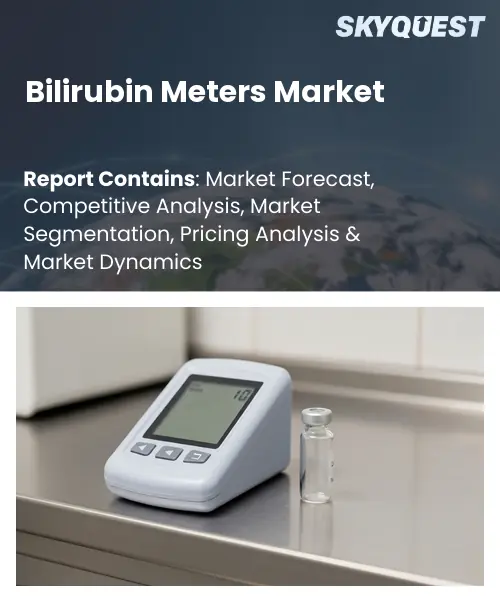
Bilirubin Meters Market
Report ID: SQMIG35A4011
Report ID: SQMIG35A4011
[email protected]
USA +1 351-333-4748
Report ID:
SQMIG35A4011 |
Region:
Global |
Published Date: June, 2026
Pages:
157
|Tables:
114
|Figures:
77


Global Bilirubin Meters Market size was valued at USD 182.5 Million in 2024 and is poised to grow from USD 191.66 Million in 2025 to USD 285.4 Million by 2033, growing at a CAGR of 5.02% during the forecast period (2026-2033).
The bilirubin meters market is focused on handheld devices that can quantitatively measure the levels of bilirubin in serum, primarily in newborn babies who are at risk of developing jaundice. This is important as it enables rapid detection of hyperbilirubinemia, and thus prevention of severe neurological damage such as kernicterus. Historically, the process was time consuming and the delay in results precluded timely intervention. Clinicians have traditionally relied on central laboratory spectrophotometers. In the past decade, improvements in photometric technology and miniaturization have led to portable analyzers like Philips’ OxiCo and Roche’s Bilirubinometer that enable bedside testing. The rise of neonatal jaundice and the need for point of care solutions has transformed the clinical workflow in hospitals around the world.
The global market for bilirubin meters is being driven by growth in newborn screening programs that include point-of-care testing in care pathways. Steady demand growth is attributed to rising government budgets for maternal-child health and the use of handheld analyzers by hospitals to comply with mandated frequencies of bilirubin monitoring. The effect is multiplied in developing economies, where mobile clinics use battery-powered meters to reach remote villages. Kenya’s community health program reduced referrals for severe jaundice by 30%. At the same time, reimbursement models in Europe and North America are pushing clinicians towards laboratory assays, driving rapid market uptake and encouraging innovation in wireless data integration.
How is AI-driven automation improving accuracy in the bilirubin meters market?
For example, bilirubin meters are being reinvented through AI-driven automation. Machine-learning algorithms are embedded in the devices to enhance calibration curves and to remove noise caused by differences in skin tones. Now that the sensors are capturing the raw optical data, the AI is interpreting that data to predict total serum bilirubin with more consistency across diverse patient populations. The technology decreases operator dependence, speeds up measurement time and reduces the risk of misreading, which is critical in newborn screening where timely decisions are essential. This means that each meter will learn from the collective experience of hospitals as they bring in the handheld devices, which will be updated in the cloud in real-time, further increasing confidence in the market and wider clinical adoption.
In June 2024, Roche introduced an AI-powered transcutaneous bilirubin meter, offering faster, more reliable readings to support early discharge protocols and drive market growth via improved clinical efficiency.
Market snapshot - (2026-2033)
Global Market Size
USD 182.5 Million
Largest Segment
Transcutaneous Bilirubin Meters
Fastest Growth
Serum/Plasma Analyzers
Growth Rate
5.02% CAGR
To get more insights on this market click here to Request a Free Sample Report
Global bilirubin meters market is segmented by type, technology, end-user, distribution and region. Based on type, the market is segmented into Transcutaneous Bilirubin Meters and Serum/Plasma Analyzers. Based on technology, the market is segmented into Reflectance Spectroscopy and Multi-Wavelength. Based on end-user, the market is segmented into NICUs (Neonatal ICU), Nurseries and Pediatric Clinics. Based on distribution, the market is segmented into Direct Sales and Distributors. Based on region, the market is segmented into North America, Europe, Asia Pacific, Latin America and Middle East & Africa.
NICU segmentation is the dominant. Newborn intensive care units require immediate and accurate bilirubin monitoring to prevent severe hyperbilirubinemia. The need for care in these settings is critical and therefore both transcutaneous and serum analyzers are used, with clinicians relying on rapid assessments to guide timely interventions. NICUs are the main demand engine of the Bilirubin Meters Market, as they are driven by this high stakes environment to constantly upgrade equipment and focus on budgeting for reliable bilirubin measurement solutions.
Pediatric Clinics segment is having the highest growth On the other hand, outpatient settings are increasing jaundice screening programs to improve early detection. With the advent of portable transcutaneous devices, bedside testing has become possible and clinics are starting to adopt noninvasive solutions for routine visits. This transition creates income sources and encourages manufacturers to tailor products, which is propelling market growth.
The reflectance spectroscopy segment is expected to hold the largest market share driven by the growing demand for noninvasive and rapid bilirubin estimation which is in line with the clinical requirements for safe newborn screening. Its accuracy and non-invasive nature of not needing blood draws reduces patient discomfort and improves workflow, which encourages hospitals to adopt these devices. The clinicians prefer its proven reliability which results in continuous procurement and solidifies its position as the preferred technology in the Bilirubin Meters Market across diverse care settings worldwide and beyond.
Meanwhile, Multi Wavelength segment is the fastest growing segment due to its capability to analyze multiple spectral bands that improve diagnostic precision and enables wider clinical applications. The continued innovation is expanding its use from neonatal screening to pediatric jaundice management, attracting investment and prompting manufacturers to focus on development, which is accelerating market expansion opportunities.
To get detailed segments analysis, Request a Free Sample Report
North America continues to dominate, driven by a combination of strong clinical networks, varied research collaborations and a regulatory environment that facilitates the rapid introduction of new devices. Healthcare providers in the region appreciate the ability to quickly diagnose and therefore quickly adopt sophisticated bilirubin monitoring solutions. A culture of evidence-based practice coupled with strong reimbursement models drives ongoing investment in the latest technology. The distribution ecosystem is also mature and the relationships between manufacturers and major hospital systems provide for ease of market entry and high utilization rates across the continuum of care.
Point of care testing in neonatal and pediatric procedures, which are generally part of tertiary care centers, is driving the US market of Bilirubin Meter due to high penetration of these facilities. Strong funding mechanisms allow public and private institutions to upgrade laboratory capabilities. A proactive regulator gets new devices approved in a timely fashion. Collaborative research projects between academic hospitals and industry result in an iterative improvement, creating a feedback loop that aligns product development with clinical needs. Clinician confidence in the accuracy and ease of use further solidifies the role of these devices in routine patient management.
The Bilirubin Meters Market is supported by Canada’s universal health system focused on equal access to diagnostic tools regardless of urban or remote areas. Provincial health agencies buy reliable, simple-to-use equipment for community hospitals and primary care clinics. Suppliers are under pressure to provide complete training and support packages as purchasing decisions are made with strict quality standards and a strong emphasis on patient safety. The need to monitor bilirubin in national neonatal screening programs underpins a collaborative relationship between clinicians, policy makers and manufacturers.
Europe’s acceleration is driven by a combination of increased clinical awareness, aligned regulatory standards and a growing focus on outpatient and home‑based care. Across the continent, health systems are investing heavily in technologies that allow rapid bedside assessment, reducing hospital stays and improving patient outcomes. Collaborative networks of health ministries, research institutions and device manufacturers encourage the spread of best practices and help the adoption of next generation meters. Growing reimbursement frameworks that acknowledge the cost-effectiveness of early detection are also driving market growth. Moreover, a cultural emphasis on preventive pediatrics ensures continued demand in both developed and developing markets.
Germany is a force to reckon with. The country has a strong tradition of clinical excellence with a well-established network of university hospitals setting the standards for diagnostics in the German bilirubin meters market. Sophisticated meters are embedded in routine neonatal care, driven by demanding quality standards and generous reimbursement policies. The close cooperation between medical device manufacturers and research laboratories ensures a constant stream of innovations, so that German physicians always have access to the newest sensor technologies. It is this attention to detail and reliability that made the country a great power in Europe.
The United Kingdom Bilirubin Meters Market is growing at a rapid pace, owing to the national efforts for early detection of jaundice in newborns and children. The National Health Service promotes point of care solutions to improve work flows and reduce laboratory turnaround times. Academic collaborations and translational research support speed review of new technologies for rapid adoption in hospitals and community settings. The momentum for patient-centered care policies increases and the market expands nationally.
France Bilirubin Meters Market is growing due to increasing focus on better pediatric screening and decentralized diagnostic services by health authorities. Regional health agencies are supporting pilot programs to introduce portable bilirubin meters in primary care and maternity wards so that clinicians can get familiar with them. Collaborations with French research institutes allow us to perform clinical validation studies that increase confidence in the accuracy of new devices. As reimbursement models shift to reward the value of early intervention, we expect to see a continued increase in demand for reliable bedside testing tools.
Asia Pacific is experiencing growth due to strategic investments in healthcare infrastructure, rapid urbanization and an expanding middle class demanding higher standards of medical care. Countries in the region are looking to incorporate point-of-care diagnostics into hospital and community health settings due to the increasing need for rapid bilirubin testing in highly populated areas. Regional manufacturers are working with global technology leaders to speed up the transfer of knowledge and localize devices, making products more affordable without compromising on quality. Furthermore, the government initiatives for neonatal health and early detection of diseases are further augmenting market momentum, thereby positioning the region as an increasingly influential contributor to global demand.
Japan's Bilirubin Meters Market is driven by a well-structured healthcare system which emphasizes on precision medicine and stringent quality control. Major academic hospitals and specialized pediatric units encourage the use of sophisticated monitoring devices. The culture of continuous improvement forces the manufacturers to improve the accuracy of the sensors and user interfaces. When neonatal outcome is a priority for government health programs, they promote the widespread adoption of bedside testing tools that allow clinicians to quickly obtain reliable data to make decisions. Industry and research institutions work together to keep a stream of innovative solutions flowing to the Japanese market.
South Korea Bilirubin Meters Market is propelled by an advanced healthcare industry and aggressive penetration of digital health solutions. Inclusion of point-of-care diagnostics in national health insurance policies could lead to the introduction of modern bilirubin meters in routine practice. The product is developed and continuously improved in close partnerships with biomedical engineering companies and clinical experts. This focus on early detection of neonatal jaundice is consistent with broader public health goals and has created an ongoing need for accurate and user friendly devices in urban and regional health care systems.
To know more about the market opportunities by region and country, click here to
Buy The Complete Report
Increasing Neonatal Screening Programs
Advances In Point‑of‑Care Technology
High Cost Of Advanced Devices
Regulatory Approval Complexity
Request Free Customization of this report to help us to meet your business objectives.
Device manufacturers are competing aggressively in the global market for bilirubin meters. Recent M&A activity and strategic partnerships have resulted in differentiation. Tech innovation is being driven by the combination of non-invasive transcutaneous sensors and AI-based analytics. Companies are working with hospital networks to increase distribution and drive clinical adoption. The appeal of the sector is clear from the investment going into health-monitoring start-ups and the larger companies looking for joint ventures and acquisitions of niche technology companies to widen their product offerings.
At SkyQuest, our Business Information Services team is called ABIRAW (Advanced Business Intelligence, Research & Analysis Wing) which Collects, Collates, Correlates and Analyses the Data collected by means of Primary Exploratory Research backed by robust Secondary Desk research.
The primary driver of the global bilirubin meters market, according to SkyQuest analysis, is the increasing neonatal screening programs that force hospitals and clinics to adopt fast point‑of‑care devices. The second catalyst is the advancement in compact wireless point‑of‑care technology, which allows bedside testing and data integration. The high cost of advanced devices may limit adoption in smaller or budget-constrained facilities, which holds the market back. Strong reimbursement structures, extensive research networks and early adoption of innovative meters keep North America on top. Reflectance Spectroscopy is ruling the segment landscape, providing reliable non-invasive measurements that are in line with clinical preferences across care settings.
| Report Metric | Details |
|---|---|
| Market size value in 2024 | USD 182.5 Million |
| Market size value in 2033 | USD 285.4 Million |
| Growth Rate | 5.02% |
| Base year | 2024 |
| Forecast period | (2026-2033) |
| Forecast Unit (Value) | USD Million |
| Segments covered |
|
| Regions covered | North America (US, Canada), Europe (Germany, France, United Kingdom, Italy, Spain, Rest of Europe), Asia Pacific (China, India, Japan, Rest of Asia-Pacific), Latin America (Brazil, Rest of Latin America), Middle East & Africa (South Africa, GCC Countries, Rest of MEA) |
| Companies covered |
|
| Customization scope | Free report customization with purchase. Customization includes:-
|
To get a free trial access to our platform which is a one stop solution for all your data requirements for quicker decision making. This platform allows you to compare markets, competitors who are prominent in the market, and mega trends that are influencing the dynamics in the market. Also, get access to detailed SkyQuest exclusive matrix.
Table Of Content
Executive Summary
Market overview
Parent Market Analysis
Market overview
Market size
KEY MARKET INSIGHTS
COVID IMPACT
MARKET DYNAMICS & OUTLOOK
Market Size by Region
KEY COMPANY PROFILES
Methodology
For the Bilirubin Meters Market, our research methodology involved a mixture of primary and secondary data sources. Key steps involved in the research process are listed below:
1. Information Procurement: This stage involved the procurement of Market data or related information via primary and secondary sources. The various secondary sources used included various company websites, annual reports, trade databases, and paid databases such as Hoover's, Bloomberg Business, Factiva, and Avention. Our team did 45 primary interactions Globally which included several stakeholders such as manufacturers, customers, key opinion leaders, etc. Overall, information procurement was one of the most extensive stages in our research process.
2. Information Analysis: This step involved triangulation of data through bottom-up and top-down approaches to estimate and validate the total size and future estimate of the Bilirubin Meters Market.
3. Report Formulation: The final step entailed the placement of data points in appropriate Market spaces in an attempt to deduce viable conclusions.
4. Validation & Publishing: Validation is the most important step in the process. Validation & re-validation via an intricately designed process helped us finalize data points to be used for final calculations. The final Market estimates and forecasts were then aligned and sent to our panel of industry experts for validation of data. Once the validation was done the report was sent to our Quality Assurance team to ensure adherence to style guides, consistency & design.
Analyst Support
Customization Options
With the given market data, our dedicated team of analysts can offer you the following customization options are available for the Bilirubin Meters Market:
Product Analysis: Product matrix, which offers a detailed comparison of the product portfolio of companies.
Regional Analysis: Further analysis of the Bilirubin Meters Market for additional countries.
Competitive Analysis: Detailed analysis and profiling of additional Market players & comparative analysis of competitive products.
Go to Market Strategy: Find the high-growth channels to invest your marketing efforts and increase your customer base.
Innovation Mapping: Identify racial solutions and innovation, connected to deep ecosystems of innovators, start-ups, academics, and strategic partners.
Category Intelligence: Customized intelligence that is relevant to their supply Markets will enable them to make smarter sourcing decisions and improve their category management.
Public Company Transcript Analysis: To improve the investment performance by generating new alpha and making better-informed decisions.
Social Media Listening: To analyze the conversations and trends happening not just around your brand, but around your industry as a whole, and use those insights to make better Marketing decisions.
REQUEST FOR SAMPLE
 REQUEST FREE CUSTOMIZATION
Global Bilirubin Meters Market size was valued at USD 182.5 Million in 2024 and is poised to grow from USD 191.66 Million in 2025 to USD 285.4 Million by 2033, growing at a CAGR of 5.02% during the forecast period (2026-2033).
The competitive landscape of the global bilirubin meters market is shaped by intense rivalry among device manufacturers, with recent M&A activity and strategic partnerships driving differentiation. Companies are accelerating tech innovation through integration of non‑invasive transcutaneous sensors and AI‑based analytics, while collaborations with hospital networks aim to expand distribution and improve clinical adoption. Funding inflows into health‑monitoring startups underscore the sector’s attractiveness, prompting incumbents to pursue joint ventures and acquire niche technology firms to reinforce their product portfolios. 'Drägerwerk AG (JM-105)', 'Respironics (Philips) - BiliChek', 'Natus Medical', 'Siemens Healthineers', 'Radiometer Medical', 'EKF Diagnostics', 'Oxtec Medical Diagnostics', 'SpectRx Inc.', 'Ikeda Rika (Minolta JM-105)', 'Konica Minolta Sensing Americas', 'Apria Healthcare', 'Criticare Systems', 'Medline Industries', 'Nihon Kohden', 'Spacelabs Healthcare', 'AVI Healthcare', 'Clarity Medical Systems', 'Veritas Medical Solutions', 'Goldway Medical Electronics', 'Shenzhen Mindray'
Healthcare providers are expanding neonatal bilirubin screening programs to ensure early detection of hyperbilirubinemia, which promotes timely intervention and reduces the risk of severe complications. This proactive approach drives broader adoption of bilirubin meters as essential diagnostic tools, encouraging hospitals and clinics to invest in reliable, easy‑to‑use devices. The heightened emphasis on preventive care creates sustained demand for accurate point‑of‑care testing, fostering market expansion through increased procurement and integration into routine newborn assessment protocols. These initiatives also support staff training, ensuring optimal device utilization and reliability across diverse clinical settings.
Point‑Of‑Care Integration Surge: The widespread adoption of bedside bilirubin meters is driving a shift toward seamless point‑of‑care integration within neonatal units. Clinicians now prefer devices that connect instantly to electronic health records, enabling real‑time data capture, automated trend analysis, and rapid clinical decision support. This connectivity reduces manual transcription errors, shortens turnaround times, and supports coordinated care across multidisciplinary teams, ultimately enhancing patient safety and operational efficiency in high‑volume hospital environments while also providing valuable insights for quality improvement initiatives and resource planning.
Why does North America Dominate the Global Bilirubin Meters Market? |@12


Want to customize this report? This report can be personalized according to your needs. Our analysts and industry experts will work directly with you to understand your requirements and provide you with customized data in a short amount of time. We offer $1000 worth of FREE customization at the time of purchase.
Feedback From Our Clients


 USA (+1) 351-333-4748

