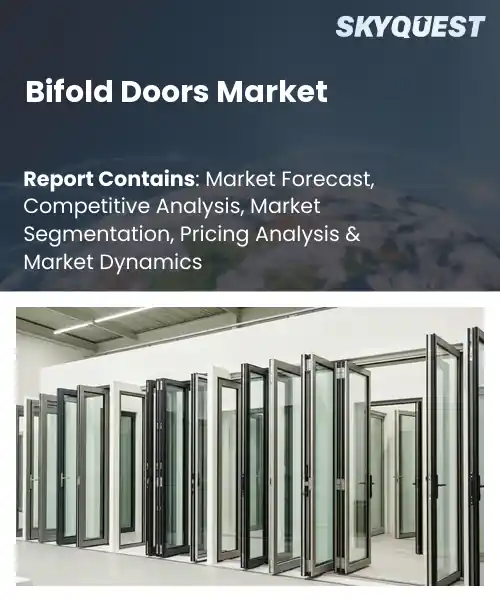
Bifold Doors Market
Report ID: SQMIG20C2260
Report ID: SQMIG20C2260
[email protected]
USA +1 351-333-4748
Report ID:
SQMIG20C2260 |
Region:
Global |
Published Date: June, 2026
Pages:
157
|Tables:
174
|Figures:
79


Global Bifold Doors Market size was valued at USD 11.3 Billion in 2024 and is poised to grow from USD 11.98 Billion in 2025 to USD 19.09 Billion by 2033, growing at a CAGR of 6.0% during the forecast period (2026-2033).
The global bifold doors market includes manufacturers, installers and distributors of hinged panel systems that fold against a wall and act as transitions between residential and commercial spaces. It is relevant because of the growing consumer demand for living spaces, energy efficient glazing and aesthetics. It was born as a niche product in the 2000s and really took off after 2010 as aluminum framing and low-emissivity glass became cheaper and better at thermal performance. A Miami condo replaced sliding doors with bifold doors, reducing the HVAC load by 15 percent and enhancing the marketability. This evolution is a case of how the technology and design trends have driven the market growth.
Bifold doors are being adopted thanks to tighter standards for thermal performance, as builders replace aging swing doors with hinged panels to take advantage of new building-code incentives. Low-U-value glazing subsidies are spurring retrofits of office towers in Europe and North America, where companies report heating bills up to 12% lower after installing insulated bifold systems. The cost benefit is causing manufacturers to develop modular product lines for quicker installation and less labor cost. This appeals to hospitality projects for their turnover. The market is accelerating as design requirements and incentives are coming together to generate revenue streams for suppliers around the world.
How is IoT enhancing energy efficiency in the commercial bifold doors market?
Internet of Things (IoT) technology now allows sensors embedded in commercial bifold doors to monitor temperature, humidity and door position in real time. These data streams are fed into building management systems that can then automatically adjust the sealing pressure and motor speed to keep the insulation at its optimum. Smart actuators gently close the doors when the HVAC zones are unoccupied, and predictive maintenance alerts prevent drafts from wear and tears. Cloud analytics integration allows facility managers to see trends in energy loss, and plan upgrades prior to inefficiencies occurring. The result is a more responsive envelope, where the operation of the door is synchronized to occupancy and climate control in such a way that every time the door opens and closes, the event is contributing to overall energy savings.
In June 2026, a major bifold door maker released an IoT-enabled door system that monitors in real-time and has adaptive sealing to reduce heat loss and improve energy management. This should, in turn, stimulate market growth.
Market snapshot - (2026-2033)
Global Market Size
USD 11.3 Billion
Largest Segment
Aluminum Bifold Doors
Fastest Growth
Aluminum Bifold Doors
Growth Rate
6.0% CAGR
To get more insights on this market click here to Request a Free Sample Report
Global bifold doors market is segmented by material type, configuration, application, operation type, end user, distribution channel and region. Based on material type, the market is segmented into Aluminum Bifold Doors, uPVC Bifold Doors, Wooden Bifold Doors, Composite Bifold Doors and Others. Based on configuration, the market is segmented into Two-Panel Bifold Doors, Three-Panel Bifold Doors, Four-Panel Bifold Doors and Multi-Panel Bifold Doors. Based on application, the market is segmented into Residential Buildings, Commercial Buildings, Hospitality, Industrial Facilities and Others. Based on operation type, the market is segmented into Inward Folding Doors and Outward Folding Doors. Based on end user, the market is segmented into New Construction and Renovation & Retrofit. Based on distribution channel, the market is segmented into Direct Sales, Dealers & Distributors and Online Retail. Based on region, the market is segmented into North America, Europe, Asia Pacific, Latin America and Middle East & Africa.
The Aluminum bifold doors segment holds the dominant share as architects and developers prefer lightweight strong bifold doors, that are easy to install and put less stress on structure. The corrosion resistance of the material fits in with sustainability aims, making it a choice specifiers prefer over alternatives. Looks good, meets current aesthetics standards and can be recycled to obtain green building certifications. Consequently, designers continue to select aluminium for new projects, further solidifying its dominant position in the bifold doors market and its long-term performance across sectors.
But the best growth momentum is seen by composite bifold doors as manufacturers are mixing wood fibers with polymers to provide superior thermal efficiency and low maintenance. This innovation provides new opportunities for eco conscious projects, creating rapid adoption and increasing the future scope and design flexibility of the market for residential and commercial installations.
Multi panel bifold doors segment leads as they provide large openings that allow a fluid transition from interior spaces to outdoor environments, catering to the open feel required by contemporary commercial designs. They are favoured by large scale projects as they fold compactly, have high glazing ratios, improving natural light, reduce energy consumption and enable flexible floor plans. Their hardware is tough enough to handle high traffic and will look good with different brands.
Meanwhile two panel bifold doors are emerging as the key high growth area as they address compact urban spaces where footprint efficiency is critical. The simple mechanism reduces installation time and cost, attracting developers who are all about quick delivery. This practicality quickens adoption, increasing market penetration and opening new vistas in space-constrained projects.
To get detailed segments analysis, Request a Free Sample Report
The Asia Pacific region’s mature construction ecosystem and cultural preference for spacious living is driving demand for high-performance bifold doors. Advanced manufacturing in the area is producing products that are a marriage between eye-catching design and stringent durability requirements, appealing to both residential and commercial developers. The move to urbanisation is creating a demand for flexible architectural solutions that optimise natural light and flow from indoors to outdoors. We are seeing a trend to sleek, minimalistic panels. Strong supply chains and increasing know-how in material innovation such as aluminium and timber composites allow for rapid product iteration and cost effective scaling. In addition to that, regional producers are taking their export-oriented strategies to neighboring markets, further enhancing the region’s leadership position in the global bifold doors space.
The Japan bifold doors market marries a rich legacy of craftsmanship with cutting-edge technology to deliver products that conform to stringent quality standards. They want good thermal performance and slim profiles for indoor and outdoor connections. Local manufacturers create custom solutions, with precision engineering and manufacturing efficiency and space-conscious interior designs. Architects and suppliers working together. The ongoing stream of new developments only serves to further cement Japan’s position as a provider of premium bifold doors.
South Korea Bifold Doors market is being driven by a robust residential sector that desires modern aesthetics and space efficiency in compact urban homes. The industry’s quick adoption of smart home integration is making bifold systems with automated controls and advanced sealing technologies more attractive. There is a big emphasis on energy efficiency in line with sustainability objectives and this includes encouragement of high performance glazing and insulated frames. South Korea is also a key player in the regional market leadership with a strong R&D framework further improving the material.
Europe’s bifold doors market is rapidly expanding, driven by a confluence of stringent energy‑efficiency regulations and a design culture that values connectivity with the outdoors. Architects and developers are focusing on solutions that offer both thermal performance and large areas of glazing, satisfying sustainability requirements and consumers’ demands for light and flexible spaces. The region’s mature supply chain, with its concentration of specialist manufacturers, allows for fast diffusion of innovative frame materials and precision engineering. Intense renovation activity throughout the existing building stock offers opportunities for retrofitting with high-quality bifold systems, while contemporary construction projects adopt modular design principles that favor flexible façade solutions. Pan-EU standards make it easier for products to be accepted and get to market.
Germany Bifold Doors Market is driven by the stringent engineering standards and a reputation for durable and high performing building components. German manufacturers are known for their precision engineering and strict testing, so you can expect your product to be made to high standards of thermal and acoustic insulation. Modern architectural styles and the search for durable solutions are driving the market which is responding to these high expectations from consumers. The country has a large renovation market, which is driving the demand of retrofitting projects. The new construction trends are large openings for natural light and fluidity of space.
UK Bifold Doors Market, Homeowners and Developers Seek Flexible Living Spaces with Indoor-Outdoor Connectivity Increased emphasis on sustainable building practices is changing the market rapidly with the adoption of energy-efficient bifold systems with advanced sealing technologies. The trend is minimalist looks and large panels of glass so manufacturers have to offer bespoke configurations. A booming retrofitting culture, powered by government incentives for energy-saving upgrades, is driving demand across historic and modern property portfolios.
In France, the taste for architectural elegance combined with environmental awareness is expected to drive the growing demand for bifold doors. The French consumer likes quality craftsmanship with a clean modern design. Hence, suppliers need to develop product lines that mix aesthetics with performance. As the demand for lower carbon footprints continues, there is an increasing interest in high-performance, insulated bifold doors that provide energy efficiency without compromising on aesthetics. In the country there is a strong market for active renovation, in particular in the cities with historic facades. This provides the opportunity to use contemporary bifold solutions that are heritage respectful but have contemporary functionality.
North America is strengthening its market position due to the convergence of advanced material development, sophisticated consumer preferences and a strong construction landscape that embraces open-plan concepts. Manufacturers spend a lot of money on research to create frame systems that are light but strong enough to allow designers to specify large areas of glass, while still meeting rigorous performance specifications. A strong home-improvement culture in the region, and the growing demand for seamless indoor-outdoor transitions, is driving both new construction and major retrofits. Bifold doors are advanced with smart-home integration and advanced automation, giving the functional appeal tech-savvy consumers want. Collaborative industry networks and responsive supply chains enable rapid scaling of custom solutions to preserve North America’s competitive advantage in the global marketplace.
The United States Bifold Doors Market is driven by the diversified construction environment including residential, commercial and hospitality sectors which all require flexible opening solutions. Consumers are drawn to wide-span bifold options to create bright and airy interiors that are both functional and modern. The industry players are focusing on integration of smart operating mechanisms and high performance glazing to attain energy efficiency aspirations while providing convenience. The market growth trajectory is fueled by design trends with strong indoor-outdoor continuity for regional climates and architectural styles.
Also, climate plays a vital role in the Canada Bifold Doors Market where weather resistance and thermal insulation are very important and also new design trends. To counteract the harshness of winter, manufacturers fit heavy duty sealing systems and triple glazed panels which preserve interior comfort and at the same time retain visual openness. There is growing demand for energy efficient bifold doors that reduce heating needs, as well as interest in sustainable building practice. The market has an active culture of renewal, as homeowners are replacing old fenestration with modern solutions that perform better and look better.
To know more about the market opportunities by region and country, click here to
Buy The Complete Report
Rising Demand for Energy Efficiency
Growing Preference for Space‑Saving Designs
High Initial Installation Costs
Complex Maintenance Requirements
Request Free Customization of this report to help us to meet your business objectives.
The bifold doors market is highly competitive in nature globally with aggressive consolidation, strategic alliances and rapid product innovation. Major manufacturers are also resorting to M&A to widen their distribution networks. Collaborations with smart-home technology providers to offer integrated door control solutions. Andersen and Pella have both developed high-efficiency insulated panels, while Milgard’s recent acquisition of a European hardware supplier strengthens its premium segment position.
Our Business Information Services team, ABIRAW (Advanced Business Intelligence, Research & Analysis Wing), Collect, Collate, Correlate and Analyses the Data collected through means of Primary Exploratory Research backed by robust Secondary Desk research.
SkyQuest analysis shows that the global bifold doors market is driven by the growing demand for energy-efficient building envelopes. The strong appeal of space-saving designs provides a second boost by enabling tighter urban footprints and flexible interiors. However, the high upfront installation cost remains a major restraint, which might deter cost-sensitive developers. Asia Pacific is the leading region due to rapid urbanisation, advanced manufacturing and strong export capacity. Aluminum bifold doors are the material segment leaders in the product mix, thanks to their lightweight strength, corrosion resistance, and compatibility with sustainability certifications. Together these forces are creating a market that is expected to grow at a CAGR of 6% through 2033.
| Report Metric | Details |
|---|---|
| Market size value in 2024 | USD 11.3 Billion |
| Market size value in 2033 | USD 19.09 Billion |
| Growth Rate | 6.0% |
| Base year | 2024 |
| Forecast period | (2026-2033) |
| Forecast Unit (Value) | USD Billion |
| Segments covered |
|
| Regions covered | North America (US, Canada), Europe (Germany, France, United Kingdom, Italy, Spain, Rest of Europe), Asia Pacific (China, India, Japan, Rest of Asia-Pacific), Latin America (Brazil, Rest of Latin America), Middle East & Africa (South Africa, GCC Countries, Rest of MEA) |
| Companies covered |
|
| Customization scope | Free report customization with purchase. Customization includes:-
|
To get a free trial access to our platform which is a one stop solution for all your data requirements for quicker decision making. This platform allows you to compare markets, competitors who are prominent in the market, and mega trends that are influencing the dynamics in the market. Also, get access to detailed SkyQuest exclusive matrix.
Table Of Content
Executive Summary
Market overview
Parent Market Analysis
Market overview
Market size
KEY MARKET INSIGHTS
COVID IMPACT
MARKET DYNAMICS & OUTLOOK
Market Size by Region
KEY COMPANY PROFILES
Methodology
For the Bifold Doors Market, our research methodology involved a mixture of primary and secondary data sources. Key steps involved in the research process are listed below:
1. Information Procurement: This stage involved the procurement of Market data or related information via primary and secondary sources. The various secondary sources used included various company websites, annual reports, trade databases, and paid databases such as Hoover's, Bloomberg Business, Factiva, and Avention. Our team did 45 primary interactions Globally which included several stakeholders such as manufacturers, customers, key opinion leaders, etc. Overall, information procurement was one of the most extensive stages in our research process.
2. Information Analysis: This step involved triangulation of data through bottom-up and top-down approaches to estimate and validate the total size and future estimate of the Bifold Doors Market.
3. Report Formulation: The final step entailed the placement of data points in appropriate Market spaces in an attempt to deduce viable conclusions.
4. Validation & Publishing: Validation is the most important step in the process. Validation & re-validation via an intricately designed process helped us finalize data points to be used for final calculations. The final Market estimates and forecasts were then aligned and sent to our panel of industry experts for validation of data. Once the validation was done the report was sent to our Quality Assurance team to ensure adherence to style guides, consistency & design.
Analyst Support
Customization Options
With the given market data, our dedicated team of analysts can offer you the following customization options are available for the Bifold Doors Market:
Product Analysis: Product matrix, which offers a detailed comparison of the product portfolio of companies.
Regional Analysis: Further analysis of the Bifold Doors Market for additional countries.
Competitive Analysis: Detailed analysis and profiling of additional Market players & comparative analysis of competitive products.
Go to Market Strategy: Find the high-growth channels to invest your marketing efforts and increase your customer base.
Innovation Mapping: Identify racial solutions and innovation, connected to deep ecosystems of innovators, start-ups, academics, and strategic partners.
Category Intelligence: Customized intelligence that is relevant to their supply Markets will enable them to make smarter sourcing decisions and improve their category management.
Public Company Transcript Analysis: To improve the investment performance by generating new alpha and making better-informed decisions.
Social Media Listening: To analyze the conversations and trends happening not just around your brand, but around your industry as a whole, and use those insights to make better Marketing decisions.
REQUEST FOR SAMPLE
 REQUEST FREE CUSTOMIZATION
Global Bifold Doors Market size was valued at USD 11.3 Billion in 2024 and is poised to grow from USD 11.98 Billion in 2025 to USD 19.09 Billion by 2033, growing at a CAGR of 6.0% during the forecast period (2026-2033).
The competitive landscape of the global bifold doors market is shaped by aggressive consolidation, strategic alliances, and rapid product innovation. Leading manufacturers are pursuing M&A deals to broaden distribution networks, while partnerships with smart‑home technology firms enable integrated door control solutions. Companies such as Andersen and Pella have launched high‑efficiency insulated panels, and Milgard’s recent acquisition of a European hardware supplier strengthens its position in the premium segment. 'JELD-WEN Holding, Inc.', 'Masonite International Corporation', 'ASSA ABLOY AB', 'Deceuninck NV', 'Aluprof S.A.', 'Reynaers Aluminium NV', 'Cortizo S.L.', 'AluK Group', 'VEKA AG', 'Schüco International KG', 'Andersen Corporation', 'Pella Corporation', 'Marvin Windows and Doors', 'NanaWall Systems, Inc.', 'Origin Frames Ltd.', 'Centor Group Pty Ltd.', 'Liniar Ltd.', 'Sunflex Aluminiumsysteme GmbH', 'Climatech Windows & Doors', 'Lacuna Doors'
The increasing focus on reducing energy consumption in residential and commercial buildings drives the adoption of bifold doors, which provide superior thermal insulation and natural lighting. Architects and developers are selecting bifold systems to create seamless indoor‑outdoor transitions while minimizing heating and cooling loads. This preference enhances market growth as manufacturers respond by offering advanced glazing and frame technologies that align with sustainability goals, thereby encouraging broader installation across new constructions and renovation projects. These savings lower operating costs for occupants, reinforcing the value proposition and prompting market expansion.
Sustainable Materials Adoption: The market is increasingly driven by consumer and regulatory demand for environmentally responsible construction, prompting manufacturers to integrate recycled aluminum, low‑VOC finishes, and sustainably sourced timber into bifold door systems. This shift not only enhances brand perception but also aligns products with green building certifications, encouraging architects to specify bifold solutions for projects targeting net‑zero targets. Suppliers are thus prioritizing circular design principles, offering modular components that simplify end‑of‑life recycling while maintaining aesthetic performance and long‑term durability across diverse climates.
Why does Asia Pacific Dominate the Global Bifold Doors Market? |@12


Want to customize this report? This report can be personalized according to your needs. Our analysts and industry experts will work directly with you to understand your requirements and provide you with customized data in a short amount of time. We offer $1000 worth of FREE customization at the time of purchase.
Feedback From Our Clients


 USA (+1) 351-333-4748

