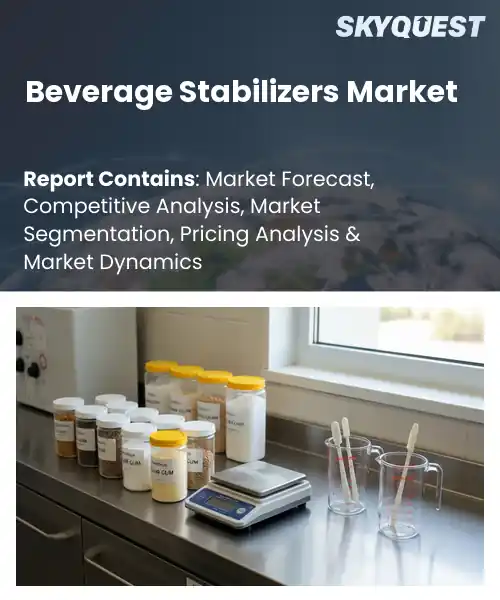
Beverage Stabilizers Market
Report ID: SQMIG30I2850
Report ID: SQMIG30I2850
[email protected]
USA +1 351-333-4748
Report ID:
SQMIG30I2850 |
Region:
Global |
Published Date: February, 2026
Pages:
157
|Tables:
148
|Figures:
78


Global Beverage Stabilizers Market size was valued at USD 1.16 Billion in 2024 and is poised to grow from USD 1.24 Billion in 2025 to USD 2.08 Billion by 2033, growing at a CAGR of 6.7% during the forecast period (2026-2033).
The main factor driving the beverage stabilizers market is increased demand for long shelf life and uniform quality in a broader product line of beverages which has resulted in manufacturers using multifunctional hydrocolloids and emulsifiers. Beverage stabilizers include pectins, xanthan gum, carrageenan, and modified starches that help to prevent phase separation, manage viscosity, and maintain mouthfeel in products ranging from fruit juices to non-dairy alternatives. This is an important market to watch because if a product fails to meet stability expectations, then it can lead to visual separation, a loss of consumer trust, and an expense for the brand when they have to process returns. Therefore, they are investing in formulation optimization and testing.
As processing techniques have advanced and clean label pressures have increased, suppliers have gravitated toward providing purer extractions and custom blends. As suppliers have transitioned to purer extractions and custom blends, the principal driver influencing growth internationally is the growing convergence between regulatory scrutiny and a growing demand from consumers for products made with natural ingredients. To meet consumers' demands for clean labelled products, there has been an increased investment in clean technologies and new types of hydrocolloids.
During this time, as companies are reformulating to provide consumers with clean labelled products, both the demand for pectin produced from citrus and sugar beets, as well as fermentation derived gums will continue to grow, thus providing new opportunities for contract manufacturers. This will also result in the faster launch of products such as plant-based milk and ready-to-drink protein beverages, where stable suspension and maintained mouthfeel are very important.
How is AI Improving Product Consistency in the Beverage Stabilizers Market?
The beverage stabilizer industry is seeing improved consistency in its products using artificial intelligence (AI) that enables the conversion of chaotic processing signals into predictable, repeatable results. These include analytical technologies that are driven by sensors; and automated feedback mechanisms for ongoing evaluation of product quality. Manufacturers currently rely on AI technology to monitor the variability of raw feedstock during production, providing the ability to adapt processing parameters so that products maintain consistent viscosity and emulsion stability across production runs.
This is particularly important as formulators continue to transition to formulating plant-based and fortified beverages, where even small changes in temperature or pH can negatively impact the product's texture. A few examples include AI-enabled processing of starch and dextrin and optimization of emulsions, both of which provide a shorter development cycle and lower variability from scale up to commercialization.
Market snapshot - 2026-2033
Global Market Size
USD 1.16 Billion
Largest Segment
Xanthan Gum
Fastest Growth
Stabilizer Blends
Growth Rate
6.7% CAGR
To get more insights on this market click here to Request a Free Sample Report
The beverage stabilizers market is segmented into product type, function, formulation type, stabilizer type, application type and region. Based on product type, the market is segmented into xanthan gum, pectin, carrageenan, gum arabic, guar gum, emulsifiers, stabilizer blends and others. Based on function, the market is segmented into thickening, emulsification, suspension stabilization, texture modification and others. Based on formulation type, the market is segmented into powder formulations and liquid formulations. Based on stabilizer type, the market is segmented into natural stabilizers and synthetic stabilizers. Based on application type, the market is segmented into non-alcoholic beverages and alcoholic beverages. Based on region, the market is segmented into North America, Europe, Asia Pacific, Latin America and Middle East & Africa.
As per global beverage stabilizers market outlook, the segment of xanthan gum reigns supreme because of its incredibly high viscosity with excellent shear-thinning capability that helps stabilize the mouthfeel of a variety of beverage matrices and minimize phase separation. Xanthan gum is also able to provide formulators with a desired texture while not impacting the flavor of the beverage; this is due to its large range of pH and temperature tolerance, ability to work well with other hydrocolloids. Xanthan gum is consistently used across a variety of beverage applications because of established supply chains and the familiarity with xanthan gum as a thickener and suspending agent for many beverage applications.
As per global beverage stabilizers market forecast, pectin is experiencing the greatest growth, which will continue as formulators develop clean label fruit-based beverages and pulpy drinks and use the natural gelling and stabilizing characteristics of pectin to stabilize the cloudiness and mouthfeel of the final product. Innovations that provide lower methoxyl content and tailored esterification of pectin will be used to create new acidic product formats and meet growing consumer demand for well-recognized natural ingredients.
Emulsification segment dominates in the market because, with a properly emulsified beverage, you can successfully combine oils, flavorings and fat-soluble nutrients in a water-based beverage without experiencing flavour degradation or creaming, thus enhancing mouthfeel. When emulsified properly, the resulting beverage will stabilize emulsified lipid droplets throughout the manufacturing/processing phase and maintain their stability during storage. Making emulsification one of the most widely used technologies for ready to drink beverages, dairy alternative beverages, and functional beverages.
As per global beverage stabilizers market analysis, suspension stabilization is experiencing the fastest growth in this segment due to increased consumer demand for pulpy, particulate and botanical-based beverages requiring controlled dispersion throughout the beverage to prevent sedimentation. This will enable the development of beverage formulations with more textured and sensory attributes as well as provides opportunities to develop new ingredient technologies to support these types of beverage formulations.
To get detailed segments analysis, Request a Free Sample Report
The global beverage stabilizers market will continue to be dominated by the Asia Pacific region because of various factors, including structural and commercial advantages. The size and diversity of the Asia Pacific beverage manufacturing industry provide substantial demand for formulation aids within all industry segments. Additionally, Asia Pacific has strong ingredient supply chains and capable, low-cost production facilities, all of which support scalable manufacturing and efficient sourcing.
Japan Beverage Stabilizers Market
The Japan beverage stabilizers market demonstrates superior technical expertise and an emphasis on premium beverage attributes. Beverage manufacturers place a high priority on the accuracy of their formulations and the sensory characteristics of their finished product (e.g., tea, dairy, functional drinks, etc.) by working closely with ingredient suppliers throughout the development process to create new products with improved texture and stability. Japan's strict quality and regulatory standards foster a greater acceptance of state-of-the-art stabilizing solutions and have led to an increased emphasis on developing unique formulations tailored to meet the needs of "sophisticated" consumers and "niche" product offerings.
South Korea Beverage Stabilizers Market
The South Korea beverage stabilizers market showcases a highly innovative culture, as well as an increasing desire among consumers for unique taste combinations and functional benefit products. To produce stable textures and appealing mouthfeel for RTD and functional beverages, manufacturers are collaborating closely with ingredient suppliers. The growing popularity of clean-label products and ingredient transparency is leading to increased demand for the use of natural stabilizers in beverage manufacturing.
There is rapid North America beverage stabilizers market growth due to consumer preferences converging and the ability to innovate quickly. The push for the beverage manufacturers towards clean labels and plant-based options is encouraging them to utilize flexible stabilizers. As a result, they are able to achieve shelf stability and texture while providing transparency of ingredient details. Companies that manufacture ingredients and provide co-packing services are heavily involved in extensive R&D to improve product applications and create new products faster.
U.S. Beverage Stabilizers Market
In the US, the beverage stabilizers market is driven by an innovative beverage industry heavily focused on product development and production at scale. Ingredient suppliers provide significant levels of technical support to address various formulation challenges across many different classes of beverages, including carbonated, dairy, plant-based, and functional beverages. The demand for clean label product offerings and interesting sensory experiences by retailers drives the adoption of customized stabilizer systems. Facilities that engage in collaborative research, testing, and agile manufacturing also assist with successfully commercializing the use of ingredients.
Canada Beverage Stabilizers Market
In Canada, the beverage stabilizers market benefits from a significant dairy and beverage sector, along with an emphasis on sourcing natural ingredients. Manufacturers are often partnering with ingredient suppliers to customize stabilizer solutions for dairy alternatives, ready-to-drink products, and functional beverages. The increase is due to priorities surrounding clean label transparency and food safety compliance.
Europe fortifies its position using sustainable innovation and environmental regulation, also using a sophisticated supplier network to put the manufacturer in a better position by considering the increasing importance of natural and functional stabilizers. Research done collaboratively between universities and companies helps develop optimized applications for dairy, plant-based, and fermented beverages. It also provides strong technical services to help customize products to match the unique preferences of consumers across both premium and mass channels.
Germany Beverage Stabilizers Market
Germany beverage stabilizers market leverages an advanced, state-of-the-art ingredient manufacturing base and strong technical and scientific expertise; beverage stabilizer suppliers have developed scaling, robust stabilizer systems that meet the beverage manufacturing needs. Manufacturers work with ingredient suppliers and their respective local research institutions to develop solutions that are both highly functional and environmentally sustainable, thereby supporting environmentally responsible practices. Furthermore, there is a demand for precise control over textures and shelf-life stability that results in many customized formulations and numerous applications testing prior to commercialization in all domestic or consumer markets.
United Kingdom Beverage Stabilizers Market
The UK beverage stabilizers market is driven by an innovative ecosystem and a cooperative beverage development community. Ingredient suppliers work closely with brands to develop new stabilization systems for premium and functional drinks while using natural ingredients both in terms of taste and texture. The presence of established analytical and sensory testing facilities fosters product iteration, while the desire for sustainable and traceable ingredients has influenced the need for multifunctional products that can keep pace with changing consumer preferences throughout all domestic distribution channels.
France Beverage Stabilizers Market
In France, the beverage stabilizers market is influenced by a rich history of high-quality cuisine and a strong dairy and beverage manufacturing sector. Ingredient vendors offer solutions for stabilizers that are based on the preservation of flavour and mouthfeel. Close cooperation between craft beverage manufacturers and industrial producers has created custom formulations. As with all other segments, sustainability, provenance, and transparency of ingredients are primary considerations in selecting and developing beverage stabilizers across all beverage segments.
To know more about the market opportunities by region and country, click here to
Buy The Complete Report
Demand for Clean Label Products
Technological Innovation in Formulation
Regulatory Compliance Challenges
Variability in the Supply of Raw Material for Beverage Stabilizers
Request Free Customization of this report to help us to meet your business objectives.
As the market for beverage stabilizers continues to grow worldwide, suppliers are becoming increasingly competitive by using clean labels and creating plant-based texture performance, which are now the criteria they are evaluated on when doing business with their customers. This competition has driven companies to pursue strategies such as acquiring formulations know-how through acquisitions and co-developing partnerships in order to secure supply and to develop new stabilizing ingredients using precision fermentation and cell-based technologies.
Clean Label Demand
Functional Beverage Innovation
SkyQuest’s ABIRAW (Advanced Business Intelligence, Research & Analysis Wing) is our Business Information Services team that Collects, Collates, Correlates, and Analyses the Data collected by means of Primary Exploratory Research backed by robust Secondary Desk research.
As per SkyQuest analysis, the global beverage stabilizers market is being driven by a key driver, rising demand for extended shelf life and consistent product quality, and a second driver is growing consumer preference for clean label, plant-based and fortified beverages that require multifunctional stabilizers. A significant restraint is evolving regulatory compliance that increases reformulation and approval costs for novel ingredients. Asia Pacific is the dominating region due to its large, diverse beverage manufacturing base and cost-competitive supply chains, while xanthan gum is the dominating segment because of its wide pH and temperature tolerance, low usage levels and established supply networks that make it the default thickening and suspension choice. The global beverage stabilizers market share is characterized by the dominance of natural stabilizers such as xanthan gum, pectin, and carrageenan, driven by increasing demand for clean-label and plant-based ingredients.
| Report Metric | Details |
|---|---|
| Market size value in 2024 | USD 1.16 Billion |
| Market size value in 2033 | USD 2.08 Billion |
| Growth Rate | 6.7% |
| Base year | 2024 |
| Forecast period | 2026-2033 |
| Forecast Unit (Value) | USD Billion |
| Segments covered |
|
| Regions covered | North America (US, Canada), Europe (Germany, France, United Kingdom, Italy, Spain, Rest of Europe), Asia Pacific (China, India, Japan, Rest of Asia-Pacific), Latin America (Brazil, Rest of Latin America), Middle East & Africa (South Africa, GCC Countries, Rest of MEA) |
| Companies covered |
|
| Customization scope | Free report customization with purchase. Customization includes:-
|
To get a free trial access to our platform which is a one stop solution for all your data requirements for quicker decision making. This platform allows you to compare markets, competitors who are prominent in the market, and mega trends that are influencing the dynamics in the market. Also, get access to detailed SkyQuest exclusive matrix.
Table Of Content
Executive Summary
Market overview
Parent Market Analysis
Market overview
Market size
KEY MARKET INSIGHTS
COVID IMPACT
MARKET DYNAMICS & OUTLOOK
Market Size by Region
KEY COMPANY PROFILES
Methodology
For the Beverage Stabilizers Market, our research methodology involved a mixture of primary and secondary data sources. Key steps involved in the research process are listed below:
1. Information Procurement: This stage involved the procurement of Market data or related information via primary and secondary sources. The various secondary sources used included various company websites, annual reports, trade databases, and paid databases such as Hoover's, Bloomberg Business, Factiva, and Avention. Our team did 45 primary interactions Globally which included several stakeholders such as manufacturers, customers, key opinion leaders, etc. Overall, information procurement was one of the most extensive stages in our research process.
2. Information Analysis: This step involved triangulation of data through bottom-up and top-down approaches to estimate and validate the total size and future estimate of the Beverage Stabilizers Market.
3. Report Formulation: The final step entailed the placement of data points in appropriate Market spaces in an attempt to deduce viable conclusions.
4. Validation & Publishing: Validation is the most important step in the process. Validation & re-validation via an intricately designed process helped us finalize data points to be used for final calculations. The final Market estimates and forecasts were then aligned and sent to our panel of industry experts for validation of data. Once the validation was done the report was sent to our Quality Assurance team to ensure adherence to style guides, consistency & design.
Analyst Support
Customization Options
With the given market data, our dedicated team of analysts can offer you the following customization options are available for the Beverage Stabilizers Market:
Product Analysis: Product matrix, which offers a detailed comparison of the product portfolio of companies.
Regional Analysis: Further analysis of the Beverage Stabilizers Market for additional countries.
Competitive Analysis: Detailed analysis and profiling of additional Market players & comparative analysis of competitive products.
Go to Market Strategy: Find the high-growth channels to invest your marketing efforts and increase your customer base.
Innovation Mapping: Identify racial solutions and innovation, connected to deep ecosystems of innovators, start-ups, academics, and strategic partners.
Category Intelligence: Customized intelligence that is relevant to their supply Markets will enable them to make smarter sourcing decisions and improve their category management.
Public Company Transcript Analysis: To improve the investment performance by generating new alpha and making better-informed decisions.
Social Media Listening: To analyze the conversations and trends happening not just around your brand, but around your industry as a whole, and use those insights to make better Marketing decisions.
REQUEST FOR SAMPLE
 REQUEST FREE CUSTOMIZATION
Global Beverage Stabilizers Market size was valued at USD 1.16 Billion in 2024 and is poised to grow from USD 1.24 Billion in 2025 to USD 2.08 Billion by 2033, growing at a CAGR of 6.7% during the forecast period (2026-2033).
Palsgaard A/S, Cargill, Incorporated, International Flavors & Fragrances Inc., Ingredion Incorporated, Tate & Lyle PLC, Kerry Group PLC, Ashland Inc., Archer Daniels Midland Company, DSM-Firmenich, Meron Group, Procudan A/S, Jungbunzlauer, CARAGUM International, Taiyo Kagaku Co.,Ltd., Stern-Wywiol Gruppe GmbH & Co. KG, Nexira, BASF SE, Compañía Española de Algas Marinas S.A., Novasol Ingredients Pvt. Ltd., Silvateam S.p.A.
The key driver of the Beverage Stabilizers Market is the increasing demand for functional and processed beverages. Rising consumer preference for improved texture, stability, and extended shelf-life in drinks is driving the adoption of stabilizers such as emulsifiers and hydrocolloids.
A key market trend in the Beverage Stabilizers Market is the growing shift toward clean-label, natural, and plant-based stabilizers. Additionally, increasing demand for functional beverages and innovative formulations is driving the use of advanced stabilizing systems to enhance texture, consistency, and shelf-life.
North America accounted for the largest share in the Beverage Stabilizers Market, driven by high consumption of processed and functional beverages, strong demand for clean-label ingredients, and the presence of established food and beverage manufacturers.


Want to customize this report? This report can be personalized according to your needs. Our analysts and industry experts will work directly with you to understand your requirements and provide you with customized data in a short amount of time. We offer $1000 worth of FREE customization at the time of purchase.
Feedback From Our Clients


 USA (+1) 351-333-4748

