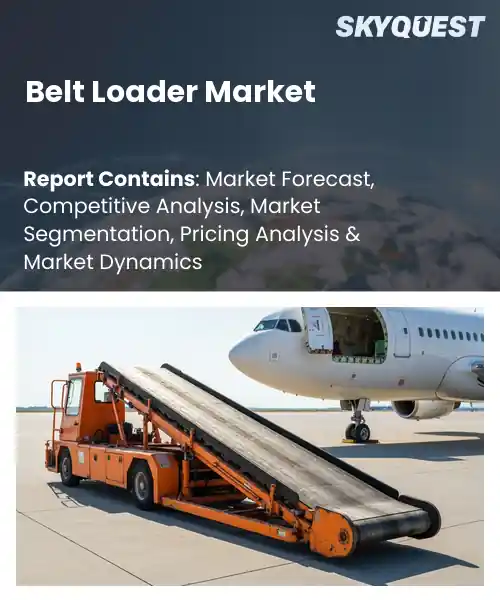
Belt Loader Market
Report ID: SQMIG20F2085
Report ID: SQMIG20F2085
[email protected]
USA +1 351-333-4748
Report ID:
SQMIG20F2085 |
Region:
Global |
Published Date: May, 2026
Pages:
157
|Tables:
256
|Figures:
82


Global Belt Loader Market size was valued at USD 2.1 Million in 2024 and is poised to grow from USD 2.22 Million in 2025 to USD 3.49 Million by 2033, growing at a CAGR of 5.8% during the forecast period (2026-2033).
The belt loader market is driven mainly by the growth in air traffic and cargo throughput, which forces ground handlers and airports to reduce turnaround times while ensuring the safety of workers. Ground Support Equipment A belt loader is equipment with a conveyor that moves baggage and cargo to and from aircraft holds. The importance of a belt loader increases with aircraft utilization and schedules. The market shifted over decades from hand-operated, diesel units to electric, telescopic and height-adjustable designs that reduce emissions and fit a variety of aircraft. Major hubs have updated fleets to support higher flight frequencies and reduce costs and increase capacity.
Regulatory pressure to decarbonize airport ground operations is a key driver shaping the global belt loader market. This is forcing operators to replace their diesel fleets with electric models, creating demand for new equipment and after sales services. As emissions targets become more stringent, manufacturers are investing in battery technology and telematics to provide units with longer duty cycles and predictive maintenance, which lowers lifecycle costs for handlers. In practice, major ground handling companies adopt electric belt loaders at hub airports to meet airline sustainability commitments, while express cargo operators order higher capacity and faster loading models to handle surges from ecommerce globally today.
How is AI-enabled predictive maintenance transforming the belt loader market?
AI-driven predictive maintenance revolutionizes belt loaders by incorporating sensors, telematics and machine learning to move maintenance from reactive repairs to condition-based attention. Key features include continuous vibration and motor monitoring, automated anomaly detection and remote diagnostics that allow technicians to schedule work when it works for operations. Today’s market is moving as airports and logistics hubs deploy retrofits and new connected units to improve uptime, simplify troubleshooting and ease skilled labor shortages. With the addition of telematics and service platforms to new belt loader lines, manufacturers are seeing real world pilots on conveyor systems with fewer unplanned stops and clearer service planning.
In January 2026, Oshkosh AeroTech announced expanded iOPS connected monitoring and smart gate solutions for cargo loaders and other ground support equipment that bring predictive alerts and remote diagnostics to the ramp, supporting greater fleet availability and smoother turn cycles through earlier fault detection and faster repairs.
Market snapshot - (2026-2033)
Global Market Size
USD 2.1 Million
Largest Segment
Towable Belt Loaders
Fastest Growth
Electric Belt Loaders
Growth Rate
5.8% CAGR
To get more insights on this market click here to Request a Free Sample Report
Global belt loader market is segmented by product type, belt capacity, belt height, power source, application, end user, mobility type, automation level, distribution channel and region. Based on product type, the market is segmented into Towable Belt Loaders, Self-Propelled Belt Loaders, Electric Belt Loaders, Diesel Belt Loaders, Hybrid Belt Loaders and Others. Based on belt capacity, the market is segmented into Light-Duty Belt Loaders, Medium-Duty Belt Loaders and Heavy-Duty Belt Loaders. Based on belt height, the market is segmented into Narrow-Body Aircraft Belt Loaders, Wide-Body Aircraft Belt Loaders and Universal/Adjustable Belt Loaders. Based on power source, the market is segmented into Internal Combustion Engine, Battery-Electric and Hybrid Power. Based on application, the market is segmented into Passenger Baggage Handling, Cargo Handling, Parcel & Logistics Handling, Military & Defense Operations and Industrial Material Handling. Based on end user, the market is segmented into Airports, Airlines, Ground Handling Service Providers, Cargo & Logistics Companies and Military & Defense Organizations. Based on mobility type, the market is segmented into Fixed Chassis Belt Loaders and Mobile Belt Loaders. Based on automation level, the market is segmented into Manual/Semi-Manual Belt Loaders and Automated/Smart Belt Loaders. Based on distribution channel, the market is segmented into OEM Sales and Aftermarket Sales. Based on region, the market is segmented into North America, Europe, Asia Pacific, Latin America and Middle East & Africa.
The Electric Belt Loaders segment is a major contributor, with operators increasingly preferring lower noise levels, reduced on-site emissions and simpler maintenance, driving procurement towards electric powered units. Less fuel handling and less frequent engine maintenance lead to greater predictability in operational uptime and lower lifecycle complexity, which should help spur fleet renewals. OEMs therefore concentrate development, support and charging integration on electric platforms, strengthening perceptions of reliability and speeding adoption by commercial handlers and airlines.
However the fastest growing area is Hybrid Belt Loaders as they are able to work on dual power and reduce fuel consumption, whilst still having range. This bridging technology provides an adoption opportunity, by providing electrification benefits with familiar refueling practices, with retrofit and resale opportunities that accelerate fleet renewal and create aftermarket revenue streams.
The Battery-Electric segment is leading the charge as buyers are looking for total cost of ownership improvements, quieter operations and alignment with sustainability goals where battery platforms are favored. Reduced routine servicing requirements and no fuel logistics simplify ground operations and allow for predictable maintenance scheduling, minimizing operational disruptions. OEM investment in charging solutions, warranty packages and dedicated service networks only boosts buyer confidence and supports wider electrified fleet deployments.
Hybrid Power is growing rapidly, as it provides electric benefits with combustion range, and reduces operational risk for long shifts. Advances in hybrid controls and battery systems can enable mixed-use duty cycles and generate demand for retrofits, training and phased electrification projects that expand procurement choices and stimulate aftermarket services.
To get detailed segments analysis, Request a Free Sample Report
A well-established ecosystem of airport infrastructure, deployed airline networks, and concentrated equipment manufacturers focusing on reliability and service, drive North America's dominance in the global belt loader market. Market leadership reinforced by wide adoption of modern ground handling practices, focus on safety of operation and mature maintenance and logistics support. Ongoing investments in training, aftermarket services and rental models boost asset utilization for the major hubs. Ground handlers, OEMs and airport authorities work together to create bespoke solutions for various aircraft types, with regulatory harmonization and access to skilled technicians allowing for rapid implementation and lifecycle management. Operators benefit from reduced operational complexity through strong aftermarket networks, local manufacturing footprints and a focus on energy efficient equipment. Industry stakeholders point to modular designs and remote diagnostics to minimize downtime and connect with airport systems. These factors work together to create a competitive environment that draws investment and enables scale on regional and international routes.
Belt Loader Market in United States is showing mature demand because of high airline operations, developed airport infrastructure and preference for established equipment and full aftermarket support. Operators want reliability, safety and compatibility with different aircraft fleets, meaning vendors have to provide customized service packages, technical training and rapid parts availability. Strong partnerships between ground handlers, OEMs and airports are driving innovation in efficiency and lifecycle management, overall strengthening market’s resilience.
The Belt Loader Market in Canada is driven by the need for operational flexibility and rugged equipment that can handle diverse climates and airport profiles. Ground handlers stress rugged design, ease of maintenance and responsive aftermarket networks to support remote operations and seasonal demands. The manufacturer-service provider cooperation allows for local support models, training programs, and spare parts logistics, to ensure consistent performance across airports and in line with safety and operational standards.
Asia Pacific is growing fast, thanks to a combination of more connections through air travel, efforts to modernize airports and more regional manufacturing of ground support equipment. Operators throughout the region are looking for scalable, cost effective handling solutions that are suitable for high throughput terminals and mixed fleet profiles. We strategically invest in mechanization, electrification and localized aftermarket services that support fleet renewal and operational efficiency. Local vendor and global OEM collaboration accelerate technology transfer and supply chain robustness. Public private initiatives and supportive regulatory frameworks are encouraging the use of energy efficient equipment and safety upgrade programs, while workforce development programs are boosting technician capacity and aftermarket capability, positioning the region as a major consumer and a growing production base for belt loader technologies. Together, demand and manufacturing momentum are fueling stronger regional supply chains and prompting more innovation.
Japan Belt Loader Market is driven by precision engineering, safety standards and a service-oriented culture that is reliability driven. Airports and ground handlers prefer compact, high-tech equipment with integrated diagnostics and predictable maintenance schedules. Partnering with domestic manufacturers allows us to provide customized solutions with an emphasis on energy efficiency and lifecycle support. Training programs and efficient parts distribution networks also increase uptime and support process driven, quality focused operations.
South Korea Belt Loader Market is a reflection of a keen interest in fast technology adoption, integration with digital airport systems and partnerships between local manufacturers and international suppliers. Operators are looking for flexible solutions to manage the dense schedule of flights involving different types of aircraft. Urban airports are suitable for focus on energy efficient and compact designs while utilization is supported by aftermarket responsiveness and training programs. Collaboration with airport authorities is very close to ensure overall compatibility with operational protocols and safety requirements.
Europe is working to strengthen its position in the belt loader market through a combination of technological innovations, regulatory focus on safety and emissions, and collaborative efforts within the industry that encourage standardization and interoperability. Operators benefit from investment in electrification, modular designs and remote diagnostics that support operational efficiency and lower lifecycle costs. Close proximity to major OEMs and a strong aftermarket ecosystem enables fast service response and customization to different airport profiles. Ground handlers, airports and equipment manufacturers are entering into cross country partnerships to facilitate pilot programs and knowledge sharing, while support for skills development ensures a qualified technician base to maintain complex fleets and speed up the adoption of next generation handling solutions. A focus on local sourcing and supply chain resilience improves lead times and vendor reliability. Sustainability certifications incentivize manufacturers to produce low emission, energy efficient models that meet airport environmental objectives. Customized financing and service agreements allow operators to upgrade fleets and manage capital commitments.
The Germany Belt Loader Market is known for engineering excellence, strong manufacturing capabilities and strict adherence to safety and environmental regulations. Operators and airports want durable, precision built equipment that can be integrated with existing maintenance practices. Aftermarket support and spare parts logistics are reliable from local OEMs and component suppliers. Industry and airport partnership efforts to advance innovation in electrification and efficiency can deliver tailored solutions to meet a range of operational needs across hub airports.
Operational agility, airline networks and integration with airport ground services are drivers for the Belt Loader Market in United Kingdom. Ground handlers prefer flexible equipment that accommodates rapid turnaround times and mixed fleet compatibility. Established aftermarket suppliers provide training, maintenance and distribution of spare parts to minimize down time. Joint programs with airports that back pilot projects are catalysts for electrification and safety improvements, driving solutions that work for major hubs and regional usage.
Belt Loader Market France is driven by strong airport modernization initiatives and focus on safety, environmental objectives and efficient ground handling. Operators such as flexible, low-emission designs that meet tough regulatory requirements and fit the needs of mixed fleets. Suppliers work together to provide local service and parts. Electrification and smart diagnostics are being tested in pilot projects with airports in support of lifecycle management so operators can maintain consistent throughput and reliability across key hub networks.
To know more about the market opportunities by region and country, click here to
Buy The Complete Report
Rising Air Cargo Demand
Technological Advancements In Equipment
High Initial Capital Requirements
Regulatory And Certification Hurdles
Request Free Customization of this report to help us to meet your business objectives.
Consolidation, electrification and partner led distribution are being increasingly used by competitors to defend share in the global belt loader market. Recent activity includes M&A for capability scale, OEM partnerships for distribution and launch of electrified products like fully electric belt loaders. At major airports, incumbents are winning contracts through product innovation and aftermarket partnerships, raising the competitive intensity surrounding electric and retrofit solutions.
SkyQuest’s ABIRAW (Advanced Business Intelligence, Research & Analysis Wing) is our Business Information Services team that Collects, Collates, Correlates, and Analyses the Data collected by means of Primary Exploratory Research backed by robust Secondary Desk research. As per SkyQuest analysis, the global belt loader market is being propelled primarily by rising air traffic and cargo throughput, which force ground handlers and airports to accelerate turnaround times and modernize fleets. Regulatory pressure to decarbonize ground operations further accelerates adoption of electric models and investment in telematics and battery technology. North America remains the dominant region supported by mature infrastructure, concentrated manufacturers and strong aftermarket networks. Electric belt loaders are the leading segment due to lower on-site emissions, quieter operation and simplified maintenance. However high initial capital requirements constrain smaller carriers and budget-conscious handlers, slowing replacement cycles despite clear operational benefits.
| Report Metric | Details |
|---|---|
| Market size value in 2024 | USD 2.1 Million |
| Market size value in 2033 | USD 3.49 Million |
| Growth Rate | 5.8% |
| Base year | 2024 |
| Forecast period | (2026-2033) |
| Forecast Unit (Value) | USD Million |
| Segments covered |
|
| Regions covered | North America (US, Canada), Europe (Germany, France, United Kingdom, Italy, Spain, Rest of Europe), Asia Pacific (China, India, Japan, Rest of Asia-Pacific), Latin America (Brazil, Rest of Latin America), Middle East & Africa (South Africa, GCC Countries, Rest of MEA) |
| Companies covered |
|
| Customization scope | Free report customization with purchase. Customization includes:-
|
To get a free trial access to our platform which is a one stop solution for all your data requirements for quicker decision making. This platform allows you to compare markets, competitors who are prominent in the market, and mega trends that are influencing the dynamics in the market. Also, get access to detailed SkyQuest exclusive matrix.
Table Of Content
Executive Summary
Market overview
Parent Market Analysis
Market overview
Market size
KEY MARKET INSIGHTS
COVID IMPACT
MARKET DYNAMICS & OUTLOOK
Market Size by Region
KEY COMPANY PROFILES
Methodology
For the Belt Loader Market, our research methodology involved a mixture of primary and secondary data sources. Key steps involved in the research process are listed below:
1. Information Procurement: This stage involved the procurement of Market data or related information via primary and secondary sources. The various secondary sources used included various company websites, annual reports, trade databases, and paid databases such as Hoover's, Bloomberg Business, Factiva, and Avention. Our team did 45 primary interactions Globally which included several stakeholders such as manufacturers, customers, key opinion leaders, etc. Overall, information procurement was one of the most extensive stages in our research process.
2. Information Analysis: This step involved triangulation of data through bottom-up and top-down approaches to estimate and validate the total size and future estimate of the Belt Loader Market.
3. Report Formulation: The final step entailed the placement of data points in appropriate Market spaces in an attempt to deduce viable conclusions.
4. Validation & Publishing: Validation is the most important step in the process. Validation & re-validation via an intricately designed process helped us finalize data points to be used for final calculations. The final Market estimates and forecasts were then aligned and sent to our panel of industry experts for validation of data. Once the validation was done the report was sent to our Quality Assurance team to ensure adherence to style guides, consistency & design.
Analyst Support
Customization Options
With the given market data, our dedicated team of analysts can offer you the following customization options are available for the Belt Loader Market:
Product Analysis: Product matrix, which offers a detailed comparison of the product portfolio of companies.
Regional Analysis: Further analysis of the Belt Loader Market for additional countries.
Competitive Analysis: Detailed analysis and profiling of additional Market players & comparative analysis of competitive products.
Go to Market Strategy: Find the high-growth channels to invest your marketing efforts and increase your customer base.
Innovation Mapping: Identify racial solutions and innovation, connected to deep ecosystems of innovators, start-ups, academics, and strategic partners.
Category Intelligence: Customized intelligence that is relevant to their supply Markets will enable them to make smarter sourcing decisions and improve their category management.
Public Company Transcript Analysis: To improve the investment performance by generating new alpha and making better-informed decisions.
Social Media Listening: To analyze the conversations and trends happening not just around your brand, but around your industry as a whole, and use those insights to make better Marketing decisions.
REQUEST FOR SAMPLE
 REQUEST FREE CUSTOMIZATION
Global Belt Loader Market size was valued at USD 2.1 Million in 2024 and is poised to grow from USD 2.22 Million in 2025 to USD 3.49 Million by 2033, growing at a CAGR of 5.8% during the forecast period (2026-2033).
Competitors in the global belt loader market increasingly deploy consolidation, electrification and partner led distribution to defend share. Recent activity shows M&A for capability scale, OEM partnerships for distribution and electrified product launches such as fully electric belt loaders. Incumbents use product innovation and aftermarket partnerships to win contracts at major airports, intensifying competition around electric and retrofit solutions. 'TLD Group', 'JBT Corporation', 'TREPEL Airport Equipment', 'AERO Specialties', 'Mallaghan Engineering', 'Charlatte Manutention', 'CIMC-TianDa Holdings', 'FAST Global Solutions', 'Mulag Fahrzeugwerk', 'Bliss-Fox Ground Support Equipment', 'Avro GSE', 'Timsan', 'LAS-1', 'DENGE Airport Equipment', 'Hydro System KG', 'NMC-Wollard', 'ITW GSE', 'Goldhofer AG', 'Jiangsu Tianyi Aviation Industry', 'Shenzhen TECHKING Industry Co., Ltd.'
The consistent increase in global air cargo demand encourages airlines and ground handlers to invest in efficient belt loader equipment to accelerate aircraft turnaround and maintain schedule reliability. Operators prioritize solutions that reduce manual handling and improve safety, prompting procurement of modern loaders with ergonomic features and faster loading cycles. This demand-driven procurement fosters market expansion as manufacturers respond with broader product offerings, streamlined support services, and regional distribution strategies that align with operational priorities across hubs and regional airports.
Automation And Smart Integration: The belt loader market is shifting toward advanced automation and system integration, with manufacturers embedding sensors, connectivity, and software platforms to enable predictive maintenance, remote diagnostics, and seamless interaction with ground handling and airport management systems. This trend emphasizes modular designs and standardized communication protocols to support fleet level coordination, reduce idle time, and increase operational flexibility. Providers are prioritizing user friendly interfaces and customizable workflows to accommodate diverse airline procedures and improve throughput in complex airport environments.
Why does North America Dominate the Global Belt Loader Market? |@12


Want to customize this report? This report can be personalized according to your needs. Our analysts and industry experts will work directly with you to understand your requirements and provide you with customized data in a short amount of time. We offer $1000 worth of FREE customization at the time of purchase.
Feedback From Our Clients


 USA (+1) 351-333-4748

