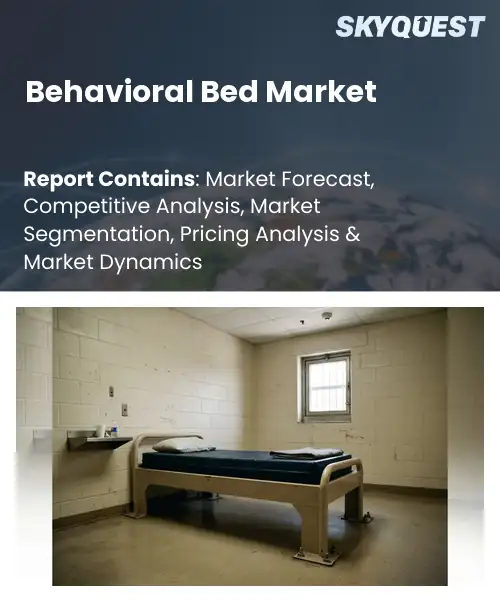
Behavioral Bed Market
Report ID: SQMIG35A4423
Report ID: SQMIG35A4423
[email protected]
USA +1 351-333-4748
Report ID:
SQMIG35A4423 |
Region:
Global |
Published Date: August, 2026
Pages:
157
|Tables:
174
|Figures:
79


Global Behavioral Bed Market size was valued at USD 487.3 Million in 2024 and is poised to grow from USD 522.39 Million in 2025 to USD 911.07 Million by 2033, growing at a CAGR of 7.2% during the forecast period (2026-2033).
The behavioral bed market refers to sleep surfaces equipped with sensors that monitor movement, heart rate and temperature to adjust support and collect data for health insights. Its significance stems from rising consumer awareness of sleep’s impact on chronic conditions and the healthcare sector’s push for monitoring. Historically, the market emerged from pressure‑mapping mattresses in the 2010s, evolved through IoT connectivity in 2018, and accelerated when manufacturers partnered with wellness apps in 2021. A primary driver of this trajectory is the convergence of affordable sensors with growing demand for personalized, data‑driven health solutions, turning beds from furniture into health platforms. The integration of telehealth ecosystems forms a pivotal growth engine for the behavioral bed market because home sleep data now feed into clinical workflows. When insurers reimburse remote monitoring, hospitals encourage patients to use smart beds that upload nightly metrics to electronic records, allowing early detection of arrhythmias or sleep apnea. This cause‑effect chain prompted manufacturers to embed AI analytics that issue actionable alerts, illustrated by a Swedish pilot where cardiology units cut emergency admissions by 12 % using automated risk scores. The resulting blend of reimbursement incentives, AI insights, and cost reductions expands market and attracts collaborations with digital‑health platforms.
How is AI-driven automation reshaping the behavioral bed market?
AI‑driven automation is redefining the behavioral bed market by linking patient monitoring, staffing schedules, and bed turnover into a single intelligent workflow. Algorithms analyze real‑time sensor data to predict when a patient is ready for discharge, allowing staff to prepare the next bed without manual checks. Automated alerts reduce idle time and improve safety, while predictive maintenance flags equipment issues before they affect care. Integration with electronic health records ensures that treatment plans and occupancy data stay synchronized, creating a smoother patient journey. These capabilities are especially valuable as demand for behavioral health services climbs and provider shortages tighten operational margins.Universal Health Services, Inc. August 2026, added AI‑driven automation to its behavioral care units, speeding bed turnover and boosting overall efficiency.
Market snapshot - (2026-2033)
Global Market Size
USD 487.3 Million
Largest Segment
Manual Behavioral Beds
Fastest Growth
Electric Behavioral Beds
Growth Rate
7.2% CAGR
To get more insights on this market click here to Request a Free Sample Report
Global behavioral bed market is segmented by product type, application, safety feature, end user, operation, distribution channel and region. Based on product type, the market is segmented into Manual Behavioral Beds, Electric Behavioral Beds, Bariatric Behavioral Beds and Others. Based on application, the market is segmented into Psychiatric Hospitals, Behavioral Health Centers, Correctional Healthcare and Others. Based on safety feature, the market is segmented into Anti-Ligature Beds, Tamper-Resistant Beds, Standard Behavioral Beds and Others. Based on end user, the market is segmented into Hospitals, Behavioral Health Facilities, Long-Term Care Facilities and Others. Based on operation, the market is segmented into Manual and Electric. Based on distribution channel, the market is segmented into Direct Sales, Medical Equipment Distributors and Others. Based on region, the market is segmented into North America, Europe, Asia Pacific, Latin America and Middle East & Africa.
Electric Behavioral Beds segment dominates because healthcare providers prioritize seamless adjustability and integrated safety controls, which align with modern patient management protocols. The ability to remotely modify positioning reduces staff exposure to aggressive behaviors, enhancing both caregiver safety and patient comfort. Moreover, built‑in alarm systems and data logging satisfy regulatory expectations, prompting institutions to favor electric solutions over manual alternatives in procurement decisions for long‑term operational efficiency and cost reduction.
Meanwhile, Manual Behavioral Beds segment is witnessing the strongest growth momentum as budget‑constrained facilities seek reliable low‑tech options that still meet safety standards. Simplicity of operation reduces maintenance complexity, encouraging adoption in smaller or resource‑limited clinics. This demand fuels manufacturers to innovate durable manual mechanisms, expanding market reach.
Anti-Ligature Beds segment dominates because safety regulations compel acute care environments to eliminate self‑harm opportunities, making ligature‑free design a non‑negotiable requirement. These beds incorporate rounded hardware, concealed mechanisms, and breakaway components that mitigate suicide risk, directly influencing purchasing decisions. Institutions prioritize such features to achieve compliance, protect liability, and demonstrate a commitment to patient wellbeing, driving consistent demand across behavioral health settings and reinforcing overall safety culture within facilities.
On the other hand, Tamper‑Resistant Beds segment is emerging as the high‑growth area as correctional healthcare providers demand furnishings that withstand intentional misuse. Reinforced frames and secure lock mechanisms extend lifespan and lower maintenance, fitting cost‑containment goals and prompting inventory upgrades, thereby accelerating market expansion and supplier opportunities.
To get detailed segments analysis, Request a Free Sample Report
North America leads the global Behavioral Bed market through a combination of advanced research ecosystems, strong consumer awareness of sleep health, and robust distribution networks that span both retail and digital channels. The United States benefits from a mature healthcare infrastructure that integrates behavioral sleep solutions into clinical practice, while Canada’s emphasis on preventive wellness supports early adoption of innovative bedding technologies. Collaborative partnerships between technology firms, academic institutions, and mattress manufacturers accelerate product development and drive rapid iteration. High disposable income levels and a cultural focus on personal comfort further reinforce demand, creating a feedback loop that sustains market leadership. Regulatory frameworks that encourage evidence‑based products also contribute to a trustworthy environment, enabling North America to set industry standards that influence global trends.
United States Behavioral Bed Market
Behavioral Bed Market in the United States is propelled by a consumer base that values personalized sleep solutions and readily embraces technology‑enabled products. Leading manufacturers collaborate with sleep clinics to validate efficacy, while retail partners showcase interactive experiences that educate shoppers. Strong venture capital support fuels startups developing sensor‑integrated mattresses, and media coverage amplifies awareness. This ecosystem creates a virtuous cycle of innovation, adoption, and feedback that sustains market momentum.
Canada Behavioral Bed Market
Behavioral Bed Market in Canada benefits from a culture that prioritizes sleep care and embraces innovations. Research programs between universities and bedding firms accelerate product validation, while health initiatives promote awareness of behavioral sleep solutions. Retail channels emphasize experiential displays that allow consumers to test sensor‑enabled mattresses, and providers increasingly recognize the value of such products. This supportive environment drives steady adoption and reinforces Canada’s reputation as an early‑adopter market.
Europe’s Behavioral Bed market is experiencing rapid expansion driven by a convergence of consumer demand for health‑centric sleep solutions, strong design heritage, and progressive regulatory frameworks that encourage innovation. Germany’s engineering expertise and established manufacturing base provide a solid foundation for high‑performance products, while the United Kingdom’s dynamic startup ecosystem accelerates digital integration and data‑driven personalization. France’s growing emphasis on wellness and lifestyle integration fuels interest in sensor‑enabled bedding. Cross‑border collaborations within the European Union facilitate knowledge sharing, and a shared cultural appreciation for quality sleep reinforces market momentum. Sustainability considerations also shape product development, with manufacturers integrating eco‑friendly materials that align with European environmental standards. Educational campaigns by health authorities further raise public awareness of the link between sleep behavior and overall wellbeing, encouraging broader adoption across demographic segments.
Germany Behavioral Bed Market
Behavioral Bed Market in Germany is anchored by a reputation for precision engineering and a manufacturing heritage that emphasizes quality and performance. Collaborative research between technical universities and bedding firms drives improvement of sensor technologies, while industrial clusters facilitate prototyping and scale‑up. Consumer confidence is reinforced by rigorous testing standards, and retail environments showcase demonstrations that highlight benefits. This ecosystem sustains Germany’s leadership and attracts international interest in its solutions.
United Kingdom Behavioral Bed Market
Behavioral Bed Market in the United Kingdom thrives on a digital ecosystem that blends investment and tech expertise with a culture of product iteration. Universities collaborate with startups to embed data analytics into mattress designs, creating sleep experiences. Retailers emphasize experiential showrooms where consumers can interact with sensor‑enabled beds, while media amplify benefits. This environment fuels market expansion and positions the United Kingdom as a leader for behavioral sleep solutions.
France Behavioral Bed Market
Behavioral Bed Market in France reflects the convergence of wellness and lifestyle, driving interest in technology‑enhanced sleep environments. Design‑focused manufacturers integrate aesthetic appeal with sensor capabilities, appealing to consumers who value both comfort and health insights. Partnerships with healthcare providers promote clinical validation, while boutique retailers create curated spaces for product trials. Growing curiosity and policy incentives encourage experimentation, positioning France as a fertile ground for innovative behavioral bedding concepts.
Asia Pacific is strengthening its position in the Behavioral Bed market by leveraging a blend of technological ambition, rising health consciousness, and expanding middle‑class consumer bases that prioritize sleep quality. Japan’s tradition of precision manufacturing combines with a cultural emphasis on holistic wellbeing, fostering acceptance of sensor‑integrated mattresses in both homes and care facilities. South Korea’s rapid digital adoption and strong electronics sector accelerate the development of smart bedding platforms that sync with broader health ecosystems. Regional trade agreements facilitate cross‑border collaboration, while government initiatives promote research into sleep science and ergonomic design. Sustainability considerations also guide material choices, with manufacturers adopting eco‑friendly fabrics that align with regional environmental goals, while educational campaigns highlight the link between restorative sleep and productivity. Together these dynamics create a fertile environment for innovation, enabling Asia Pacific to emerge as a pivotal hub for next‑generation behavioral sleep solutions.
Japan Behavioral Bed Market
Behavioral Bed Market in Japan blends a heritage of craftsmanship with a focus on health‑centered living, encouraging adoption of mattresses. Partnerships between institutes and bedding manufacturers accelerate validation of sleep‑tracking technologies, while retail experiences emphasize testing and visualization. Government health programs promote awareness of sleep quality as a measure, and appreciation for ergonomic design drives consumer willingness to invest in sleep solutions. This synergy sustains Japan’s leadership in the sector.
South Korea Behavioral Bed Market
Behavioral Bed Market in South Korea is propelled by integration and an electronics manufacturing base that enables sensor networks within mattresses. Collaboration between tech startups and bedding firms accelerates creation of sleep platforms that sync with health apps. Consumer enthusiasm for ecosystems drives demand for sleep solutions, while incentives support studies in sleep ergonomics and analytics. This convergence positions South Korea as a key innovator in the behavioral sleep arena.
To know more about the market opportunities by region and country, click here to
Buy The Complete Report
Rising Consumer Awareness of Sleep Health
Integration Of IoT Enables Real‑Time Feedback
High Cost Limits Broad Adoption
Data Privacy Concerns Hamper Acceptance
Request Free Customization of this report to help us to meet your business objectives.
The competitive landscape is shaped by rapid consolidation, strategic partnerships, and technology‑driven product launches as firms vie for market share in behavioral‑bed solutions; incumbents are acquiring niche innovators while startups leverage AI‑enabled safety features and secure large funding rounds to accelerate deployment and broaden distribution networks.
Top Player’s Company Profile
Recent Developments
SkyQuest’s ABIRAW (Advanced Business Intelligence, Research & Analysis Wing) is our Business Information Services team that Collects, Collates, Correlates, and Analyses the Data collected by means of Primary Exploratory Research backed by robust Secondary Desk research. As per SkyQuest analysis the global behavioral‑bed market is projected to reach $911 million by 2033, driven primarily by rising consumer awareness of sleep health which fuels demand for sensor‑enabled, personalized sleep solutions, while the integration of IoT for real‑time feedback acts as a second catalyst by allowing seamless data exchange with health apps and electronic records. The electric behavioral‑bed segment leads the market because its remote adjustability and built‑in safety features meet hospital procurement standards. North America dominates both in revenue and innovation thanks to mature healthcare systems and strong consumer purchasing power. However, the high cost of advanced sensor arrays remains a restraint, limiting broader adoption across price‑sensitive segments.
| Report Metric | Details |
|---|---|
| Market size value in 2024 | USD 487.3 Million |
| Market size value in 2033 | USD 911.07 Million |
| Growth Rate | 7.2% |
| Base year | 2024 |
| Forecast period | (2026-2033) |
| Forecast Unit (Value) | USD Million |
| Segments covered |
|
| Regions covered | North America (US, Canada), Europe (Germany, France, United Kingdom, Italy, Spain, Rest of Europe), Asia Pacific (China, India, Japan, Rest of Asia-Pacific), Latin America (Brazil, Rest of Latin America), Middle East & Africa (South Africa, GCC Countries, Rest of MEA) |
| Companies covered |
|
| Customization scope | Free report customization with purchase. Customization includes:-
|
To get a free trial access to our platform which is a one stop solution for all your data requirements for quicker decision making. This platform allows you to compare markets, competitors who are prominent in the market, and mega trends that are influencing the dynamics in the market. Also, get access to detailed SkyQuest exclusive matrix.
Table Of Content
Executive Summary
Market overview
Parent Market Analysis
Market overview
Market size
KEY MARKET INSIGHTS
COVID IMPACT
MARKET DYNAMICS & OUTLOOK
Market Size by Region
KEY COMPANY PROFILES
Methodology
For the Behavioral Bed Market, our research methodology involved a mixture of primary and secondary data sources. Key steps involved in the research process are listed below:
1. Information Procurement: This stage involved the procurement of Market data or related information via primary and secondary sources. The various secondary sources used included various company websites, annual reports, trade databases, and paid databases such as Hoover's, Bloomberg Business, Factiva, and Avention. Our team did 45 primary interactions Globally which included several stakeholders such as manufacturers, customers, key opinion leaders, etc. Overall, information procurement was one of the most extensive stages in our research process.
2. Information Analysis: This step involved triangulation of data through bottom-up and top-down approaches to estimate and validate the total size and future estimate of the Behavioral Bed Market.
3. Report Formulation: The final step entailed the placement of data points in appropriate Market spaces in an attempt to deduce viable conclusions.
4. Validation & Publishing: Validation is the most important step in the process. Validation & re-validation via an intricately designed process helped us finalize data points to be used for final calculations. The final Market estimates and forecasts were then aligned and sent to our panel of industry experts for validation of data. Once the validation was done the report was sent to our Quality Assurance team to ensure adherence to style guides, consistency & design.
Analyst Support
Customization Options
With the given market data, our dedicated team of analysts can offer you the following customization options are available for the Behavioral Bed Market:
Product Analysis: Product matrix, which offers a detailed comparison of the product portfolio of companies.
Regional Analysis: Further analysis of the Behavioral Bed Market for additional countries.
Competitive Analysis: Detailed analysis and profiling of additional Market players & comparative analysis of competitive products.
Go to Market Strategy: Find the high-growth channels to invest your marketing efforts and increase your customer base.
Innovation Mapping: Identify racial solutions and innovation, connected to deep ecosystems of innovators, start-ups, academics, and strategic partners.
Category Intelligence: Customized intelligence that is relevant to their supply Markets will enable them to make smarter sourcing decisions and improve their category management.
Public Company Transcript Analysis: To improve the investment performance by generating new alpha and making better-informed decisions.
Social Media Listening: To analyze the conversations and trends happening not just around your brand, but around your industry as a whole, and use those insights to make better Marketing decisions.
REQUEST FOR SAMPLE
 REQUEST FREE CUSTOMIZATION


Want to customize this report? This report can be personalized according to your needs. Our analysts and industry experts will work directly with you to understand your requirements and provide you with customized data in a short amount of time. We offer $1000 worth of FREE customization at the time of purchase.
Feedback From Our Clients


 USA (+1) 351-333-4748

