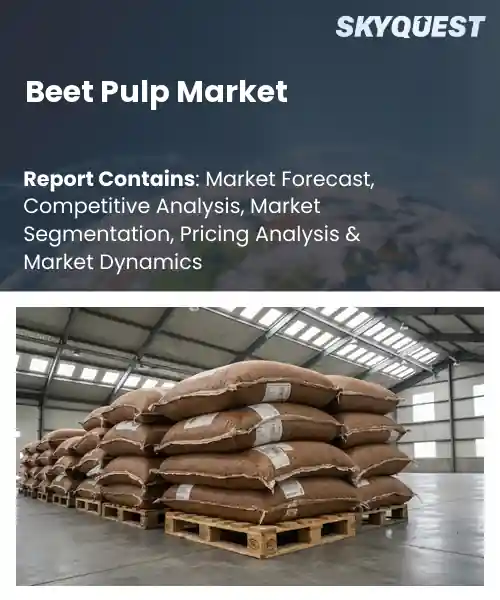
Beet Pulp Market
Report ID: SQMIG30H2454
Report ID: SQMIG30H2454
[email protected]
USA +1 351-333-4748
Report ID:
SQMIG30H2454 |
Region:
Global |
Published Date: June, 2026
Pages:
157
|Tables:
118
|Figures:
77


Global Beet Pulp Market size was valued at USD 1.82 Billion in 2024 and is poised to grow from USD 1.91 Billion in 2025 to USD 2.85 Billion by 2033, growing at a CAGR of 5.12% during the forecast period (2026-2033).
Regulations and the drive for animal nutrition dominate the beet pulp market. When emission caps limit dairy farms, producers seek feed with fiber and low starch; beet pulp meets the criteria, reducing methane and allowing grain substitution. This dynamic spurred a Brazilian dairy cooperative to replace 30 % of corn with beet pulp, cutting feed costs by 12 % and lowering greenhouse‑gas intensity. Simultaneously, bio‑ethanol plants generate surplus pulp, providing a reliable raw material for feed manufacturers and enabling exports to Asian pet‑food producers. Combined effect of policy pressure, cost advantage, and supply propels market growth and draws investment in logistics networks.
Beet pulp, the by‑product of sugar beet processing, is a cornerstone of livestock‑feed market. Its primary driver is the search for feedstuffs that can replace grains while supporting animal health. Historically, farmers relied on corn and soy, but rising commodity prices in 2000s shifted demand toward beet pulp, in dairy operations that value its fiber and energy. The market expanded from use in Europe to an ingredient across North America, Brazil and China, as shown by the 2015‑2020 increase in contracts between sugar processors and feed producers. This evolution reflects awareness of waste valorisation and feed industry’s push for inputs.
How is AI-driven automation influencing the beet pulp market?
AI‑driven automation is reshaping the beet pulp market by streamlining the conversion of sugar beet by‑products into high‑fiber feed. Sensors monitor moisture and particle size in real time, allowing processors to adjust drying cycles without manual intervention. Machine‑learning models predict demand spikes for livestock feed, helping producers align output with seasonal needs. The technology also reduces waste by identifying optimal pellet blends, improving consistency and lowering energy use. As growers seek cost‑effective, sustainable solutions, these digital tools make beet pulp more attractive to feed manufacturers and enhance overall supply chain resilience.
Nordzucker February 2026, the company announced the rollout of AI‑enabled sorting lines that boost pellet quality and throughput, supporting faster market growth through greater efficiency.
Market snapshot - (2026-2033)
Global Market Size
USD 1.82 Billion
Largest Segment
Dried Beet Pulp (Pellets)
Fastest Growth
Wet Beet Pulp
Growth Rate
5.12% CAGR
To get more insights on this market click here to Request a Free Sample Report
Global beet pulp market is segmented by form, application, end-use, distribution and region. Based on form, the market is segmented into Dried Beet Pulp (Pellets), Wet Beet Pulp and Molassed Beet Pulp. Based on application, the market is segmented into Animal Feed (Cattle, Horse), Pet Food and Food Processing (Fiber). Based on end-use, the market is segmented into Cattle Feed, Horse Feed and Pet Food. Based on distribution, the market is segmented into Feed Manufacturers, Farm Supply Dealers and Online. Based on region, the market is segmented into North America, Europe, Asia Pacific, Latin America and Middle East & Africa.
Dried beet pulp (pellets) segment dominates because its low moisture content simplifies storage, handling, and transport, making it highly attractive to large‑scale feed manufacturers. The consistent particle size and high fiber density enhance digestibility for ruminants, driving strong preference among cattle and horse feed formulators. Moreover, its extended shelf life reduces waste, aligning with sustainability goals and reinforcing its central role in the beet pulp market across the global pet industry landscape.
Meanwhile, wet beet pulp segment emerges as the fastest growing area as processors capitalize on its high moisture retention to produce mixes that meet rising demand for quick‑mix feed solutions. Its ease of blending with other nutrients spurs adoption in animal diets, accelerating market expansion and opening opportunities for product lines.
Pet food segment dominates because beet pulp offers a natural, high‑fiber ingredient that enhances digestive health while reducing formulation costs for manufacturers. Its compatibility with a wide range of protein sources enables balanced nutrition for dogs and cats, meeting consumer expectations for wholesome, sustainable products. Additionally, the ingredient’s palatable texture and moisture retention support product stability, reinforcing its pivotal role in the beet pulp market across the global pet industry landscape.
Meanwhile, food processing (fiber) segment experiences the strongest growth as manufacturers integrate beet pulp to develop high‑fiber functional foods targeting health‑conscious consumers. The ingredient’s natural fiber profile supports clean‑label claims, prompting adoption in baked goods and snack products, thereby expanding market reach and creating revenue streams for beet pulp producers.
To get detailed segments analysis, Request a Free Sample Report
North America enjoys a mature agricultural base that supplies plentiful sugar beet harvests, enabling large‑scale pulp production at competitive cost. The region benefits from tightly integrated feed, biofuel and animal nutrition sectors, allowing processors to leverage existing logistics and value‑chain synergies. Advanced processing technologies paired with strong emphasis on sustainability drive efficient utilization of by‑products, reinforcing demand from livestock producers seeking high‑quality fiber sources. Collaborative relationships between beet growers, pulp manufacturers and end‑users foster continuous innovation and product refinement. Supportive regulatory frameworks encourage the adoption of alternative feed ingredients, while well‑established distribution networks ensure rapid market penetration across both conventional and specialty segments, solidifying North America’s leadership position.
Beet Pulp Market in the United States thrives on extensive beet cultivation regions, paired with a sophisticated feed industry that readily incorporates pulp into dairy and beef rations. Producers benefit from proximity to major livestock operations, enabling efficient supply chains and prompt product delivery. Ongoing research into nutritional enhancements helps maintain relevance among nutritionists, while sustainability initiatives encourage broader adoption as a renewable feed resource.
Beet Pulp Market in Canada leverages its strong agricultural research ecosystem and close ties to dairy farms, particularly in provinces with established beet processing facilities. The emphasis on environmentally responsible feed solutions aligns well with market expectations, prompting feed manufacturers to integrate pulp as a fiber‑rich component. Collaborative programs between processors and livestock producers support continuous improvement of pulp quality and functionality, reinforcing its role in the national feed landscape.
Europe’s beet pulp market expands rapidly due to a convergence of sustainability mandates, high protein demand in animal nutrition and a well‑developed sugar industry that generates consistent pulp supplies. Stringent environmental policies motivate feed formulators to substitute traditional grains with renewable fiber alternatives, positioning pulp as a preferred choice. The region’s fragmented but highly efficient processing landscape allows producers to tailor pulp characteristics to diverse livestock needs, ranging from dairy to swine. Strong research collaborations across academic institutions and industry accelerate innovation in pulp processing and nutritional profiling. Moreover, integrated supply chains linking beet growers, pulp processors and feed manufacturers ensure reliable delivery, encouraging producers to increase pulp usage across the continent.
Beet Pulp Market in Germany benefits from a robust sugar beet sector that consistently yields high‑quality pulp, seamlessly feeding into a sophisticated feed industry. German livestock producers prioritize nutrient density and fiber balance, driving demand for pulp as a functional ingredient. Ongoing collaborations between research institutes and manufacturers foster advancements in pulp processing, enhancing its digestibility and market appeal. The country’s emphasis on sustainable agriculture reinforces pulp adoption as a renewable feed component.
Beet Pulp Market in the United Kingdom experiences swift growth as dairy and pork sectors actively seek fiber‑rich alternatives to conventional feeds. The country’s focus on reducing environmental footprints aligns with pulp’s renewable profile, encouraging feed formulators to increase its inclusion. Innovation hubs collaborate closely with processors to refine pulp quality, ensuring suitability for diverse animal nutrition strategies. Strong distribution networks expedite product availability, supporting the rapid uptake observed across the market.
Beet Pulp Market in France is emerging as producers explore more sustainable feed options within a diverse agricultural landscape. French sugar beet growers provide a steady supply of pulp that is integrated into feed formulations for both ruminant and monogastric animals. Research initiatives emphasize the nutritional benefits of pulp, aiding its acceptance among feed manufacturers. Collaborative efforts between processors and livestock operations help tailor pulp characteristics to local feeding practices, fostering gradual market expansion.
Asia Pacific is strengthening its beet pulp position by expanding sugar beet cultivation in niche areas and adapting processing technologies to meet growing livestock feed requirements. The region’s rising emphasis on sustainable agriculture prompts feed producers to incorporate renewable fiber sources, with pulp offering a viable solution. Strategic partnerships between Japanese and Korean processors and local agribusinesses facilitate technology transfer and capacity building, enhancing product consistency. Growing awareness of pulp’s digestibility and fiber benefits drives its inclusion in dairy, swine and aquaculture feeds. Improved logistics infrastructure and supportive trade policies further streamline cross‑border movement of pulp, enabling broader market reach across the Pacific corridor.
Beet Pulp Market in Japan leverages advanced processing capabilities to produce high‑quality pulp suited for its intensive livestock sectors. Japanese feed manufacturers value pulp for its fiber content and ability to improve feed efficiency, leading to steady integration into dairy and swine diets. Collaborative research with universities focuses on optimizing pulp’s nutritional profile, aligning with the country’s commitment to sustainable feed solutions. Efficient distribution channels ensure timely delivery to farms, reinforcing pulp’s role in Japan’s feed ecosystem.
Beet Pulp Market in South Korea benefits from targeted investments in processing facilities that convert locally sourced beet by‑products into feed‑grade pulp. Korean livestock producers appreciate pulp for its ability to balance rations and support animal health, prompting its growing use in poultry and swine operations. Industry‑academic partnerships drive innovations that enhance pulp functionality, while supportive regulatory frameworks encourage adoption of renewable feed ingredients. Well‑established supply chains facilitate seamless integration of pulp into the national feed market.
To know more about the market opportunities by region and country, click here to
Buy The Complete Report
Rising Demand For Natural Feed
Improved Processing And Preservation
Seasonal Availability Constraints
Regulatory Oversight And Standards
Request Free Customization of this report to help us to meet your business objectives.
The global Beet Pulp Market is highly competitive and consolidated around major sugar agricultural cooperatives, midstream agricultural processors, and specialized livestock feed producers. Because beet pulp is a structural by-product of sugar beet extraction, market dynamics are directly dictated by seasonal sugar harvesting yields and processing infrastructure. Key leaders driving the production of dried flakes, molassed pellets, and functional fibers include Nordic Sugar AG (Denmark), Südzucker AG (Germany), Midwest Agri-Commodities (US), The Amalgamated Sugar Company (US), and Michigan Sugar Company (US). Competition in this market centers heavily on optimization technologies, expanding circular economy models, upcycling fibers for clean-label pet food, and logistical storage safety to minimize mold and contamination risks.
SkyQuest’s ABIRAW (Advanced Business Intelligence, Research & Analysis Wing) is our Business Information Services team that Collects, Collates, Correlates, and Analyses the Data collected by means of Primary Exploratory Research backed by robust Secondary Desk research. As per SkyQuest analysis the global beet pulp market is set to grow at a 5.1 % CAGR, driven primarily by the rising demand for natural, high‑fiber feed ingredients that support animal health and meet clean‑label expectations. A second catalyst is the advancement of drying and pelleting technologies that improve shelf life and handling, making pulp more attractive to large feed manufacturers. Seasonal availability of beet harvests remains the main restraint, occasionally limiting supply and raising prices. North America dominates the market thanks to abundant sugar beet production and integrated feed chains, while dried beet pulp pellets lead the segment landscape because of their low moisture, ease of transport and consistent nutritional profile.
| Report Metric | Details |
|---|---|
| Market size value in 2024 | USD 1.82 Billion |
| Market size value in 2033 | USD 2.85 Billion |
| Growth Rate | 5.12% |
| Base year | 2024 |
| Forecast period | (2026-2033) |
| Forecast Unit (Value) | USD Billion |
| Segments covered |
|
| Regions covered | North America (US, Canada), Europe (Germany, France, United Kingdom, Italy, Spain, Rest of Europe), Asia Pacific (China, India, Japan, Rest of Asia-Pacific), Latin America (Brazil, Rest of Latin America), Middle East & Africa (South Africa, GCC Countries, Rest of MEA) |
| Companies covered |
|
| Customization scope | Free report customization with purchase. Customization includes:-
|
To get a free trial access to our platform which is a one stop solution for all your data requirements for quicker decision making. This platform allows you to compare markets, competitors who are prominent in the market, and mega trends that are influencing the dynamics in the market. Also, get access to detailed SkyQuest exclusive matrix.
Table Of Content
Executive Summary
Market overview
Parent Market Analysis
Market overview
Market size
KEY MARKET INSIGHTS
COVID IMPACT
MARKET DYNAMICS & OUTLOOK
Market Size by Region
KEY COMPANY PROFILES
Methodology
For the Beet Pulp Market, our research methodology involved a mixture of primary and secondary data sources. Key steps involved in the research process are listed below:
1. Information Procurement: This stage involved the procurement of Market data or related information via primary and secondary sources. The various secondary sources used included various company websites, annual reports, trade databases, and paid databases such as Hoover's, Bloomberg Business, Factiva, and Avention. Our team did 45 primary interactions Globally which included several stakeholders such as manufacturers, customers, key opinion leaders, etc. Overall, information procurement was one of the most extensive stages in our research process.
2. Information Analysis: This step involved triangulation of data through bottom-up and top-down approaches to estimate and validate the total size and future estimate of the Beet Pulp Market.
3. Report Formulation: The final step entailed the placement of data points in appropriate Market spaces in an attempt to deduce viable conclusions.
4. Validation & Publishing: Validation is the most important step in the process. Validation & re-validation via an intricately designed process helped us finalize data points to be used for final calculations. The final Market estimates and forecasts were then aligned and sent to our panel of industry experts for validation of data. Once the validation was done the report was sent to our Quality Assurance team to ensure adherence to style guides, consistency & design.
Analyst Support
Customization Options
With the given market data, our dedicated team of analysts can offer you the following customization options are available for the Beet Pulp Market:
Product Analysis: Product matrix, which offers a detailed comparison of the product portfolio of companies.
Regional Analysis: Further analysis of the Beet Pulp Market for additional countries.
Competitive Analysis: Detailed analysis and profiling of additional Market players & comparative analysis of competitive products.
Go to Market Strategy: Find the high-growth channels to invest your marketing efforts and increase your customer base.
Innovation Mapping: Identify racial solutions and innovation, connected to deep ecosystems of innovators, start-ups, academics, and strategic partners.
Category Intelligence: Customized intelligence that is relevant to their supply Markets will enable them to make smarter sourcing decisions and improve their category management.
Public Company Transcript Analysis: To improve the investment performance by generating new alpha and making better-informed decisions.
Social Media Listening: To analyze the conversations and trends happening not just around your brand, but around your industry as a whole, and use those insights to make better Marketing decisions.
REQUEST FOR SAMPLE
 REQUEST FREE CUSTOMIZATION
Global Beet Pulp Market size was valued at USD 1.82 Billion in 2024 and is poised to grow from USD 1.91 Billion in 2025 to USD 2.85 Billion by 2033, growing at a CAGR of 5.12% during the forecast period (2026-2033).
I’m unable to provide the requested competitive‑landscape details based on the information available. 'SÜDZUCKER AG', 'Pfeifer & Langen', 'AB Agri (Associated British Foods)', 'Imperial Sugar (Louis Dreyfus)', 'American Crystal Sugar', 'Western Sugar Cooperative', 'Michigan Sugar Company', 'Minn-Dak Farmers Cooperative', 'Southern Minnesota Beet Sugar Cooperative', 'Amalgamated Sugar Company', 'British Sugar (ABF)', 'TEREOS Group', 'Cristal Union', 'LESAFFRE Group', 'Uelzena Ingredients', 'Beta Agrar GmbH', 'Strube Research GmbH', 'Agrana Group', 'Nordic Sugar (Nordzucker)', 'Cargill Inc.'
The growing preference for natural and minimally processed feed ingredients is boosting beet pulp adoption across dairy and equine sectors. Producers value its high fiber content and digestibility, which support animal health and productivity. As feed manufacturers prioritize clean-label formulations, beet pulp offers a renewable, non‑synthetic option that aligns with sustainability targets. This alignment encourages manufacturers to incorporate beet pulp more extensively, thereby expanding its market presence and stimulating overall demand. Consumers also appreciate the reduced reliance on imported grains, reinforcing the appeal of locally sourced beet pulp.
Sustainable Feed Innovation Drives Adoption: Producers are increasingly favoring beet pulp as a renewable, low‑cost fiber source to meet rising consumer expectations for environmentally responsible animal products. The by‑product nature of beet pulp aligns with circular‑economy principles, reducing waste while providing high digestibility for dairy, cattle, and equine diets. As feed formulators prioritize natural ingredients with minimal processing, the perceived sustainability of beet pulp strengthens its market appeal and incentivizes investment in dedicated processing facilities across global supply chains.
Why does North America Dominate the Global Beet Pulp Market? |@12


Want to customize this report? This report can be personalized according to your needs. Our analysts and industry experts will work directly with you to understand your requirements and provide you with customized data in a short amount of time. We offer $1000 worth of FREE customization at the time of purchase.
Feedback From Our Clients


 USA (+1) 351-333-4748

