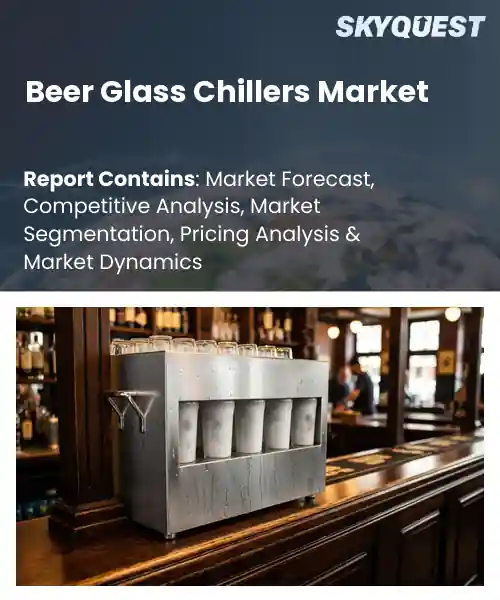
Beer Glass Chillers Market
Report ID: SQMIG30C2208
Report ID: SQMIG30C2208
[email protected]
USA +1 351-333-4748
Report ID:
SQMIG30C2208 |
Region:
Global |
Published Date: June, 2026
Pages:
157
|Tables:
176
|Figures:
79


Global Beer Glass Chillers Market size was valued at USD 2.55 Billion in 2024 and is poised to grow from USD 2.68 Billion in 2025 to USD 3.99 Billion by 2033, growing at a CAGR of 5.1% during the forecast period (2026-2033).
The global beer glass chiller market comprises of devices used to hold drinking vessels at temperatures which improve flavour stability and consumer satisfaction. The importance is in the expanding beer culture where both venues and home enthusiasts are looking for experiences that preserve carbonation and aroma. The market began in the early 2000s, when craft breweries popularized the idea of tasting flights and manufacturers began developing electric chillers for bar tops. Over the past ten years, adoption has accelerated in North America and Europe as hospitality chains have installed chilled glass stations as a service differentiator. As a result, the sector has advanced from niche accessories to mainstream hospitality technology.
Smart temperature-control systems that link chillers to IoT platforms are driving global expansion by allowing bars to monitor glass temperature in real time and adjust cooling automatically. This reduces energy waste, but still guarantees the best serving conditions. Last year a European brewery group installed networked chillers in dozens of venues. The technology is a competitive differentiator for craft pubs to adopt, with efficiency gains reducing operating costs. Consumer expectations are shifting toward consistent, immersive experiences and manufacturers are responding with modular designs that fit under existing bar rails, opening up new large revenue streams in global growth retrofit markets around the world.
How is IoT enhancing efficiency in the beer glass chillers market?
IoT is revolutionizing beer glass chillers each chiller is connected to a cloud platform that measures temperature, power consumption and usage data. Managers have dashboards with sensor data that tell them what's going on in real time, and let them trigger alerts when something goes wrong. Predictive algorithms can forecast trends and schedule maintenance before a compressor fails, resulting in less downtime. Operators can remotely control the unit and adjust cooling output to the level of service, saving energy during slow periods. Integration with brewery inventory systems helps to match the output of the chillers to the rate of keg turnover so that there are glasses available when needed. This results in a more consistent drinking experience, lower operating costs and a more seamless flow of service.
The Brewers Association in its March 2026 issue reported on a pilot program using IoT-enabled glass chillers to drive market growth and improve efficiency through energy efficiency and consistent serving temperature.
Market snapshot - (2026-2033)
Global Market Size
USD 2.55 Billion
Largest Segment
Countertop Beer Glass Chillers
Fastest Growth
Frosting & Rapid Chilling Units
Growth Rate
5.1% CAGR
To get more insights on this market click here to Request a Free Sample Report
Global beer glass chillers market is segmented by product type, technology, installation type, end user, capacity, distribution channel and region. Based on product type, the market is segmented into Countertop Beer Glass Chillers, Under-Counter Beer Glass Chillers, Integrated Bar Glass Chillers, Frosting & Rapid Chilling Units and Others. Based on technology, the market is segmented into Refrigeration-Based Chillers, CO₂-Based Glass Chillers, Glycol Cooling Systems and Others. Based on installation type, the market is segmented into Freestanding and Built-In. Based on end user, the market is segmented into Bars & Pubs, Restaurants, Hotels, Breweries & Taprooms and Others. Based on capacity, the market is segmented into Small Capacity (<50 Glasses), Medium Capacity (50–150 Glasses) and Large Capacity (>150 Glasses). Based on distribution channel, the market is segmented into Direct Sales, Foodservice Equipment Distributors, Online Sales and Others. Based on region, the market is segmented into North America, Europe, Asia Pacific, Latin America and Middle East & Africa.
Countertop Beer Glass Chillers is anticipated to be the leading segment in the market as they can meet the immediate need of cooling in high traffic venues with minimum installation, plug and play simplicity is suitable for fast service operations. Small enough to fit tight spaces on bar tops, their intuitive controls make them easy to learn with less staff training time. Operators love the ROI they get from less glass warming, translating directly into better beverage quality and customer satisfaction, an easy decision for industry players.
Integrated bar glass chillers to see high growth trajectory as establishments seek seamless integration of cooling equipment into custom bar design. Aesthetic focused venues will appreciate the ability to hide refrigeration components behind cabinetry and premium brand users will appreciate the advanced temperature uniformity, helping to drive adoption and dramatically expanding market opportunities.
The CO2 Based Glass Chillers segment is expected to hold the largest market share as it uses the gas expansion process to cool the glasses without direct contact, keeping the temperature constant at a low level. The green approach matches the venues’ sustainability goals, and the absence of liquid refrigerants makes it easier and more attractive to operators who want operational efficiency and green credentials. They are dependable, keeping glasses at the perfect temperature, preserving the flavor of beer and always raising guest satisfaction.
Glycol cooling systems also provide the new hot space, and can scale temperature control for larger inventories of glass without the logistical constraints of gas-based units. Their circulation design helps with thermal management at stations and is appealing for taprooms and breweries seeking speed, driving market expansion and installation projects.
To get detailed segments analysis, Request a Free Sample Report
North America is the leading region in the global Beer Glass Chillers market owing to its matured hospitality sector that focuses on experiential drinking. U.S. and Canadian consumers are increasingly demanding premium presentation, and bar and restaurant adoption of chilled glass solutions is on the rise. The strong distribution channels and close partnerships between the makers and high-end locations help to get the products out quickly. Eco-minded shoppers gravitate toward convenience innovations like reusable and coolant-filled designs. The region also invests heavily in marketing to position chilled glassware as a point of difference for craft breweries and premium beer brands. All these make an ecosystem feeding market leadership.
The United States beer glass chillers market is driven by the on premise culture and the allure of craft breweries and upscale bars. Often operators are attracted by temperature control that enhances flavour perception so often chilled glassware is used. There are designs in progress that support branding efforts and the emphasis on sustainability is drawing attention to reusable chillers. An increase in retail presence and consumer conversation about drinking experiences helps embed chilled glasses into service.
The Canadian beer glass chillers market is a mirror of a hospitality scene that values experience and craftsmanship. Brewers and pubs chill glassware to enhance the beer’s aromatic character, particularly for specialty lagers. Environmentally conscious operators like cooling methods that are easy to use and energy-efficient, suppliers say. Canadian beer festivals, and glass makers, collaborate to raise awareness and encourage adoption across chains. A balanced focus on quality and sustainability will keep the market moving.
The beer glass chillers market in Europe is anticipated to witness a fast growth driven by a sophisticated drinking culture demanding visual appeal and temperature accuracy. The chilled glassware is winning acceptance with consumers across the continent who are associating premium quality with the product and bars and restaurants are beginning to embrace the technology. As demand for craft beer grows, there’s increased interest in new serving solutions that can increase aroma and clarity. Increasing environmental awareness and government regulation to reduce waste is driving demand for reusable chillers over disposable chillers. Glass makers and small breweries collaborate on design projects, creating looks that fit local tastes. With well-established supply chains, chillers are being delivered quickly to venues in the city and hospitality operators are using digital storytelling to tell the story of the sensory benefits of chilled glassware. The integrated approach adds to the perception of value for the consumers and hastens the penetration of the market.
Germany’s beer glass chillers market thrives on a rich brewing tradition and a focus on refinement. The finer points of flavour are unlocked by temperature control and chilled glass solutions are de rigueur for premium beer outlets. The manufacturers are touting quality materials and tight tolerance precise cooling performance. Sustainability programs and consumer demand for green options drive reuse. Robust market activity with heritage, precision engineering & conscience.
The Beer Glass Chillers Market in UK is driven by a pub culture which looks to improve the drinking experience. Bars serve craft ales and imports in chilled glassware, highlighting the visual and tactile experience of drinking from a cold glass. The integration is easy and the operation is energy efficient which is attractive to venue owners who want control. The consumer’s curiosity with sensory detail drives experimentation that spreads among establishments quickly.
The Beer Glass Chillers market is booming in France, as consumers look for presentation as well as gastronomy. Restaurants and wine bars take the craft beer experience a step further by pouring the beer into pre-chilled glassware to enhance the flavors of the beer. They appeal to the sleek design and the use of recyclable materials that meet French standards for sustainability. Collaborative projects with local breweries result in cool solutions catching local tastes. Slow market adoption is being driven by a combination of culinary pride and environmentalism.
The Beer Glass Chillers market is expanding its footprint in the Asia Pacific owing to a blend of cultural fervor for sophisticated drinking experiences and rapid absorption of cutting-edge service technology. More venues in cities across the region are realizing that temperature control is a quality measure for their craft beers and are beginning to use chilled glassware. In response to rising environmental concerns, manufacturers are returning with compact models that run in tight bar space and energy-efficient cooling. Local brewers and glass makers are working together to create products that are more appealing to the consumer and culturally relevant. Additionally, the hospitality and tourism driven excellence in the region is creating demand for chilled glass solutions which is further adding to the growth trajectory of the market. Retail channels are also branching out to include kits of chilled glassware for home consumers seeking a bar-like experience.
Japan’s beer glass chiller market is a good example of hospitality as a temperature-driven business. You really taste the subtle flavors of craft lagers and imported beers best in a cold glass, at a bar or izakaya. Suppliers favour small cooling methods, in keeping with the spirit of limited counter space. Environmental stewardship is driving the demand for reusable chillers. Consumers expect garbage. Refinement and sustainability are driving the future market growth.
South Korea’s Beer Glass Chillers Market is driven by a scene that values sharing and temperature controlled drinking. Pubs and craft beer bars use chilled glassware to improve aroma and visual appeal, and to position themselves as venues. The producers stress stylish designs that match interior decors and also cool. Growing awareness about environmental impact drives use of reusable chillers rather than single use. It is this blend of passion and sustainability focus that is driving market growth.
To know more about the market opportunities by region and country, click here to
Buy The Complete Report
Increasing Consumer Preference For Chilled Beverages
Rise In Sustainable Packaging Adoption
High Initial Investment Costs
Limited Distribution Channel Reach
Request Free Customization of this report to help us to meet your business objectives.
Craft breweries and equipment makers are adding depth to the competitive landscape with sophisticated cooling technologies. M&A activity of late has matched beverage brands with boutique chiller makers, and partnerships are putting smart temperature controls into glassware. The notable tech innovation, including modular chiller designs and AI‑driven retail platforms, promises faster deployment and energy efficiency, heating up the rivalry for market share in premium on‑premise service.
Our Business Information Services team, ABIRAW (Advanced Business Intelligence, Research & Analysis Wing) gathers, compiles, correlates and analyses the data collected through primary exploratory research supported by strong secondary desk research.
According to SkyQuest’s analysis, the growing consumer demand for consistently chilled beverages is one of the major factors driving the growth of the global beer glass chillers market. This, in turn, pushes bars and restaurants to adopt cooling solutions that improve flavor and guest satisfaction. The second key driver is the growth of sustainable packaging processes that promote the use of reusable chillers instead of single-use ice, adding to the eco-friendly image of venues. The high upfront cost of equipment can be a barrier for smaller venues to invest and this slows the market down. North America remains at the forefront, thanks to its mature hospitality sector, with countertop beer glass chillers leading the segment landscape thanks to their plug-and-play convenience and quick return on investment.
| Report Metric | Details |
|---|---|
| Market size value in 2024 | USD 2.55 Billion |
| Market size value in 2033 | USD 3.99 Billion |
| Growth Rate | 5.1% |
| Base year | 2024 |
| Forecast period | (2026-2033) |
| Forecast Unit (Value) | USD Billion |
| Segments covered |
|
| Regions covered | North America (US, Canada), Europe (Germany, France, United Kingdom, Italy, Spain, Rest of Europe), Asia Pacific (China, India, Japan, Rest of Asia-Pacific), Latin America (Brazil, Rest of Latin America), Middle East & Africa (South Africa, GCC Countries, Rest of MEA) |
| Companies covered |
|
| Customization scope | Free report customization with purchase. Customization includes:-
|
To get a free trial access to our platform which is a one stop solution for all your data requirements for quicker decision making. This platform allows you to compare markets, competitors who are prominent in the market, and mega trends that are influencing the dynamics in the market. Also, get access to detailed SkyQuest exclusive matrix.
Table Of Content
Executive Summary
Market overview
Parent Market Analysis
Market overview
Market size
KEY MARKET INSIGHTS
COVID IMPACT
MARKET DYNAMICS & OUTLOOK
Market Size by Region
KEY COMPANY PROFILES
Methodology
For the Beer Glass Chillers Market, our research methodology involved a mixture of primary and secondary data sources. Key steps involved in the research process are listed below:
1. Information Procurement: This stage involved the procurement of Market data or related information via primary and secondary sources. The various secondary sources used included various company websites, annual reports, trade databases, and paid databases such as Hoover's, Bloomberg Business, Factiva, and Avention. Our team did 45 primary interactions Globally which included several stakeholders such as manufacturers, customers, key opinion leaders, etc. Overall, information procurement was one of the most extensive stages in our research process.
2. Information Analysis: This step involved triangulation of data through bottom-up and top-down approaches to estimate and validate the total size and future estimate of the Beer Glass Chillers Market.
3. Report Formulation: The final step entailed the placement of data points in appropriate Market spaces in an attempt to deduce viable conclusions.
4. Validation & Publishing: Validation is the most important step in the process. Validation & re-validation via an intricately designed process helped us finalize data points to be used for final calculations. The final Market estimates and forecasts were then aligned and sent to our panel of industry experts for validation of data. Once the validation was done the report was sent to our Quality Assurance team to ensure adherence to style guides, consistency & design.
Analyst Support
Customization Options
With the given market data, our dedicated team of analysts can offer you the following customization options are available for the Beer Glass Chillers Market:
Product Analysis: Product matrix, which offers a detailed comparison of the product portfolio of companies.
Regional Analysis: Further analysis of the Beer Glass Chillers Market for additional countries.
Competitive Analysis: Detailed analysis and profiling of additional Market players & comparative analysis of competitive products.
Go to Market Strategy: Find the high-growth channels to invest your marketing efforts and increase your customer base.
Innovation Mapping: Identify racial solutions and innovation, connected to deep ecosystems of innovators, start-ups, academics, and strategic partners.
Category Intelligence: Customized intelligence that is relevant to their supply Markets will enable them to make smarter sourcing decisions and improve their category management.
Public Company Transcript Analysis: To improve the investment performance by generating new alpha and making better-informed decisions.
Social Media Listening: To analyze the conversations and trends happening not just around your brand, but around your industry as a whole, and use those insights to make better Marketing decisions.
REQUEST FOR SAMPLE
 REQUEST FREE CUSTOMIZATION
Global Beer Glass Chillers Market size was valued at USD 2.55 Billion in 2024 and is poised to grow from USD 2.68 Billion in 2025 to USD 3.99 Billion by 2033, growing at a CAGR of 5.1% during the forecast period (2026-2033).
The competitive landscape is shaped by craft breweries and equipment manufacturers racing to integrate advanced cooling technologies, with recent M&A activity linking beverage brands to specialized chiller producers and partnerships that embed smart temperature controls into glassware. Notable tech innovation includes AI‑driven retail platforms and modular chiller designs that promise faster deployment and energy efficiency, intensifying rivalry for market share in premium on‑premise service. 'Perlick Corporation', 'Hoshizaki Corporation', 'True Manufacturing', 'Turbo Air', 'Beverage-Air', 'Follett Products', 'Migali Industries', 'Glastender', 'U-Star Equipment', 'Summit Appliance', 'Williams Refrigeration', 'Fagor Professional', 'Tefcold Group', 'Polar Refrigeration', 'Atosa USA', 'Foster Refrigerator', 'Gamko', 'Vestfrost Solutions', 'ISA S.p.A.', 'Afinox'
The growing desire among beer drinkers for consistently chilled beverages encourages establishments to adopt glass chillers, as these devices maintain optimal temperature throughout service, enhancing perceived beverage quality and customer satisfaction. Consequently, venues perceive chillers as essential tools for enhancing overall guest experience.
Eco‑Friendly Materials Rise: Consumers increasingly prefer sustainable products, prompting manufacturers of beer glass chillers to adopt recycled polymers and biodegradable components. This shift aligns with broader environmental initiatives and regulatory pressures in key markets. Companies that integrate eco‑friendly designs into their product lines benefit from enhanced brand perception and loyalty among environmentally conscious patrons. The trend also drives innovation in material science, leading to lighter, more durable chillers that maintain temperature performance while reducing carbon footprints across supply chains for future growth strategically.
Why does North America Dominate the Global Beer Glass Chillers Market? |@12


Want to customize this report? This report can be personalized according to your needs. Our analysts and industry experts will work directly with you to understand your requirements and provide you with customized data in a short amount of time. We offer $1000 worth of FREE customization at the time of purchase.
Feedback From Our Clients


 USA (+1) 351-333-4748

