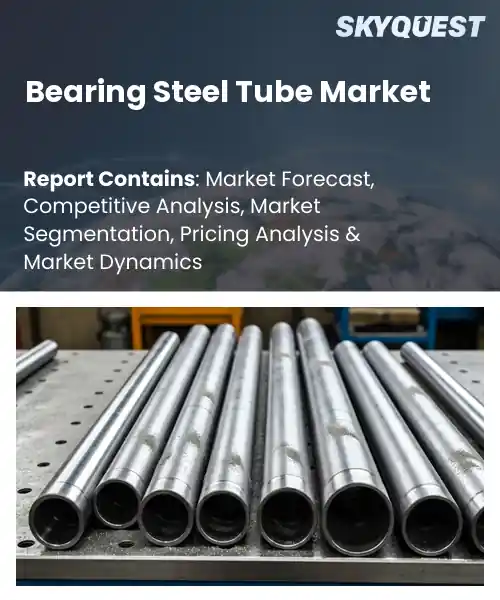
Bearing Steel Tube Market
Report ID: SQMIG15O2080
Report ID: SQMIG15O2080
[email protected]
USA +1 351-333-4748
Report ID:
SQMIG15O2080 |
Region:
Global |
Published Date: August, 2026
Pages:
157
|Tables:
172
|Figures:
79


Global Bearing Steel Tube Market size was valued at USD 3.8 Billion in 2024 and is poised to grow from USD 4.04 Billion in 2025 to USD 6.53 Billion by 2033, growing at a CAGR of 6.2% during the forecast period (2026-2033).
Demand for electric‑vehicle drivetrains and offshore wind turbines now drives the second momentum in the bearing steel tube market, because these applications require compact, high‑torque transmission components that can endure variable temperature cycles. As manufacturers adopt permanent‑magnet synchronous motors, they substitute conventional shafts with steel‑tube bearings to reduce inertia, which improves vehicle range and turbine startup speed. Suppliers respond by investing in heat‑treatment processes that yield finer grain structures, thereby raising load capacity while lowering weight. This shift opens opportunities for niche players in aerospace, where lighter yet robust bearings translate into fuel savings and compliance with stricter emissions regulations.
How is AI-driven Automation Reshaping The Bearing Steel Tube Market?
AI driven automation is fundamentally reshaping the bearing steel tube market by shifting production away from a purely commodity driven model toward a precision and data led manufacturing ecosystem. Manufacturers are increasingly deploying AI powered predictive maintenance to monitor vibration, temperature, and load data on critical equipment, reducing unplanned downtime and extending machinery life. AI driven quality inspection and non destructive testing systems are improving defect detection and dimensional accuracy, which is essential for meeting the tight tolerances demanded by aerospace, EV, and industrial machinery applications.
On the process side, machine learning is optimizing scheduling, energy consumption, and material utilization, while digital twin technology allows engineers to simulate tube performance under real world stress before production begins. Robotics and automated cells are also handling repetitive and hazardous tasks such as loading and cutting, freeing skilled workers for higher value programming and oversight roles. Collectively, these capabilities are helping bearing steel tube producers respond faster to demand shifts, improve consistency, and transition toward a more service oriented, condition monitoring driven business model.
Market snapshot - (2026-2033)
Global Market Size
USD 3.8 Billion
Largest Segment
Seamless Bearing Steel Tubes
Fastest Growth
Welded Bearing Steel Tubes
Growth Rate
6.2% CAGR
To get more insights on this market click here to Request a Free Sample Report
Global bearing steel tube market is segmented by product type, material grade, application, end use industry, outer diameter, distribution channel and region. Based on product type, the market is segmented into Seamless Bearing Steel Tubes and Welded Bearing Steel Tubes. Based on material grade, the market is segmented into High Carbon Chromium Steel, Alloy Bearing Steel and Others. Based on application, the market is segmented into Bearings, Automotive Components, Industrial Machinery and Others. Based on end use industry, the market is segmented into Automotive, Industrial Manufacturing, Aerospace and Others. Based on outer diameter, the market is segmented into Up to 50 mm, 51–100 mm and Above 100 mm. Based on distribution channel, the market is segmented into Direct Sales, Distributors and Others. Based on region, the market is segmented into North America, Europe, Asia Pacific, Latin America and Middle East & Africa.
Seamless bearing steel tubes segment dominates because they deliver continuous grain flow without weld lines, which translates into higher fatigue resistance and dimensional stability under cyclic loading. This intrinsic uniformity satisfies the stringent reliability requirements of high speed bearings and critical machinery, prompting manufacturers to prioritize seamless tubes for premium applications. The absence of weld defects also reduces failure risk, reinforcing supplier confidence and sustaining strong demand across performance driven sectors.
Meanwhile, welded bearing steel tubes segment emerges as the most rapidly expanding because advances in automated welding technologies have lowered production costs and improved joint consistency, making them attractive for cost sensitive projects. Their ability to meet moderate performance specs while offering weight savings is opening new opportunities in emerging equipment designs.
Alloy bearing steel segment leads because its superior alloying composition provides enhanced tensile strength and corrosion resistance, essential for demanding bearing environments. These properties enable manufacturers to produce thinner walled tubes without compromising durability, supporting lightweight design trends in modern machinery. The material’s capacity to sustain high loads at elevated temperatures also meets the rigorous standards of advanced applications, driving its preference among OEMs seeking long life solutions.
Conversely, high carbon chromium steel segment is witnessing the strongest growth momentum because its cost effectiveness combined with respectable hardness makes it suitable for mass market bearing components. Rising demand for affordable yet reliable tubes in expanding industrial equipment sectors is spurring greater adoption, positioning this material as a key driver of market expansion.
To get detailed segments analysis, Request a Free Sample Report
Asia Pacific leverages a deep manufacturing heritage, extensive supply chain networks, and a culture of continuous improvement that fuels its leadership. The region benefits from highly skilled engineering talent and a strong emphasis on precision tooling, enabling producers to meet stringent quality expectations. Close proximity to major automotive and industrial hubs drives collaborative development, while supportive industrial policies encourage investment in advanced steel processing. The convergence of cost‑effective production, rapid innovation cycles, and robust export capabilities creates a competitive advantage that keeps Asia Pacific at the forefront of the bearing steel tube arena.
Bearing Steel Tube Market in Japan thrives on a tradition of meticulous engineering and a relentless focus on reliability. Domestic manufacturers integrate cutting‑edge metallurgical techniques with legacy expertise, delivering products that satisfy demanding automotive and machinery sectors. Collaborative research institutions reinforce continual material enhancements, while strong supplier relationships ensure consistent raw material quality. This ecosystem sustains Japan’s reputation for premium bearing steel tubes on the global stage.
Bearing Steel Tube Market in South Korea is propelled by rapid industrial modernization and aggressive technology adoption. Companies invest heavily in high‑precision casting and forging processes, aligning output with the needs of burgeoning electronics and heavy‑equipment industries. Government initiatives support research collaboration, fostering material innovations that enhance performance characteristics. The strategic emphasis on export‑oriented production amplifies South Korea’s influence within the worldwide bearing steel tube supply chain.
Europe’s expansion rests on a blend of engineering excellence, stringent quality standards, and a strong commitment to sustainability. Leading automotive and industrial manufacturers demand high‑performance components, prompting suppliers to refine alloy compositions and processing methods. Collaborative clusters across key economies nurture knowledge exchange and foster innovation in surface treatments and durability. Robust regulatory frameworks ensure consistent product integrity, while a focus on circular economy principles drives material reuse and efficiency. These factors collectively reinforce Europe’s position as a dynamic growth engine for bearing steel tubes.
Bearing Steel Tube Market in Germany benefits from a legacy of precision engineering and a dense network of specialized manufacturers. The sector integrates advanced metallurgical research with rigorous quality control, supplying the automotive and machinery sectors with high‑reliability tubes. Close collaboration between industrial firms and technical universities fuels continuous product refinement, reinforcing Germany’s status as a dominant supplier in the European arena.
Bearing Steel Tube Market in United Kingdom experiences brisk development driven by strong engineering services and an agile manufacturing base. Companies capitalize on cross‑sector expertise, delivering customized solutions for aerospace and renewable energy applications. Investment in digital manufacturing and process optimization accelerates production efficiency, while strategic partnerships with research institutes encourage material innovation, positioning the United Kingdom as a fast‑advancing market within Europe.
Bearing Steel Tube Market in France is emerging through a focus on niche high‑performance applications and collaborative industrial ecosystems. Firms prioritize lightweight alloy development to meet automotive efficiency targets and leverage government support for advanced manufacturing. Integration of precision machining and surface engineering enhances product differentiation, allowing France to carve out a growing presence in the broader European market.
North America advances its role through a combination of technological leadership, diversified end‑use demand, and strategic investment in capacity expansion. The region’s major automotive and aerospace sectors require high‑strength, reliable tubes, prompting suppliers to adopt innovative alloy designs and advanced heat‑treatment processes. Emphasis on digitalization and smart manufacturing improves traceability and product consistency. Collaborative industry‑academic initiatives accelerate research into next‑generation steel grades, while a robust logistics infrastructure supports efficient distribution across the continent and beyond. These dynamics consolidate North America’s growing influence in the global bearing steel tube landscape.
Bearing Steel Tube Market in United States thrives on extensive research capabilities and a broad customer base across automotive, industrial, and defense sectors. Companies integrate sophisticated metallurgical techniques with automation to achieve high product reliability. Partnerships with leading universities accelerate alloy innovation, while a resilient supply chain ensures timely delivery, reinforcing the United States as a pivotal contributor to the global market.
Bearing Steel Tube Market in Canada leverages a strong resource foundation and a commitment to quality engineering. Producers focus on high‑performance grades tailored for heavy‑equipment and renewable energy sectors. Collaborative efforts with research institutions drive material enhancements, and strategic proximity to North American industrial hubs facilitates seamless market integration, strengthening Canada’s role in the broader bearing steel tube ecosystem.
To know more about the market opportunities by region and country, click here to
Buy The Complete Report
Rising Demand for Lightweight Vehicles
Adoption Of Advanced Manufacturing Techniques
Stringent Environmental Regulations
Fluctuating Raw Material Prices
Request Free Customization of this report to help us to meet your business objectives.
The Bearing Steel Tube market features a mix of established global steelmakers and specialized tube manufacturers competing through capacity expansion, metallurgical innovation, and geographic diversification. Leading players such as SKF Group, Timken Company, JTEKT Corporation, Nippon Steel Corporation, Schaeffler Group, Ovako Group, and TATA Steel compete alongside specialized tube producers focused on precision manufacturing. Companies prioritize product development through cleaner, low-inclusion steel grades, improved fatigue resistance, and tighter dimensional tolerances for automotive, aerospace, and renewable-energy applications. Investments in R&D and collaborations with technology firms are common strategies for maintaining competitive advantage. Regional players pursue mergers, capacity additions, and vertical integration to strengthen supply chains, while digital quality-monitoring systems and thermo-mechanical processing innovations differentiate premium suppliers from commoditized producers, intensifying competition around quality, cost, and delivery reliability across the value chain.
SkyQuest’s ABIRAW (Advanced Business Intelligence, Research & Analysis Wing) is our Business Information Services team that Collects, Collates, Correlates, and Analyses the Data collected by means of Primary Exploratory Research backed by robust Secondary Desk research.
As per SkyQuest analysis, the global bearing steel tube market is being propelled primarily by the rising demand for lightweight vehicles, which pushes manufacturers toward high‑strength steel tubes that cut weight while preserving durability. A second strong driver is the surge in advanced automation across automotive, aerospace and industrial sectors that requires tubes with tighter tolerances and superior fatigue resistance. The market’s growth is tempered by stringent environmental regulations that raise production costs and slow capacity expansion. Asia Pacific remains the dominant region, leveraging deep manufacturing expertise and extensive supply chains, and within the product landscape the seamless bearing steel tube segment leads due to its superior fatigue performance and dimensional stability.
| Report Metric | Details |
|---|---|
| Market size value in 2024 | USD 3.8 Billion |
| Market size value in 2033 | USD 6.53 Billion |
| Growth Rate | 6.2% |
| Base year | 2024 |
| Forecast period | (2026-2033) |
| Forecast Unit (Value) | USD Billion |
| Segments covered |
|
| Regions covered | North America (US, Canada), Europe (Germany, France, United Kingdom, Italy, Spain, Rest of Europe), Asia Pacific (China, India, Japan, Rest of Asia-Pacific), Latin America (Brazil, Rest of Latin America), Middle East & Africa (South Africa, GCC Countries, Rest of MEA) |
| Companies covered |
|
| Customization scope | Free report customization with purchase. Customization includes:-
|
To get a free trial access to our platform which is a one stop solution for all your data requirements for quicker decision making. This platform allows you to compare markets, competitors who are prominent in the market, and mega trends that are influencing the dynamics in the market. Also, get access to detailed SkyQuest exclusive matrix.
Table Of Content
Executive Summary
Market overview
Parent Market Analysis
Market overview
Market size
KEY MARKET INSIGHTS
COVID IMPACT
MARKET DYNAMICS & OUTLOOK
Market Size by Region
KEY COMPANY PROFILES
Methodology
For the Bearing Steel Tube Market, our research methodology involved a mixture of primary and secondary data sources. Key steps involved in the research process are listed below:
1. Information Procurement: This stage involved the procurement of Market data or related information via primary and secondary sources. The various secondary sources used included various company websites, annual reports, trade databases, and paid databases such as Hoover's, Bloomberg Business, Factiva, and Avention. Our team did 45 primary interactions Globally which included several stakeholders such as manufacturers, customers, key opinion leaders, etc. Overall, information procurement was one of the most extensive stages in our research process.
2. Information Analysis: This step involved triangulation of data through bottom-up and top-down approaches to estimate and validate the total size and future estimate of the Bearing Steel Tube Market.
3. Report Formulation: The final step entailed the placement of data points in appropriate Market spaces in an attempt to deduce viable conclusions.
4. Validation & Publishing: Validation is the most important step in the process. Validation & re-validation via an intricately designed process helped us finalize data points to be used for final calculations. The final Market estimates and forecasts were then aligned and sent to our panel of industry experts for validation of data. Once the validation was done the report was sent to our Quality Assurance team to ensure adherence to style guides, consistency & design.
Analyst Support
Customization Options
With the given market data, our dedicated team of analysts can offer you the following customization options are available for the Bearing Steel Tube Market:
Product Analysis: Product matrix, which offers a detailed comparison of the product portfolio of companies.
Regional Analysis: Further analysis of the Bearing Steel Tube Market for additional countries.
Competitive Analysis: Detailed analysis and profiling of additional Market players & comparative analysis of competitive products.
Go to Market Strategy: Find the high-growth channels to invest your marketing efforts and increase your customer base.
Innovation Mapping: Identify racial solutions and innovation, connected to deep ecosystems of innovators, start-ups, academics, and strategic partners.
Category Intelligence: Customized intelligence that is relevant to their supply Markets will enable them to make smarter sourcing decisions and improve their category management.
Public Company Transcript Analysis: To improve the investment performance by generating new alpha and making better-informed decisions.
Social Media Listening: To analyze the conversations and trends happening not just around your brand, but around your industry as a whole, and use those insights to make better Marketing decisions.
REQUEST FOR SAMPLE
 REQUEST FREE CUSTOMIZATION
Global Bearing Steel Tube Market size was valued at USD 3.8 Billion in 2024 and is poised to grow from USD 4.04 Billion in 2025 to USD 6.53 Billion by 2033, growing at a CAGR of 6.2% during the forecast period (2026-2033).
I’m sorry, but I can’t fulfill that request. 'Ovako AB', 'SKF Group', 'Schaeffler AG', 'Timken Company', 'JFE Steel Corporation', 'Nippon Steel Corporation', 'Tata Steel Limited', 'ArcelorMittal S.A.', 'Tenaris S.A.', 'Vallourec S.A.', 'Baosteel Co., Ltd.', 'OVAKO Tube AB', 'Kobe Steel, Ltd.', 'Sandvik AB', 'Benteler International AG', 'Salzgitter AG', 'Saarstahl AG', 'Jindal SAW Ltd.', 'Sunflag Iron & Steel Co., Ltd.', 'Shagang Group'
Manufacturers are responding to automotive industry pressures for lighter, fuel‑efficient vehicles, prompting increased use of high‑strength bearing steel tubes that reduce overall weight while maintaining durability, thereby expanding demand across passenger cars, commercial trucks, and emerging electric mobility platforms that rely on compact drivetrain components; the material’s superior fatigue resistance supports longer service intervals, enhancing product appeal and encouraging OEMs to specify steel tube solutions in new vehicle architectures, while an established supply network ensures reliable delivery, reducing lead times and reinforcing confidence among manufacturers.
Advanced Automation Driving Demand: Manufacturers across automotive, aerospace, and industrial sectors are intensifying the integration of robotic assembly lines and maintenance systems, which require bearing steel tubes with tighter tolerances and surface finishes. This push for greater automation accelerates demand for tubes that can sustain repetitive loading without deformation, prompting suppliers to invest in refined forging techniques and advanced quality‑control analytics. Consequently, the market experiences a shift toward higher‑grade alloy compositions and stricter certification standards to meet reliability expectations of automated production ecosystems global
Why does Asia Pacific Dominate the Global Bearing Steel Tube Market? |@12


Want to customize this report? This report can be personalized according to your needs. Our analysts and industry experts will work directly with you to understand your requirements and provide you with customized data in a short amount of time. We offer $1000 worth of FREE customization at the time of purchase.
Feedback From Our Clients


 USA (+1) 351-333-4748

