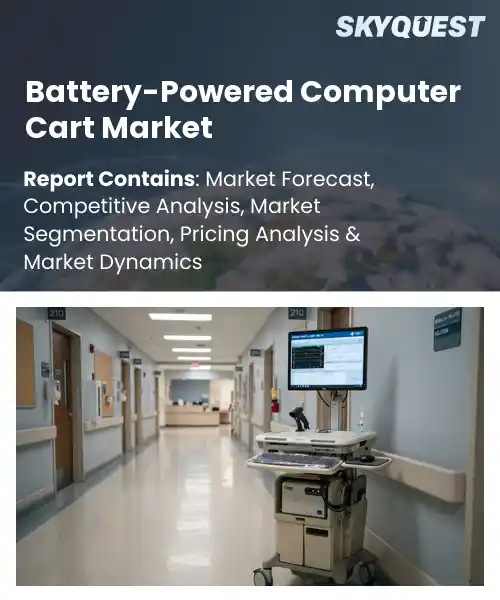
Battery-Powered Computer Cart Market
Report ID: SQMIG35A4406
Report ID: SQMIG35A4406
[email protected]
USA +1 351-333-4748
Report ID:
SQMIG35A4406 |
Region:
Global |
Published Date: August, 2026
Pages:
157
|Tables:
154
|Figures:
78


Global Battery-Powered Computer Cart Market size was valued at USD 1.64 Billion in 2024 and is poised to grow from USD 1.78 Billion in 2025 to USD 3.48 Billion by 2033, growing at a CAGR of 8.7% during the forecast period (2026-2033).
The global battery‑powered computer cart market consists of workstations mounted on wheeled frames, equipped with rechargeable power packs that eliminate reliance on fixed outlets. Its relevance stems from the need for flexible, on‑site computing in sectors such as healthcare, education, and field services where power constraints limit traditional desktops. Originating in the early 2000s as a niche solution for hospitals seeking sterile, movable documentation stations, the segment expanded rapidly as lithium‑ion technology reduced weight and extended runtime. By 2020 manufacturers introduced modular designs that integrate touchscreen displays and wireless connectivity, turning carts into hubs that adapt to evolving workflow demands. Demand for uninterrupted data access in critical settings drives market growth because organizations value operational continuity over reliance on fixed outlets. When hospitals adopt electronic health records, battery‑powered carts let clinicians capture patient information at the bedside, cutting charting errors and speeding discharge. Universities use similar carts during lab rotations, enabling students to run simulations despite occasional power interruptions. These applications push manufacturers to develop faster‑charging cells and remote‑monitoring platforms, which reduce total cost of ownership and create openings in emerging markets where power reliability is limited and support compliance with data‑security regulations, while also allowing software updates across workstations.
How is AI and IoT integration influencing the battery-powered computer cart market?
AI and IoT are turning battery‑powered computer carts into smart workstations that anticipate clinician needs. Sensors collect usage patterns, while AI algorithms prioritize tasks, streamline data entry and trigger predictive maintenance alerts. IoT connectivity links carts to electronic health records, allowing seamless patient information updates and real‑time location tracking across facilities. This convergence reduces downtime, improves workflow efficiency and supports a more responsive care environment. Hospitals are adopting these intelligent carts to enhance staff productivity and to meet growing expectations for rapid, data‑driven decision making.Hill‑Rom announced an AI‑integrated, IoT‑enabled cart in March 2024, demonstrating how real‑time analytics and remote diagnostics can extend battery life and cut service interruptions, reinforcing market momentum toward smarter, more reliable cart solutions.
Market snapshot - (2026-2033)
Global Market Size
USD 1.64 Billion
Largest Segment
Mobile Computer Carts
Fastest Growth
Medical Computer Carts
Growth Rate
8.7% CAGR
To get more insights on this market click here to Request a Free Sample Report
Global battery-powered computer cart market is segmented by product type, battery type, application, cart configuration, end user and region. Based on product type, the market is segmented into Mobile Computer Carts, Medical Computer Carts, Laptop Carts, Tablet Carts, Charging Computer Carts and Others. Based on battery type, the market is segmented into Lead-Acid Batteries, Lithium-Ion Batteries and Other Battery Types. Based on application, the market is segmented into Healthcare, Education, Corporate & Commercial, Government, Industrial and Others. Based on cart configuration, the market is segmented into Single-Device Carts, Multi-Device Carts, Adjustable Carts and Specialized Carts. Based on end user, the market is segmented into Hospitals & Healthcare Facilities, Schools & Universities, Corporations, Government Institutions, Industrial Facilities and Others. Based on region, the market is segmented into North America, Europe, Asia Pacific, Latin America and Middle East & Africa.
Lithium Ion Batteries segment dominates because its superior energy density and low maintenance needs align perfectly with the mobile nature of battery powered computer carts. The technology’s rapid charge capability reduces downtime while its lighter weight enables designers to create more ergonomic carts. These advantages address key user priorities such as reliability, portability and total cost of ownership, driving widespread preference across healthcare, education and corporate environments throughout global markets.
However, Lead Acid Batteries segment is witnessing the strongest growth momentum as manufacturers improve cycle life and introduce sealed designs that meet safety standards. This evolution expands suitability for budget conscious institutions and remote facilities, stimulating new adoption and widening the overall market’s addressable base future opportunity potential for growth.
Medical Computer Carts segment dominates because they integrate specialized hardware and antimicrobial surfaces that meet stringent clinical standards. Their design supports bedside charting, imaging and medication verification, which aligns with the workflow needs of modern health facilities. This strong fit drives preference among healthcare providers seeking reliable, mobile solutions that improve patient safety and operational efficiency. Additionally, manufacturers embed seamless EMR connectivity and intuitive user interfaces, reducing training time and ensuring compliance with documentation protocols.
On the other hand, Tablet Carts segment is emerging as the key high growth area as educational institutions adopt interactive learning tools. The lightweight form factor and touch screen capabilities enable flexible classroom configurations, prompting rapid procurement cycles. This surge expands the overall market and creates new avenues for accessory and software ecosystem development.
To get detailed segments analysis, Request a Free Sample Report
Asia Pacific leads the market because of strong manufacturing ecosystems, deep integration of mobile computing in education and health sectors, and aggressive adoption of ergonomic solutions. The region benefits from extensive R&D capabilities that drive innovative battery technologies and lightweight cart designs. High demand from hospitals, clinics, and laboratories aligns with government initiatives supporting digital transformation and patient mobility. Robust supply chains and proximity to component suppliers reduce lead times, allowing rapid rollout of new models. In addition, cultural emphasis on space efficiency in dense urban environments fuels preference for mobile workstations that combine power and portability, reinforcing the region’s leadership.
Battery-Powered Computer Cart Market in Japan is shaped by a mature healthcare infrastructure that prioritizes patient mobility and infection control. Hospitals and clinics value the modular design that integrates seamlessly with advanced imaging equipment. Local manufacturers focus on precision engineering, delivering carts with high reliability and compact footprints suited to space‑constrained facilities. Continuous collaboration between device vendors and medical institutions drives iterative improvements tailored to Japanese clinical workflows and outcomes.
Battery-Powered Computer Cart Market in South Korea benefits from strong governmental support for digital health initiatives and a high adoption rate of mobile medical technologies. Leading electronics firms leverage their expertise in battery management to produce carts that deliver extended runtime and robust performance. The market is responsive to demand from large teaching hospitals that require flexible, sterilizable workstations, fostering a culture of continuous innovation and rapid product iteration globally.
North America experiences rapid expansion due to a convergence of clinical demand for mobility, strong emphasis on patient safety, and a vibrant ecosystem of technology providers. Health systems across the United States and Canada prioritize flexible workstations that can be quickly repositioned to support bedside care and diagnostic procedures. Robust funding mechanisms enable hospitals to invest in advanced cart solutions that integrate with electronic health records and imaging platforms. The presence of leading component manufacturers and a culture of innovation accelerate the development of carts with sophisticated battery management and ergonomic features. Moreover, regulatory frameworks encourage adoption of equipment that enhances infection control and operational efficiency, reinforcing market momentum.
Battery-Powered Computer Cart Market in United States is driven by hospital networks that demand scalable, interoperable solutions for bedside diagnostics. Manufacturers focus on integrating advanced battery technologies that ensure long operational periods and rapid charging cycles. The market benefits from strong collaboration between cart producers and software vendors to embed clinical decision support tools directly into mobile workstations. Feedback from clinicians promotes iterative design enhancements tailored to the American healthcare environment.
Battery-Powered Computer Cart Market in Canada reflects a health system that emphasizes accessibility across dispersed facilities. Providers seek carts with reliable battery life that can support extended use in remote clinics and long‑term care settings. Integration with electronic health record standards drives demand for workstations that streamline data capture at the bedside. Suppliers respond by offering designs that can be customized to meet diverse clinical requirements while maintaining infection‑control standards.
Europe is strengthening its position through a combination of rigorous regulatory standards, advanced engineering capabilities, and a strong focus on sustainability in healthcare equipment. Market participants leverage the region’s deep expertise in precision manufacturing to produce carts with superior durability and refined ergonomics suitable for high‑volume clinical environments. Health institutions across the continent prioritize solutions that align with infection‑control protocols and integrate seamlessly with evolving digital health platforms. Collaborative research initiatives among universities, technology firms, and medical providers foster continuous innovation, resulting in battery management systems that extend operational time while minimizing environmental impact. The emphasis on value‑based procurement encourages adoption of versatile workstations that can be reconfigured for multiple medical specialties, reinforcing Europe’s growing influence in the global market.
Battery-Powered Computer Cart Market in Germany is characterized by precision engineering and a heritage that translates into robust medical workstations. German manufacturers emphasize testing and compliance with EU safety directives, delivering carts that offer reliable battery endurance and modular flexibility for clinical settings. Healthcare providers value integration of advanced imaging interfaces, enabling bedside diagnostics. Collaboration with research hospitals drives improvements, ensuring the German market remains at the forefront of ergonomic and innovation.
Battery-Powered Computer Cart Market in United Kingdom reflects a healthcare ecosystem that prioritizes patient mobility and efficiency within NHS facilities. British firms develop carts with interchangeable battery modules that support swapping to minimize downtime. Emphasis on ergonomic design aligns with regulatory guidelines promoting staff safety and comfort. Integration with digital health initiatives ensures that carts can feed data into electronic patient records, enhancing clinical decision‑making across diverse care settings.
Battery-Powered Computer Cart Market in France is shaped by an emphasis on innovation and compliance with European medical device regulations. French manufacturers invest in battery chemistry to extend runtime while reducing weight, catering to hospital and clinical applications. Market benefits from collaboration with research institutes that drive integration of diagnostics and connectivity features into workstations. Providers value the ability to customize cart configurations to support workflows and improve care efficiency.
To know more about the market opportunities by region and country, click here to
Buy The Complete Report
Increasing Demand for Mobile Workstations
Advancements In Battery Technology
High Initial Capital Expenditure
Limited Battery Life Under Heavy Loads
Request Free Customization of this report to help us to meet your business objectives.
The competitive landscape is shaped by manufacturers leveraging advanced lithium‑iron‑phosphate battery technology and forming strategic alliances with logistics providers to deliver mobile workstations that combine durability with extended runtime, while rivals pursue acquisitions of niche battery‑system firms to broaden product portfolios and accelerate time‑to‑market.
Top Player’s Company Profile
Recent Developments
SkyQuest’s ABIRAW (Advanced Business Intelligence, Research & Analysis Wing) is our Business Information Services team that Collects, Collates, Correlates, and Analyses the Data collected by means of Primary Exploratory Research backed by robust Secondary Desk research. As per SkyQuest analysis the global battery‑powered computer cart market is being propelled primarily by the rising demand for mobile workstations that allow clinicians and technicians to access critical applications without fixed outlets, while a second important driver is the rapid advancement in lithium‑ion battery technology which delivers longer runtimes and faster charging. The market is currently led by the Asia Pacific region, benefitting from strong manufacturing ecosystems and aggressive digital‑health adoption, and the medical computer cart segment holds the largest share thanks to its antimicrobial designs and seamless EMR integration. However, high initial capital expenditure remains a notable restraint, tempering adoption in budget‑constrained facilities.
| Report Metric | Details |
|---|---|
| Market size value in 2024 | USD 1.64 Billion |
| Market size value in 2033 | USD 3.48 Billion |
| Growth Rate | 8.7% |
| Base year | 2024 |
| Forecast period | (2026-2033) |
| Forecast Unit (Value) | USD Billion |
| Segments covered |
|
| Regions covered | North America (US, Canada), Europe (Germany, France, United Kingdom, Italy, Spain, Rest of Europe), Asia Pacific (China, India, Japan, Rest of Asia-Pacific), Latin America (Brazil, Rest of Latin America), Middle East & Africa (South Africa, GCC Countries, Rest of MEA) |
| Companies covered |
|
| Customization scope | Free report customization with purchase. Customization includes:-
|
To get a free trial access to our platform which is a one stop solution for all your data requirements for quicker decision making. This platform allows you to compare markets, competitors who are prominent in the market, and mega trends that are influencing the dynamics in the market. Also, get access to detailed SkyQuest exclusive matrix.
Table Of Content
Executive Summary
Market overview
Parent Market Analysis
Market overview
Market size
KEY MARKET INSIGHTS
COVID IMPACT
MARKET DYNAMICS & OUTLOOK
Market Size by Region
KEY COMPANY PROFILES
Methodology
For the Battery-Powered Computer Cart Market, our research methodology involved a mixture of primary and secondary data sources. Key steps involved in the research process are listed below:
1. Information Procurement: This stage involved the procurement of Market data or related information via primary and secondary sources. The various secondary sources used included various company websites, annual reports, trade databases, and paid databases such as Hoover's, Bloomberg Business, Factiva, and Avention. Our team did 45 primary interactions Globally which included several stakeholders such as manufacturers, customers, key opinion leaders, etc. Overall, information procurement was one of the most extensive stages in our research process.
2. Information Analysis: This step involved triangulation of data through bottom-up and top-down approaches to estimate and validate the total size and future estimate of the Battery-Powered Computer Cart Market.
3. Report Formulation: The final step entailed the placement of data points in appropriate Market spaces in an attempt to deduce viable conclusions.
4. Validation & Publishing: Validation is the most important step in the process. Validation & re-validation via an intricately designed process helped us finalize data points to be used for final calculations. The final Market estimates and forecasts were then aligned and sent to our panel of industry experts for validation of data. Once the validation was done the report was sent to our Quality Assurance team to ensure adherence to style guides, consistency & design.
Analyst Support
Customization Options
With the given market data, our dedicated team of analysts can offer you the following customization options are available for the Battery-Powered Computer Cart Market:
Product Analysis: Product matrix, which offers a detailed comparison of the product portfolio of companies.
Regional Analysis: Further analysis of the Battery-Powered Computer Cart Market for additional countries.
Competitive Analysis: Detailed analysis and profiling of additional Market players & comparative analysis of competitive products.
Go to Market Strategy: Find the high-growth channels to invest your marketing efforts and increase your customer base.
Innovation Mapping: Identify racial solutions and innovation, connected to deep ecosystems of innovators, start-ups, academics, and strategic partners.
Category Intelligence: Customized intelligence that is relevant to their supply Markets will enable them to make smarter sourcing decisions and improve their category management.
Public Company Transcript Analysis: To improve the investment performance by generating new alpha and making better-informed decisions.
Social Media Listening: To analyze the conversations and trends happening not just around your brand, but around your industry as a whole, and use those insights to make better Marketing decisions.
REQUEST FOR SAMPLE
 REQUEST FREE CUSTOMIZATION


Want to customize this report? This report can be personalized according to your needs. Our analysts and industry experts will work directly with you to understand your requirements and provide you with customized data in a short amount of time. We offer $1000 worth of FREE customization at the time of purchase.
Feedback From Our Clients


 USA (+1) 351-333-4748

