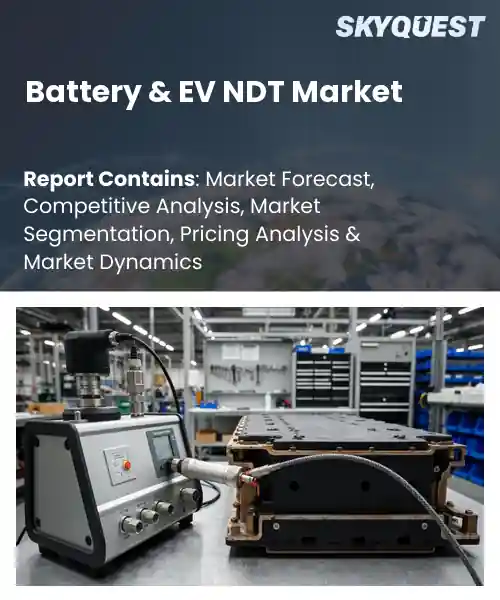
Battery & EV NDT Market
Report ID: SQMIG20D2568
Report ID: SQMIG20D2568
[email protected]
USA +1 351-333-4748
Report ID:
SQMIG20D2568 |
Region:
Global |
Published Date: March, 2026
Pages:
157
|Tables:
95
|Figures:
87


Global Battery & EV NDT Market size was valued at USD 780 Million in 2024 and is poised to grow from USD 930 Million in 2025 to USD 3,880 Million by 2033, growing at a CAGR of 19.5% during the forecast period (2026-2033).
The global battery & EV NDT market strategies focuses on technologies and services that detect defects inside cells, modules, and packs without causing damage. Its primary driver is accelerating electric vehicle adoption together with stricter safety regulations and OEM quality expectations, which increase demand for reliable battery inspection. Inspection evolved from manual visual checks and simple electrical tests to advanced ultrasonic imaging, X-ray computed tomography, and automated in line systems as battery architectures grew more complex and energy dense. Manufacturers, fleet operators, and recyclers rely on these techniques to prevent failures, extend life, and enable safe reuse.
As manufacturers and fleet operators rely on non-destructive testing to prevent failures and enable reuse, investment in automated NDT solutions has accelerated. Higher production volumes force in line ultrasonic and X-ray inspection to reduce defect rates, which lowers warranty costs and shortens time to market. Increased cell energy density, and therefore increased thermal and mechanical risk, leads to more use of thermal imaging and acoustic emission monitoring to determine if thermal runaway is imminent. Increased demand provides opportunities for integrated AI analytics and robotics to analyze the results in real time. In recycling, CT-based sorting will help to recover more materials and create revenue while reducing environmental impact.
How is AI Improving Defect Detection Accuracy in the Battery & EV NDT Market?
AI is improving defect detection accuracy in the battery and EV nondestructive testing market by combining advanced imaging with machine learning. The shift from manual triage to automated analysis of X-ray and CT volumes is being driven by advanced technologies such as remote acoustic and ultrasound signature detection, along with AI-based visual inspection models that recognize standard manufacturing patterns. These innovations enhance efficiency and safety in mass manufacturing by reducing errors, minimizing the need for re-inspection, and improving overall quality assurance. Additionally, AI-augmented imaging techniques for CT scans enable faster identification of suspect cells, helping to accelerate follow-up inspections and improve decision-making accuracy.
In March 2026, XAVIS was recognized for a Dual Inlet 3D CT system that embeds AI based image quality enhancement. This innovation improves detection of subtle internal defects and enables faster inline sorting which supports production scale up and higher quality yields for battery and EV manufacturers.
Market snapshot - (2026-2033)
Global Market Size
USD 0.78 Billion
Largest Segment
Equipment
Fastest Growth
Software
Growth Rate
19.5% CAGR
To get more insights on this market click here to Request a Free Sample Report
Global battery & EV NDT market is segmented by components, testing methods, applications and region. Based on components, the market is segmented into equipment, software and services. Based on testing methods, the market is segmented into ultrasonic testing, radiographic testing, magnetic particle testing, liquid penetrant testing, visual inspection testing, eddy-current testing, acoustic emission testing, thermography testing and computed tomography testing. Based on applications, the market is segmented into battery manufacturing and high voltage systems. Based on region, the market is segmented into North America, Europe, Asia Pacific, Latin America and Middle East & Africa.
Based on the global battery & EV NDT market growth, equipment segment dominates because hardware forms the foundation of Battery & EV NDT workflows, enabling consistent, high throughput inspection across cell and pack assembly. By translating inspection methods into repeatable processes that are factory ready, manufacturers of stronger imaging systems and probe arrays eliminate false negatives and rework. Standardization, compatibility and automation by equipment manufacturers help to drive the adoption of reliable inline NDT by OEMs and tier 1 suppliers who need to maintain production rate and quality assurance.
However, software emerges as the most rapidly expanding area as analytics, AI driven defect recognition, and digital reporting turn raw inspection outputs into actionable quality decisions. Centralized traceability and predictive maintenance are facilitated by cloud-enabled platforms, resulting in unlocked value through the life of both manufacturing and service processes creating opportunities for new innovative subscription models.
Thermography testing segment dominates because non contact infrared inspection provides rapid surface thermal mapping that addresses thermal instability risks inherent to battery cells. Through its ability to identify new and developing 'hot spots' along with anomalous heat patterns, it facilitates early intervention and does not disrupt your production flow. Thermography is preferred by OEMs and service/maintenance personnel for routine screening and after-test verification purposes, thus resulting in thermal inspection being included in quality protocols to reduce fire risk and expensive failures in the field.
However, computed tomography testing emerges as the most rapidly expanding approach as high resolution 3D imaging reveals internal defects, electrode misalignments, and assembly voids that other techniques miss. As a result of this, there is a growing market for both service providers and manufacturers of test and measurement equipment that has the capability of testing the mechanical properties of various products.
To get detailed segments analysis, Request a Free Sample Report
As per the global battery & EV NDT market share, Asia Pacific dominance stems from a concentrated combination of manufacturing scale, integrated supply chains and deep technical expertise across battery value chains. Large regional OEMs and battery manufacturers drive continuous investment in inspection technologies while a dense network of suppliers and specialized NDT equipment providers supports rapid deployment. There is a strong collaboration between manufacturers and researchers, which speeds up the development of specific inspection methods for cells, modules and packs. Solid factory automation and testing infrastructure support established, rapid-volume inspection processes and regional economies of scale make advanced NDT economically viable. Further policy focus on electrification and supportive industrial ecosystems enhances regional leadership, which allows the Asia-Pacific to create standards and bring new inspection methods to market while influencing the global direction of NDT innovation in battery and EV applications.
Battery & EV NDT market in Japan features concentrated capabilities in cell and pack inspection supported by sophisticated automation, precision manufacturing culture and strong ties between OEMs and equipment vendors. To further develop microscopy, imaging, and diagnostic standards for battery safety and quality, researchers working at research facilities and specialists who provide non-destructive testing services work together. The push for reliability domestically has resulted in the rapid implementation of next-generation inspection techniques on production lines, as well as in the validation of components, thereby creating an innovative technology environment.
Battery & EV NDT market in South Korea is anchored by major battery manufacturers and electronics expertise, fostering rapid integration of advanced inspection technologies into production workflows. Robust supplier networks and collaborations between industry and academia will help develop in-line diagnostics to support imaging and predictive maintenance in cell formats. The fact that the emphasis is placed on improving scale, yield and safety embeds Nondestructive Testing (NDT) into quality systems while also helping equipment innovators create local solutions that allow for rapid deployment of equipment throughout the manufacturing clusters.
Based on global battery & EV NDT market regional forecast, Europe rapid expansion is driven by a confluence of regulatory emphasis on safety and environmental performance, concentrated automotive manufacturing and strategic industrial initiatives promoting domestic battery capacity. To ensure cell quality, pack reliability and vehicle safety, regional OEMs and system integrators are putting significant emphasis on developing very rigorous inspection regimes. Thereby resulting in higher levels of demand for more sophisticated non-destructive testing (NDT) service providers and their associated equipment. The development of collaborative relationships across manufacturers, testing laboratories and research institutions allows for increased speed of standardizing inspection methodologies and developing new inspection modalities. Given the increased emphasis on circularity, re-use at the end-of-life, and reuse and recycling; there has been a large increase in the demand for integrated non-destructive testing solutions across the second life and recycling streams of non-destructive evaluation.
Battery & EV NDT market in Germany is anchored by an automotive legacy, extensive supplier networks and testing facilities that support rigorous inspection across cell, module and pack production. OEM requirements for reliability and safety drive adoption of advanced NDT modalities, while specialized equipment manufacturers refine solutions for varied battery formats. Regional collaborations between industry and technical institutes accelerate standard development and best practices, reinforcing Germany role as a validation hub.
Battery & EV NDT market in United Kingdom is emerging through a mix of automotive strengths, equipment suppliers and growing test laboratory networks that support battery validation and aftermarket inspection services. Universities and hubs collaborate with industry to pilot novel imaging and diagnostic approaches, while service providers adapt in-line systems for fleet markets. Emphasis on safety, certification and interoperability positions United Kingdom as a flexible testing market for new inspection modalities.
Battery & EV NDT market in France is growing driven by expanding domestic battery projects, innovation clusters and emphasis on sustainability and circularity. Manufacturers and integrators of French-based inspection equipment are concentrating largely on creating adaptable inspection systems. Additionally, initiatives from different industries are working together to facilitate the commercialization and expanded regional deployment of inspection system technologies across both the manufacturing and recycling value chains.
As per global battery & EV NDT market regional outlook, North America is strengthening its position by aligning advanced manufacturing initiatives, academic research and supplier innovation to deepen capabilities in battery & EV NDT. OEMs and battery suppliers are working closely together to develop new machines for quality control during manufacturing, and they want to manufacture as much of their product in the U.S. as possible. More NDT service providers and equipment manufacturers want to provide scalable solutions for end-to-end manufacturing. Global collaboration between industrial clusters, federal labs, and universities will help speed up the validation of new imaging and test methods (but they have to be safe). More investment in workforce training and digital/remote testing platforms will allow local manufacturers to implement comprehensive testing and quality assurance systems for a variety of battery types and how they are integrated into vehicles.
Battery & EV NDT market in United States is propelled by OEM test programs, a strong equipment manufacturing sector and research that support commercialization of advanced inspection modalities. Manufacturers and testing providers integrate automated inline inspection, imaging and data analytics to address reliability and safety priorities. Collaboration among national laboratories, universities and suppliers fosters validation of novel sensors and protocols, while service networks expand aftermarket and refurbishment testing across vehicle fleets.
Battery & EV NDT market in Canada leverages materials supply expertise, research institutions and manufacturing capabilities to support inspection needs across battery supply chains. Lab and tech hubs are working collaboratively with producer companies to validate cell chemistries, enable the integration of packs, and develop non-destructive testing (NDT) methods for cold weather performance and durability. Sustainability has become a driving force in the supply chain as concerns around waste and end of life streams grow. Therefore, the development of inspection methodologies is playing a major role in meeting this need.
To know more about the market opportunities by region and country, click here to
Buy The Complete Report
Rising Electric Vehicle Adoption
With the increasing uptake of electric vehicles, there is an increase or raise to the level or volume produced, which effects manufacturers when it comes to producing batteries that perform well and are also safe. Therefore, there will be an increasing demand for advanced non-destructive testing technology in order to help detect defects in the products produced by the manufacturers as they continue to put more emphasis on defect detection, lifecycle assessment, and quality assurance. Thus making NDT services and equipment a significant part of both production and maintenance processes. Manufacturers will continue to invest in advanced inspection technologies and skilled service providers in order to prevent failures.
Stringent Safety and Regulatory Standards
Stringent safety and regulatory requirements compel manufacturers, suppliers, and service providers to integrate comprehensive inspection regimes that verify battery integrity, performance, and safe operation throughout lifecycle stages. The above rules require the use of nondestructive methods of testing for compliance verification, minimizing the chance for recalls, and meeting industry standard criteria. As regulatory agencies focus on safety in transport and environmental issues, they have encouraged investment in nondestructive testing equipment and qualified personnel, as well as a focus on integrating NDT methods into the manufacturing processes, which, together, have increased the overall demand for inspection and testing products and services in the marketplace.
High Capital Investment Requirements
The adoption barriers created by the need for substantial capital investment in advanced inspection equipment, their installation and qualification costs, and the cost of training operators can be significant, especially for smaller manufacturers and aftermarket service providers. High upfront investments and ongoing maintenance costs can delay the incorporation of NDT into production and repair processes, thereby resulting in stakeholders giving priority to short-term production costs versus long-term quality assurance. This economic barrier to entry decreases the pace at which new entrants and price-sensitive operators adopt advanced testing solutions thus limiting the speed of market growth and technology adoption.
Limited Skilled Workforce Availability
The scarcity of professionals with specialized expertise in battery focused non destructive testing and the time required to develop competency limit widespread implementation. When organizations lack access to trained technicians and engineers who understand electrochemical cell architectures and inspection modalities, they may defer or restrict NDT deployment to critical stages only. Recruitment and upskilling challenges increase operational risk and raise reliance on external service providers, which can slow integration, complicate supply of localized services, and ultimately act as a bottleneck to market growth and geographic scaling.
Request Free Customization of this report to help us to meet your business objectives.
Competition in the global Battery & EV NDT market outlook is intensifying as legacy NDT vendors and deep tech entrants race to supply factory grade X ray CT, ultrasonic and AI inspection for cell and pack qualification. Competitive dynamics is driven by OEM demand for faster inline validation and by consolidation and product rollouts, exemplified by FOERSTER acquiring PRÜFTECHNIK, Lumafield’s late stage capital raise to scale CT for factories, and DÜRR NDT’s recent detector and software launches.
SkyQuest’s ABIRAW (Advanced Business Intelligence, Research & Analysis Wing) is our Business Information Services team that Collects, Collates, Correlates, and Analyses the Data collected by means of Primary Exploratory Research backed by robust Secondary Desk research.
As per SkyQuest analysis, the global battery & EV NDT industry is poised for rapid expansion driven primarily by rising electric vehicle adoption and supported by stringent safety and regulatory standards which push manufacturers toward sophisticated inspection regimes. The equipment sector leads the way in the industry because of the use of factory-grade scanners and probe arrays that allow for high-speed and repeated inspections. Asia Pacific is the largest region because of the concentration of manufacturing, integrated supply chains and depth of technical knowledge. High capital investment for advanced non-destructive testing (NDT) hardware and integration remain a major barrier to adoption among smaller companies, but continued advancement in AI analytics and inline automation will dictate how fast stakeholders will be able to work through those barriers.
| Report Metric | Details |
|---|---|
| Market size value in 2024 | USD 0.78 Billion |
| Market size value in 2033 | USD 3.88 Billion |
| Growth Rate | 19.5% |
| Base year | 2024 |
| Forecast period | (2026-2033) |
| Forecast Unit (Value) | USD Billion |
| Segments covered |
|
| Regions covered | North America (US, Canada), Europe (Germany, France, United Kingdom, Italy, Spain, Rest of Europe), Asia Pacific (China, India, Japan, Rest of Asia-Pacific), Latin America (Brazil, Rest of Latin America), Middle East & Africa (South Africa, GCC Countries, Rest of MEA) |
| Companies covered |
|
| Customization scope | Free report customization with purchase. Customization includes:-
|
To get a free trial access to our platform which is a one stop solution for all your data requirements for quicker decision making. This platform allows you to compare markets, competitors who are prominent in the market, and mega trends that are influencing the dynamics in the market. Also, get access to detailed SkyQuest exclusive matrix.
Table Of Content
Executive Summary
Market overview
Parent Market Analysis
Market overview
Market size
KEY MARKET INSIGHTS
COVID IMPACT
MARKET DYNAMICS & OUTLOOK
Market Size by Region
KEY COMPANY PROFILES
Methodology
For the Battery & EV NDT Market, our research methodology involved a mixture of primary and secondary data sources. Key steps involved in the research process are listed below:
1. Information Procurement: This stage involved the procurement of Market data or related information via primary and secondary sources. The various secondary sources used included various company websites, annual reports, trade databases, and paid databases such as Hoover's, Bloomberg Business, Factiva, and Avention. Our team did 45 primary interactions Globally which included several stakeholders such as manufacturers, customers, key opinion leaders, etc. Overall, information procurement was one of the most extensive stages in our research process.
2. Information Analysis: This step involved triangulation of data through bottom-up and top-down approaches to estimate and validate the total size and future estimate of the Battery & EV NDT Market.
3. Report Formulation: The final step entailed the placement of data points in appropriate Market spaces in an attempt to deduce viable conclusions.
4. Validation & Publishing: Validation is the most important step in the process. Validation & re-validation via an intricately designed process helped us finalize data points to be used for final calculations. The final Market estimates and forecasts were then aligned and sent to our panel of industry experts for validation of data. Once the validation was done the report was sent to our Quality Assurance team to ensure adherence to style guides, consistency & design.
Analyst Support
Customization Options
With the given market data, our dedicated team of analysts can offer you the following customization options are available for the Battery & EV NDT Market:
Product Analysis: Product matrix, which offers a detailed comparison of the product portfolio of companies.
Regional Analysis: Further analysis of the Battery & EV NDT Market for additional countries.
Competitive Analysis: Detailed analysis and profiling of additional Market players & comparative analysis of competitive products.
Go to Market Strategy: Find the high-growth channels to invest your marketing efforts and increase your customer base.
Innovation Mapping: Identify racial solutions and innovation, connected to deep ecosystems of innovators, start-ups, academics, and strategic partners.
Category Intelligence: Customized intelligence that is relevant to their supply Markets will enable them to make smarter sourcing decisions and improve their category management.
Public Company Transcript Analysis: To improve the investment performance by generating new alpha and making better-informed decisions.
Social Media Listening: To analyze the conversations and trends happening not just around your brand, but around your industry as a whole, and use those insights to make better Marketing decisions.
REQUEST FOR SAMPLE
 REQUEST FREE CUSTOMIZATION
Global Battery & Ev Ndt Market size was valued at USD 0.78 Billion in 2024 and is poised to grow from USD 0.93 Billion in 2025 to USD 3.88 Billion by 2033, growing at a CAGR of 19.5% during the forecast period (2026-2033).
Competition in the global Battery and EV NDT market is intensifying as legacy NDT vendors and deep tech entrants race to supply factory grade X ray CT, ultrasonic and AI inspection for cell and pack qualification. Competitive dynamics are being driven by OEM demand for faster inline validation and by consolidation and product rollouts, exemplified by FOERSTER acquiring PRÜFTECHNIK, Lumafield’s late stage capital raise to scale CT for factories, and DÜRR NDT’s recent detector and software launches. 'Mistras Group Inc.', 'Intertek Group plc', 'Applus Services SA', 'Eddyfi Technologies (Previan)', 'NDT Global GmbH and Co. KG', 'Ashtead Technology plc', 'TWI Ltd.', 'CyXplus SA', 'VJ Technologies Inc.', 'Nikon Metrology NV', 'Testia (Airbus) GmbH', 'Zetec Inc.', 'Insight NDT Equipment Ltd.', 'Thermography Infrared Testing', 'Magnaflux (Illinois Tool Works Inc.)', 'Ultrasonic Testing', 'Dürr NDT GmbH and Co. KG', 'Excillum AB', 'Visual Inspection Testing', 'Charging Infrastructure Components', 'Eddyfi Technologies', 'Waygate Technologies', 'Hamamatsu Photonics', 'Comet Yxlon', 'Testia GmbH', 'North Star Imaging', 'Teledyne FLIR', 'Magnaflux', 'Evident', 'Keyence', 'GOM'
Rising electric vehicle adoption expands production volumes and intensifies pressure on manufacturers to ensure battery performance and safety, which elevates demand for advanced non destructive testing solutions. As automakers and suppliers prioritize defect detection, lifecycle assessment, and quality assurance, NDT services and equipment become integral to production and maintenance workflows. The need to prevent failures, extend battery longevity, and comply with safety expectations drives investment in inspection technologies and skilled service providers, directly supporting market growth through broader implementation across development, manufacturing, and aftersales operations.
Battery Manufacturing Scale-Up: As global manufacturers expand production capacity and introduce diverse cell formats, NDT demand shifts toward high-throughput, inline solutions that preserve cycle times while ensuring consistent cell integrity. Quality assurance integrates more tightly with production lines, emphasizing automated defect detection, process feedback loops, and material traceability. Suppliers and OEMs prioritize scalable inspection technologies that enable rapid qualification of new chemistries and form factors, reduce scrap, and support tighter supplier collaboration through standardized inspection protocols and data-driven quality governance.
As per the global battery & EV NDT market share, Asia Pacific dominance stems from a concentrated combination of manufacturing scale, integrated supply chains and deep technical expertise across battery value chains.


Want to customize this report? This report can be personalized according to your needs. Our analysts and industry experts will work directly with you to understand your requirements and provide you with customized data in a short amount of time. We offer $1000 worth of FREE customization at the time of purchase.
Feedback From Our Clients


 USA (+1) 351-333-4748

