Battery Energy Storage System Market
Report ID: SQMIG55E2087
Report ID: SQMIG55E2087
[email protected]
USA +1 351-333-4748
Report ID:
SQMIG55E2087 |
Region:
Global |
Published Date: July, 2025
Pages:
178
|Tables:
176
|Figures:
71


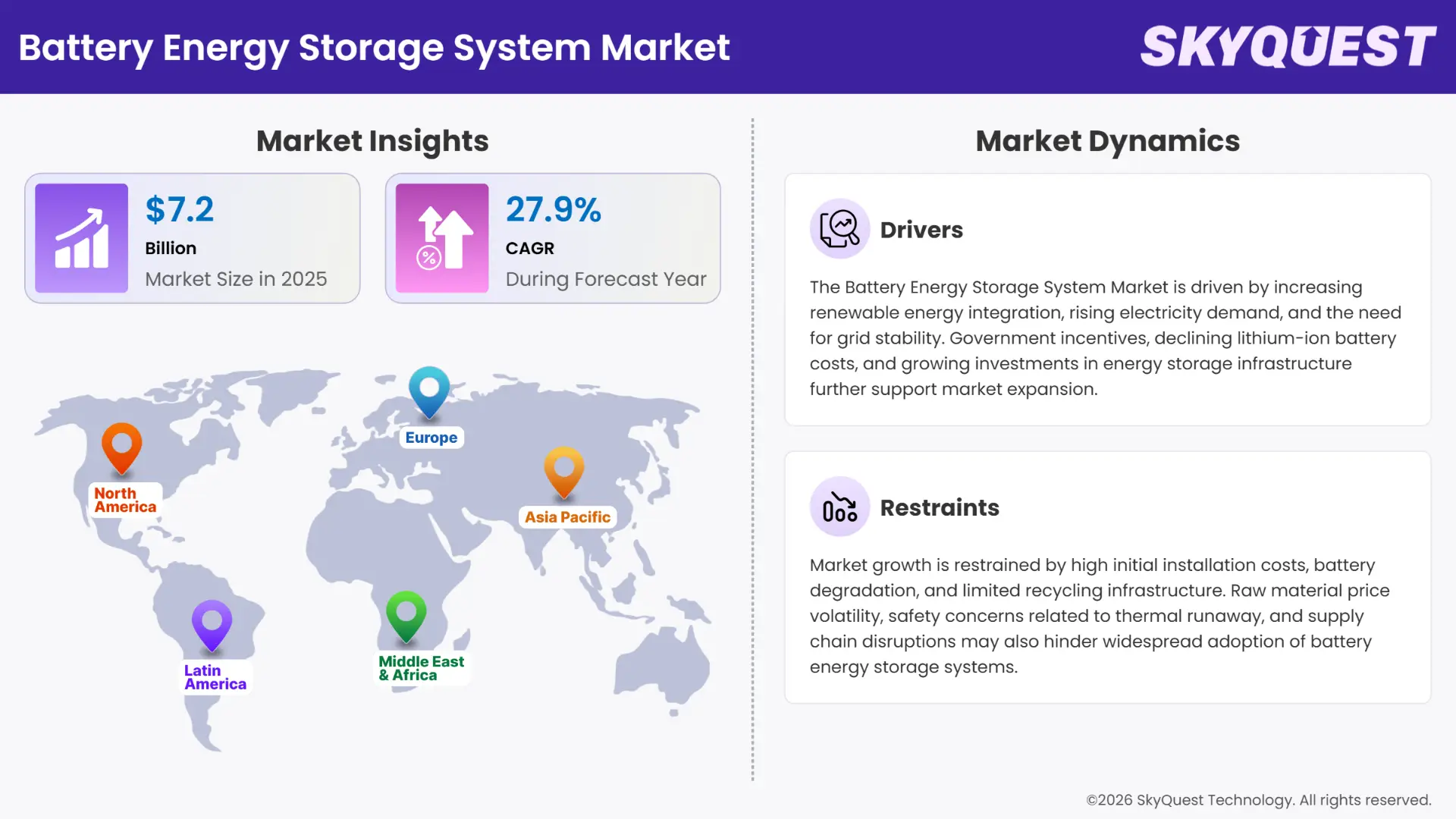
Global Battery Energy Storage System Market size was valued at USD 5.63 Billion in 2024 and is poised to grow from USD 7.2 Billion in 2025 to USD 51.56 Billion by 2033, growing at a CAGR of 27.9% during the forecast period (2026–2033).
Key Takeaways: Market Trends & Insights
The Battery Energy Storage System (BESS) market is developing rapidly as global energy systems transition to sustainable and decarbonized systems. As more renewable energy is adopted, riders are becoming more unstable, driving the need for advanced energy storage solutions. BESS is an effective method for storing excess energy while ensuring access when demand exceeds generation supply, it is essential for energy reliability, smart grid operation, and the reduction of fossil fuel usage. The biggest drivers of BESS market growth include: The global push for renewable energy integration, Government funding and incentives, and Growth in energy demand.
Solar and wind energy generation is growing and requires efficient storage systems for peak balancing and emergency backup power. Supportive regulations, decreased battery prices, and technology improvement with lithium-ion batteries, as well as flow type batteries, have made BESS market more viable. In addition, increasing demand for uninterruptable supply of power from residential, commercial, and industrial locations will further increase market growth in the future in several areas around the world.
Although they are overwhelmingly beneficial, there are challenges that exist in the BESS market as it is growing very fast, high upfront cost, regulatory uncertainties, and safety considerations. The use of battery storage systems entails risks associated with overcoming, fire, and safety and the environment. Limited raw material availability and supply chain constraints affect the ability to scale production, particularly in reference to lithium and cobalt. More challenges arise when attempting to integrate battery systems into existing grid infrastructure, in addition to limited standardization across markets and regions makes deployments expensive and regulations complicate long term investments.
How is Artificial Intelligence Reshaping the Landscape of Battery Energy Storage System?
AI is revolutionizing the BESS industry by propelling predictive maintenance processes or smart energy optimization processes. For example, machine learning models can analyze a large data sets around battery health, variables in their operating environment, performance history data, etc., to estimate degradation conditions and failure prevention. Simultaneously, AI-driven trading platforms are constantly optimizing charge-discharge cycles in real time, allowing them to manage revenue while retaining the longevity and safety of their batteries.
When you consider all of these capabilities, it become easy to see that this automated, efficient task results in a sustainable approach that has improved the O&M costs of operation, and extended the life of their assets, thus making jump into the increasingly profitable & sustainable grid-scale energy storage industry a much easier decision. In other words, AI is making BESS a revenue-generating asset that is no longer a static pole on the grid infrastructure of our cities or businesses, with improvements in reliability and operating efficiencies.
To get more insights on this market click here to Request a Free Sample Report
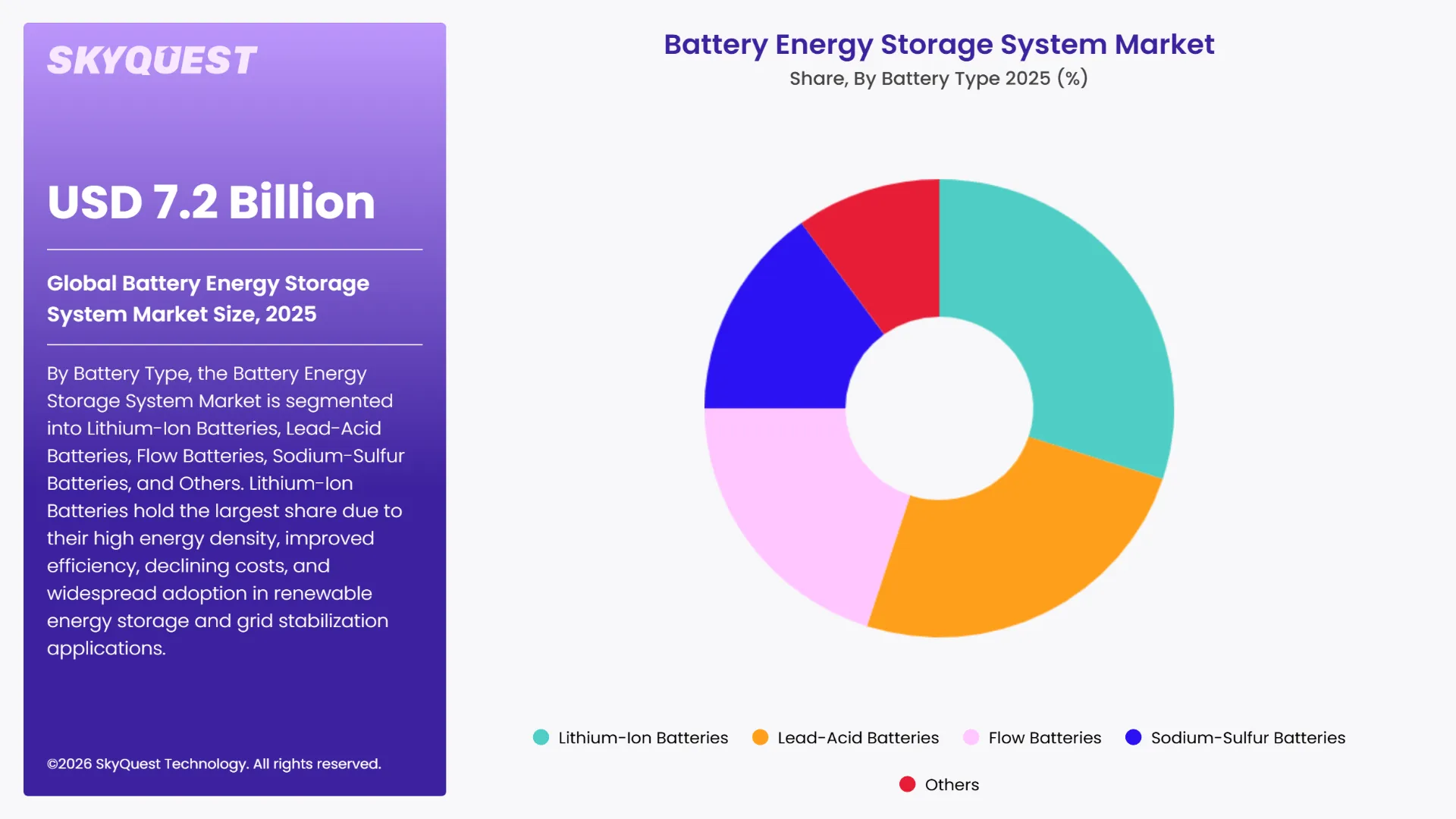
The global Battery Energy Storage System Market is segmented by Battery Type, Connection Type, Ownership, Energy Capacity, Technology Integration, Application and region. Based on Battery Type, the market is segmented into Lithium-Ion, Lead-Acid, Flow Battery, Sodium-Sulphur and Others. Based on Connection Type, the market is segmented into On-Grid and Off-Grid. Based on Ownership, the market is segmented into Customer-Owned, Third-Party Owned and Utility-Owned.
Based on Energy Capacity, the market is segmented into Below 100 kWh, 100–500 kWh, 500 kWh–1 MWh, 1–5 MWh and Above 5 MWh. Based on Technology Integration, the market is segmented into Standalone Systems, Hybrid Power Systems, Microgrids and Virtual Power Plants. Based on Application, the market is segmented into Residential, Commercial, Utility-Scale and Industrial. Based on region, the market is segmented into North America, Europe, Asia Pacific, Latin America and Middle East & Africa.
The Lithium-ion batteries segment dominated the market in terms of revenue in 2021. Due to its lightweight, low cost, and restricted coverage area, lithium-ion batteries are expected to see an increase in demand for energy storage systems in the future. The market for lithium-ion battery energy storage systems will also rise in the future years due to rising infrastructure spending from the residential, industrial, and commercial sectors.
The need for an uninterrupted power supply cannot be overstated in data centers. The losses brought on by such a power outage are enormous. An estimated USD 50.0 billion is lost yearly in the United States alone as a result of power outages and related issues. Losses may occur from irregularities that negatively impact data center equipment, such as energy dips and spikes. A line-interactive UPS system can also serve as a filter, modifying the input power and changing the output to ensure that the internal systems have a steady and uninterrupted supply of power.
To get detailed segments analysis, Request a Free Sample Report
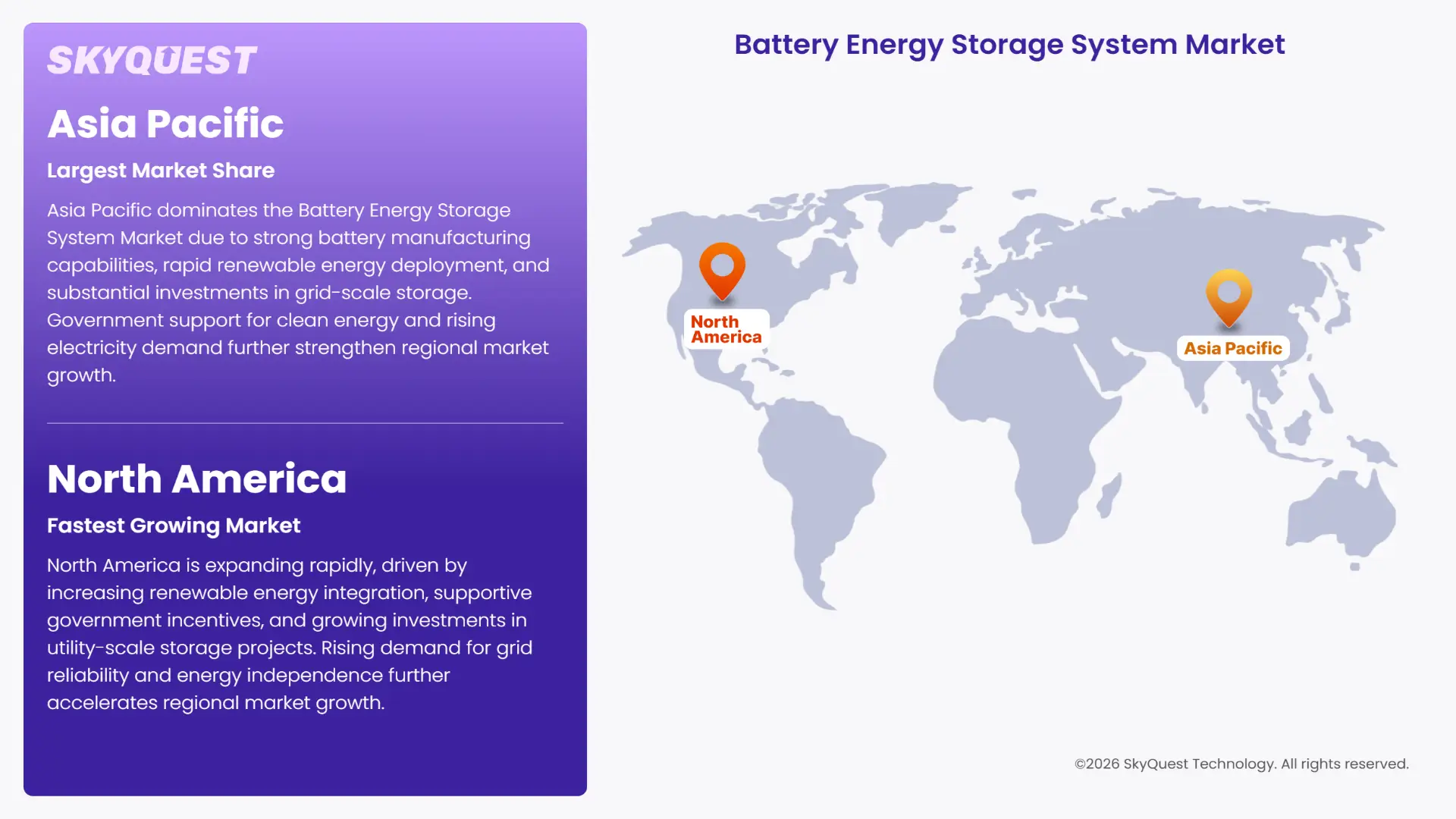
Asia Pacific dominates the BESS market due to aggressive renewable rollouts, supportive policies, and large-scale energy storage mandates. Governments in Japan, South Korea, China, and India are mandating solar-plus-storage systems, investing heavily, and forging strategic partnerships to boost grid resilience and renewable adoption.
Japan Battery Energy Storage System Market
Japan leverages smart grid and energy security initiatives, deploying about 1.5 GW of energy storage systems backed by a US$1.5 billion investment over three years, supported by government subsidies to manage renewable intermittency.
South Korea Battery Energy Storage System Market
South Korea emphasizes smart grid modernization via IT-enabled grid deployment orchestrated by KEPCO to integrate renewables and improve energy efficiency, making it a pivotal market for BESS.
North America leads fastest growth worldwide with surging BESS deployment driven by declining costs, strong policy levers like the Inflation Reduction Act, and utility‑scale expansion across the U.S. and Canada.
The United States Battery Energy Storage System Market
The U.S. dominates North America with ~85% market share, adding nearly 12 GW in 2024 and expecting over 18 GW in 2025. Utility-scale projects in California and Texas are key growth engines, boosted by tax credits and FERC reforms.
Canada Battery Energy Storage System Market
Canada’s BESS market is expanding at a CAGR of ~29 % through 2030, supported by grid-scale procurements like Ontario’s 2.5 GW competitive bid and provincial support for remote-grid integration.
Europe ranks third globally but remains a vibrant BESS market backed by inter-country infrastructure projects and renewable integration mandates.
Germany Battery Energy Storage System Market
Germany is deploying battery-buffered EV charging corridors, participating in cross-border pilot networks (Denmark–Netherlands) to minimize grid congestion and support EV scaling.
France Battery Energy Storage System Market
France continues expanding battery arrays to alleviate distribution congestion and bolster regional renewables, deploying dozens of new utility-scale storage facilities under climate policy targets.
UK Battery Energy Storage System Market
The UK is integrating BESS across solar farms and grid infrastructure under government energy resilience schemes, reflecting a strong policy focus on storage mandates in new renewable energy installations.
To know more about the market opportunities by region and country, click here to
Buy The Complete Report
Integration of Renewable Energy Sources.
Government Incentives and Policy Support
High Initial Investment and Maintenance Costs
Safety Risks and Environmental Concerns
Request Free Customization of this report to help us to meet your business objectives.
The BESS market is evolving beyond hardware, as integrators strategically differentiate via vertical integration, AI-enabled dispatch software, and regional manufacturing investments. For instance, Tesla’s Megapack dominance stems from its vertically integrated supply chain and rapid feature rollouts, while Fluence leverages proprietary bidding and project execution software that supports major utilities. BYD capitalizes on low-cost LFP modules in Asian tenders, undercutting competitors. Meanwhile LG Energy bundles hardware with long-term service contracts for reliability. Natron Energy and Form Energy focus on sodium-ion and iron-air chemistries to carve niche roles in data centers and long-duration storage.
Shift Toward Long-Duration Energy Storage
Rise of Modular and Scalable BESS Solutions
SkyQuest’s ABIRAW (Advanced Business Intelligence, Research & Analysis Wing) is our Business Information Services team that Collects, Collates, Correlates, and Analyses the Data collected using Primary Exploratory Research backed by robust Secondary Desk research.
SkyQuest’s study suggests that the Battery Energy Storage System (BESS) market is rapidly expanding, driven primarily by the integration of renewable energy sources like solar and wind, which require stable storage solutions for efficient grid management. However, high upfront costs and safety risks—such as thermal runaway in lithium-ion batteries—remain key restraints. Asia Pacific dominates the market, with Japan and South Korea leading large-scale deployments backed by strong policy support. Lithium-ion technology holds the largest market share due to its high energy density and decreasing costs. A secondary driver boosting growth is the rise of long-duration storage technologies, including iron-air and flow batteries, which enhance grid resilience and enable 24/7 clean energy supply integration.
| Report Metric | Details |
|---|---|
| Market size value in 2024 | USD 5.63 Billion |
| Market size value in 2033 | USD 51.56 Billion |
| Growth Rate | 27.9% |
| Base year | 2024 |
| Forecast period | 2026–2033 |
| Forecast Unit (Value) | USD Billion |
| Segments covered |
|
| Regions covered | North America (US, Canada), Europe (Germany, France, United Kingdom, Italy, Spain, Rest of Europe), Asia Pacific (China, India, Japan, Rest of Asia-Pacific), Latin America (Brazil, Rest of Latin America), Middle East & Africa (South Africa, GCC Countries, Rest of MEA) |
| Companies covered |
|
| Customization scope | Free report customization with purchase. Customization includes:-
|
To get a free trial access to our platform which is a one stop solution for all your data requirements for quicker decision making. This platform allows you to compare markets, competitors who are prominent in the market, and mega trends that are influencing the dynamics in the market. Also, get access to detailed SkyQuest exclusive matrix.
Table Of Content
Executive Summary
Market overview
Parent Market Analysis
Market overview
Market size
KEY MARKET INSIGHTS
COVID IMPACT
MARKET DYNAMICS & OUTLOOK
Market Size by Region
KEY COMPANY PROFILES
Methodology
For the Battery Energy Storage System Market, our research methodology involved a mixture of primary and secondary data sources. Key steps involved in the research process are listed below:
1. Information Procurement: This stage involved the procurement of Market data or related information via primary and secondary sources. The various secondary sources used included various company websites, annual reports, trade databases, and paid databases such as Hoover's, Bloomberg Business, Factiva, and Avention. Our team did 45 primary interactions Globally which included several stakeholders such as manufacturers, customers, key opinion leaders, etc. Overall, information procurement was one of the most extensive stages in our research process.
2. Information Analysis: This step involved triangulation of data through bottom-up and top-down approaches to estimate and validate the total size and future estimate of the Battery Energy Storage System Market.
3. Report Formulation: The final step entailed the placement of data points in appropriate Market spaces in an attempt to deduce viable conclusions.
4. Validation & Publishing: Validation is the most important step in the process. Validation & re-validation via an intricately designed process helped us finalize data points to be used for final calculations. The final Market estimates and forecasts were then aligned and sent to our panel of industry experts for validation of data. Once the validation was done the report was sent to our Quality Assurance team to ensure adherence to style guides, consistency & design.
Analyst Support
Customization Options
With the given market data, our dedicated team of analysts can offer you the following customization options are available for the Battery Energy Storage System Market:
Product Analysis: Product matrix, which offers a detailed comparison of the product portfolio of companies.
Regional Analysis: Further analysis of the Battery Energy Storage System Market for additional countries.
Competitive Analysis: Detailed analysis and profiling of additional Market players & comparative analysis of competitive products.
Go to Market Strategy: Find the high-growth channels to invest your marketing efforts and increase your customer base.
Innovation Mapping: Identify racial solutions and innovation, connected to deep ecosystems of innovators, start-ups, academics, and strategic partners.
Category Intelligence: Customized intelligence that is relevant to their supply Markets will enable them to make smarter sourcing decisions and improve their category management.
Public Company Transcript Analysis: To improve the investment performance by generating new alpha and making better-informed decisions.
Social Media Listening: To analyze the conversations and trends happening not just around your brand, but around your industry as a whole, and use those insights to make better Marketing decisions.
REQUEST FOR SAMPLE
 REQUEST FREE CUSTOMIZATION
Global Battery Energy Storage System Market size was valued at USD 5.63 Billion in 2024 and is poised to grow from USD 7.2 Billion in 2025 to USD 51.56 Billion by 2033, growing at a CAGR of 27.9% during the forecast period (2026–2033).
The key vendors in the Battery Energy Storage System Market include Tesla, Inc., BYD Company Limited, CATL, LG Energy Solution Ltd., Samsung SDI Co., Ltd., Panasonic Holdings Corporation, Fluence Energy, Inc., Wärtsilä Corporation, Siemens Energy AG, and ABB Ltd. These companies focus on advanced battery technologies, grid-scale storage solutions, renewable energy integration, and energy management systems.
The key driver of the Battery Energy Storage System Market is the growing integration of renewable energy sources, particularly solar and wind, into power grids. Rising demand for grid stability, reliable electricity supply, peak load management, and energy storage solutions further accelerates market growth.
The key market trend in the Battery Energy Storage System Market is the growing adoption of large-scale energy storage projects and advanced lithium-ion battery technologies. Increasing integration of artificial intelligence, smart energy management systems, and modular storage solutions is improving operational efficiency, grid flexibility, and renewable energy utilization.
Asia Pacific accounted for the largest share of the Battery Energy Storage System Market, driven by rapid renewable energy deployment, strong battery manufacturing capabilities, and increasing investments in grid-scale storage projects. Government initiatives supporting clean energy, rising electricity demand, and expanding electric vehicle industries further strengthen regional market dominance.


Want to customize this report? This report can be personalized according to your needs. Our analysts and industry experts will work directly with you to understand your requirements and provide you with customized data in a short amount of time. We offer $1000 worth of FREE customization at the time of purchase.
Feedback From Our Clients


 USA (+1) 351-333-4748

