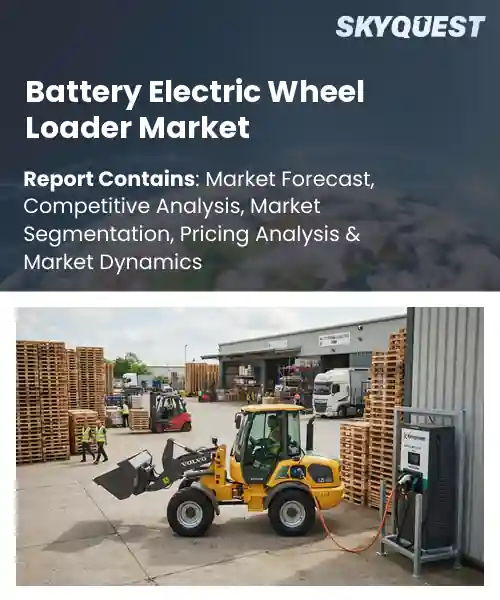
Battery Electric Wheel Loader Market
Report ID: SQMIG20G2198
Report ID: SQMIG20G2198
[email protected]
USA +1 351-333-4748
Report ID:
SQMIG20G2198 |
Region:
Global |
Published Date: August, 2026
Pages:
157
|Tables:
144
|Figures:
78


Global Battery Electric Wheel Loader Market size was valued at USD 6.82 Billion in 2024 and is poised to grow from USD 7.82 Billion in 2025 to USD 23.26 Billion by 2033, growing at a CAGR of 14.6% during the forecast period (2026-2033).
The global battery‑electric wheel loader market comprises heavy‑duty construction machines powered solely by rechargeable lithium‑ion packs, replacing diesel engines with zero‑emission propulsion. Its significance stems from tightening emissions regulations, rising fuel costs, and the construction sector’s push toward sustainable operations. Historically, wheel loaders were dominated by internal‑combustion models, but the first commercial electric unit appeared in 2018 when a European OEM launched a 30‑tonne loader for urban tunneling projects. Since then, adoption has accelerated as manufacturers improve energy density and charging infrastructure, allowing operators to meet both productivity targets and environmental commitments, while also enhancing long‑term cost efficiency for owners. The dominant growth factor now is the convergence of advanced battery management systems with telematics platforms that enable real‑time load monitoring and predictive maintenance, thereby reducing downtime and total cost of ownership. Operators such as a major North American quarry have integrated electric loaders with a cloud‑based fleet manager, cutting idle time by 15 percent and lowering energy expenses through optimized charge cycles. This efficiency gain fuels further market expansion because it demonstrates a financial upside beyond regulatory compliance. Consequently, equipment manufacturers are investing in modular battery designs and fast‑charging stations, creating a virtuous cycle of adoption and technology refinement.
How is AI-driven automation influencing battery electric wheel loader adoption?
AI‑driven automation is reshaping battery electric wheel loaders by embedding intelligent control systems that continuously analyze terrain, load weight and battery state. Predictive algorithms adjust motor torque in real time, minimizing energy waste while preserving performance. Integrated telematics feed data to fleet managers, enabling remote diagnostics and proactive maintenance that keep equipment on site longer. Autonomous guidance assists operators with precision positioning, reducing cycle times and operator fatigue. These capabilities make electric loaders more productive and cost‑effective, encouraging contractors to replace diesel machines with cleaner alternatives. As site owners prioritize sustainability and efficiency, the synergy of AI and electrification accelerates market penetration.LiuGong introduced the 820TE all‑electric wheel loader in August 2026, featuring AI‑based load‑optimization that cuts cycle time and extends battery life, reinforcing adoption momentum.
Market snapshot - (2026-2033)
Global Market Size
USD 6.82 Billion
Largest Segment
Up to 5 Tons
Fastest Growth
Above 10 Tons
Growth Rate
14.6% CAGR
To get more insights on this market click here to Request a Free Sample Report
Global battery electric wheel loader market is segmented by operating weight, battery capacity, application, charging type, end user and region. Based on operating weight, the market is segmented into Up to 5 Tons, 5–10 Tons and Above 10 Tons. Based on battery capacity, the market is segmented into Up to 100 kWh, 101–200 kWh and Above 200 kWh. Based on application, the market is segmented into Construction, Mining and Agriculture. Based on charging type, the market is segmented into AC Charging and DC Fast Charging. Based on end user, the market is segmented into Construction Contractors, Mining Companies, Rental Companies and Agricultural Operators. Based on region, the market is segmented into North America, Europe, Asia Pacific, Latin America and Middle East & Africa.
Above 10 tons segment dominates because large capacity loaders deliver the productivity needed for high volume earthmoving, allowing customers to replace multiple conventional machines with a single electric unit. Their robust chassis supports bigger battery packs, extending operational time and justifying the higher upfront cost through reduced fuel expenses and lower maintenance. This capability aligns with project owners seeking to meet emissions targets while maintaining throughput and improving overall site efficiency.
However, 5 to 10 tons segment is the most rapidly expanding as mid size electric loaders strike a balance between maneuverability and payload, making them attractive for urban construction projects and modular mining operations. Their moderate battery requirements lower total cost of ownership, prompting quicker adoption and fueling new market opportunities.
Above 200 kWh segment dominates because the ability to store large amounts of energy enables continuous operation on demanding sites without frequent recharging pauses. These high capacity units support extensive duty cycles and can power auxiliary hydraulics, meeting the rigorous performance criteria of heavy earthmoving tasks. Their endurance aligns with customers’ priorities for productivity and compliance with zero emission mandates, making them the preferred choice for large scale projects and lasting stability.
Meanwhile, 101 to 200 kWh segment is the most rapidly expanding as medium capacity batteries provide a practical compromise between range and upfront cost, attracting contractors focused on moderate size jobs. The reduced weight and flexible installation options accelerate deployment, spurring broader market penetration and stimulating innovation in charger integration.
To get detailed segments analysis, Request a Free Sample Report
Europe’s dominance is rooted in a tightly integrated regulatory landscape that encourages low‑emission equipment, coupled with strong manufacturing heritage and advanced engineering ecosystems. Policy frameworks across key markets create incentives for electrified construction machinery, while green procurement standards push manufacturers toward electric solutions. Established supply chains for high‑performance batteries and components provide a competitive edge, enabling rapid product development and cost efficiencies. Moreover, collaborative research hubs and industry alliances foster innovation in powertrain design, control systems, and durability testing. Customer expectations for sustainability and operational efficiency reinforce demand, and the presence of major original equipment manufacturers accelerates market penetration. These converging factors position Europe as the leading force shaping global adoption of battery electric wheel loaders.
Battery Electric Wheel Loader Market in Germany benefits from a robust engineering culture and strong emphasis on carbon‑neutral construction practices. Local manufacturers integrate precision mechanics with cutting‑edge electric drivetrains, supported by a dense network of battery suppliers. Collaborative projects between research institutes and OEMs accelerate technology validation, while public‑sector procurement targets create early‑adopter opportunities for electric equipment on major infrastructure sites and contribute to long‑term operational cost reductions for contractors.
Battery Electric Wheel Loader Market in the United Kingdom is propelled by ambitious decarbonisation agendas and a mature construction services sector. Policy incentives encourage fleet electrification, while leading universities collaborate with manufacturers to refine power management algorithms. Supply chains link domestic battery cell producers with equipment makers, facilitating swift integration of emerging storage technologies. Project pipelines for sustainable infrastructure provide testing grounds that reinforce confidence in electric loader performance across diverse site conditions.
Battery Electric Wheel Loader Market in France aligns with national climate objectives and a strong tradition of heavy‑equipment engineering. Government programmes promote zero‑emission machinery for public works, encouraging manufacturers to scale electric platforms. Partnerships between automotive battery firms and construction equipment builders accelerate component standardisation and improve reliability. Urban redevelopment projects showcase the quiet, low‑maintenance benefits of electric loaders, fostering broader acceptance among contractors and reinforcing France as a hub for sustainable construction technology.
North America’s market expansion is fueled by a convergence of regulatory pressure, corporate sustainability commitments, and a thriving ecosystem of technology providers. Federal and regional emissions standards encourage manufacturers to replace diesel‑powered loaders with electric alternatives, while major construction firms set ambitious carbon‑reduction targets for their fleets. Significant investment in battery innovation and high‑power charging infrastructure reduces range anxiety and improves asset utilization. The presence of large‑scale renewable energy projects creates demand for cleaner equipment on remote sites, and partnerships between equipment OEMs and energy storage specialists accelerate product qualification. Together these forces generate a compelling business case for rapid adoption of battery electric wheel loaders across the continent.
Battery Electric Wheel Loader Market in the United States benefits from extensive research collaborations and a deep supplier base for high‑energy batteries. Federal incentives for clean construction equipment and state‑level sustainability programs drive early‑adopter interest among contractors. Large infrastructure initiatives provide testing venues where electric loaders demonstrate productivity and lower operating costs. Integration with smart fleet management platforms further enhances operational visibility, encouraging broader confidence in electric technology across diverse construction sectors.
Battery Electric Wheel Loader Market in Canada is shaped by strong environmental regulations and a commitment to green building practices. Provincial programs incentivize the transition to zero‑emission equipment, while local universities work closely with OEMs to adapt battery systems for colder climates. Emerging renewable energy projects in remote regions demand quiet, low‑emission loaders, creating niche opportunities that expand overall market acceptance. Collaborative pilot programs highlight performance reliability and reinforce confidence among Canadian contractors.
The Asia Pacific region is advancing its position through a blend of aggressive industrial modernization and focused investment in electric powertrain technologies. Countries prioritize decarbonisation of heavy‑equipment sectors, prompting manufacturers to develop locally adapted electric wheel loaders that meet demanding productivity standards. Strong manufacturing bases, combined with rapid growth in battery cell production, enable cost‑effective scaling of electric platforms. Government initiatives that support clean‑energy construction and the expansion of high‑capacity charging networks reduce barriers to adoption. Additionally, close collaboration between automotive‑grade battery firms and construction equipment makers accelerates innovation in thermal management and durability, positioning the region as a future hub for advanced electric construction machinery.
Battery Electric Wheel Loader Market in Japan leverages a sophisticated supply chain and a cultural emphasis on precision engineering. Leading battery manufacturers partner with equipment builders to create compact, high‑efficiency electric loaders suited for dense urban sites. Government targets for reduced emissions in construction stimulate early adoption, while research institutes refine battery management systems for optimal performance. Demonstration projects on infrastructure redevelopment showcase the operational benefits, reinforcing confidence among Japanese contractors and solidifying the market’s growth trajectory.
Battery Electric Wheel Loader Market in South Korea benefits from a robust electronics industry and strong governmental emphasis on green manufacturing. Collaboration between semiconductor‑level battery producers and construction equipment firms drives rapid integration of high‑density energy storage into loader designs. National policies encouraging low‑carbon construction encourage contractors to trial electric machines on large‑scale projects. Continuous improvement in fast‑charging infrastructure and smart grid connectivity further enhances operational flexibility, positioning South Korea as a notable contributor to the regional evolution of electric construction equipment.
To know more about the market opportunities by region and country, click here to
Buy The Complete Report
Increasing Environmental Regulations
Advances In Battery Technology
High Initial Capital Expenditure
Limited Charging Infrastructure
Request Free Customization of this report to help us to meet your business objectives.
Industry players such as Caterpillar, Komatsu and Volvo are accelerating market consolidation through targeted M&A, forming strategic partnerships with battery manufacturers, and deploying advanced telematics to improve energy efficiency of electric wheel loaders. Recent examples include Caterpillar’s acquisition of a lithium‑ion battery pack developer to secure supply chain control, Komatsu’s joint venture with a European charger network to expand charging infrastructure, and Volvo’s integration of AI‑driven load‑management software to enhance productivity while reducing emissions.
Top Player’s Company Profile
Recent Developments
SkyQuest’s ABIRAW (Advanced Business Intelligence, Research & Analysis Wing) is our Business Information Services team that Collects, Collates, Correlates, and Analyses the Data collected by means of Primary Exploratory Research backed by robust Secondary Desk research. As per SkyQuest analysis, tightening environmental regulations are the primary driver of growth in the global battery‑electric wheel loader market, pushing contractors to replace diesel units with zero‑emission alternatives. A second catalyst is rapid progress in battery technology, which lifts runtime and enables faster charging, making electric loaders increasingly competitive. However, the high upfront capital outlay required for battery packs and specialised chassis continues to restrain adoption, especially among smaller firms. Europe dominates the market thanks to stringent policies, strong OEM presence and extensive charging networks, while the above‑10‑ton operating‑weight segment commands the largest share, reflecting demand for high‑productivity, long‑duration machines.
| Report Metric | Details |
|---|---|
| Market size value in 2024 | USD 6.82 Billion |
| Market size value in 2033 | USD 23.26 Billion |
| Growth Rate | 14.6% |
| Base year | 2024 |
| Forecast period | (2026-2033) |
| Forecast Unit (Value) | USD Billion |
| Segments covered |
|
| Regions covered | North America (US, Canada), Europe (Germany, France, United Kingdom, Italy, Spain, Rest of Europe), Asia Pacific (China, India, Japan, Rest of Asia-Pacific), Latin America (Brazil, Rest of Latin America), Middle East & Africa (South Africa, GCC Countries, Rest of MEA) |
| Companies covered |
|
| Customization scope | Free report customization with purchase. Customization includes:-
|
To get a free trial access to our platform which is a one stop solution for all your data requirements for quicker decision making. This platform allows you to compare markets, competitors who are prominent in the market, and mega trends that are influencing the dynamics in the market. Also, get access to detailed SkyQuest exclusive matrix.
Table Of Content
Executive Summary
Market overview
Parent Market Analysis
Market overview
Market size
KEY MARKET INSIGHTS
COVID IMPACT
MARKET DYNAMICS & OUTLOOK
Market Size by Region
KEY COMPANY PROFILES
Methodology
For the Battery Electric Wheel Loader Market, our research methodology involved a mixture of primary and secondary data sources. Key steps involved in the research process are listed below:
1. Information Procurement: This stage involved the procurement of Market data or related information via primary and secondary sources. The various secondary sources used included various company websites, annual reports, trade databases, and paid databases such as Hoover's, Bloomberg Business, Factiva, and Avention. Our team did 45 primary interactions Globally which included several stakeholders such as manufacturers, customers, key opinion leaders, etc. Overall, information procurement was one of the most extensive stages in our research process.
2. Information Analysis: This step involved triangulation of data through bottom-up and top-down approaches to estimate and validate the total size and future estimate of the Battery Electric Wheel Loader Market.
3. Report Formulation: The final step entailed the placement of data points in appropriate Market spaces in an attempt to deduce viable conclusions.
4. Validation & Publishing: Validation is the most important step in the process. Validation & re-validation via an intricately designed process helped us finalize data points to be used for final calculations. The final Market estimates and forecasts were then aligned and sent to our panel of industry experts for validation of data. Once the validation was done the report was sent to our Quality Assurance team to ensure adherence to style guides, consistency & design.
Analyst Support
Customization Options
With the given market data, our dedicated team of analysts can offer you the following customization options are available for the Battery Electric Wheel Loader Market:
Product Analysis: Product matrix, which offers a detailed comparison of the product portfolio of companies.
Regional Analysis: Further analysis of the Battery Electric Wheel Loader Market for additional countries.
Competitive Analysis: Detailed analysis and profiling of additional Market players & comparative analysis of competitive products.
Go to Market Strategy: Find the high-growth channels to invest your marketing efforts and increase your customer base.
Innovation Mapping: Identify racial solutions and innovation, connected to deep ecosystems of innovators, start-ups, academics, and strategic partners.
Category Intelligence: Customized intelligence that is relevant to their supply Markets will enable them to make smarter sourcing decisions and improve their category management.
Public Company Transcript Analysis: To improve the investment performance by generating new alpha and making better-informed decisions.
Social Media Listening: To analyze the conversations and trends happening not just around your brand, but around your industry as a whole, and use those insights to make better Marketing decisions.
REQUEST FOR SAMPLE
 REQUEST FREE CUSTOMIZATION


Want to customize this report? This report can be personalized according to your needs. Our analysts and industry experts will work directly with you to understand your requirements and provide you with customized data in a short amount of time. We offer $1000 worth of FREE customization at the time of purchase.
Feedback From Our Clients


 USA (+1) 351-333-4748

