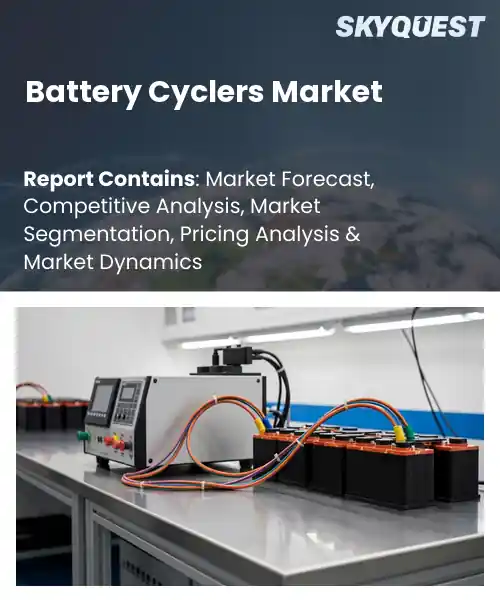
Battery Cyclers Market
Report ID: SQMIG20D2552
Report ID: SQMIG20D2552
[email protected]
USA +1 351-333-4748
Report ID:
SQMIG20D2552 |
Region:
Global |
Published Date: February, 2026
Pages:
157
|Tables:
153
|Figures:
78


Global Battery Cyclers Market size was valued at USD 1.10 Billion in 2024 and is poised to grow from USD 1.28 Billion in 2025 to USD 4.31 Billion by 2033, growing at a CAGR of 16.4% during the forecast period (2026-2033).
The global battery cyclers market growth is driven because electric vehicle adoption needs advanced battery testing methods to ensure quality control of battery production processes. Battery cyclers operate as specialized devices which charge and discharge cells, which research laboratories and manufacturing plants and certification organizations use for their operations.
Moreover, the global battery cyclers market outlook is transitioned from basic low-channel bench systems to complete automated high-channel operations which include software and analytic functions during the last ten years. The worldwide battery cyclers market grows because electric vehicles and stationary storage manufacturers need to increase their testing operations for high-throughput testing equipment that provides precise results. The test time decreases and yield enhancement capabilities of the modular systems with cloud analytics development to create business prospects in the software-as-a-service and lab automation sectors. Cyclers enable fast state-of-health assessment in recycling and second-life markets, which enables businesses to refurbish products for profit while supporting their circular economy operations.
How is AI Improving Performance and Efficiency in the Battery Cyclers Market?
AI boosts the efficiency of battery cyclers by using predictive insights that control testing operations through data-driven methods. The system features three main elements, including adaptive cycling which changes profiles according to cell activity, anomaly detection which detects unexpected degradation, and machine learning models which find patterns in extensive test data to enhance optimization processes. The market demands faster electric vehicles and grid storage development processes while laboratory operations need to maintain efficiency. AI technology uses its capabilities to enhance operational procedures by reducing unnecessary repetition, boosting testing efficiency, and physics-based model usage to enhance validation processes.
Chroma, in December 2025, introduced an enhanced testing system which includes multiple testing modules and pack testing capabilities to streamline data management operations and complete testing procedures faster. The platform uses AI analytics to improve cycle recipe efficiency while accelerating validation processes, which boosts market expansion through higher laboratory productivity and increased product qualification confidence.
Market snapshot - (2026-2033)
Global Market Size
USD 1.1 Billion
Largest Segment
Lithium-Ion
Fastest Growth
Solid-State
Growth Rate
16.4% CAGR
To get more insights on this market click here to Request a Free Sample Report
The global battery cyclers market is segmented by battery type, product type, function, application industry, end user, and region. Based on battery type, the market is categorized into lithium-ion, lead-acid, nickel-based, solid-state, and other battery types. In terms of product type, it is segmented into single-channel, multi-channel, and programmable battery cyclers. By function, the market includes cell testing, module testing, pack testing, end-of-line testing, and battery recycling.
Based on the application industry, it is divided into automotive and transportation, energy and utilities, industrial, education and research, aerospace, and others. In terms of end users, the market comprises manufacturers, research organizations, educational institutes, government agencies, and others. Regionally, the market is analyzed across North America, Europe, Asia Pacific, Latin America, and the Middle East & Africa.
As per the global battery cyclers market analysis, the lithium-Ion segment dominates because lithium-ion chemistries are the primary focus of product development across electric vehicles, portable electronics and grid storage, compelling cycler manufacturers to optimize performance, precision and safety for these cells. The industry focuses its investments on developing high-power programmable cyclers which provide both precise operational control and complete system diagnostics, while suppliers create protocols and thermal management systems and lifecycle simulation tools to comply with both OEM and testing requirements, which results in a market environment that keeps reinforcing lithium-ion equipment.
Whereas the solid-state technology has become the fastest growing sector because its research activities and initial market entry lead to higher sales of cyclers that operate at new voltage levels and need specific adaptations for testing unique interface characteristics and thermal sensitivity conditions. The manufacturing sector creates specialized instruments which operate at low current while delivering high accuracy results, and their flexible testing protocols enable prototype validation and rapid material development and new testing services.
According to the global battery cyclers market forecast, the module testing segment dominates testing because module-level validation functions as a bridge between cell testing and total pack testing, which makes it valuable to OEMs who need to find the right development speed for their production operations. The manufacturing sector increases its investment in synchronized multi-channel cyclers and thermal profiling technologies which come with built-in BMS communication to achieve maximum automation efficiency while maintaining throughput capacity, because they use module consistency to minimize failures in their manufacturing process. Manufacturers use module-capable cyclers and their related software systems and advanced field-testing tools to ensure product reliability throughout their complete lifecycle.
Batteries now require pack testing, which has become essential because the increasing need for system verification in vehicles and stationary systems requires safety testing to be performed. Cycler manufacturers create scalable high-power systems which include automated testing procedures and advanced diagnostic tools that enable complete system validation for quicker product development and new testing business models for field measurements and product guarantees.
To get detailed segments analysis, Request a Free Sample Report
As per the battery cyclers market regional forecast, Asia Pacific dominates the market because it has all three of these strengths advanced battery research facilities together with its manufacturing operations and its established supply chain networks. Industrial ecosystems in core markets enable testing and cycling equipment to be produced at full capacity, while manufacturers of battery cells and packs who operate nearby lead to faster technology uptake. Equipment manufacturers partner with research institutes and vehicle plus electronics OEMs to create shared testing processes which enable fast testing process advancement.
Continuous investment in cycler technology receives support from electrification policies and diverse application requirements that cover three sectors, including consumer electronics and mobility and stationary storage. The combination of strong aftermarket services plus local technical support enables customers to feel confident, while rising testing standards drive ongoing demand for cyclers that deliver improved performance.
The battery cyclers industry in Japan benefits from a dense ecosystem of battery research institutions, precision equipment manufacturers, and quality-focused OEMs. Demand from advanced consumer electronics and mobility applications drives the need for products which deliver both dependable performance and extended product lifespan. Local manufacturers emphasize high-quality test protocols and integration with automation, while strong collaboration between industry and academia accelerates innovation. The combined effects of aftermarket service networks and regulatory requirements drive cycler system adoption by establishing higher performance standards.
The battery cyclers sector in South Korea establishes its identity through its dual connection to vital supply chains which provide battery cells and its demand for scalable cyclers. The industrial sector needs rapid innovation and process enhancements, so manufacturers select automated testing systems and modular development platforms as their top priority. Providers strengthen their operational abilities through two factors: their strong export orientation and their close professional relationships with component suppliers. Industry consortia together with a skilled technical workforce enable businesses to implement advanced cycler systems which handle mobility and storage demands.
The North American battery cyclers market experiences dynamic growth because electric mobility and utility-scale storage systems and advanced research initiatives show strong demand. The region has established equipment manufacturing facilities which operate alongside expanding battery cell production and vehicle OEM operations to create a strong demand for both high-throughput production cyclers and specialized lab-grade systems. The combination of test infrastructure investments and safety plus performance validation needs creates more complex requirement standards which drive technological differences between suppliers. Regional suppliers use their relationships with customers to create personalized solutions while industry partners with national laboratories and universities to develop standard methods and specific cycler applications.
The United States battery cyclers market advances through three factors, including research activities and development initiatives plus major vehicle OEM companies and widespread use in transportation plus grid systems. Demand production cyclers occur in two forms, including high-throughput systems and advanced laboratory equipment which support development and certification processes. The service and calibration networks sustain operational efficiency through their uptime capabilities, while manufacturer and national laboratory plus system integrator partnerships advance testing system development. The necessity for scalable automated cycler equipment drives fleets to make procurement investments.
The Canadian battery cyclers market penetration is driven through increasing energy storage projects and academic research institutions and the emerging supply chain system. Demand centers on flexible cycler platforms that can serve lab validation and pilot production needs. Local suppliers prioritize their products to deliver maintenance service capacity, which they combine with battery management systems and data analytics software. Universities together with industry partners and utilities create customized testing programs, which safety standards and long-term performance criteria guide procurement selection.
European countries enhance their battery cyclers' market share through their industrial modernization activities and their shared research initiatives and their increasing focus on battery security and battery lifespan management. The established engineering companies and the specialized test equipment manufacturers allocate resources to develop modular energy-efficient cycler systems which can handle rigorous testing demands for both automotive and stationary storage applications. The cross-border collaborations between manufacturers and certification bodies and research institutions enable testing standard harmonization while they expedite technology transfer processes. The regional value chains which prioritize quality and reliability and advanced system integration create demand for premium cycler solutions which manufacturers use to establish long-term serviceability through their aftermarket and calibration services.
The German battery cyclers market growth exists because of Germany's strong automotive supply chain and its advanced engineering capabilities and its commitment to conducting safety and performance testing at precise levels. The customer base demands cycler systems which provide both robustness and scalability while functioning with factory automation systems and data analytics platforms. The local manufacturers demonstrate their superiority through their capabilities to deliver tailored products and their commitment to maintaining product quality while supporting long-term service contracts. The collaborative efforts between OEMs and testing laboratories and equipment providers establish the validation standards which enable industrial testing operations to achieve high efficiency.
The United Kingdom battery cyclers market revenue exists because of the country's strong research foundations and its specialized testing facilities and its rising electrification projects in the transportation and energy sectors. The market demands cyclers which provide both flexibility and modular design so they can accommodate various development and certification requirements. The equipment suppliers provide solutions which enable users to integrate their systems with simulation and digital twin workflows while offering calibration and maintenance services. The collaboration between universities and testing houses and industrial partners creates testing protocols which determine how technology will be adopted.
The French battery cyclers market trends combines strong academic research with growing industrial adoption in mobility and stationary storage projects. The need for safety validation and lifecycle testing drives demand for versatile cycler platforms which can handle various cell chemistries. The equipment providers develop systems which enable users to monitor operations from a distance while providing access to all information systems. The research centers and industrial manufacturers and certification bodies work together to develop testing methods which enable organizations to achieve rigorous testing standards while their collaborative efforts accelerate the adoption of cycler technologies.
To know more about the market opportunities by region and country, click here to
Buy The Complete Report
Growing Electric Vehicle Adoption
Expansion Of Energy Storage Projects
High Equipment Acquisition Costs
Technical Standardization Challenges
Request Free Customization of this report to help us to meet your business objectives.
The global battery cyclers market is experiencing heightened competition as suppliers use consolidation and platform partnerships and product differentiation methods to meet the needs of EV and energy storage manufacturers. The industry leaders use mergers and acquisitions together with co-development partnerships to expand their product range which includes regenerative high-channel-count cyclers and factory automation systems that Chroma developed together with Shanghai Jida. Specialized companies are using simulation and CT-based quality control methods to develop their products, while established companies use M&A partnerships to develop regenerative high-channel-count cyclers and factory automation systems.
SkyQuest’s ABIRAW (Advanced Business Intelligence, Research & Analysis Wing) is our Business Information Services team that Collects, Collates, Correlates, and Analyses the Data collected by means of Primary Exploratory Research backed by robust Secondary Desk research.
As per SkyQuest analysis, the global battery cyclers market experiences growth from two main factors the rapid electrification trend and the increased demand for thorough battery testing while energy storage system development serves as an additional market expansion element. Asia Pacific controls the market because it combines manufacturing and research development activities with short supply chains, and lithium-ion batteries hold the largest market share because OEMs and grid storage systems invest in those battery technologies. Researchers and small-scale manufacturers face equipment acquisition costs which constitute the primary obstacle that prevents them from using advanced technology. Modular automated systems combined with AI-powered analytics enable suppliers to enhance lab-to-production processes by improving throughput and diagnostics. The current trend creates new chances for services that involve recycling and assessing the performance of products in their second operational life.
| Report Metric | Details |
|---|---|
| Market size value in 2024 | USD 1.1 Billion |
| Market size value in 2033 | USD 4.31 Billion |
| Growth Rate | 16.4% |
| Base year | 2024 |
| Forecast period | (2026-2033) |
| Forecast Unit (Value) | USD Billion |
| Segments covered |
|
| Regions covered | North America (US, Canada), Europe (Germany, France, United Kingdom, Italy, Spain, Rest of Europe), Asia Pacific (China, India, Japan, Rest of Asia-Pacific), Latin America (Brazil, Rest of Latin America), Middle East & Africa (South Africa, GCC Countries, Rest of MEA) |
| Companies covered |
|
| Customization scope | Free report customization with purchase. Customization includes:-
|
To get a free trial access to our platform which is a one stop solution for all your data requirements for quicker decision making. This platform allows you to compare markets, competitors who are prominent in the market, and mega trends that are influencing the dynamics in the market. Also, get access to detailed SkyQuest exclusive matrix.
Table Of Content
Executive Summary
Market overview
Parent Market Analysis
Market overview
Market size
KEY MARKET INSIGHTS
COVID IMPACT
MARKET DYNAMICS & OUTLOOK
Market Size by Region
KEY COMPANY PROFILES
Methodology
For the Battery Cyclers Market, our research methodology involved a mixture of primary and secondary data sources. Key steps involved in the research process are listed below:
1. Information Procurement: This stage involved the procurement of Market data or related information via primary and secondary sources. The various secondary sources used included various company websites, annual reports, trade databases, and paid databases such as Hoover's, Bloomberg Business, Factiva, and Avention. Our team did 45 primary interactions Globally which included several stakeholders such as manufacturers, customers, key opinion leaders, etc. Overall, information procurement was one of the most extensive stages in our research process.
2. Information Analysis: This step involved triangulation of data through bottom-up and top-down approaches to estimate and validate the total size and future estimate of the Battery Cyclers Market.
3. Report Formulation: The final step entailed the placement of data points in appropriate Market spaces in an attempt to deduce viable conclusions.
4. Validation & Publishing: Validation is the most important step in the process. Validation & re-validation via an intricately designed process helped us finalize data points to be used for final calculations. The final Market estimates and forecasts were then aligned and sent to our panel of industry experts for validation of data. Once the validation was done the report was sent to our Quality Assurance team to ensure adherence to style guides, consistency & design.
Analyst Support
Customization Options
With the given market data, our dedicated team of analysts can offer you the following customization options are available for the Battery Cyclers Market:
Product Analysis: Product matrix, which offers a detailed comparison of the product portfolio of companies.
Regional Analysis: Further analysis of the Battery Cyclers Market for additional countries.
Competitive Analysis: Detailed analysis and profiling of additional Market players & comparative analysis of competitive products.
Go to Market Strategy: Find the high-growth channels to invest your marketing efforts and increase your customer base.
Innovation Mapping: Identify racial solutions and innovation, connected to deep ecosystems of innovators, start-ups, academics, and strategic partners.
Category Intelligence: Customized intelligence that is relevant to their supply Markets will enable them to make smarter sourcing decisions and improve their category management.
Public Company Transcript Analysis: To improve the investment performance by generating new alpha and making better-informed decisions.
Social Media Listening: To analyze the conversations and trends happening not just around your brand, but around your industry as a whole, and use those insights to make better Marketing decisions.
REQUEST FOR SAMPLE
 REQUEST FREE CUSTOMIZATION
Global Battery Cyclers Market size was valued at USD 1.1 Billion in 2024 and is poised to grow from USD 1.28 Billion in 2025 to USD 4.31 Billion by 2033, growing at a CAGR of 16.4% during the forecast period (2026-2033).
Competition in the global battery cyclers market is intensifying as suppliers pursue consolidation, platform partnerships, and product differentiation to serve EV and energy storage manufacturers. Incumbents pursue M&A and co-development deals to add regenerative, high-channel-count cyclers and factory automation, for example Chroma's co-development with Shanghai Jida, while specialized entrants push simulation and CT-based quality control to shorten development cycles. 'AMETEK, Inc.', 'BioLogic', 'Chroma ATE, Inc.', 'Arbin Instruments', 'DIGATRON', 'Bitrode Corporation', 'Maccor, Inc.', 'Greenlight Innovation', 'Ivium Technologies B.V.', 'Neware Technology Limited', 'HIOKI E.E. Corporation', 'BorgWarner (Hearth)', 'AVL', 'Keysight Technologies', 'Kikusui Electronics', 'Cadex Electronics', 'NH Research (NI)', 'WonATech', 'TDK-Lambda', 'PEC'
Accelerating adoption of electric vehicles increases demand for battery testing throughout development and production, and battery cyclers play a central role by enabling repeated charge and discharge cycles that validate performance and longevity; manufacturers therefore invest in cycler capacity to meet validation schedules and quality assurance needs, which expands market uptake. Additionally, the complexity of modern battery chemistries and pack configurations requires versatile cycler solutions for safe characterization and certification, driving procurement of advanced testing equipment across automotive and related supply chains.
Bms Integration And Automation: Manufacturers are embedding cycler functionality within battery management systems and automated lines to improve testing throughput, enable health monitoring, and shorten development cycles. The trend emphasizes software and hardware co design, tighter control loop integration, and remote diagnostics that support iterative cell characterization and adaptive charge and discharge profiles. Demand prefers modular interfaces, common communication protocols, and cloud based data pipelines that streamline validation workflows across research and development and manufacturing sites while reducing manual intervention and accelerating validated designs.
As per the battery cyclers market regional forecast, Asia Pacific dominates the market because it has all three of these strengths advanced battery research facilities together with its manufacturing operations and its established supply chain networks.


Want to customize this report? This report can be personalized according to your needs. Our analysts and industry experts will work directly with you to understand your requirements and provide you with customized data in a short amount of time. We offer $1000 worth of FREE customization at the time of purchase.
Feedback From Our Clients


 USA (+1) 351-333-4748

