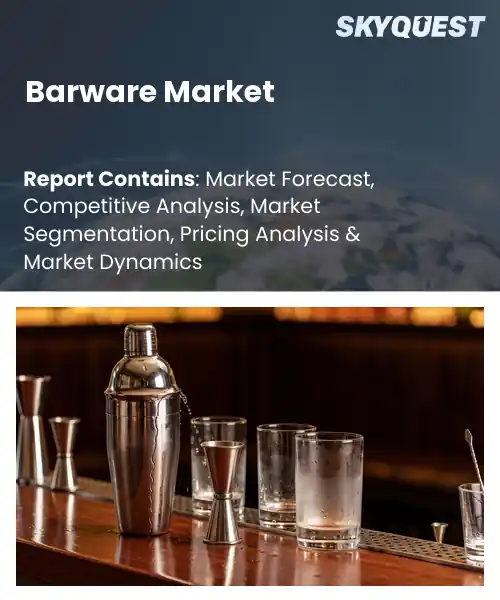
Barware Market
Report ID: SQMIG20I2910
Report ID: SQMIG20I2910
[email protected]
USA +1 351-333-4748
Report ID:
SQMIG20I2910 |
Region:
Global |
Published Date: April, 2026
Pages:
157
|Tables:
88
|Figures:
76


Global Barware Market size was valued at USD 3.42 Billion in 2024 and is poised to grow from USD 3.59 Billion in 2025 to USD 3.4 Billion by 2033, growing at a CAGR of 5.1% during the forecast period (2026-2033).
Barware market is primarily driven by rising consumer demand for premium at home drinking experiences, which reshapes product portfolios. The barware market includes glassware, cocktail tools, bar furniture and accessories used in households and hospitality, and it matters because it connects lifestyle trends with beverage industry revenues and supply chains. Over time the market shifted from utilitarian pieces toward artisanal and experiential items as craft cocktails and home bartending became popular; for example, speakeasy bars and televised mixology increased interest in specialized shakers and bitters. That maturation pushed manufacturers to innovate in materials, design collaborations and direct to consumer channels.Premiumization of beverage consumption acts as the factor accelerating global barware growth because higher spending consumers demand quality tools that enhance preparation and presentation, prompting retailers to expand assortments. As disposable incomes rose and home entertainment became focal during pandemic restrictions, sales of premium glassware, weighted shakers and temperature controlled tools increased, enabling mixologists and bartenders to replicate bar level cocktails at home. Consequently brands invest in storytelling, limited editions and sustainable materials to capture margins and loyalty, opening opportunities for collaborations with spirits houses, subscription boxes, and hospitality refurbishments that concretely translate consumer preference into scalable revenue streams globally.
How is AI enhancing product personalization in the global barware market?
AI is enhancing product personalization in the global barware market by combining consumer data with design and production tools. Key aspects include AI driven taste profiling that shapes recommended glass shapes and finishes, computer vision that links visual presentation to preferred cocktails, and adaptive manufacturing that supports bespoke engraving and modular components. Today brands and apps suggest drinks and match barware to user context, while retailers use algorithmic mixology and immersive experiences to make choices feel tailored and effortless. These shifts raise product relevance, strengthen brand loyalty, and streamline inventory and sourcing for venues.UniX AI January 2026, showcased a Wanda robot that identifies barware and prepares drinks, demonstrating how embodied AI personalizes service choices in real venues and helps operators scale tailored experiences with greater speed and consistency.
Market snapshot - (2026-2033)
Global Market Size
USD 3.42 Billion
Largest Segment
Plush/Fabric Toys (Cotton/Polyester)
Fastest Growth
Sustainable/Organic Soft Toys
Growth Rate
5.1% CAGR
To get more insights on this market click here to Request a Free Sample Report
Global barware market is segmented by material type, distribution channel (major revenue logic), target end-user and region. Based on material type, the market is segmented into Plush/Fabric Toys (Cotton/Polyester) and Sustainable/Organic Soft Toys. Based on distribution channel (major revenue logic), the market is segmented into Offline Retail (Specialty Toy Stores/Hypermarkets) and Online E-commerce & D2C Brands. Based on target end-user, the market is segmented into Infants & Toddlers (0-3 Years), Kids (3-12 Years) and Others (Collectors & Gifting). Based on region, the market is segmented into North America, Europe, Asia Pacific, Latin America and Middle East & Africa.
Online E-commerce & D2C Brands segment leads because digital channels provide direct access to specialty consumers, enabling targeted storytelling around craftsmanship and unique barware functions. Direct-to-consumer models reduce intermediaries, allowing rapid product iteration, personalized bundles, and subscription offerings that deepen engagement. Rich content, influencer partnerships, and streamlined fulfillment improve discovery and reduce purchase friction, which drives sustained demand for designer and functional barware products.
However, Offline Retail (Specialty Toy Stores/Hypermarkets) is emerging as the fastest growing channel as tactile product evaluation and curated displays boost premium conversions. Physical retail supports experiential activations, demonstrations, and cross-category merchandising that introduce barware to new buyers, creating discovery-driven growth and enabling partnerships with hospitality channels to scale wholesale and gifting opportunities.
Others (Collectors & Gifting) segment dominates because collector demand and gifting occasions prioritize design-led, limited-edition, and premium barware that command higher visibility and retail attention. Collectors value provenance and craftsmanship, driving brands to produce curated series and collaborations which elevate perceived value. Gifting cycles also concentrate purchases around celebrations, prompting retailers and brands to develop premium packaging and bundled offers that sustain steady revenue and brand prestige in the barware market.
Meanwhile, Kids (3-12 Years) is the fastest growing end-user niche as parental demand for safe, themed mocktail and training glassware expands. Innovation in unbreakable materials, playful designs, and educational sets encourages early brand affinity, while family-oriented marketing and bundling with beverage mixers create new household purchase occasions that broaden long-term customer pipelines for barware brands.
To get detailed segments analysis, Request a Free Sample Report
North America leads due to a combination of mature consumer preferences, a robust hospitality ecosystem, and a strong innovation pipeline from both established manufacturers and niche designers. Consumer interest in craft cocktails and home entertaining has driven demand for higher quality tools and experiential products, while premiumization encourages brand differentiation through design, materials, and functionality. Well developed retail and e-commerce channels enable rapid market scaling and product discovery. Professional training institutions and a vibrant bar culture support product adoption in on trade channels, and collaborative ventures between spirit brands and barware producers reinforce market visibility. Supply chain capabilities and access to advanced materials and finishing techniques further strengthen the region as a hub for both mass and artisanal barware offerings.
Barware Market in United States reflects a dynamic blend of premium artisanal offerings and accessible consumer lines, driven by a sophisticated cocktail culture and widespread interest in home mixology. Specialty retailers, independent designers, and large lifestyle brands coexist, fostering innovation in materials and ergonomics. On trade establishments and professional bartending influence product trends, while digital platforms accelerate niche product discovery. Sustainability and design provenance are increasingly important, prompting collaborations between spirits brands and barware makers to deliver curated, experience-focused assortments that cater to both consumers and hospitality professionals.
Barware Market in Canada is characterized by an expanding interest in craft beverages and seasonal entertaining, with consumers seeking functional yet design-forward pieces. Regional tastes and regulatory frameworks shape on trade demand, encouraging boutique bars and local producers to experiment with bespoke tools and glassware. Retail partnerships and online channels support distribution beyond urban centers, while emphasis on quality and craftsmanship attracts premium buyers. Import reliance coexists with emerging local artisans, creating a market environment where curated collections and sustainability claims resonate with discerning consumers and hospitality operators alike.
The European barware market is expanding rapidly due to a convergence of cultural appreciation for design, a thriving hospitality scene, and a consumer base that values craftsmanship and experiential consumption. Restaurateurs and bars focus on cocktail theatre and presentation, prompting demand for specialized tools and distinctive glassware. Cross-border trade and a network of niche manufacturers and artisanal studios support diverse product offerings, while retail innovation and the growth of boutique hospitality concepts enhance market access. Sustainability, heritage techniques, and contemporary design sensibilities combine to elevate product differentiation. Regional design traditions and a willingness to blend classic and modern aesthetics position Europe as a fertile ground for premium, collectible, and limited edition barware that appeals to both professionals and lifestyle consumers.
Barware Market in Germany benefits from a strong manufacturing tradition and emphasis on functional, precision engineering. Demand is driven by professional hospitality channels that prioritize durable, high-performance tools and glassware. Retailers and distributors favor products that combine reliable construction with understated design, appealing to both trade buyers and pragmatic consumers. Export orientation among manufacturers fosters international design influences while maintaining rigorous quality standards. The market supports both mass-market suppliers and specialized craftsmen who deliver technical innovation and refined finishing to meet exacting professional and consumer expectations.
Barware Market in United Kingdom is propelled by a vibrant cocktail culture and rapid retail innovation, with independent bars and mixology pioneers shaping consumer tastes. Trend-driven demand encourages experimentation with novel materials, bespoke sets, and designer collaborations. Evolving online retail and pop-up concepts enhance accessibility for niche and premium products, while social media and influencer activity accelerate trend adoption. Professional bartenders and hospitality incubators act as key trendsetters, driving interest in both performance-oriented tools and visually distinctive pieces that complement experiential drinking occasions and lifestyle consumption.
Barware Market in France is emerging through the integration of culinary artistry and beverage presentation, where elegance and aesthetic refinement guide product preferences. Boutique hotels, fine dining establishments, and boutique bars emphasize curated presentation, creating demand for stylish and often handcrafted barware. Consumers show interest in pieces that convey heritage and luxury, while independent artisans and small ateliers supply distinctive, design-led offerings. The market favors nuanced craftsmanship and visual storytelling, positioning barware as part of a broader lifestyle and hospitality experience that values both form and function.
Asia Pacific is strengthening its role through a combination of cultural adaptation, rising bar and restaurant sophistication, and growing domestic design capacity that fuses local aesthetics with global trends. Urbanization and an expanding middle class drive demand for experiential dining and premium beverages, prompting bars to invest in high-quality tools and distinctive presentation. Local manufacturers and designers increasingly offer products that reflect regional tastes and materials, while e-commerce platforms facilitate wide distribution. Cross-cultural influences lead to innovative form factors and hybrid designs, and hospitality training programs and cocktail competitions help professionalize the sector. Strategic collaborations between international brands and regional partners accelerate knowledge transfer and market penetration, enhancing the region's relevance in the global barware landscape.
Barware Market in Japan is distinguished by meticulous craftsmanship, minimalist aesthetics, and an appreciation for material integrity. Product preferences favor precision, refined finishing, and subdued elegance that complements a culture of connoisseurship. Department stores and curated retailers present carefully selected assortments, while artisans produce limited collections that appeal to collectors and professionals. Design influences often blend traditional techniques with contemporary mixology needs, resulting in tools and glassware that prioritize tactile quality and understated presentation for discerning consumers and hospitality establishments.
Barware Market in South Korea is shaped by fast-moving lifestyle trends and a strong urban cocktail scene that favors stylish, statement-making pieces. Consumers and bars show appetite for design-forward, compact, and portable solutions that suit modern entertaining and social media aesthetics. Fast adoption of online retail channels and influencer-driven product discovery accelerates trend cycles, while local designers create vibrant, contemporary assortments. The market values visually distinctive barware that complements dynamic hospitality concepts and elevates experiential drinking occasions across metropolitan centers.
To know more about the market opportunities by region and country, click here to
Buy The Complete Report
Rising Demand For Premium Barware
Innovation In Sustainable Materials
Rising Manufacturing and Material Costs
Regulatory Compliance Complexity
Request Free Customization of this report to help us to meet your business objectives.
The competitive landscape of the global barware market is defined by consolidation, brand partnerships, and product innovation that intensify rivalry around at-home mixology and premium presentation. Strategic moves include beverage and appliance partnerships that prototype new at-home experiences, investments by legacy spirits groups into DTC lifestyle retailers, and co-branded design collaborations between glassmakers and restaurants to capture premium gift and hospitality channels.
Top Player’s Company Profile
Recent Developments
SkyQuest’s ABIRAW (Advanced Business Intelligence, Research & Analysis Wing) is our Business Information Services team that Collects, Collates, Correlates, and Analyses the Data collected by means of Primary Exploratory Research backed by robust Secondary Desk research. As per SkyQuest analysis, the global barware market is being propelled by rising demand for premium at-home drinking experiences, which is reshaping product portfolios toward artisanal, design-led offerings and higher price points. North America remains the dominating region thanks to a mature cocktail culture and strong retail and hospitality ecosystems, while online e-commerce and D2C brands are the dominating segment in distribution by enabling direct storytelling and rapid product iteration. Growth is further supported by innovation in sustainable materials that appeals to environmentally conscious consumers, but rising manufacturing and material costs act as a key restraint, pressuring margins and limiting smaller producers’ ability to scale.
| Report Metric | Details |
|---|---|
| Market size value in 2024 | USD 3.42 Billion |
| Market size value in 2033 | USD 3.4 Billion |
| Growth Rate | 5.1% |
| Base year | 2024 |
| Forecast period | (2026-2033) |
| Forecast Unit (Value) | USD Billion |
| Segments covered |
|
| Regions covered | North America (US, Canada), Europe (Germany, France, United Kingdom, Italy, Spain, Rest of Europe), Asia Pacific (China, India, Japan, Rest of Asia-Pacific), Latin America (Brazil, Rest of Latin America), Middle East & Africa (South Africa, GCC Countries, Rest of MEA) |
| Companies covered |
|
| Customization scope | Free report customization with purchase. Customization includes:-
|
To get a free trial access to our platform which is a one stop solution for all your data requirements for quicker decision making. This platform allows you to compare markets, competitors who are prominent in the market, and mega trends that are influencing the dynamics in the market. Also, get access to detailed SkyQuest exclusive matrix.
Table Of Content
Executive Summary
Market overview
Parent Market Analysis
Market overview
Market size
KEY MARKET INSIGHTS
COVID IMPACT
MARKET DYNAMICS & OUTLOOK
Market Size by Region
KEY COMPANY PROFILES
Methodology
For the Barware Market, our research methodology involved a mixture of primary and secondary data sources. Key steps involved in the research process are listed below:
1. Information Procurement: This stage involved the procurement of Market data or related information via primary and secondary sources. The various secondary sources used included various company websites, annual reports, trade databases, and paid databases such as Hoover's, Bloomberg Business, Factiva, and Avention. Our team did 45 primary interactions Globally which included several stakeholders such as manufacturers, customers, key opinion leaders, etc. Overall, information procurement was one of the most extensive stages in our research process.
2. Information Analysis: This step involved triangulation of data through bottom-up and top-down approaches to estimate and validate the total size and future estimate of the Barware Market.
3. Report Formulation: The final step entailed the placement of data points in appropriate Market spaces in an attempt to deduce viable conclusions.
4. Validation & Publishing: Validation is the most important step in the process. Validation & re-validation via an intricately designed process helped us finalize data points to be used for final calculations. The final Market estimates and forecasts were then aligned and sent to our panel of industry experts for validation of data. Once the validation was done the report was sent to our Quality Assurance team to ensure adherence to style guides, consistency & design.
Analyst Support
Customization Options
With the given market data, our dedicated team of analysts can offer you the following customization options are available for the Barware Market:
Product Analysis: Product matrix, which offers a detailed comparison of the product portfolio of companies.
Regional Analysis: Further analysis of the Barware Market for additional countries.
Competitive Analysis: Detailed analysis and profiling of additional Market players & comparative analysis of competitive products.
Go to Market Strategy: Find the high-growth channels to invest your marketing efforts and increase your customer base.
Innovation Mapping: Identify racial solutions and innovation, connected to deep ecosystems of innovators, start-ups, academics, and strategic partners.
Category Intelligence: Customized intelligence that is relevant to their supply Markets will enable them to make smarter sourcing decisions and improve their category management.
Public Company Transcript Analysis: To improve the investment performance by generating new alpha and making better-informed decisions.
Social Media Listening: To analyze the conversations and trends happening not just around your brand, but around your industry as a whole, and use those insights to make better Marketing decisions.
REQUEST FOR SAMPLE
 REQUEST FREE CUSTOMIZATION


Want to customize this report? This report can be personalized according to your needs. Our analysts and industry experts will work directly with you to understand your requirements and provide you with customized data in a short amount of time. We offer $1000 worth of FREE customization at the time of purchase.
Feedback From Our Clients


 USA (+1) 351-333-4748

