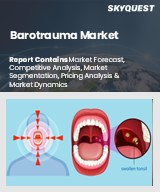
Barotrauma Market
Report ID: SQMIG35A3105
Report ID: SQMIG35A3105
[email protected]
USA +1 351-333-4748
Report ID:
SQMIG35A3105 |
Region:
Global |
Published Date: December, 2025
Pages:
187
|Tables:
99
|Figures:
71


Global Barotrauma Market size was valued at USD 1.18 Billion in 2024 and is poised to grow from USD 1.27 Billion in 2025 to USD 2.27 Billion by 2033, growing at a CAGR of 7.5% during the forecast period (2026–2033).
The global barotrauma market is being driven by the rising incidence of barotrauma stemming from increased air travel and recreational diving activities. As more people engage in commercial flights, adventure tourism, and underwater sports, cases of pressure-induced injuries from ear and sinus barotrauma to pulmonary complications have surged. This uptick has fueled demand for advanced diagnostic and treatment solutions across hospitals and specialty clinics. Healthcare providers are expanding clinical programs that integrate streamlined imaging, minimally invasive interventions, and tailored rehabilitation plans to address patients’ evolving needs while maintaining seamless care pathways.
One of the key trends driving the global barotrauma market is the integration of artificial intelligence and machine learning into diagnostic and monitoring platforms. Leading companies are incorporating AI-enabled algorithms in imaging systems and wearable sensors to identify early developments of tissue damage, allowing clinicians to act and intervene before returning to a baseline state. Predictive analytics has enabled personalized management strategies that shorten recovery time and yield improved patient outcomes. Partnerships between technology developers and medical devices have resulted in smart solutions entering the market much quicker than before, further supporting the shift toward proactive data-driven care models.
How AI-Enabled Diagnostic Platforms Enhance Early Detection and Personalized Management in the Global Barotrauma Market?
Artificial intelligence (AI) is transforming the global barotrauma industry trends by embedding advanced pattern‑recognition and predictive‑modeling capabilities into diagnostic workflows. AI-enabled imaging software can now assess CT and MRI scans in real-time, assessing minor tissue changes due to pressure, and signal clinicians to intervene. Machine learning algorithms improve the process of risk stratification. They do so by using patient history and dive profiles or flight profiles to allow clinicians to better design hypoxia treatment or provide finely tuned treatment regimens. These regimens range from oxygen therapy to pressure-equalization devices. Recently, a leader in medical imaging launched a cloud-based AI module which connects to hospital PACS systems to automatically indicate the condition and lower its diagnostic turnaround by over 30 percent.
Market snapshot - 2026-2033
Global Market Size
USD 1.1 billion
Largest Segment
Ear
Fastest Growth
Lung
Growth Rate
7.5% CAGR
To get more insights on this market click here to Request a Free Sample Report
Global Barotrauma Market is segmented by Barotrauma Type, Treatment, Diagnosis and region. Based on Barotrauma Type, the market is segmented into Ear, Sinus, Lung and Others. Based on Treatment, the market is segmented into Pressure Relief, Medications, Surgery, Oxygen Treatment, Recompression Therapy and Others. Based on Diagnosis, the market is segmented into Otoscopy, X-Ray, CT scan, Pulmonary Function Test, Lung Perfusion Scan, MRI, Pulse Oximetry and Others. Based on region, the market is segmented into North America, Europe, Asia Pacific, Latin America and Middle East & Africa.
Ear barotrauma is the dominates the global barotrauma market trends due to its high incidence and established diagnostic protocols. Clinicians frequently rely on otoscopy for rapid identification of middle‑ear pressure imbalance, and ongoing enhancements in handheld otoscopic devices have streamlined point‑of‑care evaluations. Recent integration of smartphone‑based visualization tools has further improved early detection rates, reducing complication risks. Health practitioners also benefit from standardized training modules that emphasize ear barotrauma management, reinforcing its leading share of clinical resources and research focus.
According to our global barotrauma market analysis, lung barotrauma is the fastest‑growing sub-segment, driven by rising use of advanced respiratory support. The growing use of mechanical ventilation in critical care has emphasized pulmonary pressure injuries, leading to the adoption of new fast-track protocols concerning ventilator settings and constant assessment. Real-time lung compliance sensors being developed by manufacturers will accomplish personal ventilation strategies. This technological emphasis on lung protection has accelerated research funding and device approvals, underscoring lung barotrauma’s rapid expansion.
Pressure relief is the dominant treatment within the global barotrauma market outlook, owing to its non‑invasive approach and ease of access. Medical guidelines routinely recommend tympanostomy tubes or a nasal decongestant as first-line interventions, and at the same time the introduction of over-the-counter pressure-equalization devices have increased patient self-management options. Clinicians are also using telehealth consultations to help patients perform at-home pressure relief exercises, providing evidence that continuous patient engagement embeds this sub-segment as the main line of therapy in the majority of care settings.
Recompression therapy is the most rapidly growing treatment and gives the highest global barotrauma market growth, running hand-in-glove with the emergence of portable chambers. The increase in mobile hyperbaric units creates access to treatment in remote or emergency contexts, while continued efforts at miniaturization have decreased set-up time for portable chambers. Grants provided for field deployable systems for military and adventure-medicine applications, increasing, coupled with a plethora of hyperbaric technician training courses offered allow ample access to an entrepreneurial continuum targeting the hypothetical relationships that exist in hyperbaric medicine.
To get detailed segments analysis, Request a Free Sample Report
North America is the dominant region in the global barotrauma industry due to its comprehensive clinical guidelines and sustained investment in barotrauma diagnostics. Health authorities have endorsed standardized screening protocols, encouraging widespread use of advanced otoscopy tools and imaging platforms. Recent public‑private partnerships accelerated the deployment of portable pressure‑monitoring devices in outpatient clinics. Additionally, reimbursement schemes in both the United States and Canada support integrated barotrauma care pathways, enabling rapid adoption of telehealth consultations for remote diagnosis and follow‑up. Together, these elements underpin North America’s market leadership and drive ongoing innovation in patient management.
United States dominates the North American barotrauma market share, thanks to its robust research infrastructure and early embrace of telehealth solutions. Major universities now provide virtual otology services with accompanying smartphone adapters, enhancing early‑stage detection. A pilot at an esteemed medical school illustrated a 20% reduction in complication rates from distributing home‑use pressure‑equalization kits. In parallel, the FDA has fast-tracked the approval of handheld imaging devices, enabling earlier availability of novel diagnostic devices, increasing the ability to scale into practice in the clinical environment and ultimately improve patient outcomes.
Canada is growing rapidly within the North American barotrauma regional forecast because of its significant public‑health funding and provincial telemedicine initiatives. Certain provinces equipped mobile clinics with portable CT scanners and pulmonary function testing units, enabling clinics to engage with more rural communities, providing timely care previously unavailable. In early 2025, a federal program bolstered online training modules on barotrauma management algorithms for rural practitioners, increasing the accuracy of diagnosis. This targeted effort has increased access to specialty care while simultaneously capturing an expanding dataset on efficacy of treatment in varying space and treatment design.
Asia Pacific is the fastest‑growing region within the global barotrauma market strategies, owing to escalating demand for advanced respiratory support and expanding critical‑care infrastructure. Hospitals in Japan and South Korea are incorporating new generation ventilators with real-time lung compliance measures that may help to prevent pulmonary pressure injuries from ventilators. Collaborative grants funded studies on the best ventilation protocols, culminating in socialized best practice guidance now being adopted at the region level. Moreover, device manufacturers have introduced AI imaging add-ons in an effort to improve diagnosis at bedside in acute care and critical care settings. These integrations collectively advance the region's quick expansion and showcase the potential for greater uptake of technology going forward.
Japan dominates the Asia Pacific barotrauma market revenue, due of its precision engineering heritage and strong clinical research partnerships. Japanese medical centers pilot smart ventilator interfaces that automatically adjust pressure settings based on feedback loops. In March 2025, a university consortium reported a 15% decline in lung barotrauma incidents by using these systems. National training programs in hyperbaric medicine also expanded access to recompression therapy, equipping technicians with certified protocols for diverse clinical environments.
South Korea is growing rapidly within the Asia Pacific barotrauma market forecast because of its widespread adoption of integrated tele‑monitoring platforms in critical care. Major hospital networks are already using pulse oximeter and lung compliance sensors with centralized dashboards to monitor and respond to changes in patient status. An exciting technology demonstration was recently conducted in Seoul with a small area recompression chamber intended for transport in an emergency situation. Government funding to support medical‑tech start‑ups has fast-tracked some regulatory approvals.
According to our global barotrauma market regional forecast, Europe is the emerging region because of its unified digital‑health strategies and emphasis on collaborative clinical trials. These projects involve integrating portable attachments for CT and remote otoscopy, as these improve the diagnostic footprint. A recent series of funded multicenter studies into mobile pressure‑relief devices were awarded Horizon Europe grants and resulted in new protocols for care now adopted by hospitals in member states. With a continued emphasis on interoperable standards and technology supported teaching for clinicians, Europe will continue to develop significant capabilities in the field of barotrauma research and patient management.
Germany is dominating the European barotrauma market trends, due to its advanced engineering sector and strong hospital‑industry alliances. Companies in Germany have launched smart otoscopy attachments that upload diagnostic pictures to an electronic health record. Just a key example, a medical device launched by a global leader was announced in April 2025 at a Berlin symposium with a next‑generation lung‑compliance sensor attached to an electronic record tablet. Support for regulatory agencies that facilitate their digital‑health designation has enabled medical device firms to complete pilot programs in university hospitals and collect and validate data from electronic health records and devices.
France is experiencing the highest European barotrauma market reveneue, due to its substantial public‑sector support for clinical innovation. National health organizations subsidized evaluations in pilot studies of mobile pulmonary testing units and advanced outpatient detection. Recent telehealth activities in the Île‑de‑France region employed diagnostic van units (with CT and MRI tools). The result of the investment doubled the rate of identifying early cases in suburban environments, stimulating ensuing interest in scalable models of care for barotrauma.
Spain is emerging in the European barotrauma market, with its regional tele‑consultation networks and university collaboration on innovation hubs. Quality centers making pneumatic pressure‑relief devices and AI image analysis comparisons are being secured in Catalonia and Andalusia. In May 2025, a Madrid hospital worked with a tech start‑up to pilot test portable recompression chambers for use in the field. Promising feedback in early studies suggested improved patient location of treatment adherence and overall accessibility to care using community clinics.
To know more about the market opportunities by region and country, click here to
Buy The Complete Report
Expansion of Mechanical Ventilation and ICU Infrastructure
Technological Advancements in Diagnostic Imaging and Otoscopy
Limited Awareness and Misdiagnosis in Non-Specialized Settings
High Cost and Limited Availability of Hyperbaric and Recompression Therapy
Request Free Customization of this report to help us to meet your business objectives.
The competitive landscape of the global barotrauma market is characterized by its major international players leveraging distinct global barotrauma market strategies to maintain market share. For instance, Sechrist Industries prioritizes expansive service networks and equipment rentals to ensure swift chamber access. Perry Baromedical focuses on modular chamber designs that simplify installation in diverse clinical settings. Macro trends here include integration of AI‑driven imaging for early barotrauma detection and expansion of telemedicine platforms to guide remote pressure‑relief therapy. The market has consistent stringent regulatory pathways, high equipment customization, and partnerships between device makers and hospital systems that drive tailored solution offerings.
The global barotrauma market is experiencing dynamic growth through the emergence of specialized startups which are pivotal in advancing barotrauma care by miniaturizing hardware and embedding digital diagnostic tools. Many have received venture funding that has allowed them to continue the refinement of AI-enabled otoscopy and real-time lung compliance sensors. Their cycle of prototype development and partnerships with university research centers advances the proof-of-concept studies. While they occupy a smaller revenue share, these innovators catalyze technology transfer to larger manufacturers and promote competitive differentiation through niche, high‑value offerings, which also ensures global barotrauma market penetration.
SkyQuest’s ABIRAW (Advanced Business Intelligence, Research & Analysis Wing) is our Business Information Services team that Collects, Collates, Correlates, and Analyses the Data collected by means of Primary Exploratory Research backed by robust Secondary Desk research.
As per SkyQuest analysis, the global barotrauma market is being propelled by the increased reliance on mechanical ventilation with additional ICU capacity that is escalating the rate of lung injuries while pushing the use of mature (and emerging) monitoring and intervention options. The reality is that widespread misdiagnosis in non-specialized environments still serves as a deterrent to adoption, with mild injuries often diagnosed as unrelated conditions that extend delays in appropriate care.
North America has dominated in terms of global share because of clinical practice guidelines, reimbursement, and an environment which encourages investment in diagnostic innovations like portable otoscopy and pressure monitoring tools. When examining the market segments, ear barotrauma is the biggest overall contributor given its higher incidence and more recent development of standardized diagnosis pathways and smartphone-based visualizations that facilitate early diagnosis and ultimately support ongoing professional practice.
| Report Metric | Details |
|---|---|
| Market size value in 2024 | USD 1.18 Billion |
| Market size value in 2033 | USD 2.27 Billion |
| Growth Rate | 7.5% |
| Base year | 2024 |
| Forecast period | 2026-2033 |
| Forecast Unit (Value) | USD Billion |
| Segments covered |
|
| Regions covered | North America (US, Canada), Europe (Germany, France, United Kingdom, Italy, Spain, Rest of Europe), Asia Pacific (China, India, Japan, Rest of Asia-Pacific), Latin America (Brazil, Rest of Latin America), Middle East & Africa (South Africa, GCC Countries, Rest of MEA) |
| Companies covered |
|
| Customization scope | Free report customization with purchase. Customization includes:-
|
To get a free trial access to our platform which is a one stop solution for all your data requirements for quicker decision making. This platform allows you to compare markets, competitors who are prominent in the market, and mega trends that are influencing the dynamics in the market. Also, get access to detailed SkyQuest exclusive matrix.
Table Of Content
Executive Summary
Market overview
Parent Market Analysis
Market overview
Market size
KEY MARKET INSIGHTS
COVID IMPACT
MARKET DYNAMICS & OUTLOOK
Market Size by Region
KEY COMPANY PROFILES
Methodology
For the Barotrauma Market, our research methodology involved a mixture of primary and secondary data sources. Key steps involved in the research process are listed below:
1. Information Procurement: This stage involved the procurement of Market data or related information via primary and secondary sources. The various secondary sources used included various company websites, annual reports, trade databases, and paid databases such as Hoover's, Bloomberg Business, Factiva, and Avention. Our team did 45 primary interactions Globally which included several stakeholders such as manufacturers, customers, key opinion leaders, etc. Overall, information procurement was one of the most extensive stages in our research process.
2. Information Analysis: This step involved triangulation of data through bottom-up and top-down approaches to estimate and validate the total size and future estimate of the Barotrauma Market.
3. Report Formulation: The final step entailed the placement of data points in appropriate Market spaces in an attempt to deduce viable conclusions.
4. Validation & Publishing: Validation is the most important step in the process. Validation & re-validation via an intricately designed process helped us finalize data points to be used for final calculations. The final Market estimates and forecasts were then aligned and sent to our panel of industry experts for validation of data. Once the validation was done the report was sent to our Quality Assurance team to ensure adherence to style guides, consistency & design.
Analyst Support
Customization Options
With the given market data, our dedicated team of analysts can offer you the following customization options are available for the Barotrauma Market:
Product Analysis: Product matrix, which offers a detailed comparison of the product portfolio of companies.
Regional Analysis: Further analysis of the Barotrauma Market for additional countries.
Competitive Analysis: Detailed analysis and profiling of additional Market players & comparative analysis of competitive products.
Go to Market Strategy: Find the high-growth channels to invest your marketing efforts and increase your customer base.
Innovation Mapping: Identify racial solutions and innovation, connected to deep ecosystems of innovators, start-ups, academics, and strategic partners.
Category Intelligence: Customized intelligence that is relevant to their supply Markets will enable them to make smarter sourcing decisions and improve their category management.
Public Company Transcript Analysis: To improve the investment performance by generating new alpha and making better-informed decisions.
Social Media Listening: To analyze the conversations and trends happening not just around your brand, but around your industry as a whole, and use those insights to make better Marketing decisions.
REQUEST FOR SAMPLE
 REQUEST FREE CUSTOMIZATION


Want to customize this report? This report can be personalized according to your needs. Our analysts and industry experts will work directly with you to understand your requirements and provide you with customized data in a short amount of time. We offer $1000 worth of FREE customization at the time of purchase.
Feedback From Our Clients


 USA (+1) 351-333-4748

