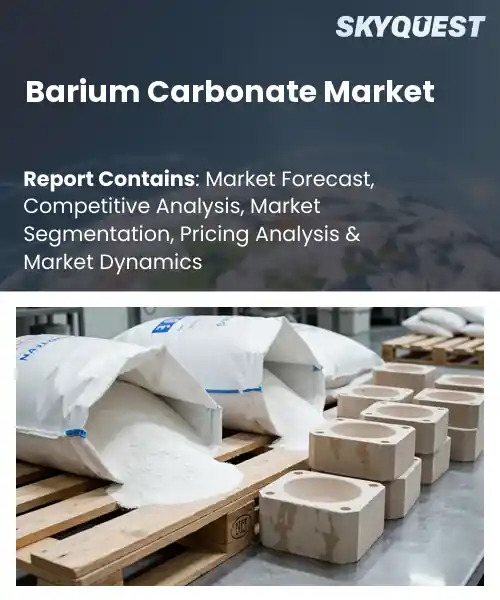
Barium Carbonate Market
Report ID: SQMIG15E3500
Report ID: SQMIG15E3500
[email protected]
USA +1 351-333-4748
Report ID:
SQMIG15E3500 |
Region:
Global |
Published Date: May, 2026
Pages:
157
|Tables:
128
|Figures:
77


Global Barium Carbonate Market size was valued at USD 689.3 Million in 2024 and is poised to grow from USD 715.49 Million in 2025 to USD 964.24 Million by 2033, growing at a CAGR of 3.8% during the forecast period (2026-2033).
The barium carbonate market centers on an inorganic compound used in glass, ceramics and oilfield chemical formulations, and its primary driver has been demand for advanced specialty glass and ceramics that require precise refractive and physical properties. Over decades production shifted from small batch mineral-derived processes to scaled synthetic routes driven by industrial chemistry improvements and geographic concentration of feedstock suppliers, which lowered costs and increased consistency. This evolution matters because more reliable supply enables downstream manufacturers to design higher-performance products, for example optical lenses and ceramic insulators, while regulatory changes and environmental considerations have reshaped sourcing and processing practices.
A key factor driving global barium carbonate growth is the expanding application in electronic ceramics and high-refractive-index glass where performance gains translate into premium pricing and volumes. As consumer electronics and optical instrument manufacturers demand thinner lenses and more precise dielectric constants, producers increase capacity and invest in higher-purity production methods which lowers impurity-related rejects and unlocks new contracts. This cause creates opportunities for downstream integration into LED phosphors and oil-well drilling additives, and it encourages regional players to form long-term offtake agreements, spurring R&D into greener extraction and recycling techniques with commercial implications.
How is AI optimizing supply chain forecasting in the barium carbonate market?
AI is optimizing supply chain forecasting in the barium carbonate market by integrating demand sensing, supplier risk mapping, inventory optimization and material quality prediction. Models take in order history, market signals, shipping updates and supplier performance to anticipate supply interruptions and suggest sourcing shifts. The market context features growing demand from electronics and specialty ceramics plus trade measures that make lead times and grades more variable. In practice AI supports scenario planning for disruptions, predictive maintenance at processing sites and synthetic data driven quality forecasts that help producers and buyers reduce stockouts and respond faster to shifting end use needs.
Voyageur March 2026, announced advancements on its barium projects and vertical integration plans that increase visibility across the feedstock to finished product chain. This development provides richer, timelier data inputs so AI forecasting can better align sourcing with production, improving supply reliability and operational efficiency.
Market snapshot - (2026-2033)
Global Market Size
USD 689.3 Million
Largest Segment
Industrial Grade
Fastest Growth
Electronic Grade
Growth Rate
3.8% CAGR
To get more insights on this market click here to Request a Free Sample Report
Global barium carbonate market is segmented by product grade, application, end-use industry, distribution channel and region. Based on product grade, the market is segmented into Industrial Grade, Electronic Grade, Chemical Reagent Grade, High Purity Grade and Others. Based on application, the market is segmented into Ceramics, Glass Manufacturing, Brick & Clay Products, Ferrite & Electronic Components, Chemical Manufacturing, Water Treatment Chemicals, Rubber & Plastics Additives and Others. Based on end-use industry, the market is segmented into Construction Materials, Electronics & Electrical, Chemicals, Glass Industry, Automotive, Industrial Manufacturing and Others. Based on distribution channel, the market is segmented into Direct Sales, Distributors & Traders and Online/Industrial E-commerce. Based on region, the market is segmented into North America, Europe, Asia Pacific, Latin America and Middle East & Africa.
Industrial Grade segment dominates because it meets the bulk performance needs of ceramics and glass manufacturers where high purity is not critical. Its cost effectiveness, compatibility with large scale firing and glazing processes, and tolerance for broader impurity profiles make it the preferred choice for routine formulations. Reliable supply chains and familiarity among production engineers further reinforce its central position in long established manufacturing workflows.
However, Electronic Grade is emerging as the most rapidly expanding area because demand for cleaner, tightly controlled powders is rising with advanced electronic dielectric and ferrite applications. Stringent quality requirements and particle size control drive suppliers to adopt refined production and certification practices, creating new high margin opportunities and enabling barium carbonate to serve specialized electronic component markets.
Ceramics segment dominates because barium carbonate is integral to glaze chemistry and body fluxing, improving vitrification, color responses and surface quality across traditional and specialty ceramics. Its multifunctional role in tiles, sanitary ware and decorative ceramics makes it a consistent additive of choice. Manufacturers rely on its predictable effects to reduce glaze defects and enhance finished product durability, anchoring steady demand within established formulation practices.
On the other hand, Ferrite & Electronic Components is the fastest growing area as demand for miniature inductors and high performance ferrites grows with electronics innovation. Requirements for precise material properties drive investments in tailored barium carbonate grades and particle engineering, unlocking premium component performance and new high value application opportunities.
To get detailed segments analysis, Request a Free Sample Report
Asia Pacific dominance is driven by a concentrated ecosystem of end use industries that demand consistent access to specialty inorganic chemicals. Integrated manufacturing clusters in the region link chemical producers with major consumers in electronics, advanced ceramics, glass, and specialty coatings, creating reliable throughput from raw materials to finished components. Strong technological capabilities in material formulation and quality control in leading markets support high purity requirements and product customization. Efficient logistics networks and supplier ecosystems reduce lead times and enable flexible sourcing, while strategic investments in processing infrastructure sustain capacity and resilience. Collaborative ties between research institutions and industry further advance product performance, reinforcing the region as a primary center for both production and innovation in the barium carbonate market.
Barium Carbonate Market in Japan is characterized by demand for high purity material for precision electronics, dielectric ceramics, and specialized glass. Established chemical manufacturers emphasize stringent quality control and material consistency to support sophisticated supply chains. Close collaboration between research institutes and industry drives development of tailored formulations and advanced processing techniques. The market benefits from mature logistics infrastructure and a focus on high value applications that prioritize reliability and performance over commoditized supply.
Barium Carbonate Market in South Korea is shaped by a strong electronics and petrochemical manufacturing base that seeks dependable feedstock for glass, ceramics, and chemical intermediates. Domestic producers align with large downstream manufacturers to ensure supply chain continuity and to meet technical specifications. Emphasis on export oriented production and process efficiency supports steady demand for quality materials. Strategic partnerships and investment in processing capabilities enable responsiveness to evolving application requirements in regional and global markets.
Rapid expansion in Europe is fueled by a convergence of industrial modernization, application diversification, and proximity to high value manufacturing sectors. Demand from automotive, advanced ceramics, specialty glass, and chemical processing industries has elevated need for tailored barium carbonate grades that meet strict European technical and environmental standards. Strong capabilities in material science and targeted investments by chemical firms support product innovation and value added offerings. Emerging suppliers leverage established distribution networks and compliance expertise to access complex supply chains. Regional collaboration between manufacturers and research entities accelerates development of specialty formulations for optics and electronics. The combination of stringent quality expectations and growing niche applications positions Europe as a dynamic expansion arena within the global market.
Barium Carbonate Market in Germany is anchored by a robust chemical industry and a dense network of precision manufacturers in automotive and industrial ceramics. Local producers emphasize high quality production and integration with downstream engineering firms to deliver application specific grades. Strong industrial standards and close supplier relationships support complex procurement needs. The market reflects a preference for reliable supply chains and advanced material performance suited to demanding technical applications across sectors.
Barium Carbonate Market in United Kingdom exhibits emerging demand driven by specialty chemicals, research led innovation, and niche manufacturing in coatings and glass technology. Academic and industrial collaboration fuels development of high purity formulations and novel uses. Market participants focus on agility and customized service models to meet sophisticated customer requirements. Growth is supported by a diverse mix of domestic consumption and strategic trade linkages that facilitate access to broader European and global supply networks.
Barium Carbonate Market in France is experiencing rapid growth driven by investments in advanced glass, optical components, and specialty ceramics. Manufacturers and research institutions collaborate to enhance material performance for high end applications. Emphasis on product quality, industrial design, and applied research helps capture emerging opportunities. The market benefits from targeted industrial policies and growing demand for differentiated material solutions that align with regional manufacturing strengths and export oriented strategies.
North America is reinforcing its role through strategic capacity development, emphasis on supply chain resilience, and focus on high value end markets. Regional players are concentrating on securing feedstock reliability and on enhancing processing capabilities to produce consistent, application ready grades. Collaboration between manufacturers and technology developers promotes material innovation for electronics, specialty glass, and industrial ceramics. Attention to environmental compliance and sustainable sourcing practices supports market acceptance among quality conscious customers. Enhanced distribution frameworks and partnerships aim to reduce dependence on distant supply sources while improving responsiveness to customer specifications. Together, these efforts elevate North America as a region improving its competitiveness in the global barium carbonate landscape.
Barium Carbonate Market in United States is characterized by strong demand from electronics, industrial ceramics, and specialty chemical sectors that prioritize consistent quality and supply reliability. Domestic manufacturers and distributors focus on value added services, technical support, and tailored formulations to meet complex specifications. Investment in processing and quality assurance enhances market readiness for high purity applications. The market benefits from extensive logistics networks and a business environment that encourages collaboration between industry and research institutions.
Barium Carbonate Market in Canada is supported by chemical processing clusters and a focus on supplying regional manufacturers with dependable material grades. Emphasis on sustainable sourcing and manufacturing practices aligns with customer expectations for environmental stewardship. Producers and distributors work closely with downstream industries to ensure material suitability for glass, ceramics, and specialty applications. The market leverages proximity to North American supply chains and prioritizes stable supply relationships and technical service.
To know more about the market opportunities by region and country, click here to
Buy The Complete Report
Growing Glass and Ceramics Demand
Rising Electronics and Ferroelectric Applications
Stringent Environmental and Safety Regulations
Availability Of Alternative Materials
Request Free Customization of this report to help us to meet your business objectives.
Competition in the global barium carbonate market is driven by consolidation and technology differentiation, evidenced by strategic divestitures, licensing and spin outs. Recent M&A and divestiture activity, research lab spin outs that license barium based material technology, and wafer scale barium titanate commercialization are shifting procurement toward vertically integrated suppliers and creating technical differentiation among competitors.
SkyQuest’s ABIRAW (Advanced Business Intelligence, Research & Analysis Wing) is our Business Information Services team that Collects, Collates, Correlates, and Analyses the Data collected by means of Primary Exploratory Research backed by robust Secondary Desk research.
As per SkyQuest analysis, the global barium carbonate market is gaining momentum primarily from expanding applications in electronic ceramics and high‑refractive‑index glass, while growth is also supported by rising demand in glass and traditional ceramics. However stringent environmental and safety regulations for soluble barium compounds constrain production, handling and downstream use, increasing compliance costs. Asia Pacific remains the dominant region due to integrated manufacturing clusters and robust supply chains, and industrial grade barium carbonate is the leading segment because it meets bulk performance needs and cost expectations. Ongoing investments in higher-purity production and vertical integration are likely to shape supplier strategies and premiumization.
| Report Metric | Details |
|---|---|
| Market size value in 2024 | USD 689.3 Million |
| Market size value in 2033 | USD 964.24 Million |
| Growth Rate | 3.8% |
| Base year | 2024 |
| Forecast period | (2026-2033) |
| Forecast Unit (Value) | USD Million |
| Segments covered |
|
| Regions covered | North America (US, Canada), Europe (Germany, France, United Kingdom, Italy, Spain, Rest of Europe), Asia Pacific (China, India, Japan, Rest of Asia-Pacific), Latin America (Brazil, Rest of Latin America), Middle East & Africa (South Africa, GCC Countries, Rest of MEA) |
| Companies covered |
|
| Customization scope | Free report customization with purchase. Customization includes:-
|
To get a free trial access to our platform which is a one stop solution for all your data requirements for quicker decision making. This platform allows you to compare markets, competitors who are prominent in the market, and mega trends that are influencing the dynamics in the market. Also, get access to detailed SkyQuest exclusive matrix.
Table Of Content
Executive Summary
Market overview
Parent Market Analysis
Market overview
Market size
KEY MARKET INSIGHTS
COVID IMPACT
MARKET DYNAMICS & OUTLOOK
Market Size by Region
KEY COMPANY PROFILES
Methodology
For the Barium Carbonate Market, our research methodology involved a mixture of primary and secondary data sources. Key steps involved in the research process are listed below:
1. Information Procurement: This stage involved the procurement of Market data or related information via primary and secondary sources. The various secondary sources used included various company websites, annual reports, trade databases, and paid databases such as Hoover's, Bloomberg Business, Factiva, and Avention. Our team did 45 primary interactions Globally which included several stakeholders such as manufacturers, customers, key opinion leaders, etc. Overall, information procurement was one of the most extensive stages in our research process.
2. Information Analysis: This step involved triangulation of data through bottom-up and top-down approaches to estimate and validate the total size and future estimate of the Barium Carbonate Market.
3. Report Formulation: The final step entailed the placement of data points in appropriate Market spaces in an attempt to deduce viable conclusions.
4. Validation & Publishing: Validation is the most important step in the process. Validation & re-validation via an intricately designed process helped us finalize data points to be used for final calculations. The final Market estimates and forecasts were then aligned and sent to our panel of industry experts for validation of data. Once the validation was done the report was sent to our Quality Assurance team to ensure adherence to style guides, consistency & design.
Analyst Support
Customization Options
With the given market data, our dedicated team of analysts can offer you the following customization options are available for the Barium Carbonate Market:
Product Analysis: Product matrix, which offers a detailed comparison of the product portfolio of companies.
Regional Analysis: Further analysis of the Barium Carbonate Market for additional countries.
Competitive Analysis: Detailed analysis and profiling of additional Market players & comparative analysis of competitive products.
Go to Market Strategy: Find the high-growth channels to invest your marketing efforts and increase your customer base.
Innovation Mapping: Identify racial solutions and innovation, connected to deep ecosystems of innovators, start-ups, academics, and strategic partners.
Category Intelligence: Customized intelligence that is relevant to their supply Markets will enable them to make smarter sourcing decisions and improve their category management.
Public Company Transcript Analysis: To improve the investment performance by generating new alpha and making better-informed decisions.
Social Media Listening: To analyze the conversations and trends happening not just around your brand, but around your industry as a whole, and use those insights to make better Marketing decisions.
REQUEST FOR SAMPLE
 REQUEST FREE CUSTOMIZATION
Global Barium Carbonate Market size was valued at USD 689.3 Million in 2024 and is poised to grow from USD 715.49 Million in 2025 to USD 964.24 Million by 2033, growing at a CAGR of 3.8% during the forecast period (2026-2033).
Competition in the global barium carbonate market is driven by consolidation and technology differentiation, evidenced by strategic divestitures, licensing and spin outs. Recent M&A and divestiture activity, research lab spin outs that license barium based material technology, and wafer scale barium titanate commercialization are shifting procurement toward vertically integrated suppliers and creating technical differentiation among competitors. 'Solvay', 'Sakai Chemical Industry', 'Nippon Chemical Industrial', 'Chemical Products Corporation', 'Shandong Xinke Environmental Chemistry', 'Hebei Xinji Chemical Group', 'Fengda Group', 'Guizhou Redstar Developing', 'Zaozhuang Yongli Chemical', 'Shandong Qilu King-Phar Pharmaceutical', 'Yingfengyuan Industrial Group', 'Lianyungang Jinhong Mining', 'Hubei Jingshan Chutian Barium Salt', 'Hunan Liuyang Chemical', 'Xinji Chemical Group', 'Yuci Jintai Barium Salt Chemical', 'Yingkou Tanyun Chemical Research Institute', 'Baerlocher', 'Merck KGaA', 'Noah Technologies Corporation'
Barium carbonate serves as a key flux and stabilizer in the production of glass and ceramic glazes, improving melting behavior and color stability, which makes it sought after by manufacturers. As demand for high-quality architectural and technical ceramics rises, producers increasingly rely on barium carbonate to meet performance specifications and aesthetic requirements. This consistent application in formulation encourages manufacturers to secure reliable supplies and supports investment in production capacity, thereby strengthening market growth through sustained industrial demand and deeper integration into supply chains.
High-Purity Grade Demand: Producers and downstream manufacturers increasingly prioritize high-purity barium carbonate to meet stricter performance requirements in advanced ceramics, electronic components, and specialty glass formulations. This shift drives suppliers to develop tailored grades, tighter impurity control, and enhanced technical support, creating opportunities for premiumization and long-term supply relationships. Value is captured through customized particle size distributions, consistency assurances, and collaborative R&D with customers to enable superior dielectric properties and process reliability, supporting differentiation across high-value end markets and strengthen collaborative innovation efforts.
Why does Asia Pacific Dominate the Global Barium Carbonate Market? |@12


Want to customize this report? This report can be personalized according to your needs. Our analysts and industry experts will work directly with you to understand your requirements and provide you with customized data in a short amount of time. We offer $1000 worth of FREE customization at the time of purchase.
Feedback From Our Clients


 USA (+1) 351-333-4748

