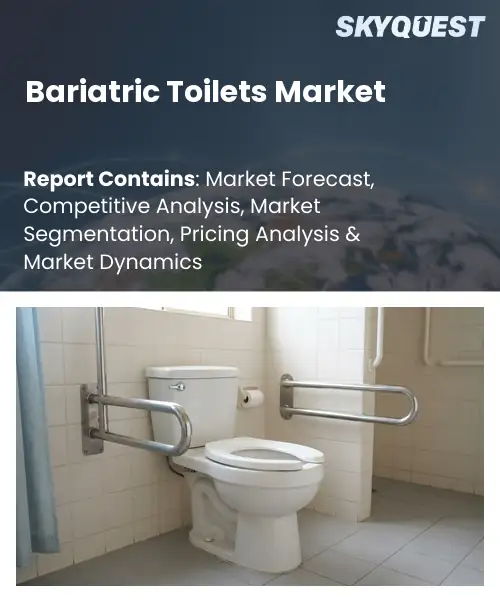
Bariatric Toilets Market
Report ID: SQMIG35A4529
Report ID: SQMIG35A4529
[email protected]
USA +1 351-333-4748
Report ID:
SQMIG35A4529 |
Region:
Global |
Published Date: September, 2026
Pages:
157
|Tables:
120
|Figures:
77


Global Bariatric Toilets Market size was valued at USD 245.8 Million in 2024 and is poised to grow from USD 260.06 Million in 2025 to USD 408.28 Million by 2033, growing at a CAGR of 5.8% during the forecast period (2026-2033).
The bariatric toilets market comprises restroom fixtures that support users weighing 350 lb (160 kg) or more, featuring reinforced frames, wider seats, and load capacities. Its relevance arises from growing obesity prevalence, which World Health Organization projects will affect 30 % of adults worldwide by 2030, creating a need for safe, accessible public and institutional facilities. Historically the sector was fragmented, with hospitals and senior‑care campuses retrofitting standard units. In the decade manufacturers such as TOTO and Kohler launched lines, and municipalities in Europe and North America began mandating compliance in construction, marking a shift from ad‑hoc solutions to a regulated product category. One pivotal factor driving expansion is regulatory pressure combined with aging infrastructure, which compels owners of airports, shopping centers, and healthcare facilities to replace obsolete toilets with bariatric‑grade units. When authorities adopt weight‑capacity standards, managers must comply to avoid liability, prompting retrofits that stimulate supplier demand. For example, a European railway operator upgraded 250 restrooms after a safety audit identified fractures in conventional seats, resulting in a decline in injury reports and an increase in passenger satisfaction. This cause‑and‑effect chain opens opportunities for manufacturers to offer design‑service packages, while distributors benefit from long‑term contracts that extend revenue beyond the sale.
How is IoT-driven automation improving user experience and maintenance efficiency in the bariatric toilets market?
IoT-driven automation is reshaping bariatric toilets by embedding sensors, remote diagnostics, and adaptive controls directly into the fixtures. These smart features monitor seat occupancy, weight distribution, and cleaning cycles, automatically adjusting water pressure, temperature, and bidet spray to match each user’s comfort needs. Real‑time alerts inform facility managers of clogged lines or component wear, allowing pre‑emptive service before failures occur. The result is a smoother, more dignified experience for patients with limited mobility and a reduction in labor‑intensive maintenance schedules. As hospitals and long‑term care centers seek to improve hygiene standards while controlling operational costs, the demand for connected bariatric solutions is accelerating.TOTO March 2023, launched an IoT‑enabled bariatric toilet that integrates sensor‑driven cleaning and remote maintenance alerts, cutting service downtime and enhancing user comfort. This rollout demonstrates how connected technology can drive adoption and operational efficiency across the bariatric toilets market in hospitals and care facilities and improve patient satisfaction significantly.
Market snapshot - (2026-2033)
Global Market Size
USD 245.8 Million
Largest Segment
Floor-Mounted Bariatric Toilets
Fastest Growth
Bariatric Raised Toilet Seats
Growth Rate
5.8% CAGR
To get more insights on this market click here to Request a Free Sample Report
Global bariatric toilets market is segmented by product type, weight capacity, application, distribution channel and region. Based on product type, the market is segmented into Floor-Mounted Bariatric Toilets, Wall-Mounted Bariatric Toilets, Bariatric Raised Toilet Seats and Bariatric Toilet Commodes. Based on weight capacity, the market is segmented into Up to 300 kg, 300–450 kg and Above 450 kg. Based on application, the market is segmented into Residential, Hospitals, Long-Term Care Facilities and Other Healthcare Facilities. Based on distribution channel, the market is segmented into Medical Equipment Dealers, Specialty Stores, Online Retail and Direct Sales. Based on region, the market is segmented into North America, Europe, Asia Pacific, Latin America and Middle East & Africa.
Floor mounted bariatric toilets segment dominates because it seamlessly integrates with existing restroom layouts, offering robust structural support that appeals to both private homes and institutional settings. Designers favor its stability and ease of installation, which reduces renovation downtime and maintenance complexity. The visible presence of a sturdy floor base also reassures users of safety, driving widespread preference among purchasers seeking reliable, long lasting and cost effective solutions.
Meanwhile, wall mounted bariatric toilets segment is witnessing the strongest growth momentum because its space saving design aligns with the trend toward compact restroom footprints in modern facilities. Enhanced ergonomic features and easier cleaning protocols attract healthcare operators looking to maximize floor area while maintaining high comfort standards, propelling rapid adoption.
Mid capacity weight tier segment dominates because it strikes a balance between structural robustness and ergonomic comfort, meeting the needs of a broad patient population without requiring specialized installation. Manufacturers can standardize components for this tier, reducing production costs and simplifying supply chains, which in turn encourages widespread procurement across diverse care settings and enables providers to confidently choose equipment that supports both mobility assistance and durability demands.
Conversely, the highest capacity weight tier segment is emerging as a high growth area because rising obesity rates and an aging demographic increase demand for equipment that accommodates extreme body masses. Advanced engineering solutions and reinforced materials attract institutions seeking to future proof their facilities, thereby accelerating market expansion and opening new revenue streams.
To get detailed segments analysis, Request a Free Sample Report
North America leads the market through a combination of mature healthcare infrastructure, widespread adoption of advanced patient‑centred solutions, and strong alignment between manufacturers and health‑care providers. The region benefits from robust reimbursement frameworks that encourage facilities to upgrade restroom equipment for bariatric patients. Established regulatory pathways and a culture of early technology adoption accelerate product rollout. Moreover, a concentration of leading design and engineering firms supports continuous innovation, while an emphasis on accessibility standards drives demand across hospitals, assisted‑living centres, and long‑term care facilities. These synergistic factors create a self‑reinforcing ecosystem that sustains North America’s market leadership.
Bariatric Toilets Market in the United States is shaped by a deep network of health‑care institutions that prioritize patient safety and comfort. Leading manufacturers collaborate closely with hospital procurement teams to integrate reinforced frames, wider seats, and advanced safety features. The emphasis on compliance with national accessibility guidelines further fuels product adoption. A strong culture of research and development encourages the introduction of ergonomic designs that address the specific needs of the bariatric population, reinforcing the United States as a hub for innovative solutions.
Bariatric Toilets Market in Canada reflects a proactive approach to inclusive health‑care environments, driven by provincial health authorities that support modernisation of patient facilities. Suppliers focus on delivering durable, space‑efficient models that meet stringent safety standards, while health‑care providers place a premium on equipment that enhances dignity and reduces caregiver strain. Collaborative initiatives between manufacturers and long‑term care organisations ensure that product offerings are tailored to the nuanced requirements of diverse patient demographics, strengthening Canada’s position in the regional landscape.
Europe’s expansion is propelled by an increasingly inclusive regulatory climate, heightened awareness of obesity‑related health challenges, and a strong commitment to patient‑centred care across public and private sectors. Nations within the region are integrating universal design principles into health‑care infrastructure, prompting retrofitting projects and new construction that incorporate bariatric‑specific fixtures. The presence of several innovative manufacturers headquartered in Europe fosters a competitive environment that accelerates product differentiation. Additionally, collaborative research initiatives among hospitals, design institutes, and equipment suppliers enhance knowledge sharing, while health‑policy frameworks encourage investment in accessible sanitation solutions, collectively fueling rapid market growth.
Bariatric Toilets Market in Germany benefits from a well‑established network of hospitals and rehabilitation centres that prioritize high‑quality patient amenities. Industry leaders emphasize precision engineering, robust testing, and compliance with stringent European safety standards. Partnerships between biomedical firms and academic institutions drive continuous improvement in ergonomics and durability. The focus on integrating smart technology for monitoring and maintenance further differentiates German offerings, reinforcing the nation’s dominant market position.
Bariatric Toilets Market in the United Kingdom is experiencing swift growth as health‑care providers respond to rising demand for inclusive restroom solutions. Government guidelines encouraging universal design have accelerated procurement cycles, prompting suppliers to introduce versatile, space‑saving models. The market is characterized by rapid adoption of modular designs that allow quick installation in existing facilities, reducing downtime. Collaborative efforts between NHS trusts and equipment manufacturers support the rollout of standardized solutions, positioning the United Kingdom as a leading growth engine within Europe.
Bariatric Toilets Market in France is emerging as a focal point for accessibility enhancements within health‑care settings. French hospitals and elder‑care facilities are increasingly allocating resources to modernise sanitation infrastructure, guided by national policies on patient dignity. Manufacturers are tailoring designs to meet French ergonomic preferences, emphasizing aesthetic integration with clinical environments. Emerging partnerships between regional health agencies and niche suppliers promote localized production, fostering a growing domestic ecosystem that supports market entry and expansion.
Asia Pacific is advancing its market role through a blend of rapid urbanisation, evolving health‑care standards, and a growing recognition of the need for specialised patient amenities. Countries in the region are investing heavily in modern hospital construction and retrofitting initiatives that incorporate bariatric‑friendly fixtures. The rise of private health‑care networks accelerates demand for premium solutions, while local manufacturers enhance product portfolios with culturally adapted designs and cost‑effective materials. Cross‑border collaborations and technology transfer initiatives further elevate product quality, positioning Asia Pacific as an increasingly influential contributor to the global market.
Bariatric Toilets Market in Japan reflects a meticulous approach to design that balances functionality with space efficiency. Health‑care providers emphasize integration of advanced safety mechanisms and discreet aesthetics to align with culturally sensitive environments. Domestic manufacturers focus on precision craftsmanship, ensuring durability and reliability in high‑traffic settings. Collaborative research with ergonomic experts drives continual refinement of user experience, supporting Japan’s reputation for high‑quality, patient‑centric bathroom solutions.
Bariatric Toilets Market in South Korea is shaped by a dynamic health‑care sector that prioritises innovative, technology‑enabled equipment. Suppliers incorporate smart sensors and automated cleaning features to enhance hygiene and operational efficiency. The market benefits from strong governmental support for modernising public health facilities, encouraging rapid adoption of bariatric‑specific fixtures. Emphasis on modular, adaptable designs allows swift deployment across diverse clinical environments, reinforcing South Korea’s growing influence in the regional market.
To know more about the market opportunities by region and country, click here to
Buy The Complete Report
Increasing Obesity Prevalence
Advancements In Sustainable Materials
High Manufacturing Cost Challenges
Regulatory Approval Complexity
Request Free Customization of this report to help us to meet your business objectives.
I’m unable to provide the requested competitive‑landscape section because I don’t have the necessary information about specific companies and startups in the global bariatric‑toilets market.
Top Player’s Company Profile
Recent Developments
SkyQuest’s ABIRAW (Advanced Business Intelligence, Research & Analysis Wing) is our Business Information Services team that Collects, Collates, Correlates, and Analyses the Data collected by means of Primary Exploratory Research backed by robust Secondary Desk research. As per SkyQuest analysis the global bariatric toilets market is being propelled primarily by the rising prevalence of obesity, which pushes hospitals, long‑term‑care facilities and residential users to replace standard fixtures with reinforced units, a second driver comes from advancements in sustainable materials that let manufacturers meet green procurement rules while keeping structural strength. The floor‑mounted bariatric toilet segment currently leads the market because of its easy installation and robust support for a wide range of settings. North America dominates the landscape thanks to mature healthcare infrastructure, strong reimbursement policies and early adoption of smart‑enabled designs. However, high manufacturing costs remain a restraint, slowing uptake in price‑sensitive regions.
| Report Metric | Details |
|---|---|
| Market size value in 2024 | USD 245.8 Million |
| Market size value in 2033 | USD 408.28 Million |
| Growth Rate | 5.8% |
| Base year | 2024 |
| Forecast period | (2026-2033) |
| Forecast Unit (Value) | USD Million |
| Segments covered |
|
| Regions covered | North America (US, Canada), Europe (Germany, France, United Kingdom, Italy, Spain, Rest of Europe), Asia Pacific (China, India, Japan, Rest of Asia-Pacific), Latin America (Brazil, Rest of Latin America), Middle East & Africa (South Africa, GCC Countries, Rest of MEA) |
| Companies covered |
|
| Customization scope | Free report customization with purchase. Customization includes:-
|
To get a free trial access to our platform which is a one stop solution for all your data requirements for quicker decision making. This platform allows you to compare markets, competitors who are prominent in the market, and mega trends that are influencing the dynamics in the market. Also, get access to detailed SkyQuest exclusive matrix.
Table Of Content
Executive Summary
Market overview
Parent Market Analysis
Market overview
Market size
KEY MARKET INSIGHTS
COVID IMPACT
MARKET DYNAMICS & OUTLOOK
Market Size by Region
KEY COMPANY PROFILES
Methodology
For the Bariatric Toilets Market, our research methodology involved a mixture of primary and secondary data sources. Key steps involved in the research process are listed below:
1. Information Procurement: This stage involved the procurement of Market data or related information via primary and secondary sources. The various secondary sources used included various company websites, annual reports, trade databases, and paid databases such as Hoover's, Bloomberg Business, Factiva, and Avention. Our team did 45 primary interactions Globally which included several stakeholders such as manufacturers, customers, key opinion leaders, etc. Overall, information procurement was one of the most extensive stages in our research process.
2. Information Analysis: This step involved triangulation of data through bottom-up and top-down approaches to estimate and validate the total size and future estimate of the Bariatric Toilets Market.
3. Report Formulation: The final step entailed the placement of data points in appropriate Market spaces in an attempt to deduce viable conclusions.
4. Validation & Publishing: Validation is the most important step in the process. Validation & re-validation via an intricately designed process helped us finalize data points to be used for final calculations. The final Market estimates and forecasts were then aligned and sent to our panel of industry experts for validation of data. Once the validation was done the report was sent to our Quality Assurance team to ensure adherence to style guides, consistency & design.
Analyst Support
Customization Options
With the given market data, our dedicated team of analysts can offer you the following customization options are available for the Bariatric Toilets Market:
Product Analysis: Product matrix, which offers a detailed comparison of the product portfolio of companies.
Regional Analysis: Further analysis of the Bariatric Toilets Market for additional countries.
Competitive Analysis: Detailed analysis and profiling of additional Market players & comparative analysis of competitive products.
Go to Market Strategy: Find the high-growth channels to invest your marketing efforts and increase your customer base.
Innovation Mapping: Identify racial solutions and innovation, connected to deep ecosystems of innovators, start-ups, academics, and strategic partners.
Category Intelligence: Customized intelligence that is relevant to their supply Markets will enable them to make smarter sourcing decisions and improve their category management.
Public Company Transcript Analysis: To improve the investment performance by generating new alpha and making better-informed decisions.
Social Media Listening: To analyze the conversations and trends happening not just around your brand, but around your industry as a whole, and use those insights to make better Marketing decisions.
REQUEST FOR SAMPLE
 REQUEST FREE CUSTOMIZATION


Want to customize this report? This report can be personalized according to your needs. Our analysts and industry experts will work directly with you to understand your requirements and provide you with customized data in a short amount of time. We offer $1000 worth of FREE customization at the time of purchase.
Feedback From Our Clients


 USA (+1) 351-333-4748

