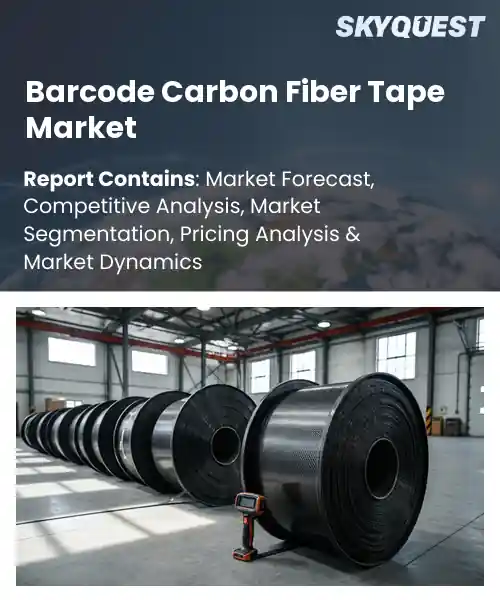
Barcode Carbon Fiber Tape Market
Report ID: SQMIG15B2197
Report ID: SQMIG15B2197
[email protected]
USA +1 351-333-4748
Report ID:
SQMIG15B2197 |
Region:
Global |
Published Date: March, 2026
Pages:
157
|Tables:
116
|Figures:
77


Global Barcode Carbon Fiber Tape Market size was valued at USD 4.4 Billion in 2024 and is poised to grow from USD 4.97 Billion in 2025 to USD 13.22 Billion by 2033, growing at a CAGR of 13.0% during the forecast period (2026-2033).
The push towards lightweight composites, for both weight reduction, but also traceability through complex supply chains, has been the main driver behind the growth of the barcode carbon fiber tape market. The barcode carbon fiber tape provides high strength to weight ratio carbon fiber reinforcement, and an identification surface able to be printed upon. As such, manufacturers are able to use barcode carbon fibre tape for structural integration and as part of the digital tagging process during layup and assembly.
The importance of the barcode carbon fiber tape market is that the aerospace, automotive and sporting goods manufacturing industries, require both performance and provenance, in order to meet safety requirements and consumer expectations. In the last decade, the use of barcode carbon fiber tape has progressed from prototype laboratories, into production facilities, as manufacturers of carbon fibre composite parts have scaled their operations, as evidenced by the airline industry requesting serialized wing components, and automobile manufacturers requesting the tracking of battery enclosure assemblies.
One of the key factors driving the global growth of the barcode carbon fiber tape market is the integration of Industry 4.0 systems. The ability to embed barcodes directly into carbon fiber tape, gives manufacturers the ability to automate the process of scanning, performing quality analytics, and lifecycle management, which in turn, will reduce inspection time and warranty costs. As manufacturers implement machine vision and manufacturing execution systems onto their manufacturing lines, suppliers will also begin to provide manufacturers with preprinted, heat-resistant tactile tape, which is able to withstand the curing and bonding process. This will lead manufacturers to prefer to use integrated materials for their products, over the use of separate labelling processes.
How is IoT Enhancing Supply Chain Visibility for the Barcode Carbon Fiber Tape Market?
By employing embedded identification, sensor data, and cloud analytics for improved supply chain visibility, IoT is modernizing the barcode carbon fiber tape market. Important components of this process are asset tagging (through the use of barcodes and RFID), condition sensing (for humidity tension), and location tracking (through gateways). Manufacturers and converters are faced with increasingly complex multi-tiered supply chains, coupled with the demand from both the aerospace and automotive industries for lightweight materials that can be traced. With IoT-enabled scanners and smart labels, manufacturers will be able to trace rolls from production to assembly, detect handling anomalies, and incorporate that information into inventory and quality workflows.
Market snapshot - (2026-2033)
Global Market Size
USD 4.4 Billion
Largest Segment
Single-Sided Tape
Fastest Growth
Custom Printed Tape
Growth Rate
13.0% CAGR
To get more insights on this market click here to Request a Free Sample Report
Global barcode carbon fiber tape market is segmented into product type, application, end-user, sales channel and region. Based on product type, the market is segmented into single-sided tape, double-sided tape and custom printed tape. Based on application, the market is segmented into aerospace, automotive and construction. Based on end-user, the market is segmented into manufacturers, retailers and distributors. Based on sales channel, the market is segmented into online sales and offline sales. Based on region, the market is segmented into North America, Europe, Asia Pacific, Latin America and Middle East & Africa.
As per global barcode carbon fiber tape market analysis, the double-sided tape segment takes the lead due to its ability to create a strong bond that overcomes specific challenges at the connection point of barcode carbon fiber tape assemblies. The tape dual adhesive contact ensures a consistent connection with both carbon fiber and protective material, thus decreasing the possibility of becoming detached/peeling/lifting due to mechanical forces or thermal cycling. As a result, manufacturers use double-sided solutions in automatic lamination processes and seek durable adhesion, which leads to optimized materials, stringent quality control processes, and specialized suppliers that reinforce the market position for double-sided tape.
As per global barcode carbon fiber tape market forecast, custom printed tape is growing faster than any other category because there is an increased need for integrated forms of identification and traceability directly on-the-tape. The advancements in the ability of ink to adhere and print with high resolution on carbon fiber tape allow for the use of durable barcodes and branding without needing an additional label, which simplifies logistics and compliance issues. By providing a means to distinguish one product from another and provide value-added services & solutions, Custom Printed Tapes will continue to drive new growth in the market at a faster pace with greater margins than the traditional double-sided tape category.
The aerospace segment dominates with large barcode carbon fiber tape market share because of its stringent requirements for safety, durability, and weight. The aerospace segment requires suppliers to deliver high-performing barcode carbon fiber tape solutions. Materials are needed that would allow for barcode readability while in extreme temperatures, subject to extreme vibration, and with long service intervals. Rigorous formulation and testing, as well as certification, are all required under the conditions of use in the aerospace industry.
As per global barcode carbon fiber tape market outlook, as the electric vehicle sector generates increased sales volumes and builds upon assembly automation, the automotive industry represents the fastest-growing application for inline traceability and lightweight adhesive bonding. Additionally, automobile manufacturers are currently looking for tapes that provide structural and processing advantages and are also appropriate for very high-volume production. A combination of increased scale of manufacturing, an increase in automated processes, and innovations in manufacturing techniques are resulting in rapid adoption of these products, expanded use cases, and significant growth opportunities.
To get detailed segments analysis, Request a Free Sample Report
As per global barcode carbon fiber tape industry analysis, the Asia Pacific region leads the market with a lot of manufacturers, strong electronics supply chains, and a concentration of strategic industrial clusters near both component and integrator producers. There is extensive experience with advanced materials as well as strong connections among materials science, industrial design, and electronics manufacturing which results in very rapid growth of superior performance adhesive tapes.
As per global barcode carbon fiber tape market regional outlook, Japan market is supported by advances in material science, traditions of precision manufacturing, and collaboration among Advanced Material R&D institutes and electronic OEMs. High quality expectations from consumer electronics and automotive parts create a strong pull for suppliers to maintaintotal process consistency and robust process control.
As per global barcode carbon fiber tape market regional forecast, South Korea market is defined by a mature electronics manufacturing base, nimble contract manufacturers, and close collaborations between materials innovators and systems designers. Increased demand from mobile electronics, automotive electrification and precision instrumentation has led to accelerated prototyping and customized support of customers. Suppliers focus on high levels of strength-to-weight ratio and strong adhesion properties related to automation assembly processes. Collaborative supply chains and export-driven production promote the widespread use of Barcode Carbon Fiber Tape in all industrial sectors.
The barcode carbon fiber tape market in North America is growing quickly as all kinds of technology-heavy end uses create more opportunities for OEMs and specialized materials suppliers to collaborate on lightweight, durable products for both transportation and industrial applications. Application engineering and early adopters have helped create an innovative environment through which customized tape formulas and integration methods can be developed for demanding assembly lines.
Demand for lightweight, high-strength solutions to assemble complex components has accelerated growth of the carbon fiber tape barcode market in the U.S. Aerospace, defense, automotive, and electronics producers are looking closely at how they can best utilize carbon fiber tape in their automated manufacturing processes, while application engineers work with carbon fiber tape suppliers to develop custom specifications for tape. Prototyping and testing resources are available throughout the U.S. This helps to qualify and scale new carbon fiber tape products before they can be manufactured commercially.
Canada barcode carbon fiber tape market has several supporting strengths built upon precision manufacturing, advanced industrial fabrication capabilities, as well as the automotive components sector, which create the need for specialty tapes. Additionally, OEMs (original equipment manufacturers) and Contract Manufacturers work collaboratively together to create opportunities for product development and qualification specific to carbon fiber tape products. Quality assurance programs and traceability of materials enable suppliers to provide manufacturers with assembly materials. In addition, the collaborative relationship between suppliers and manufacturers, and the links between suppliers and manufacturers for purposes of research and logistics, promote export-based supply chains that allow Canadian manufacturers access to both domestic and international markets.
Europe is enhancing its barcode carbon fiber tape position by promoting joint industry activities, building engineering strengths, and providing reliable products for the automotive, aerospace, and industrial equipment sectors. Manufacturers establish a foundation of consumer trust with strict quality systems, traceability of materials, and compliance with regulatory standards, giving them a positive reputation with conservative buyers. International partnerships among research facilities and specialty suppliers enhance the development of advanced material formulations and application engineering. Pilot production and integration testing investments provide quicker qualifications for complicated assemblies. Many areas have become regional clusters for manufacturing and design which encourages knowledge transfer and exchange, while a focus on sustainability and supply chain resilience suggests a long-term strategic competitive advantage for barcode carbon fiber tape solutions.
In Germany, the barcode carbon fiber tape market is supported by a strong automotive supply chain and a precision engineering culture that require higher quality standards with more avenues to test products. Suppliers place a high importance on process control, traceability of materials, and integration into the assembly processes of automated systems. Working collaboratively with research institutes and tier suppliers provides suppliers with tape formulations to meet the most demanding applications in vehicles and other industries. The high degree of reliability/certification of equipment utilized by manufacturers and integrators enables quick and effective qualification of product utilization for assembly lines.
The barcode carbon fiber tape market in the United Kingdom is aided by an engineering landscape that integrates aerospace, defense and advanced manufacturing expertise through robust design capabilities. Collaborative engagement between universities and industry accelerates the development of specialized adhesives and substrate treatments to meet stringent bonding and durability requirements. Manufacturers work with suppliers to obtain qualifications for their products in high reliability markets while assisting integrators through application engineering. Logistics hubs are located close to food, manufacturing and traditional distribution channels, enabling efficient global distribution of complex systems.
France barcode carbon fiber tape market has benefited from expertise in composites in both aerospace and industrial sectors; the providers of materials have focused on customized resin systems and surface treatments. Collaboration between technical centers and manufacturing companies has encouraged the creation of application-specific construction of tapes that can withstand extreme thermal and mechanical conditions. Manufacturers also focus on providing traceability, certification and compatibility for automatic assembly when working with other manufacturers (providers) for supplies. The proximity of Europe’s industrial clusters also helps manufacturers’ qualifications and adoption by system integrators.
To know more about the market opportunities by region and country, click here to
Buy The Complete Report
Increasing Use in Electronics
Increasingly, the popularity of lightweight, high-performance materials within consumer electronics has increased the importance of barcode carbon fiber tape as a reliability enhancing material for products, improving the ability to handle flexible circuits and supporting miniaturization efforts. Manufacturers want materials that aid in assembling thinner assemblies and building durable interconnects while maintaining the integrity of their signals and providing mechanical support. The greater interest in materials will lead to increased investment in sourcing and integrating materials, which will lead to suppliers developing larger product portfolios and developers specifying the use of carbon fiber tape for new product designs and manufacturing processes.
Adopting into Automotive Manufacturing
Automotive manufacturers are also increasingly incorporating barcode carbon fiber tape into their wiring assemblies, improving the crash resistance of lightweight structures, and supporting the movement to an electrically powered architecture by providing reliable and compact cabling solutions. The combination of tensile strength and thin profile of the material will allow designers to meet their safety and packaging objectives while simplifying component complexity. As original equipment manufacturers continue to focus on long-term durability and the consistent identification of parts, using tape for harnessing and module assembly will result in wider supplier adoption and integration throughout a vehicle platform or component line.
High Production Costs
Higher production costs of carbon fiber tapes due to special raw materials, intensive production, and strict quality control limit their ability to be substituted for lower priced products. Procurement and contract manufacturing groups experience conflicting ideals of performance and costs, often delaying changes in specification or accepting low volumes of product. The sensitivity to price affects the market penetration of carbon fiber tape in competitive price segments, with suppliers limiting usage of carbon fiber tape to premium or critical use rather than to a broader consumer base across varying end-use industries.
Insufficient Recycling Infrastructure
The lack of recycling and end-of-life disposal solutions for composite materials have created variables around sustainability credibility and future environmental effects, resulting in manufacturers who promote sustainability not to specify carbon fiber tape. Companies that use a circular materials strategy may be reluctant to increase their use of carbon fiber tapes, as they do not have established routes for recovery, reuse, or environmentally sound disposal. This lack of established recycling routes increases the perceived lifecycle risk, complicates the ability to comply with strict sustainability strategies, and causes some purchasers to prefer products with established recycling routes, limiting the potential market of carbon fiber tape in the mainstream market.
Request Free Customization of this report to help us to meet your business objectives.
The competition within the global carbon fibre barcode tape market is primarily driven by product innovation based on three factors differentiation through traceable use; product cost; and automation-driven manufacturing processes. Companies are forming partnerships or establishing recycling alliances to secure the supply of carbon feedstock (i.e., agreements among recycling companies operating in the industry). Companies are adding barcode-enabled carrier tapes that can be used for in-line tracking of tape products. Deep tech entrants are commercializing automated production of composite materials using tapes-compatible products, thereby creating scale and enhancing production quality.
Smart Packaging and Traceability: Increasing use of carbon-fiber tape with a barcode for the development of smart packing is due to the demand by businesses for lightweight and strong labels that can withstand the conditions of the global supply chain and provide durable tracking. Combining with RFID, printed electronics, or blockchain for traceability makes the material an advantageous substrate. Not only does it help preserve the readability of the barcode, but it also maintains the structural integrity of the material. Manufacturers and logistics companies are also looking for materials that combine mechanical functionality with the ability to be scanned consistently, which leads to the potential for customized formulations, joint development, and supply chain solutions in herbicides, drugs, and cold chain business segments.
Demand in Medical Devices: The growing demand for medical devices has increased the interest in barcode carbon fiber tape solutions that are resistant to sterilization, chemical exposure and handling, and will maintain legibility for inventory and implant tracking purposes. Medical device manufacturers are searching for materials to support their regulatory traceability, provide long-lasting adhesive properties to complex substrates, and can be combined with their sterile packaging process. This barcode carbon fiber tape market trendis driving suppliers to develop medical-grade formulations, provide documentation and joint supply agreements with their OEMs and manufacturers, and offer these products with respect to tracking their life cycle.
SkyQuest’s ABIRAW (Advanced Business Intelligence, Research & Analysis Wing) is our Business Information Services team that Collects, Collates, Correlates, and Analyses the Data collected by means of Primary Exploratory Research backed by robust Secondary Desk research.
As per SkyQuest analysis, the global barcode carbon fiber tape industry is propelled by the simultaneous push for lightweight composites and precise part traceability, with integration into Industry 4.0 and IoT-enabled tracking serving as a second important driver. Growth is concentrated in Asia Pacific, which dominates due to manufacturing scale and materials expertise, while double-sided tape leads to the product mix by offering superior adhesion for automated lamination. Market expansion is tempered by high production costs that limit adoption in price-sensitive segments. Vendors focusing on printed identification, heat-resistant adhesives, and connected supply chain services are best positioned to capture rising demand across aerospace, automotive, and electronics.
| Report Metric | Details |
|---|---|
| Market size value in 2024 | USD 4.4 Billion |
| Market size value in 2033 | USD 13.22 Billion |
| Growth Rate | 13.0% |
| Base year | 2024 |
| Forecast period | (2026-2033) |
| Forecast Unit (Value) | USD Billion |
| Segments covered |
|
| Regions covered | North America (US, Canada), Europe (Germany, France, United Kingdom, Italy, Spain, Rest of Europe), Asia Pacific (China, India, Japan, Rest of Asia-Pacific), Latin America (Brazil, Rest of Latin America), Middle East & Africa (South Africa, GCC Countries, Rest of MEA) |
| Companies covered |
|
| Customization scope | Free report customization with purchase. Customization includes:-
|
To get a free trial access to our platform which is a one stop solution for all your data requirements for quicker decision making. This platform allows you to compare markets, competitors who are prominent in the market, and mega trends that are influencing the dynamics in the market. Also, get access to detailed SkyQuest exclusive matrix.
Table Of Content
Executive Summary
Market overview
Parent Market Analysis
Market overview
Market size
KEY MARKET INSIGHTS
COVID IMPACT
MARKET DYNAMICS & OUTLOOK
Market Size by Region
KEY COMPANY PROFILES
Methodology
For the Barcode Carbon Fiber Tape Market, our research methodology involved a mixture of primary and secondary data sources. Key steps involved in the research process are listed below:
1. Information Procurement: This stage involved the procurement of Market data or related information via primary and secondary sources. The various secondary sources used included various company websites, annual reports, trade databases, and paid databases such as Hoover's, Bloomberg Business, Factiva, and Avention. Our team did 45 primary interactions Globally which included several stakeholders such as manufacturers, customers, key opinion leaders, etc. Overall, information procurement was one of the most extensive stages in our research process.
2. Information Analysis: This step involved triangulation of data through bottom-up and top-down approaches to estimate and validate the total size and future estimate of the Barcode Carbon Fiber Tape Market.
3. Report Formulation: The final step entailed the placement of data points in appropriate Market spaces in an attempt to deduce viable conclusions.
4. Validation & Publishing: Validation is the most important step in the process. Validation & re-validation via an intricately designed process helped us finalize data points to be used for final calculations. The final Market estimates and forecasts were then aligned and sent to our panel of industry experts for validation of data. Once the validation was done the report was sent to our Quality Assurance team to ensure adherence to style guides, consistency & design.
Analyst Support
Customization Options
With the given market data, our dedicated team of analysts can offer you the following customization options are available for the Barcode Carbon Fiber Tape Market:
Product Analysis: Product matrix, which offers a detailed comparison of the product portfolio of companies.
Regional Analysis: Further analysis of the Barcode Carbon Fiber Tape Market for additional countries.
Competitive Analysis: Detailed analysis and profiling of additional Market players & comparative analysis of competitive products.
Go to Market Strategy: Find the high-growth channels to invest your marketing efforts and increase your customer base.
Innovation Mapping: Identify racial solutions and innovation, connected to deep ecosystems of innovators, start-ups, academics, and strategic partners.
Category Intelligence: Customized intelligence that is relevant to their supply Markets will enable them to make smarter sourcing decisions and improve their category management.
Public Company Transcript Analysis: To improve the investment performance by generating new alpha and making better-informed decisions.
Social Media Listening: To analyze the conversations and trends happening not just around your brand, but around your industry as a whole, and use those insights to make better Marketing decisions.
REQUEST FOR SAMPLE
 REQUEST FREE CUSTOMIZATION
Global Barcode Carbon Fiber Tape Market size was valued at USD 4.4 Billion in 2024 and is poised to grow from USD 4.97 Billion in 2025 to USD 13.22 Billion by 2033, growing at a CAGR of 13.0% during the forecast period (2026-2033).
Competition in the global barcode carbon fiber tape market is driven by product differentiation through traceability, material-cost and feedstock security, and automation-led manufacturing. Firms deploy partnerships and recycling alliances to secure carbon feedstock, as seen in industry recycling agreements. Suppliers add barcode-enabled carrier tapes for inline tracking. Deeptech entrants commercialize autonomous composite production to scale tape-compatible components and improve quality control. 'Toray Industries', 'Hexcel Corporation', 'Solvay SA', 'SGL Carbon SE', 'Mitsubishi Chemical', 'Teijin Limited', 'Evonik Industries', 'Celanese Corporation', '3M Company', 'Arkema', 'Saudi Arabian Oil Co. (Aramco)', 'Koninklijke DSM', 'Cevotec GmbH', 'Compagnie Chomarat', 'Cristex', 'Easy Composites', 'Eurocarbon BV', 'ACP Composites', 'Zoltek', 'Sigmatex'
The growing preference for lightweight, high-strength components in consumer electronics has elevated the role of barcode carbon fiber tape as a material that enhances product reliability, improves handling of flexible circuits, and supports miniaturization efforts. Manufacturers seek materials that contribute to thinner assemblies and durable interconnects while maintaining signal integrity and mechanical support. This increased interest stimulates investment in material sourcing and integration processes, encouraging suppliers to expand product portfolios and developers to specify carbon fiber tape in new device designs and production workflows.
Smart Packaging And Traceability: Adoption of barcode carbon fiber tape for smart packaging is accelerating as brands seek lighter, durable labeling that resists global supply chain conditions while enabling long-lasting tracking. Integration with RFID, printed electronics and blockchain traceability positions the material as a premium substrate that preserves barcode readability and structural integrity. Manufacturers and logistics providers prioritize materials combining mechanical performance with consistent scanning reliability, creating opportunities for tailored formulations, co-development partnerships and solutions across consumer goods, pharmaceuticals and cold chain segments.
Why does Asia Pacific Dominate the Global Barcode Carbon Fiber Tape Market? |@12


Want to customize this report? This report can be personalized according to your needs. Our analysts and industry experts will work directly with you to understand your requirements and provide you with customized data in a short amount of time. We offer $1000 worth of FREE customization at the time of purchase.
Feedback From Our Clients


 USA (+1) 351-333-4748

