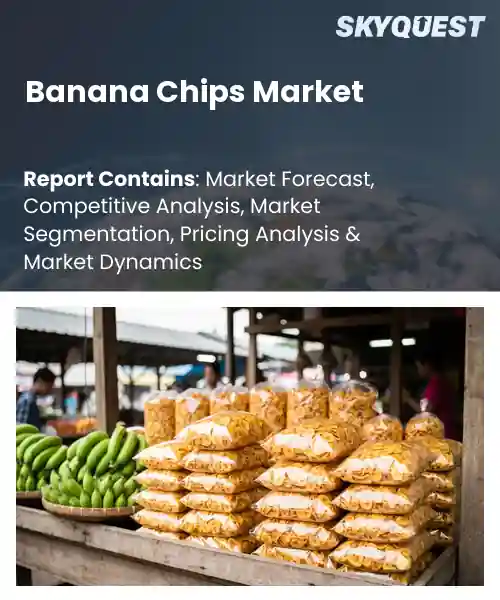
Banana Chips Market
Report ID: SQMIG30I2836
Report ID: SQMIG30I2836
[email protected]
USA +1 351-333-4748
Report ID:
SQMIG30I2836 |
Region:
Global |
Published Date: February, 2026
Pages:
157
|Tables:
146
|Figures:
78


Global Banana Chips Market size was valued at USD 1.40 Billion in 2024 and is poised to grow from USD 1.52 Billion in 2025 to USD 2.89 Billion by 2033, growing at a CAGR of 8.4% during the forecast period (2026-2033).
As a research analyst, I identify changing consumer preferences toward convenient, shelf-stable snacks as the primary driver reshaping the banana chips market. This industry consists of retail, foodservice and ingredient uses of dehydrated and fried banana slices and is important as it links tropical agriculture and packaged snacking trends and provides value-added financial returns to banana-producing regions. The market originally grew from small coastal processors to large industrial supply, e.g., the expansion of Philippine and Indian producers supplying North America and Europe, and brands created baked and flavored varieties in response to the demand for health and taste benefits and for greater storage and logistics efficiency.
Building on manufacturing expansion, increased health-conscious snacking represents a key trend driving the global banana chips sector growth because consumers seek whole-fruit ingredients and lower-fat alternatives, prompting producers to adopt baking and vacuum-frying technologies that reduce oil content and extend shelf life. As a result, retailers including premium supermarket chains and online grocery platforms allocate shelf space and marketing support, enabling exporters from Ecuador and Thailand to access higher-margin markets, and foodservice operators incorporate flavored banana chips into grab-and-go menus as tropical complements. Consequently, investment in processing equipment and creating opportunities for contract manufacturers and ingredient suppliers and retailers.
How is AI Optimizing Supply Chain Efficiency in the Banana Chips Market?
AI is reshaping supply chain efficiency in the banana chips market by improving forecasting, quality control, and logistics. Key aspects include demand sensing to match dehydration and packing schedules, computer vision and sort fruit and detect defects, and predictive maintenance to keep lines running. Given the perishability of fresh bananas, these tools help manage harvest variability, tighten traceability from farm to pack, and align production with retailer demand, so operations become more responsive and less wasteful.
In July 2025, BranchOut Food Inc. reported large warehouse club orders for banana chip products, a milestone showing commercial scale. When that kind of volume is combined with AI-driven demand forecasting and sensor-based quality control, it lowers waste, smooths production planning, and improves shelf availability for retailers.
Market snapshot - (2026-2033)
Global Market Size
USD 1.4 Billion
Largest Segment
Salted
Fastest Growth
Spicy
Growth Rate
8.4% CAGR
To get more insights on this market click here to Request a Free Sample Report
Global banana chips market is segmented by flavor, processing type, nature, packaging type, distribution channel and region. Based on flavor, the market is segmented into sweet, salted, spicy and honey. Based on processing type, the market is segmented into fried, baked and freeze-dried. Based on nature, the market is segmented into organic and non-organic. Based on packaging type, the market is segmented into plastic bags, glass containers, resealable pouches and boxes. Based on distribution channel, the market is segmented into supermarkets & hypermarkets, specialty stores, convenience stores and online retailers. Based on region, the market is segmented into North America, Europe, Asia Pacific, Latin America and Middle East & Africa.
Based on global banana chips market share, sweet segment dominates because consumer preference skews toward familiar, dessert-like flavor profiles that pair well with banana’s natural sweetness, driving broad appeal across snack categories. Manufacturers design sweet formulas so that consumers are more likely to make impulse purchases and to cross-merchant in the candy aisle; therefore retail buyers choose established SKUs as they minimize the risk of stocking their inventory. The heavy production emphasis of these sweet formulations leads to consistent placement in the distribution channel and to a continuous stream of flavor innovations based on established consumer acceptance and margin stability.
However, honey is the most rapidly expanding flavor as premium positioning and clean label trends drive adoption among health-conscious buyers. By developing natural coating technologies and pairing those solutions with gourmet seasoning ingredients, each product offered becomes differentiated, leading to a new level of pricing opportunities and premium placement on shelves. As more companies adopt this method, the result will be greater numbers of new products being launched, increased numbers of co-branded products, and more diverse avenues for distribution channels.
Fried segment dominates because its familiar texture and cooking profile deliver the crunchy mouthfeel consumers expect from traditional banana chips, anchoring category recognition and frequent repurchase. Due to lower processing costs and established frying equipment, manufacturers can provide more competitive pricing while providing more consistent products, giving retailers a reason to give priority to shelf space for these products. As a result, manufacturers are continuing to focus on achieving scale efficiencies, applying a variety of flavor coatings and utilizing promotional campaigns focused on fried items to maintain market leadership.
Meanwhile, freeze-dried is witnessing the strongest growth momentum as demand for lightweight, shelf-stable snacks with premium nutrient retention rises among discerning buyers. The command over premium pricing and a strong appeal factor creates the basis for innovation in texture and flavor combinations; resulting in countless new introductions that will continue to grow the relevance of these categories to health-oriented consumers.
To get detailed segments analysis, Request a Free Sample Report
As per the global banana chips market growth, Asia Pacific dominance reflects a combination of natural advantage, cultural affinity for banana based snacks, and matured processing ecosystems that support large scale production. Many suppliers provide raw/unprocessed bananas in different nations throughout the world. Contract processors and established snack manufacturers allow for a variety of different formats of finished products as well as flavour profiles that can appeal to both domestic and international markets. There are forms of increased penetration by both retail and modern trade in terms of distributing mainstream and premium products, while continued growth in e-commerce and convenience channel sales provides greater distribution of banana chips.
Banana chips market in Japan shows strong alignment with premiumization and quality driven demand, where consumers prefer refined flavor profiles and health forward variants. Domestic retailers and specialty stores emphasize provenance and ingredient transparency, prompting manufacturers to focus on clean label formulations and artisanal presentations. Packaging and portioning for convenience occasions and giftable formats further elevate product positioning, while targeted marketing through urban food service and boutique channels supports steady niche expansion.
Banana chips market in South Korea is shaped by dynamic snacking culture and rapid adoption of novel flavor innovations that blend local taste preferences with international trends. The desire for portable and shareable items from young, urban consumers with an on-the-go lifestyle; the impact of social media on trend cycles are both accelerating the need for these formats. Retail assortments include both mainstream supermarkets, convenience stores, and online distribution channels in order to offer the opportunity to experiment with both mainstream and premium brands as well as private labels.
Based on banana chips market regional forecast, rapid expansion in North America is driven by evolving consumer snacking habits that favor portable, flavorful, and perceived healthy options, plus strong channels for product discovery and distribution. Clean label messaging, ingredient transparency, and product variety are beginning to be included more at the forefront of brand's overall marketing approach to satisfy both healthy and indulgent segments of consumers simultaneously.
Innovations in sourcing, processing, and flavour have created products for both the traditional grocery channel as well as the natural food channel while also providing opportunities for new products to be made available through e-commerce features and subscription services. The influences from different cultures around the world and an increasing consumer desire to purchase plant-based snack foods has helped to drive the diversification of the category.
Banana chips market in United States benefits from wide distribution across mass grocery, natural channel, convenience retail, and digital marketplaces, enabling rapid consumer access and trial. Product developers emphasize clean label credentials and bold flavor innovation to meet a spectrum of consumer expectations from health conscious to indulgent. Co-branding with lifestyle and wellness storytelling (through assortment strategies that include both multipack and single, ready-to-use formats) supports both at-home and on-the-go consumption occasions, helping to sustain momentum for the category.
Banana chips market in Canada is characterized by a balanced focus on health oriented formulations and artisanal flavor development tailored to diverse consumer tastes. The retail market is comprised of traditional grocery outlets, natural grocer stores and online businesses. Established brand retailers offer a way for niche merchants to also enter this space. With regards to how this affects the snacks included in their meals, consumers are generally able to find products that are convenient and pair well with other snack foods, allowing these products to have increasing frequency of use within their meal plans.
As per banana chips market regional outlook, Europe is strengthening its position through strategic emphasis on sustainability, premiumization, and regulatory compliant innovation that aligns with sophisticated consumer expectations. Import networks and local processing capacity have been optimized to allow for quality control and traceability of imported foods that are considered organic/fair trade/clean label in multiple markets.
Retailers as well as distributors are proactively creating an assortment mix of both mainstream, affordable products and niche, premium ones; however, food service and impulse distribution channels will be expanding the presence of these products beyond traditional retail stores. Flavor development typically combines regional culinary and global flavors; marketing will promote both provenance and ethically sourced products to create consumer trust in their brands as well as enhance credibility across the continent.
Banana chips market in Germany shows strong consumer interest in natural and organic options along with responsible sourcing narratives that match local values. Retailers also seek to innovate by introducing textures and flavors that local consumers prefer. Retailers distribute products via many different stores, including supermarkets, discount stores, and organic food stores. They are therefore providing consumers with access to a wide variety of products on a consistent basis, therefore allowing consumers to adopt their products easily.
Banana chips market in United Kingdom is influenced by trend driven snacking and a vibrant retail landscape where convenience and novelty drive trial. Additionally, high-quality and health-focused variants can be found on the shelves of general and specialized retail outlets. Online searches for products happen at a fast pace, and retail stores provide quick choices through impulse purchasing. This creates a variety of dynamic opportunities for stimulating consumption and increasing the period in which products are available for purchase.
Banana chips market trends in France emphasizes taste sophistication and culinary influenced flavors that appeal to discerning consumers who value quality and provenance. Curated retail assortments have an emphasis on bridging gourmet and everyday snack standards between large and small producers with a focus on texture refinement and ingredient transparency. Brand exposure from food service and leisure opportunities supports the ability to create premium positions.
To know more about the market opportunities by region and country, click here to
Buy The Complete Report
Rising Demand For Healthy Snacks
Expansion Of Retail And Ecommerce Channels
Raw Material Price Volatility
Perishable Supply Chain Challenges
Request Free Customization of this report to help us to meet your business objectives.
Competitive intensity in the global banana chips market outlook is rising as branded entrants and funded startups target premium, quick commerce and retail channels, prompting consolidation and verticalization. Competitors and firms are looking at acquisitions, partnerships in retail and quick commerce, and automation to obtain shelf placement and traceable sources of supply. For example, Beyond Snack recently completed its institutional financing rounds (to raise funds) and built an automated manufacturing facility to compete against its competitors.
SkyQuest’s ABIRAW (Advanced Business Intelligence, Research & Analysis Wing) is our Business Information Services team that Collects, Collates, Correlates, and Analyses the Data collected by means of Primary Exploratory Research backed by robust Secondary Desk research.
As per SkyQuest analysis, the global banana chips industry is being propelled by rising demand for healthy snacks, with one key driver being shifting consumer preferences toward convenient, fruit-based and lower-oil options. Raw materials being expensive are a limiting factor due to fluctuating costs leading to tightened margins and supply chain problems. The strongest geography is Asia Pacific, which has a manufacturing scale advantage, shares the same culture, and has extensive export networks. Also, just under fry processing is by far the strongest segment for growth. The overarching reason for this is fried products have a thicker texture and cost efficiency than non-fried products, therefore they are attractive to consumers worldwide as an appealing option. Another driver of growth is the increased number of retail and e-commerce distribution points that are opening to reach consumers.
| Report Metric | Details |
|---|---|
| Market size value in 2024 | USD 1.4 Billion |
| Market size value in 2033 | USD 2.89 Billion |
| Growth Rate | 8.4% |
| Base year | 2024 |
| Forecast period | (2026-2033) |
| Forecast Unit (Value) | USD Billion |
| Segments covered |
|
| Regions covered | North America (US, Canada), Europe (Germany, France, United Kingdom, Italy, Spain, Rest of Europe), Asia Pacific (China, India, Japan, Rest of Asia-Pacific), Latin America (Brazil, Rest of Latin America), Middle East & Africa (South Africa, GCC Countries, Rest of MEA) |
| Companies covered |
|
| Customization scope | Free report customization with purchase. Customization includes:-
|
To get a free trial access to our platform which is a one stop solution for all your data requirements for quicker decision making. This platform allows you to compare markets, competitors who are prominent in the market, and mega trends that are influencing the dynamics in the market. Also, get access to detailed SkyQuest exclusive matrix.
Table Of Content
Executive Summary
Market overview
Parent Market Analysis
Market overview
Market size
KEY MARKET INSIGHTS
COVID IMPACT
MARKET DYNAMICS & OUTLOOK
Market Size by Region
KEY COMPANY PROFILES
Methodology
For the Banana Chips Market, our research methodology involved a mixture of primary and secondary data sources. Key steps involved in the research process are listed below:
1. Information Procurement: This stage involved the procurement of Market data or related information via primary and secondary sources. The various secondary sources used included various company websites, annual reports, trade databases, and paid databases such as Hoover's, Bloomberg Business, Factiva, and Avention. Our team did 45 primary interactions Globally which included several stakeholders such as manufacturers, customers, key opinion leaders, etc. Overall, information procurement was one of the most extensive stages in our research process.
2. Information Analysis: This step involved triangulation of data through bottom-up and top-down approaches to estimate and validate the total size and future estimate of the Banana Chips Market.
3. Report Formulation: The final step entailed the placement of data points in appropriate Market spaces in an attempt to deduce viable conclusions.
4. Validation & Publishing: Validation is the most important step in the process. Validation & re-validation via an intricately designed process helped us finalize data points to be used for final calculations. The final Market estimates and forecasts were then aligned and sent to our panel of industry experts for validation of data. Once the validation was done the report was sent to our Quality Assurance team to ensure adherence to style guides, consistency & design.
Analyst Support
Customization Options
With the given market data, our dedicated team of analysts can offer you the following customization options are available for the Banana Chips Market:
Product Analysis: Product matrix, which offers a detailed comparison of the product portfolio of companies.
Regional Analysis: Further analysis of the Banana Chips Market for additional countries.
Competitive Analysis: Detailed analysis and profiling of additional Market players & comparative analysis of competitive products.
Go to Market Strategy: Find the high-growth channels to invest your marketing efforts and increase your customer base.
Innovation Mapping: Identify racial solutions and innovation, connected to deep ecosystems of innovators, start-ups, academics, and strategic partners.
Category Intelligence: Customized intelligence that is relevant to their supply Markets will enable them to make smarter sourcing decisions and improve their category management.
Public Company Transcript Analysis: To improve the investment performance by generating new alpha and making better-informed decisions.
Social Media Listening: To analyze the conversations and trends happening not just around your brand, but around your industry as a whole, and use those insights to make better Marketing decisions.
REQUEST FOR SAMPLE
 REQUEST FREE CUSTOMIZATION
Global Banana Chips Market size was valued at USD 1.4 Billion in 2024 and is poised to grow from USD 1.52 Billion in 2025 to USD 2.89 Billion by 2033, growing at a CAGR of 8.4% during the forecast period (2026-2033).
Competitive intensity in the global banana chips market is rising as branded entrants and funded startups target premium, quick commerce and retail channels, prompting consolidation and verticalization. Investors and incumbents pursue acquisitions, strategic retail and quick commerce partnerships, and factory automation to secure shelf space and traceable sourcing; Beyond Snack’s recent institutional rounds and automated plant illustrate these competitive strategies. 'Gold Chips', 'Jamaica Producers Group', 'Dole plc', 'Haldiram Snacks Food Pvt. Ltd', 'Beyond Snack (Barnana)', 'Augason Farms', 'Traina Foods', 'Mota Chips', 'LTA FOODS MANUFACTURING', 'BG Fruits and Nuts Manufacturing Corporation', 'Four Seasons Fruits Corporation', 'Snapsnax Ventures', 'Southern Harvest Inc.', 'PepsiCo, Inc.', 'Krema Nut Company', 'Snack Factory Kerala', 'Four Seasons Dry Fruit Company', 'Melissas Produce', 'GoodSam Foods', 'Goya Foods'
Banana chips benefit from growing consumer preference for healthier snacks that still offer convenience and enjoyable taste. As health awareness rises, manufacturers position banana chips as a fruit based option aligning with clean label expectations and natural ingredient narratives. This supports product innovation in formulation and packaging, encourages merchandising alongside other health focused items, and helps attract buyers seeking better for you snacks. The perception of fruit derived ingredients combined with crisp texture and shelf stability strengthens market acceptance and stimulates category expansion through retailer support and marketing.
Premiumization Of Snack Offerings: Consumers increasingly seek premium, gourmet banana chip variants featuring novel flavors, higher-quality ingredients, and artisanal processing methods that justify elevated price points. Brands are emphasizing provenance, superior texture, and clean-label formulations while launching small-batch and limited-edition offerings to create perceived value. Retailers respond with curated shelving and gift-oriented merchandising that supports premium positioning. This trend encourages innovation in flavor development, packaging aesthetics, and brand storytelling, enabling manufacturers to capture higher margins and differentiate in crowded snack assortments and expand distribution.
As per the global banana chips market growth, Asia Pacific dominance reflects a combination of natural advantage, cultural affinity for banana based snacks, and matured processing ecosystems that support large scale production.


Want to customize this report? This report can be personalized according to your needs. Our analysts and industry experts will work directly with you to understand your requirements and provide you with customized data in a short amount of time. We offer $1000 worth of FREE customization at the time of purchase.
Feedback From Our Clients


 USA (+1) 351-333-4748

