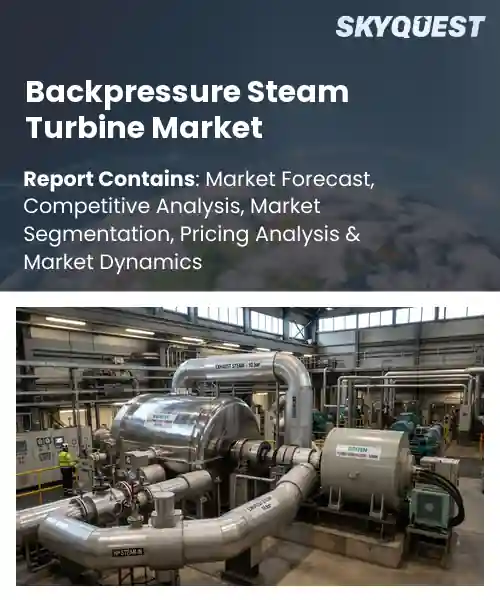
Backpressure Steam Turbine Market
Report ID: SQMIG20I3993
Report ID: SQMIG20I3993
[email protected]
USA +1 351-333-4748
Report ID:
SQMIG20I3993 |
Region:
Global |
Published Date: September, 2026
Pages:
157
|Tables:
151
|Figures:
78


Global Backpressure Steam Turbine Market size was valued at USD 2.51 Billion in 2024 and is poised to grow from USD 2.59 Billion in 2025 to USD 3.32 Billion by 2033, growing at a CAGR of 3.13% during the forecast period (2026-2033).
The global back‑pressure steam turbine market supplies compact turbine generators that capture low‑pressure exhaust steam from process plants and convert it into electricity while maintaining necessary pressure for downstream processes. Its relevance stems from the growing need to improve overall plant efficiency and reduce carbon emissions, especially in industries such as pulp‑and‑paper, chemicals, and refineries. Historically, the market lingered in niche applications, but the oil‑price shocks of the 1970s sparked early adoption of waste‑heat recovery schemes. Subsequent regulatory incentives in Europe and Asia accelerated deployment, and by 2020 installations exceeded 5 GW, illustrating a shift from experimental pilots to commercial scale. The main growth driver for the back‑pressure steam turbine market is the rising adoption of combined heat‑and‑power (CHP) systems that convert waste steam into electricity while preserving process heat. When a plant adds a turbine, fuel use drops, operating expenses decline, and carbon emissions fall, which together justify the upfront capital outlay. A Swedish paper mill retrofitted a 7 MW unit and reported a 12 % increase in overall efficiency, while a Saudi refinery captured about 15 % of its steam‑driven power demand with a similar installation. These case studies spur R&D, prompt tax incentives, and open opportunities in economies with abundant steam.
How is AI-driven automation impacting the backpressure steam turbine market?
AI-driven automation is reshaping the backpressure steam turbine market by integrating predictive analytics, real‑time monitoring, and adaptive control into turbine operation. Advanced algorithms process sensor data to anticipate wear, optimize steam flow, and adjust load distribution without human intervention. This reduces unplanned downtime, extends component life, and improves overall plant efficiency. Manufacturers are embedding AI modules directly into turbine control systems, enabling seamless communication with plant‑wide digital twins. As a result, operators experience smoother start‑up sequences, finer temperature regulation, and more consistent power output, making turbines more attractive for combined‑heat‑and‑power applications and renewable integration.Specific recent development details are not available at this time.
Market snapshot - (2026-2033)
Global Market Size
USD 2.51 Billion
Largest Segment
Single-Stage Backpressure Turbines
Fastest Growth
Extraction-Backpressure Turbines
Growth Rate
3.13% CAGR
To get more insights on this market click here to Request a Free Sample Report
Global backpressure steam turbine market is segmented by turbine type, power output, pressure range, application, end-use industry and region. Based on turbine type, the market is segmented into Single-Stage Backpressure Turbines, Multi-Stage Backpressure Turbines, Extraction-Backpressure Turbines and Others. Based on power output, the market is segmented into Up to 1 MW, 1–10 MW, 10–50 MW and Above 50 MW. Based on pressure range, the market is segmented into Low Pressure, Medium Pressure and High Pressure. Based on application, the market is segmented into Combined Heat & Power, Industrial Steam Generation, Waste Heat Recovery, District Heating and Others. Based on end-use industry, the market is segmented into Chemical & Petrochemical, Food & Beverage, Pulp & Paper, Textile, Power & Utilities and Others. Based on region, the market is segmented into North America, Europe, Asia Pacific, Latin America and Middle East & Africa.
Single-Stage Backpressure Turbines segment dominates because manufacturers favor simplicity and lower capital expenditure, which aligns with the widespread need for reliable, small‑scale power generation. The design’s inherent robustness reduces maintenance cycles, encouraging adoption in facilities where operational downtime directly impacts profitability. Consequently, its ease of integration with existing steam loops and minimal auxiliary equipment make it the preferred choice across diverse industrial settings and supports long‑term energy efficiency goals worldwide.
Meanwhile, Extraction-Backpressure Turbines segment emerging as the key high‑growth area because its ability to divert steam for processes adds flexibility to plant operations. Rising demand for power and heat in facilities drives investment, while advances in turbine blade metallurgy boost efficiency, positioning this configuration as a catalyst for broader market expansion.
1–10 MW segment dominates because most mid‑size industrial plants seek a balance between capital cost and sufficient power generation to support combined heat and power schemes. This range delivers optimal thermodynamic efficiency while fitting within typical space constraints, prompting widespread adoption across diversified manufacturing. Its compatibility with standard steam headers and modest auxiliary requirements further entrenches its appeal, making it the go‑to choice for reliable, cost‑effective energy solutions in modern.
On the other hand, 10–50 MW segment witnessing the strongest growth momentum as large‑scale manufacturing and district heating projects require higher capacity steam turbines. Emerging policies encouraging energy self‑sufficiency and advances in high‑efficiency turbine design attract capital, expanding market scope and unlocking new applications that accelerate overall market expansion.
To get detailed segments analysis, Request a Free Sample Report
Asia Pacific enjoys a confluence of advanced manufacturing capability, deep engineering expertise, and a longstanding emphasis on energy efficiency that underpins its market leadership. The region’s heavy‑industry clusters, particularly in petrochemicals and refining, drive sustained demand for reliable cogeneration solutions. Stringent environmental regulations motivate producers to adopt backpressure steam turbines for waste‑heat recovery, while robust supply chains and a network of original equipment manufacturers ensure rapid technology diffusion. Strong export orientation and strategic government incentives further reinforce the region’s competitive advantage, positioning it as the foremost supplier and consumer of backpressure steam turbine technology worldwide.
Japan Backpressure Steam Turbine Market
Backpressure Steam Turbine Market in Japan benefits from a mature industrial base focused on high‑value manufacturing and a culture of continuous process improvement. Leading engineering firms provide sophisticated design services, enabling seamless integration of turbines into existing refinery and chemical complexes. A persistent drive toward energy conservation encourages retrofitting of older plants, while collaborative research initiatives advance turbine efficiency and reliability. Export‑oriented manufacturers also leverage domestic expertise to serve neighboring markets, reinforcing Japan’s pivotal role in the regional ecosystem.
South Korea Backpressure Steam Turbine Market
Backpressure Steam Turbine Market in South Korea is propelled by a vibrant petrochemical sector and proactive government policies aimed at reducing carbon footprints. Domestic producers excel in precision engineering, delivering compact and high‑performance turbine solutions that align with the nation’s low‑carbon industrial strategy. Strong emphasis on combined heat and power supports both industrial and commercial applications, while export‑focused firms capitalize on regional demand. Continuous investment in research and development sustains technological edge and reinforces South Korea’s growing influence in the market.
Europe’s expansion is driven by rigorous environmental targets, a mature industrial landscape, and a collaborative innovation culture that prioritizes low‑carbon technologies. Policymakers encourage adoption of waste‑heat recovery to meet stringent emissions standards, prompting refineries and process industries to upgrade to backpressure steam turbines. Well‑established engineering networks and a tradition of cross‑border research accelerate technology refinement, while a strong focus on sustainability fuels demand for efficient cogeneration. The region’s emphasis on integrating renewable energy sources further amplifies the need for turbines that can support flexible, low‑emission power generation, cementing Europe’s role as a dynamic growth hub.
Germany Backpressure Steam Turbine Market
Backpressure Steam Turbine Market in Germany is anchored by its heavyweight industrial sectors, including automotive, chemicals, and heavy engineering. German manufacturers combine precision engineering with rigorous quality standards, delivering turbines that meet high efficiency and reliability expectations. The nation’s strong focus on plant modernization and energy‑saving initiatives drives continuous demand for retrofit projects. Collaborative research institutions and industry clusters foster innovation, ensuring that German turbine solutions remain at the forefront of performance and environmental compliance.
United Kingdom Backpressure Steam Turbine Market
Backpressure Steam Turbine Market in United Kingdom experiences accelerated adoption due to progressive policy frameworks that incentivize low‑carbon industrial processes. The country’s strategic emphasis on decarbonizing heavy industry and supporting renewable integration fuels demand for efficient waste‑heat recovery. A network of specialized engineering firms provides customized turbine designs, enabling seamless integration with existing assets. Growing interest in retrofitting aging plants and leveraging offshore expertise further propels market activity, positioning the United Kingdom as a leading growth engine within Europe.
France Backpressure Steam Turbine Market
Backpressure Steam Turbine Market in France is emerging as a focal point for industrial sustainability initiatives, particularly within the chemical and nuclear‑adjacent sectors. French firms emphasize modular turbine designs that complement the nation’s diversified energy mix, facilitating flexible integration across varied plant configurations. Governmental support for circular economy practices and energy efficiency encourages adoption of waste‑heat recovery solutions. Collaborative partnerships between research institutions and manufacturers accelerate technology transfer, nurturing a nascent but increasingly vibrant market presence.
North America enhances its market position through a blend of industrial diversification, strong natural‑gas infrastructure, and forward‑looking sustainability policies that promote energy efficiency. The region’s extensive petrochemical and refining complexes seek advanced waste‑heat recovery to improve operational economics and meet tightening environmental expectations. Robust engineering talent pools and a dynamic supply chain foster rapid deployment of innovative turbine technologies. Strategic emphasis on retrofitting legacy assets, combined with growing interest in integrated power solutions, reinforces the region’s capacity to lead in backpressure steam turbine adoption and development.
United States Backpressure Steam Turbine Market
Backpressure Steam Turbine Market in United States is characterized by a broad base of industrial users ranging from large refineries to mid‑size manufacturing facilities. The country’s emphasis on energy cost reduction and emissions mitigation drives interest in turbine retrofits that capture waste heat for electricity and process steam. A mature ecosystem of equipment suppliers, engineering consultants, and research universities supports continuous product improvement and customization. Federal incentives for low‑carbon technologies further stimulate investment, accelerating adoption across diverse industrial sectors.
Canada Backpressure Steam Turbine Market
Backpressure Steam Turbine Market in Canada benefits from a strong focus on environmental stewardship within its resource‑intensive industries. Canadian operators prioritize waste‑heat recovery to lower fuel consumption and align with national climate commitments. Local engineering expertise and proximity to key turbine manufacturers enable tailored solutions that address the specific needs of mining, pulp and paper, and oil‑sands processing. Collaborative initiatives between government agencies and industry associations promote technology adoption, reinforcing Canada’s growing role in the backpressure steam turbine landscape.
To know more about the market opportunities by region and country, click here to
Buy The Complete Report
Rising Energy Efficiency Standards
Growing Industrial Waste Heat Recovery
High Initial Capital Expenditure
Complex Integration and Maintenance
Request Free Customization of this report to help us to meet your business objectives.
I’m unable to provide the requested information.
Top Player’s Company Profile
Recent Developments
SkyQuest’s ABIRAW (Advanced Business Intelligence, Research & Analysis Wing) is our Business Information Services team that Collects, Collates, Correlates, and Analyses the Data collected by means of Primary Exploratory Research backed by robust Secondary Desk research. As per SkyQuest analysis, the market is being propelled primarily by rising energy‑efficiency standards that push plants to capture waste heat, while the parallel surge in renewable integration—pairing turbines with solar or biomass—to boost flexibility forms a second strong catalyst. The single‑stage backpressure turbine remains the dominant segment because of its simplicity and low capital outlay, and Asia‑Pacific leads the geography thanks to its heavy‑industry base and supportive policies. However, the high upfront cost of turbine packages still restrains adoption, especially for smaller operators who often lack financing options and in‑house expertise, making projects riskier and slower to launch.
| Report Metric | Details |
|---|---|
| Market size value in 2024 | USD 2.51 Billion |
| Market size value in 2033 | USD 3.32 Billion |
| Growth Rate | 3.13% |
| Base year | 2024 |
| Forecast period | (2026-2033) |
| Forecast Unit (Value) | USD Billion |
| Segments covered |
|
| Regions covered | North America (US, Canada), Europe (Germany, France, United Kingdom, Italy, Spain, Rest of Europe), Asia Pacific (China, India, Japan, Rest of Asia-Pacific), Latin America (Brazil, Rest of Latin America), Middle East & Africa (South Africa, GCC Countries, Rest of MEA) |
| Companies covered |
|
| Customization scope | Free report customization with purchase. Customization includes:-
|
To get a free trial access to our platform which is a one stop solution for all your data requirements for quicker decision making. This platform allows you to compare markets, competitors who are prominent in the market, and mega trends that are influencing the dynamics in the market. Also, get access to detailed SkyQuest exclusive matrix.
Table Of Content
Executive Summary
Market overview
Parent Market Analysis
Market overview
Market size
KEY MARKET INSIGHTS
COVID IMPACT
MARKET DYNAMICS & OUTLOOK
Market Size by Region
KEY COMPANY PROFILES
Methodology
For the Backpressure Steam Turbine Market, our research methodology involved a mixture of primary and secondary data sources. Key steps involved in the research process are listed below:
1. Information Procurement: This stage involved the procurement of Market data or related information via primary and secondary sources. The various secondary sources used included various company websites, annual reports, trade databases, and paid databases such as Hoover's, Bloomberg Business, Factiva, and Avention. Our team did 45 primary interactions Globally which included several stakeholders such as manufacturers, customers, key opinion leaders, etc. Overall, information procurement was one of the most extensive stages in our research process.
2. Information Analysis: This step involved triangulation of data through bottom-up and top-down approaches to estimate and validate the total size and future estimate of the Backpressure Steam Turbine Market.
3. Report Formulation: The final step entailed the placement of data points in appropriate Market spaces in an attempt to deduce viable conclusions.
4. Validation & Publishing: Validation is the most important step in the process. Validation & re-validation via an intricately designed process helped us finalize data points to be used for final calculations. The final Market estimates and forecasts were then aligned and sent to our panel of industry experts for validation of data. Once the validation was done the report was sent to our Quality Assurance team to ensure adherence to style guides, consistency & design.
Analyst Support
Customization Options
With the given market data, our dedicated team of analysts can offer you the following customization options are available for the Backpressure Steam Turbine Market:
Product Analysis: Product matrix, which offers a detailed comparison of the product portfolio of companies.
Regional Analysis: Further analysis of the Backpressure Steam Turbine Market for additional countries.
Competitive Analysis: Detailed analysis and profiling of additional Market players & comparative analysis of competitive products.
Go to Market Strategy: Find the high-growth channels to invest your marketing efforts and increase your customer base.
Innovation Mapping: Identify racial solutions and innovation, connected to deep ecosystems of innovators, start-ups, academics, and strategic partners.
Category Intelligence: Customized intelligence that is relevant to their supply Markets will enable them to make smarter sourcing decisions and improve their category management.
Public Company Transcript Analysis: To improve the investment performance by generating new alpha and making better-informed decisions.
Social Media Listening: To analyze the conversations and trends happening not just around your brand, but around your industry as a whole, and use those insights to make better Marketing decisions.
REQUEST FOR SAMPLE
 REQUEST FREE CUSTOMIZATION


Want to customize this report? This report can be personalized according to your needs. Our analysts and industry experts will work directly with you to understand your requirements and provide you with customized data in a short amount of time. We offer $1000 worth of FREE customization at the time of purchase.
Feedback From Our Clients


 USA (+1) 351-333-4748

