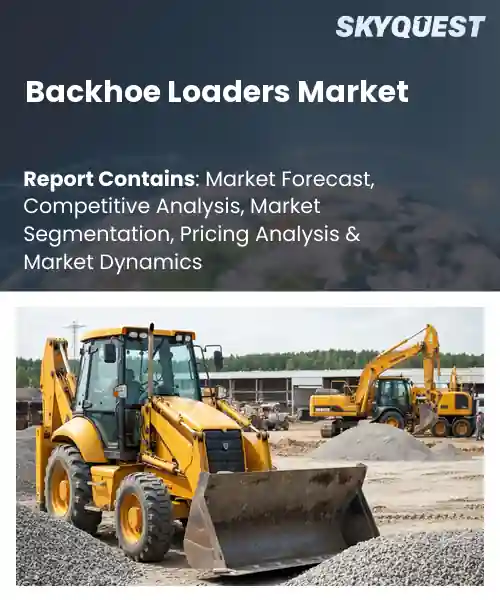
Backhoe Loaders Market
Report ID: SQMIG20G2157
Report ID: SQMIG20G2157
[email protected]
USA +1 351-333-4748
Report ID:
SQMIG20G2157 |
Region:
Global |
Published Date: June, 2026
Pages:
157
|Tables:
144
|Figures:
78


Global Backhoe Loaders Market size was valued at USD 8.52 Billion in 2024 and is poised to grow from USD 9.06 Billion in 2025 to USD 14.85 Billion by 2033, growing at a CAGR of 6.32% during the forecast period (2026-2033).
Construction, agricultural, utility, and municipal maintenance jobs can all take advantage of the flexibility offered by backhoe loaders market trends, which combine compact excavators and front loaders. The combination of these two functions means that fleets of backhoe machines have reduced maintenance and operating costs as a result of having numerous functions in one machine. Because of continued investment in infrastructure, rapid growth of urban areas, and the need for flexible equipment in developing countries to support road, housing, and utility projects, demand for backhoes has also increased.
Over time, manufacturers have moved away from using strictly mechanical machines to produce hydraulic, comfortable, and telematics-equipped backhoes, as evidenced by the development of India's rural electrification programs and Europe's urban redevelopment programs, while similarly, the rise of the rental market has increased turnover of rented fleets. Operators and suppliers face several challenges and opportunities with the recent advancements in technology and regulatory pressures affecting the global backhoe loader market; specifically, increasing emissions standards and the increased use of telematics are expected to drive original equipment manufacturers (OEMs) to develop new products.
As emissions limits become more stringent, most manufacturers will be required to produce cleaner operating engines or hybrid systems to help reduce the cost of fuel consumed by rental fleets that are performing urban trenching and road repairs. In addition, the increased use of telematics and modular attachment designs will result in better utilization of assets by contractors when bidding on municipal contracts; thus, increasing the aftermarket services provided by contractors and spurring greater investment in prototypes for electric-powered equipment and creating new opportunities within secondary markets.
How is IoT Improving Fleet Management Efficiency in the Backhoe Loaders Market?
Backhoe loaders market growth are seeing improvements in their fleet management through the Internet of Things (IoT) thanks to the ability to remotely connect to machines, have Connected Machine Monitoring (CMM), carry out Remote Diagnostic Port (RDP) access, and implement Intelligent Dispatch. Some key features include: telematics for monitoring location and fuel utilization; sensors that provide real-time machine health data on both engines and hydraulics; and geofencing technology to help reduce idle time on machines.
In today’s backhoe loaders market share, there is considerable pressure on owners to deliver a reliable and flexible fleet to customers. Telematics for machines provide owners with the scheduling capabilities necessary to perform preventative maintenance on assets and provide the best machine for a particular job. Real-world examples of telematics using video-based technology are being used to identify operator behavior trends and fault trends thus allowing for the minimization of downtime and to lengthen the lifecycle of machinery.
In March 2026, Caterpillar introduced intelligent telematics for Caterpillar® Backhoe Loaders powered by Artificial Intelligence (AI) at CONEXPO to enhance remote monitoring capability and utilize predictive maintenance for fleet managers through improved availability; provide valuable data to be used in the overall allocation of fleets which will improve customer satisfaction; reduce unscheduled downtime, improved visibility; lower overall costs and help contractors meet the demands of more stringent delivery of projects due to shorter time frames.
Market snapshot - (2026-2033)
Global Market Size
USD 8.52 Billion
Largest Segment
Diesel Engine
Fastest Growth
Electric/Hybrid
Growth Rate
6.32% CAGR
To get more insights on this market click here to Request a Free Sample Report
Global backhoe loaders market is segmented by engine type, loader capacity, application, end-user, distribution and region. Based on engine type, the market is segmented into diesel engine and electric/hybrid. Based on loader capacity, the market is segmented into small (<1.0 m³), medium (1.0-1.5 m³) and large (>1.5 m³). Based on application, the market is segmented into construction, agriculture, utilities and mining. Based on end-user, the market is segmented into construction companies, government/municipal and agriculture. Based on distribution, the market is segmented into dealers, direct sales and rental. Based on region, the market is segmented into North America, Europe, Asia Pacific, Latin America and Middle East & Africa.
Diesel engines established refueling networks and proven torque characteristics, diesel engines will continue to be the most popular option for heavy digging and loading applications. The extensive service networks for diesel engines provide little delay in making repairs, as they have many individuals that are qualified to complete repairs. Also, there will be large amounts of used diesel engine units available for resale because of the operator confidence in diesel engines.
In addition to diesel engines, electric and hybrid drive systems are currently the fastest-growing segment of the power generation market, driven by stricter regulations and improvements in battery and hybrid technology, leading to lower operating costs for electric and hybrid machines than their fossil-fueled counterparts. Further, increased investment from OEMs in these areas and the maturation of electric and hybrid technologies will create more opportunities for businesses that had been avoided in the past, such as city and emission-sensitive jobs. This will create new leasing opportunities and create an increase in the number of businesses leasing electric or hybrid equipment.
The dealer segment reigns supreme as the broad network of dealers deliver an integrated sales experience through access to parts, and post-sale support, thus streamlining the procurement and ownership experience for their customers. With easy access to spare parts, certified and trained technicians, and availability of financing or trade-in options, contractors are less likely to experience downtime on their equipment and view owning their equipment less risky and are thus more loyal to their dealer. as a result, dealers are able to influence both the cycle and specification of the replacement items provided to contractors and equipment managers.
By contrast, the rental segment is emerging as the strongest growth opportunity for manufacturers due to contractors preferring to have flexible access to loaders over owning them during peak project hours and for varying workloads. Digital fleet management and vendor-managed fleets enable users to easily book low-term rentals and/or manage the maintenance of their fleets; and the need for a quick mobilization of loaders of multiple sizes has also created opportunities for both original equipment manufacturers (OEMs) and rental companies to expand their rental fleets and create reoccurring revenue streams by providing added value for end-users by enabling end-users to use their equipment across multiple projects and project types.
To get detailed segments analysis, Request a Free Sample Report
The Asia Pacific region leads the worldwide backhoe loader market with large amounts of infrastructure development, a wide variety of construction needs, and a wide range of agricultural mechanization in multiple geographic regions. Manufacturing plants, including engineering capabilities, provide local suppliers with a large selection of urban and rural applications. A robust network of dealer and service facilities provides customers with increased availability of the machines and after-sale support. The growth of compact and fuel-efficient loader models along with modern technologies, such as telematics, enables the manufacturers to create products that meet customers' operational priorities. Manufacturers, rental companies and contractors develop cooperative relationships that support flexible ownership models and ongoing customer demands. Policy support for public transportation and utility infrastructure, combined with a growing aftermarket product and service network, contribute to purchasing cycles and lifetime value considerations by customers.
Backhoe loaders market forecast in Japan benefits from advanced engineering, precision manufacturing and a strong focus on compact, low emission and high reliability machines suited to dense urban construction and complex terrain. Deep dealer networks and emphasis on preventative maintenance support uptime. Domestic OEMs and component suppliers drive continuous product refinement while rental and contractor sectors favor versatile, manoeuvrable models, reinforcing a market oriented toward durability, operator comfort and technology integration.
Backhoe loaders market outlook in South Korea is characterized by strong industrial manufacturing, emphasis on compact and versatile machines for urban infrastructure and redevelopment projects, and robust supplier ecosystems that support customization. Focus on operator safety, telematics and efficient engines reflects a push toward productivity. Established service networks and collaboration between OEMs and construction firms enhance equipment utilization, fostering preference for reliable, tech enabled backhoe loaders across public and private works.
North America's backhoe loader market is expanding rapidly due to the robust growth of infrastructure renewal projects, the prevalence of construction activity within urban and suburban markets, and utility and municipal maintenance sectors driving demand. Customers are looking for multi-purpose backhoe loaders that have operator comfort, greater productivity, and integration of telematics in their fleet management systems. The existence of a robust rental market and established finance options reduces the barriers to acquiring equipment, making backhoe loaders available to a broad range of owners (i.e., both end-users and rental operators). Domestic manufacturers and close supplier relationships enable responsive aftermarket parts and customization for specific industries/sector applications. The coordination between the original equipment manufacturers (OEMs), dealers, and service providers creates a framework where parts are available and maintenance of backhoe loaders is efficient. In addition, the emphasis on durable, fuel-efficient equipment supports cost-saving efforts by operators and meets regulatory requirements. The focus on telematic-based maintenance and increased safety measures creates additional support for fleet decision making with backhoe loaders through reducing the total cost of ownership.
Backhoe loaders market penetration in United States is shaped by extensive infrastructure rehabilitation, diverse construction activity and high fleet utilization across works and commercial projects. Demand centers on powerful, versatile machines offering operator ergonomics, telematics and fuel efficiency for demanding cycles. Mature rental channels support flexible acquisition, while strong dealer networks and aftermarket service capacity ensure uptime. OEMs provide product lines and configurations meeting rigorous performance and safety expectations and reliability.
Backhoe loaders market regional forecast in Canada is influenced by diverse terrain and climatic conditions that demand robust, cold tolerant machines suitable for municipal maintenance and infrastructure projects. Operators value durability, serviceability and adaptability for seasonal work. Strong dealer and service networks provide technical support across dispersed regions, while rental providers favor versatile models with telematics for fleet oversight. OEM focus on ruggedization and fuel efficiency reinforces market preferences broadly.
The European market for backhoe loaders is continuing to evolve as manufacturers adopt advanced technology, enforce stringent environmental regulations into their new product development activities and focus on developing infrastructure projects that will support efficient equipment with reduced emissions. European producers continue to develop heavy-duty, high-performance loaders with enhanced safety devices and telematics capabilities, as well as the ability to be configured to suit unique demands in urban areas as well as in the completion of large civil engineering projects via robust and well established distributor networks and certified dealer channels providing the necessary lifecycle support and services that maximize uptime. The growth of cross-border business activity, combined with harmonised regulations and cooperative relationships between OEM's and component suppliers is facilitating the continual improvement of backhoe loaders. In addition, the growing use of rental equipment and the analysis of total-cost-of-ownership decisions are leading to the acquisition of modern backhoe loaders based upon fuel economies, safety features, and fuel efficiency, which ultimately strengthens Europe's position as a leader in the global market for construction equipment. The European manufacturers are also making significant investments in electric and hybrid technologies as well as modular designs to increase their ability to adapt to the wide range of project-specific requirements and cross-market usage.
Backhoe loaders market regional outlook in Germany is underpinned by precision engineering, strong OEM capabilities and demand from civil engineering projects. Emphasis on robust, high performance machines with advanced safety and emissions management informs procurement. Comprehensive dealer networks and service providers sustain lifecycle performance, while rental firms and contractors seek adaptable, productive models. Focus on digital integration, telematics and operator ergonomics reflects a market oriented toward efficiency, durability and regulatory compliance standards.
Backhoe loaders industry in United Kingdom focuses on compact, manoeuvrable machines for urban redevelopment, utilities and highway maintenance where jobsite footprints demand versatile equipment. Procurement emphasizes low emission operation, safety features and serviceability. Strong rental sector and contractor networks drive demand for multifunctional models fitted with telematics for fleet oversight. Dealer and service channels provide parts support, while OEMs adapt product offerings for operational flexibility and urban applications market resilience.
Backhoe loaders industry trends in France reflects demand across urban renewal, road maintenance and agricultural applications where versatility and operator comfort are valued. Buyers seek machines with adaptable attachments, reliable serviceability and compliance with environmental requirements. Strong local dealer networks and rental operators support flexible access and parts distribution. French OEMs and suppliers emphasize compact, efficient designs with telematics and safety enhancements, aligning product offerings to municipal tenders and contractor needs.
To know more about the market opportunities by region and country, click here to
Buy The Complete Report
Infrastructure Development Initiatives
Technological Innovation and Automation
High Initial Acquisition Costs
Stringent Emissions Regulations Compliance
Request Free Customization of this report to help us to meet your business objectives.
The competitive landscape for global backhoe loaders is shifting toward technology led differentiation and strategic consolidation. Electrification and powertrain expertise drive competition, evidenced by John Deere's majority acquisition of Kreisel Electric and CASE's Project Zeus collaboration with Green Machine and Moog. Companies pursue targeted acquisitions, battery partnerships, and OEM technology alliances to secure electrification, autonomy, and fleet services advantages.
Top Player’s Company Profile
Recent Developments in the Backhoe Loaders Market
SkyQuest’s ABIRAW (Advanced Business Intelligence, Research & Analysis Wing) is our Business Information Services team that Collects, Collates, Correlates, and Analyses the Data collected by means of Primary Exploratory Research backed by robust Secondary Desk research. As per SkyQuest analysis, a key driver is infrastructure development initiatives that increase demand for multifunctional equipment, while a restraint is high initial acquisition costs that deter fleet renewal and purchases. Asia Pacific remains the dominating region due to extensive construction, agricultural mechanization and local manufacturing. The diesel engine segment is the dominating product segment supported by torque characteristics, service networks and refueling infrastructure. A second driver is technological innovation and automation, including telematics and predictive maintenance, which improve productivity, lower operating cost and support rental and fleet management models, creating opportunities for OEMs, dealers and rental operators. This dynamic shapes procurement and aftermarket strategies.
| Report Metric | Details |
|---|---|
| Market size value in 2024 | USD 8.52 Billion |
| Market size value in 2033 | USD 14.85 Billion |
| Growth Rate | 6.32% |
| Base year | 2024 |
| Forecast period | (2026-2033) |
| Forecast Unit (Value) | USD Billion |
| Segments covered |
|
| Regions covered | North America (US, Canada), Europe (Germany, France, United Kingdom, Italy, Spain, Rest of Europe), Asia Pacific (China, India, Japan, Rest of Asia-Pacific), Latin America (Brazil, Rest of Latin America), Middle East & Africa (South Africa, GCC Countries, Rest of MEA) |
| Companies covered |
|
| Customization scope | Free report customization with purchase. Customization includes:-
|
To get a free trial access to our platform which is a one stop solution for all your data requirements for quicker decision making. This platform allows you to compare markets, competitors who are prominent in the market, and mega trends that are influencing the dynamics in the market. Also, get access to detailed SkyQuest exclusive matrix.
Table Of Content
Executive Summary
Market overview
Parent Market Analysis
Market overview
Market size
KEY MARKET INSIGHTS
COVID IMPACT
MARKET DYNAMICS & OUTLOOK
Market Size by Region
KEY COMPANY PROFILES
Methodology
For the Backhoe Loaders Market, our research methodology involved a mixture of primary and secondary data sources. Key steps involved in the research process are listed below:
1. Information Procurement: This stage involved the procurement of Market data or related information via primary and secondary sources. The various secondary sources used included various company websites, annual reports, trade databases, and paid databases such as Hoover's, Bloomberg Business, Factiva, and Avention. Our team did 45 primary interactions Globally which included several stakeholders such as manufacturers, customers, key opinion leaders, etc. Overall, information procurement was one of the most extensive stages in our research process.
2. Information Analysis: This step involved triangulation of data through bottom-up and top-down approaches to estimate and validate the total size and future estimate of the Backhoe Loaders Market.
3. Report Formulation: The final step entailed the placement of data points in appropriate Market spaces in an attempt to deduce viable conclusions.
4. Validation & Publishing: Validation is the most important step in the process. Validation & re-validation via an intricately designed process helped us finalize data points to be used for final calculations. The final Market estimates and forecasts were then aligned and sent to our panel of industry experts for validation of data. Once the validation was done the report was sent to our Quality Assurance team to ensure adherence to style guides, consistency & design.
Analyst Support
Customization Options
With the given market data, our dedicated team of analysts can offer you the following customization options are available for the Backhoe Loaders Market:
Product Analysis: Product matrix, which offers a detailed comparison of the product portfolio of companies.
Regional Analysis: Further analysis of the Backhoe Loaders Market for additional countries.
Competitive Analysis: Detailed analysis and profiling of additional Market players & comparative analysis of competitive products.
Go to Market Strategy: Find the high-growth channels to invest your marketing efforts and increase your customer base.
Innovation Mapping: Identify racial solutions and innovation, connected to deep ecosystems of innovators, start-ups, academics, and strategic partners.
Category Intelligence: Customized intelligence that is relevant to their supply Markets will enable them to make smarter sourcing decisions and improve their category management.
Public Company Transcript Analysis: To improve the investment performance by generating new alpha and making better-informed decisions.
Social Media Listening: To analyze the conversations and trends happening not just around your brand, but around your industry as a whole, and use those insights to make better Marketing decisions.
REQUEST FOR SAMPLE
 REQUEST FREE CUSTOMIZATION
Global Backhoe Loaders Market size was valued at USD 8.52 Billion in 2024 and is poised to grow from USD 9.06 Billion in 2025 to USD 14.85 Billion by 2033, growing at a CAGR of 6.32% during the forecast period (2026-2033).
The competitive landscape for global backhoe loaders is shifting toward technology led differentiation and strategic consolidation. Electrification and powertrain expertise drive competition, evidenced by John Deere's majority acquisition of Kreisel Electric and CASE's Project Zeus collaboration with Green Machine and Moog. Companies pursue targeted acquisitions, battery partnerships, and OEM technology alliances to secure electrification, autonomy, and fleet services advantages. 'JCB Ltd.', 'Caterpillar Inc.', 'CNH Industrial (Case)', 'Mahindra & Mahindra', 'John Deere', 'Komatsu Ltd.', 'Volvo Construction Equipment', 'Terex Corporation', 'XCMG Group', 'Liugong Machinery', 'Sany Group', 'LiuGong Dressta Machinery', 'Doosan Bobcat', 'Manitou BF', 'Action Construction Equipment', 'Tata Hitachi Construction Machinery', 'Escorts Construction Equipment', 'Zoomlion Heavy Industry', 'SDLG (Volvo)', 'Wirtgen Group (John Deere)'
The expansion of public and private infrastructure projects stimulates demand for versatile earthmoving equipment such as backhoe loaders, because these machines combine excavation and loading functions in a single platform and reduce the need for multiple specialized units, improving operational efficiency on construction sites. Their adaptability to varied tasks and terrain makes them preferred choices for contractors executing road, utility, and building projects, thereby encouraging suppliers to increase production and develop tailored offerings that support sustained market growth through broader equipment adoption.
Telematics And Fleet Connectivity: Adoption of telematics and connected solutions is reshaping equipment management by enabling remote diagnostics, proactive maintenance scheduling, and real time utilization tracking that improve uptime and resource allocation. Manufacturers and firms integrate platforms that deliver services, optimize fleet performance, and support predictive maintenance models. The trend fosters customer relationships through data driven insights, creates service revenue streams, and encourages collaboration between OEMs, dealers and technology providers building interoperable ecosystems that simplify operations and enhance decision making for contractors, fleet managers.
Why does Asia Pacific Dominate the Global Backhoe Loaders Market? |@12


Want to customize this report? This report can be personalized according to your needs. Our analysts and industry experts will work directly with you to understand your requirements and provide you with customized data in a short amount of time. We offer $1000 worth of FREE customization at the time of purchase.
Feedback From Our Clients


 USA (+1) 351-333-4748

