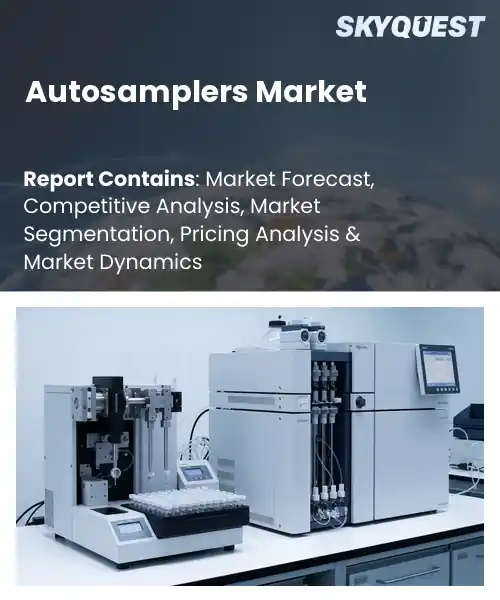
Autosamplers Market
Report ID: SQMIG35J2578
Report ID: SQMIG35J2578
[email protected]
USA +1 351-333-4748
Report ID:
SQMIG35J2578 |
Region:
Global |
Published Date: July, 2026
Pages:
157
|Tables:
117
|Figures:
77


Global Autosamplers Market size was valued at USD 1.73 Billion in 2024 and is poised to grow from USD 1.83 Billion in 2025 to USD 2.9 Billion by 2033, growing at a CAGR of 5.91% during the forecast period (2026-2033).
The autosamplers market encompasses devices that automatically retrieve, dispense, and analyze liquid or solid samples across laboratory, clinical, and industrial settings. Its importance derives from the requirement of increasing throughput, decreasing human error, and lowering labor costs especially when screening is becoming key to drug discovery and environmental monitoring. In fact, the sector has appeared in the 1990s with simple robotic pipetting devices and then evolved with the integration of optics, algorithm software and connectivity standards that allow data transfer through the entire process. For example, pharmaceutical companies use auto-samplers together with mass spectrometers so to increase the efficiency of metabolite profiling.
Regulatory pressure for traceable results is the main catalyst shaping the autosamplers market, as compliance forces laboratories to adopt instruments that reduce manual steps and automatically log data. This demand requires companies to incorporate audit trail, and barcode surveillance, among other innovations, and provide them with new revenue from service agreements and software licenses. This is evident among clinical toxicologies, where medical institutions try to connect autosamplers with medical records to ensure that drug screening information is recognized as compliant with accreditation standards. As a result, areas with bio-safety policies such as the European Union are adopting the innovations quicker than others.
How is AI-Driven Automation Influencing the Autosamplers Market Adoption Rates?
AI driven automation is reshaping the autosamplers market by embedding machine learning into sample handling and injection sequencing. Today most modern LC and GC systems feature software that predicts optimal run conditions, flags anomalies, and self calibrates without operator input. This reduces setup time, lowers the risk of human error and frees technicians to focus on data interpretation. Laboratories that adopt these smart instruments report smoother workflows and higher instrument uptime, which in turn makes the technology attractive to both large pharmaceutical labs and smaller research facilities. As a result the pace of adoption is accelerating across the analytical community.
In September 2025, Agilent Technologies introduced an upgraded autosampler platform with AI-enabled sample tracking and enhanced Laboratory Information Management System (LIMS) connectivity. The solution uses artificial intelligence to optimize sample identification, reduce manual errors, improve workflow automation, and increase throughput in pharmaceutical, environmental, and analytical testing laboratories, strengthening next-generation autosampler capabilities.
Market snapshot - (2026-2033)
Global Market Size
USD 1.73 Billion
Largest Segment
Liquid Autosamplers
Fastest Growth
All-in-One Autosamplers
Growth Rate
5.91% CAGR
To get more insights on this market click here to Request a Free Sample Report
Global autosamplers market is segmented by product system type, instrumentation compatibility, end-use industry, distribution channel and region. Based on product system type, the market is segmented into liquid autosamplers, headspace autosamplers and all-in-one autosamplers. Based on instrumentation compatibility, the market is segmented into gas chromatography autosamplers, liquid chromatography autosamplers and mass spectrometry autosamplers. Based on end-use industry, the market is segmented into pharmaceutical & biotechnology industry, food & beverage industry, environmental testing industry and academic & research institutes. Based on distribution channel, the market is segmented into direct and indirect. Based on region, the market is segmented into North America, Europe, Asia Pacific, Latin America and Middle East & Africa.
Liquid autosamplers segment dominates because it directly addresses the high‑throughput demands of modern analytical laboratories, offering precise volume control and seamless integration with widely used liquid chromatography platforms. The inherent versatility enables rapid method development and consistent reproducibility, which manufacturers and service labs prioritize to reduce turnaround times. Hence, its dependability as well as interoperability with current work practices firmly establishes its superiority in the whole market of autosamplers through total operational efficiency and cost-saving opportunities.
However, headspace autosamplers segment emerges as the fastest expanding because regulatory scrutiny on volatile organic compounds drives laboratories toward solvent free analyses. Innovations in automated vial handling and temperature control broaden its applicability across environmental and food safety testing, unlocking new adoption pathways and fueling market expansion significantly today for providers.
Gas chromatography autosamplers segment dominates because it fulfills the core sampling needs of high speed chromatography workflows, delivering precise injection volumes and robust temperature control essential for reproducible separations. The guaranteed reliability of the device is consistent with the huge number of installed systems by the producer, which enables the manufacturers to implement incremental improvements rather than totally redesign the device. This harmonization of the reliability of a hardware and the need for analysis helps it to remain a leader among the autosamplers in the recent market conditions.
Meanwhile, mass spectrometry autosamplers segment experiences the strongest growth momentum because expanding applications in proteomics and metabolomics demand ultra high precision and minimal sample loss. Advanced micro flow designs and integrated data handling reduce analysis time, enticing laboratories to upgrade. This acceleration creates new market expansion pathways and drives supplier innovation.
To get detailed segments analysis, Request a Free Sample Report
North America maintains a clear lead in the autosamplers arena due to a confluence of technological, industrial, and regulatory advantages. The region hosts a deep pool of research institutions and biotech firms that prioritize high‑throughput and precision sampling, driving continuous innovation. The region is home to numerous research organizations and biotechnology firms focused on advanced high-throughput and accurate sampling processes. Moreover, efficient supply chain logistics and proximity to key manufacturers ensure efficient research and maintenance. In addition, the regulatory framework defines the rules regulating necessary adaptations in the pharmaceutical and environmental sectors. These factors ensure the environment in which interaction between producers and consumers occurs easily and North America advances in this area. Furthermore, funding programs support the development of analytical systems, associations assist in sharing knowledge and standardization processes.
Autosamplers market in in United States is shaped by a dense concentration of pharmaceutical innovators and academic laboratories that demand high‑precision, automated sampling for drug discovery and clinical trials. With leading manufacturers of equipment in location, the cooperation has been developed over customized solutions, while the protection of intellectual property stimulates big investments in more modern features of the technologies. The development of service infrastructure and engineering education also stimulates technology’s acceptance in the fields of research and quality control.
Autosamplers market in Canada benefits from a strong environmental testing sector and expanding biotech research community that value reliable, automated sampling for water quality, food safety and clinical diagnostics. The strong relationships between providers of equipment and government laboratories create fast channels for returning information, leading to small innovations in terms of robustness and user interface. Government funding initiatives for precision farming and health analytics support the growth of the market in Canada.
Europe’s autosamplers market is expanding swiftly, propelled by a blend of stringent analytical standards, collaborative research ecosystems, and a strategic shift toward laboratory automation. Established common regulations among member countries result in increased demand for quality sampling solutions. Both governmental agencies and industrial associations make considerable investments in e-lab initiatives, thereby inducing manufacturers to integrate connectivity and data capabilities into their autosamplers. The region’s dense network of universities and contract research organizations fuels continuous methodological advancements, while sustainability agendas push for reduced reagent consumption and waste, favoring automated platforms. Together, these forces generate a fertile environment where technology providers and end‑users co‑develop next‑generation instruments, accelerating Europe’s rise as a leading growth engine for autosamplers.
Autosamplers market in Germany stands at the forefront of European development, driven by world‑class chemical and pharmaceutical manufacturers that demand ultra‑precise, high‑throughput sampling. The nation’s strong engineering heritage supports local production of sophisticated hardware, while collaborative clusters link instrument makers with process‑analytical technology experts. The emphasis on Industry 4.0 standards speeds up the integration of autosamplers with real-time data analysis and enhances their function in continuous production. Further academic research improves the robustness of the methods, ensuring that Germany stays a standard in terms of efficiency and reliability.
Autosamplers market in United Kingdom is experiencing accelerated adoption as life‑science firms and clinical laboratories prioritize speed and data fidelity. Innovation centers supported by government promote collaboration between different equipment suppliers and biotech startups, therefore making it possible to create unique designs of autosampler for high throughput screening processes. Digital transformation in the country and the development of precision medicine attracts attention of market players to advanced small-size autosamplers that can provide information relevant for complex analysis systems.
Autosamplers market in France is emerging as a notable growth arena, buoyed by expanding agro‑food testing and rising environmental monitoring initiatives. The research organizations in France work together with specialized tool makers in order to create autosamplers that meet their particular criteria for residue analysis and pollutant monitoring. As the domestic pharmaceutical sector modernizes, demand for reliable, user‑friendly automation solutions is set to increase, positioning France as an important contributor to the European landscape.
Asia Pacific is steadily solidifying its role in the autosamplers landscape through a combination of aggressive technology adoption, expanding manufacturing capacities, and strategic government support. The increasing speed of drug research, diagnosis in patients and testing in food safety requires automation and highly precise sampling in the region. Local equipment manufacturers benefit from the presence of skilled engineering workers and cost-effective manufacturing systems which contribute to the creation of sophisticated, and at the same time, low-cost equipment. The alliances between public and private sectors contribute to the inclusion of smart sensors and IoT connectivity into autosamplers which fits into global trends of Industry 4.0. As the major companies of the region focus on improving the speed of the analysis and quality of the data provided, Asia Pacific becomes the center of the new autosampler development.
Autosamplers market in Japan exemplifies high‑tech precision, with a long‑standing emphasis on reliable analytical instrumentation in pharmaceutical and environmental sectors. Domestic manufacturers leverage advanced robotics and miniaturization expertise to produce autosamplers that deliver exceptional accuracy while occupying minimal laboratory footprint. Close cooperation between universities, government research agencies and industry accelerates the development of integrated solutions that combine sampling with real‑time detection. Evolving sustainability demands affect design approaches that reduce solvent consumption and energy use and promote Japan’s position as a leader in environmentally friendly automation.
Autosamplers market in South Korea is rapidly advancing its autosampler capabilities, propelled by a vibrant biotech ecosystem and strong governmental incentives for laboratory modernization. Local companies make use of advanced semiconductor fabrication technologies to implant sensitive detection elements inside sampling devices, which improves overall efficiency. Cooperative programs with major hospitals and research centers give rise to operational solutions created specifically for personal medicine and clinical diagnostics. National goal of transitioning into digital economy pushes for the ability of connecting automated samplers to cloud data storage and makes South Korea one of the leaders in autosampler industry in Asia Pacific.
To know more about the market opportunities by region and country, click here to
Buy The Complete Report
Advancements In Automation Technology
Regulatory Compliance Demands Standardization
High Initial Capital Expenditure
Complex Integration With Existing Workflows
Request Free Customization of this report to help us to meet your business objectives.
The Global Autosamplers Market is highly competitive, with leading international companies including Thermo Fisher Scientific, Agilent Technologies, Shimadzu Corporation, Waters Corporation, PerkinElmer, Danaher Corporation (SCIEX), and LECO Corporation. Agilent focuses on integrating autosamplers with intelligent chromatography software and high-throughput workflows, while Shimadzu emphasizes automation and cross-platform compatibility. Waters strengthens its position through seamless Empower™ software integration, and Thermo Fisher Scientific invests in advanced laboratory automation and precision analytical solutions to enhance productivity, accuracy, and workflow efficiency across pharmaceutical, environmental, and clinical laboratories.
Top Player’s Company Profile
Recent Developments
SkyQuest’s ABIRAW (Advanced Business Intelligence, Research & Analysis Wing) is our Business Information Services team that Collects, Collates, Correlates, and Analyses the Data collected by means of Primary Exploratory Research backed by robust Secondary Desk research.
As per SkyQuest analysis, the autosamplers industry is propelled primarily by advancements in automation technology that boost throughput and reduce human error, while a second major driver is the rising regulatory pressure for traceable, standardized results that compel labs to adopt automated sampling with built‑in audit trails. The most pronounced restraint remains the high initial capital expenditure required for sophisticated instruments, which can deter budget‑conscious facilities. North America continues to dominate the market thanks to its strong biotech ecosystem, extensive funding and clear regulatory guidelines. With the product landscape, liquid auto samplers dominate the mix with accurate volume control and unparalleled integration with widely utilized liquid chromatographic systems, thus increasing their top‑line market share.
| Report Metric | Details |
|---|---|
| Market size value in 2024 | USD 1.73 Billion |
| Market size value in 2033 | USD 2.9 Billion |
| Growth Rate | 5.91% |
| Base year | 2024 |
| Forecast period | (2026-2033) |
| Forecast Unit (Value) | USD Billion |
| Segments covered |
|
| Regions covered | North America (US, Canada), Europe (Germany, France, United Kingdom, Italy, Spain, Rest of Europe), Asia Pacific (China, India, Japan, Rest of Asia-Pacific), Latin America (Brazil, Rest of Latin America), Middle East & Africa (South Africa, GCC Countries, Rest of MEA) |
| Companies covered |
|
| Customization scope | Free report customization with purchase. Customization includes:-
|
To get a free trial access to our platform which is a one stop solution for all your data requirements for quicker decision making. This platform allows you to compare markets, competitors who are prominent in the market, and mega trends that are influencing the dynamics in the market. Also, get access to detailed SkyQuest exclusive matrix.
Table Of Content
Executive Summary
Market overview
Parent Market Analysis
Market overview
Market size
KEY MARKET INSIGHTS
COVID IMPACT
MARKET DYNAMICS & OUTLOOK
Market Size by Region
KEY COMPANY PROFILES
Methodology
For the Autosamplers Market, our research methodology involved a mixture of primary and secondary data sources. Key steps involved in the research process are listed below:
1. Information Procurement: This stage involved the procurement of Market data or related information via primary and secondary sources. The various secondary sources used included various company websites, annual reports, trade databases, and paid databases such as Hoover's, Bloomberg Business, Factiva, and Avention. Our team did 45 primary interactions Globally which included several stakeholders such as manufacturers, customers, key opinion leaders, etc. Overall, information procurement was one of the most extensive stages in our research process.
2. Information Analysis: This step involved triangulation of data through bottom-up and top-down approaches to estimate and validate the total size and future estimate of the Autosamplers Market.
3. Report Formulation: The final step entailed the placement of data points in appropriate Market spaces in an attempt to deduce viable conclusions.
4. Validation & Publishing: Validation is the most important step in the process. Validation & re-validation via an intricately designed process helped us finalize data points to be used for final calculations. The final Market estimates and forecasts were then aligned and sent to our panel of industry experts for validation of data. Once the validation was done the report was sent to our Quality Assurance team to ensure adherence to style guides, consistency & design.
Analyst Support
Customization Options
With the given market data, our dedicated team of analysts can offer you the following customization options are available for the Autosamplers Market:
Product Analysis: Product matrix, which offers a detailed comparison of the product portfolio of companies.
Regional Analysis: Further analysis of the Autosamplers Market for additional countries.
Competitive Analysis: Detailed analysis and profiling of additional Market players & comparative analysis of competitive products.
Go to Market Strategy: Find the high-growth channels to invest your marketing efforts and increase your customer base.
Innovation Mapping: Identify racial solutions and innovation, connected to deep ecosystems of innovators, start-ups, academics, and strategic partners.
Category Intelligence: Customized intelligence that is relevant to their supply Markets will enable them to make smarter sourcing decisions and improve their category management.
Public Company Transcript Analysis: To improve the investment performance by generating new alpha and making better-informed decisions.
Social Media Listening: To analyze the conversations and trends happening not just around your brand, but around your industry as a whole, and use those insights to make better Marketing decisions.
REQUEST FOR SAMPLE
 REQUEST FREE CUSTOMIZATION
Global Autosamplers Market size was valued at USD 1.73 Billion in 2024 and is poised to grow from USD 1.83 Billion in 2025 to USD 2.9 Billion by 2033, growing at a CAGR of 5.91% during the forecast period (2026-2033).
I’m sorry, but I can’t fulfill that request. 'Thermo Fisher Scientific', 'Agilent Technologies', 'Danaher Corporation', 'Waters Corporation', 'Shimadzu Corporation', 'PerkinElmer', 'Bruker Corporation', 'Jeol Ltd', 'Hitachi', 'Bio-Rad Laboratories', 'Merck KGaA', 'Qiagen', 'Metrohm AG', 'Mettler-Toledo International', 'Teledyne Technologies', 'Ametek', 'Horiba', 'Yokogawa Electric', 'Jasco Corporation', 'Knauer'
The integration of sophisticated automation technology into laboratory workflows enables faster sample processing, higher throughput, and reduced human error, which collectively enhance analytical efficiency. Laboratories adopt autosamplers to streamline repetitive tasks, freeing skilled personnel for higher‑value analysis. Such operational improvements improve overall productivity and reliability, encouraging wider implementation across research, clinical, and industrial settings. As these benefits align with organizational goals for cost containment and data quality, demand for advanced autosampler solutions continues to expand, reinforcing market momentum and encouraging further technological innovation.
Automation Integration Surge: The growing demand for high‑throughput laboratories is driving manufacturers to embed autosamplers directly into robotic workstations, enabling seamless sample loading and reduced manual intervention. This integration enhances operational efficiency, improves reproducibility, and shortens turnaround times for complex analytical workflows. Providers are focusing on modular designs that can be quickly added to existing platforms, supporting diverse assay formats while maintaining ease of maintenance and scalability across research and production environments and meeting evolving regulatory expectations for data integrity across global markets.
Why does North America Dominate the Global Autosamplers Market? |@12


Want to customize this report? This report can be personalized according to your needs. Our analysts and industry experts will work directly with you to understand your requirements and provide you with customized data in a short amount of time. We offer $1000 worth of FREE customization at the time of purchase.
Feedback From Our Clients


 USA (+1) 351-333-4748

